Ruminations

Blog dedicated primarily to randomly selected news items; comments reflecting personal perceptions

Monday, February 08, 2021

Post-COVID China Monopolizing Global Food Shipping Containers
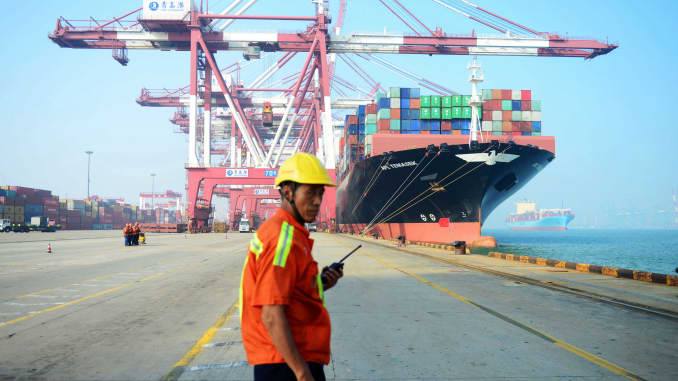
A Chinese worker looks on as a cargo ship is loaded at a port in Qingdao, eastern China's Shandong province.
A Chinese worker looks on as a cargo ship is loaded at a port in Qingdao, eastern China’s Shandong province.     AFP Contributor | AFP | Getty Images
"People aren't getting their goods where they need them."
"One of my customers ships eight to ten containers of rice every week from Thailand to Los Angeles. But he can only ship two to three containers a week right now."
"It's been like that since December. You're going to get not only a shortage of food but a shortage of everything."
"I would not be surprised to hear some beneficial cargo owners' freight rates for 2021-2022 shipping seasons double from previous years."
Steve Kranig, director of logistics, IMEX Global Inc. freight forwarder

"It's not possible to get the amount of volume we have here in Vancouver to return containers in those tight windows."
"Pulses [crops such as peas and lentils] in general are struggling getting on the ships."
Jordan Atksins, vice-president, WTC Group
 
"We know that some of the industry's largest and most consistent buyers of soybean containers in Asia over the years are now electing to buy bulk vessel supplies."
"And certainly like others, we had some booking cancellations."
"It's a bit of a perfect storm. You have pent up demand in Asia for agriculture products and that's at the same time you have a pretty substantial consumer goods demand in the U.S."
"When you add to that some of these labour issues, that's what really created the scarcity you are seeing."
Doug Grennan, vice-president, select global grain and oilseeds, Scoular Co.
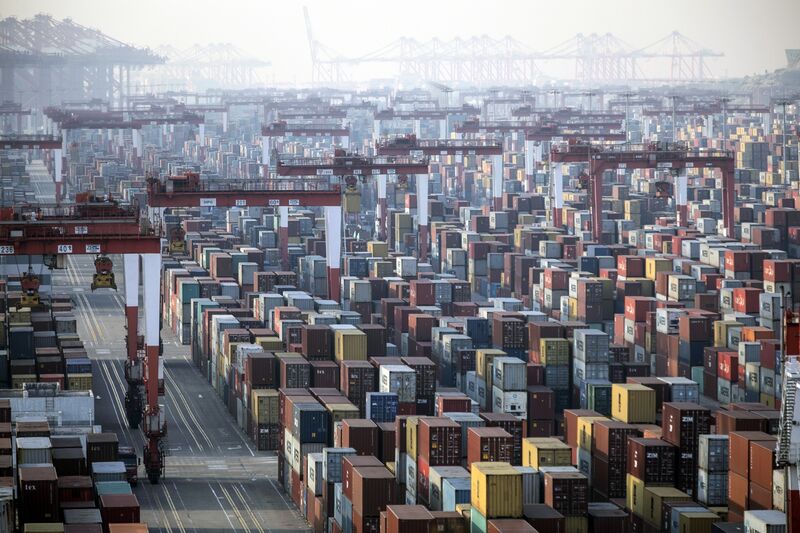
Views of the Yangshan Container Port Ahead of Trade Figures
The Global Food Trade Has Been Upended by a Container Crisis  Bloomberg
 
China is well ahead of the rest of the world in its initial recovery from COVID-19, accelerating its export economy and in the process willing to pay out huge premiums for containers. A situation that has made it quite a bit more profitable to have the containers returned empty, rather than normally refilling them on return. This has led to soaring freight rates increasing the cost of some foods. As an example, white sugar prices surged last month to a three-year high while delays in food-grade soybean shipments from the U.S. may anticipate higher costs for consumers of tofu and soy milk in Asia.
 
https://static.reuters.com/resources/r/?d=20201210&i=OVD8FJ8GB&r=OVD8FJ8GB&t=2
Carriers are now content to continue hauling shipping containers empty to China, the profit motive initialling that on the dotted line. Competition for the steel containers has resulted in Thailand unable to ship its rice, Canada stuck with peas, and India unable to offload mountains of sugar. While shipping empty boxes back to China as a profitable new enterprise has created backlogs and shortages where even some U.S. soybean shippers have had to fight for containers so anxious Asian buyers can be supplied.
 
Carriers usually make an effort to backfill shipping containers to maximize profit from shipping rates in both directions. The cost of carrying goods from China to thr U.S. comes in at close to ten times higher than the reverse journey, persuading liners to gain profit in favouring empty boxes rather than loading them, according to data. Three in every four boxes going back to Asia from the port of Los Angeles, the biggest for container cargo in the U.S., now travel empty, in comparison to the normal 50 percent rate.
 
A farmer holds soybeans at a London, Ont., farm.
Soybeans Ont. farm. Photo D. Ruttan/London Free Press
Canada, the second-largest producer of pulses in the world, is experiencing difficulty in meeting the new time limits to transport stuffed boxes at terminals onto ships, from three days to as little as seven hours. India was able to export only 70,000 metric tonnes of sugar, as the world's second-largest producer in January representing less than a fifth of the volume shipped last year. The largest producer of robusta coffee beans used to make instant drinks and espresso, Vietnam now struggles to export. 

Worldwide, foodstuff buyers cool their heels, while others have taken to halting purchases altogether. It is now conceivable that once the bulk of North American and European vaccinations have been completed and life returns to normal these high freight rates may be passed to these populations returning to cafes, restaurants and office towers, as a rude awakening of the fall-out still being experienced as a consequence of the turmoil caused by the SARS-CoV-2 pandemic.
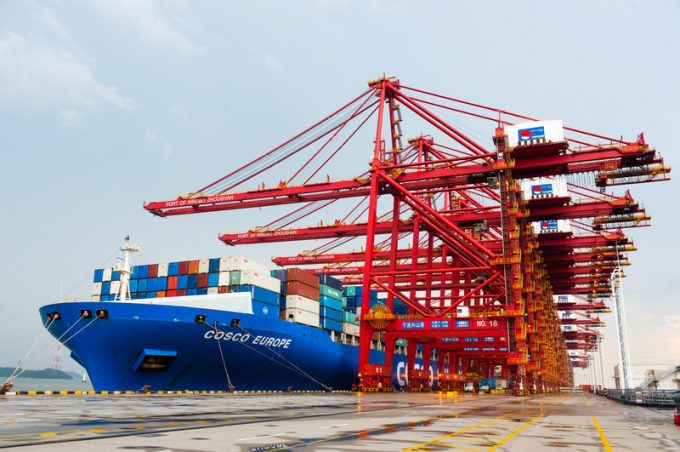
Ningbo
Photo 130984715 © Hunterbliss - Dreamstime.com
China's vast demands on American crops meant to provide feedstock for a hog herd recovering from a deadly pig disease has come along faster than anticipated, making for a dire situation leading some buyers to cancel contracts choosing instead bulk shipping methods, commonly used for feed products, or in an effort to avoid high freight costs, delaying purchases. Yet, given the economic slowdown caused by the coronavirus, it remains unclear how much of the increase in shipping costs companies may plan to pass on to consumers.

Refrigerated containers have also been impacted by the pandemic where in China, boxes have been piled up at ports while workers must comply with strict COVID-testing procedures as well as disinfection of meat and seafood products in the wake of China claiming that frozen food imports were responsible for the spread of the coronavirus. The volume of cold containers in the port of Dalian is such that there are insufficient power plugs for them. 

And then there is the issue of labour shortages as a result of the coronavirus spread slowing operations at ports and deleteriously impacting the container shortage. Demand for American agriculture products has been boosted by strikes in Argentina, affecting supplies to Asia, further increasing competition for boxes.

Shipping containers at the Port of Los Angeles in California.

Labels: , , , ,

Monday, December 07, 2020

COVID Vaccines : Production, Approval, Distribution, Vaccination Take-Up

Vaccine
Challenge of distribution for COVID-19   (AFP)
"We need to be absolutely  transparent about what is known and what is not known about each vaccine in order to allow people to weigh the risks and benefits of these novel vaccines."
"We must be utterly clear about who the vaccines were tested on, what kinds of safety issues we might expect -- even when they are typically very rare in vaccines -- how long the immunity from the vaccine can be expected to last, and whether or not the vaccine stops you from being able to transmit the virus." 
"Messaging around these vaccines should be fairly neutral and stick to the facts as we know them at the time."
"There simply isn't enough vaccine supply to achieve this [herd immunity] -- and we don't even know yet if these vaccines will halt transmission of COVID-19. So the choice to get the vaccine or not will be a personal health decision in the early days of immunization programs and people need to have the facts in order to make informed choices about whether and when to get vaccinated."
Allison Thompson, researcher, University of Toronto
"We can plan, but at this point  it's unknown which of the vaccines will be approved first and what quantities will come to Canada."
"The military has significant expertise in logistics, especially in medical and health service support. They will be skilled in quickly setting up places where vaccines could be administered to patients, set up processes for administration, plan logistics, routes for shipping and transport if needed."
Mahesh Nagarajan, professor of supply chain management and health care operations, Sauder School of Business, University of British Columbia

"This is a completely new platform [messenger RNA in both the Pfizer and Moderna vaccines] for a vaccine."
"The public has to understand how they work. We already have people who are worried about standard vaccines. These are even newer." 
"Many of the larger hospitals have that [sub-zero-plus] capability. But then you have to figure out how to get it out [safely to the end-user]."
"Fridges will break down. If we work hard and we're diligent, that wastage can be kept to a minimum."
Dr.Gerald Evans, chair, division of infectious diseases, Queen's University

"What we are doing is unprecedented in scale."
Dr.Kate O'Brien, director, department of immunization, vaccines and biologicals, World Health Organization
© GettyImages/Natalia Kokhanova
Getty Images  Natalia Kokhanova

The WHO's Dr. O'Brien spoke at the Canadian Immunization Conference that took place last week, addressing the complex logistics health professionals will be facing in the effort to roll out approved vaccines, taking into account measures to safeguard their efficacy, and inoculating billions of people across the globe. Public health officials have a need to identify those in the public to be given priority status, she stressed, those most in need of immediate protection from the virus simply because they represent the demographic most at risk of serious complications, often death.
 
The three vaccine front-runners still awaiting final approval destined to be distributed in Canada; Pfizer/BioNTech, Moderna and Astra-Zeneca, are two-dose vaccines. Transport and storage of the Pfizer vaccine is in and of itself a challenge since it must be stored under ultra-chilled conditions requiring freezers able to keep products at -70C. To further complicate matters it's highly likely that multiple types of vaccines will be delivered simultaneously across the country, including those to be delivered to remote and isolated parts of the Canadian geography.
 
To develop a vaccine and market it typically takes between ten and fifteen years, under normal circumstances. The advent of the novel coronavirus is anything but typical, and this is an abnormal circumstance the world is now living in -- on tenterhooks to obtain a reliable, effective and safe vaccine. And because the scientific community took heed of the desperate need and worked feverishly in many countries of the world to develop a suitable vaccine, these COVID-19 vaccines took under a year for development, now contemplating distribution.

Having to be transported over long geographic distances, vaccines undergo many transfers and types of transportation, requiring constant cold temperatures to ensure their viability. Should a vulnerability occur in the transportation link and the integrity of their ultra-cold stability be interrupted, potency can be affected and the vaccine rendered unusable. Additionally, when vials are lost, damaged or have expired and when doses are left over in multi-dose vials, a certain percentage of vaccine is wasted.The average of spoilage and waste sits at around  fifteen to 20 percent.

Due to its need of ultra-cold storage, the Pfizer vaccine -- which must be maintained at -70C and administered within five days after transfer to a refrigerator -- it is likely to be used in large cities. Having reached its destination, a dilutant is added to each vial containing vaccine to produce five doses which gives the solution six hours of effectiveness. In large cities, hospitals and research institutions equipped with suitable freezer units are to be found, whereas towns and small cities are unlikely to have these ultra-cold freezers in use which come with a price tag of $15,000 and $20,000 apiece.

Wastage occurs for the most part when the vaccine is sent to providers such as physicians' offices and clinics, unlikely to possess the refrigeration type whose quality is a requirement for vaccine efficacy preservation.  According to Dr.Halperin, central and regional storage depots are monitored and alarmed, the type of equipment not generally to be found in the offices and clinics of the end-users. The Canadian military has been tasked to work with private companies with their own competent logistical systems and delivery trucks.

 As an example, McKesson, a medical logistics provider, is able to ship, store, transport, plan and control inventory and resources for freezing and refrigeration.Vials of Pfizer's vaccine are to be shipped in large thermal boxes containing dry ice -- with companies like UPS and FedEx -- from its manufacturing site in Kalamazoo, Michigan. Moderna manufactures its vaccine in New Hampshire, Pennsylvania and Indiana, shipping through McKesson's Irving, Texas distribution centre where the hub of the U.S. government's Operation Warp Speed is located as a public-private vaccination initiative with the aim of producing and delivering 300 million doses beginning in December.

The shipping temperature for Moderna's vaccine is -20C, a temperature that will keep the vaccine stable for six months. Thawed, the vaccine can be refrigerated for up to 30 days and as such may be a more suitable candidate for dispatch to remote areas. Typically, people are required to wait for fifteen minutes post-injection, just in case an allergic reaction to the vaccine occurs. For the COVID vaccines, that wait time may be a little longer, during which time physical distancing must be maintained.

To the present, only short-term efficacy results are known. Unknown as yet is whether COVID vaccines will require boosters, and when, if required. There can be no expectation that immunity from vaccines will last longer than does natural immunity, and even that is an unknown at the present time. And then the issue of take-up presents; how many in the public will immediately agree to vaccinate. According to an Ipsos/Radio-Canada Internet poll of 3,001 people last week, 64 percent indicated they would likely or certainly get vaccinated; 16 percent that they definitely would not, and 21 percent were uncertain.

High rates of coverage always present a challenge. To achieve herd immunity for COVID, between 65 to 75 percent of the population would have to be immunized, lower as it happens than is required for infections like measles which requires substantially over 90 percent coverage. Data on long-term safety and effectiveness has been elusive outside the controlled atmosphere of clinical trials. Once it is clear a protective effect can be achieved for the community with higher uptake rates, messaging may need to change, observed Dr.Thompson. "People need to be reassured, not have their concerns dismissed as baseless." 
"For the two vaccines that require very low temperature storage, this likely means there will be less wastage because the vaccine will be more centrally controlled."
"Natural immunity lasts at least three to six months. We need to follow how people who recover from the disease do over time and we just haven't had long enough follow-up to know how long protection does last."
"If protection lasts only a year, then we will need annual vaccination like with flu vaccines."
"We need high levels of confidence and low levels of refusal."
"Some say they will [get vaccinated] but don't, others say they won't but after a few months when they see that the vaccine is well tolerated, they will."
Dr.Scott Halperin, director, Canadian Center for Vaccinology, Halifax
A person in Mainz, Germany gets a dose of the Pfizer/BioNTech vaccine as part of the product's clinical trial. Public health officials said as many as three million Canadians will be vaccinated in the first three months of 2021 (Reuters)

Labels: , , , , , ,

Tuesday, May 19, 2020

COVID Panic over Cushy Tushy Paper

"Found some toilet paper in the wild! Driving it home now."
"This is as close as I'll ever come to knowing what it feels like driving one of those armoured money trucks."
A bit of Twitter fun from @TransForYang
mg-8887.jpg
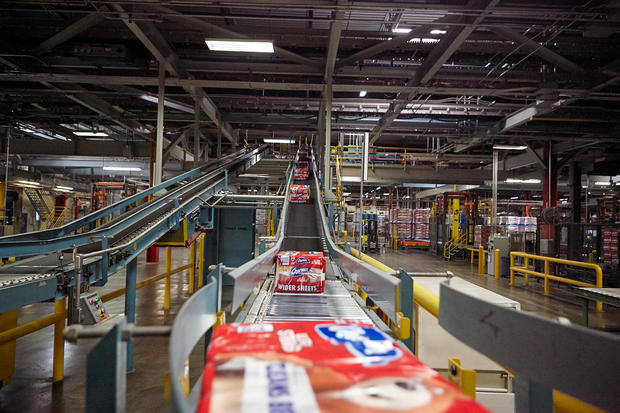
Rolling, rolling, rolling: A Procter & Gamble manufacturing facility. David Salpeter

Things have been so tense in North America with wild panic setting in over the possibility of consumers unable to access toilet paper that the Twitterer might even have experienced how nasty it can be when an armoured truck is held up, its driver held at attention with the barrel of a revolver held to his head while a voice emanating from a face mask snaps at  him, report this to the authorities and I'll neutralize you, while making off with his cushy tushy paper.

Supermarkets in North America and no doubt elsewhere sported shelves empty of cleaning products, refrigerated units void of meat, shortages of eggs, but it was the sight of empty shelves where shoppers knew toilet paper should be stacked that really set civilization aflame. Consumers of toilet paper had a mission: find out where the toilet paper is being shipped to, get there first, and grab it -- all of it -- before anyone else can get their greasy hands on it!

Hmm, toilet paper. Those big double, soft, three-ply, embossed stacked rolls take up a whole lot of room. So supermarkets, unwilling to take up precious stock room with it, order and shelve only what is estimated to sell during a certain period of time. How would they know there'd be a run on toilet paper? It's as though people had become so irritably nervous over the very thought of the threat hanging over the world at a time of SARS-CoV-2, their bowels continually ran.

Meticulously cleaning up the ensuring - er - mess, takes lots, scads of toilet paper. Evidently. Consumer products data tracker NCSolutions issued updates on the pathetic lack of toilet paper and data for re-stocking shelves. 73 percent of U.S.grocery stores came up perilously slack on re-stocking sending consumers into a blizzard of failing confidence in the market. One mightn't think that a 27 percent increase in demand over the same period a year earlier would produce such terror.
Reuters Graphic
Consisting on average of 2.6 people, U.S. households use roughly 409 rolls annually. This, according to the producer of Angel Soft and Quilted Northern, Georgia Pacific. Remaining home 24/7 under lockdown would boost that average usage by 40 percent -- imagine! Increasing the need to purchase said rolls to the rate of 9 doubles in about two weeks.

Toilet paper was in the exalted company of other shortage items such as pasta, soap, flour, yeast and canned goods, all of which swiftly vacated store shelves and became unavailable to other citizens equally entitled to share the riches of civilized living but hadn't had the speedy wit to begin stockpiling as their more savvy-selfish neighbours had.

It's a clear bet that Procter & Gamble, Kimberly-Clark and Georgia Pacific never in their wildest industrial dreams imagined that they might ever represent the pot of gold at the end of the rainbow in popular appeal during a global pandemic.

https://s2.reutersmedia.net/resources/r/?m=02&d=20200429&t=2&i=1516820959&r=LYNXNPEG3S04G&w=1600
A shelf at a Kroger-owned Ralphs store is stocked with toilet paper in Los Angeles, California, U.S., April 25, 2020. Picture taken April 25, 2020. REUTERS/Lisa Baertlein


Labels: , , , , , , ,

Wednesday, July 04, 2018

Conserving the Arctic Biosphere

"That is one area [Lancaster Sound, Northwest Passage] that has the potential for high conflict. It's an obligatory pathway for both vessels that are going in and out of the passage as well as marine mammals that are migratory."
"There's been a lot of research to suggest that vessels may have impacts on marine mammals."
"We're at this precipice where vessels are poised to expand into these regions. The idea behind this study is to provide a comprehensive assessment to help plan for the future." 
"These obligatory pinch points [narrow passageways where ships and animals are most likely to intersect; the Bering Strait separating the U.S. and Russia, and Lancaster Sound in the northern Canadian territory of Nunavut] are used by migratory species to get in and out of the Arctic, but they are also necessary passageways for vessels using these sea routes."
"Identifying the relative risks in Arctic regions and among marine mammals can be helpful when establishing strategies to deal with potential effects."

Donna Hauser, marine scientist, University of Alaska
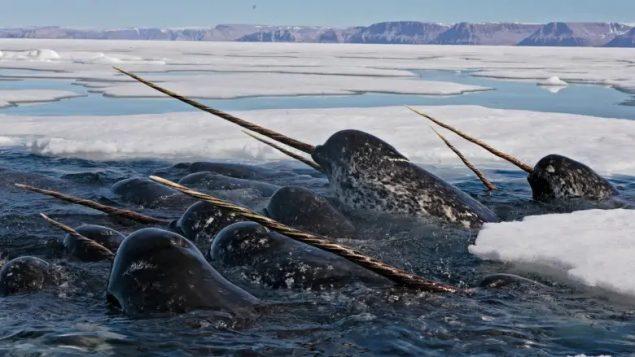
A unique Arctic species, already affected by climate change, could soon be facing another challenge, greatly increased Arctic shipping. ( Paul Nicklen-WWF)

"Narwhals have all the traits that make them vulnerable to vessel disturbances -- they stick to really specific areas, they're pretty inflexible in where they spend the summer, they live in only about a quarter of the Arctic, and they're smack dab in the middle of shipping routes."
"They also rely on sound, and are notoriously skittish and sensitive to any kind of disturbance."
"I think we can learn a lot from areas that have already been thinking about these kinds of conflicts between ships and marine mammal populations -- for example the North Atlantic right whale, or fin and blue whales around California."
"We could aim to develop some mitigation strategies in the Arctic that help ships avoid key habitats, adjust their timing taking into account the migration of animals, make efforts to minimize sound disturbance, or in general help ships detect and deviate from [proximity with] animals."
Kristin Laidre, polar scientist, UW Applied Physics Laboratory's Polar Science Center, study co-author
A freighter in Navy Board Inlet near Lancaster Sound, Nunavut. CNW Group/WWF-Canada
Tens of thousands of bowhead, beluga and narwhal migrate through Lancaster Sound as well as along a part of the central Arctic coast of Russia; both considered to be vulnerable areas for regional wildlife. Although polar bears and seals are both accounted for in the region in great numbers, it is not they who face risks but other Arctic animals more vulnerable to certain harm due to increased, and the expectations of greater increases in sea traffic by ships.

Even though shipping through the passage remains as yet relatively sparse (China is looking to the Arctic to expedite and reduce costs for its vast enterprise of shipping Chinese-made products world-wide) because of the diminishing presence of sea ice responding to climate change and a warming environment in the Arctic, expectations are that each decade will see an approximately 13 percent change both in prevalent ice cover and the ongoing access of the passage to shipping traffic.

The presence of ships influence whales to alter swimming speed or dive rate. That combination of change for vulnerable sea animals can have the effect of driving them out of the territory or cause them to remain in fraught areas where sea ice can rapidly coalesce, freezing the mammals in place. These are also, as it happens, animals on which Arctic Inuit -- whose heritage culture includes hunting of the mammals -- depend upon as a vital food source.
Inuit hunters
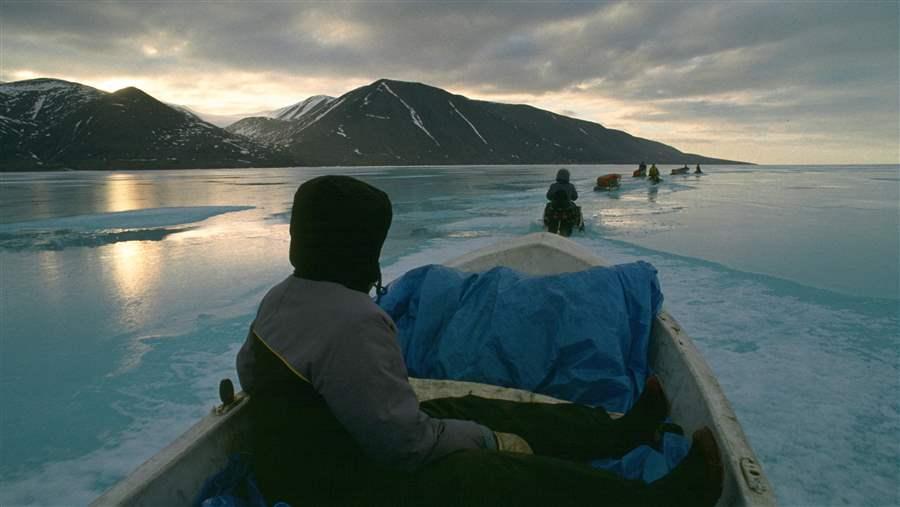
Lancaster Sound, at the entrance to Canada’s Northwest Passage, is slated to become the country’s fifth national marine conservation area. Inuit hunters, integral to the protection efforts, rely upon the area’s concentration of marine mammals to sustain their traditional way of life.    © Richard Olsenius/Getty Images

It was only a matter of time before travel through the Arctic Ocean became a target in shortening shipping routes with the discovery of the thinning of the Arctic ice fields. The Russian route appears to present the most potential for commercial ships. The Northern Sea Route hosted over 200 ships from 2011 to 2016, all large vessels. Over 100 vessels passed through the Northwest Passage in that same time frame, more than half of which were small, private vessels such as personal yachts.

Apart from purely commercial shipping on the increase, it also won't be long before passage through the Arctic waters that have for so long been closed to any possibility of marine shipping, will open for tourism entrepreneurship. No better time than the present before all the activities for various purposes become commonplace, impacting on marine life, to set rules and boundaries. And to adequately do that, acquiring reliable wildlife data of the region is a necessity.

Enter Dr. Hauser's and her colleagues' paper published in the Proceedings of the National Academy of Sciences. "We know from more temperate regions that vessels and whales don't always mix well, and yet vessels are poised to expand into this sensitive region. Even going right over the North Pole may be passable within a matter of decades. It raises questions of how to allow economic development while also protecting Arctic marine species." The study represents the first comprehensive survey of the population of vulnerable Arctic marine mammals' exposure to shipping along two main routes to estimate which of the routes and which mammals face the greatest risks from heavier regional traffic.

The researchers examined 80 different populations of narwhals, belugas, bowhead whales, seals, walrus and polar bears making the North their home, the goal being to judge just how vulnerable they would be in the presence of large ships transiting through the territory. The study focused on how habitat could intersect with likely sea routes in the target month of September when ice has its least presence and shipping would be increased as a result.

It is imperative that authorities get this just right; gauging the study results and the concomitant recommendations of the researchers for the purpose of addressing potential harm to Arctic wildlife so dependent on the area they migrate through, to provide the food they require for survival on their traditional migration route. In the best of all possible worlds, commercial shipping could be accommodated with certain restrictions meant to ensure the vital interests of protection of ocean biodiversity.

Polar Bear
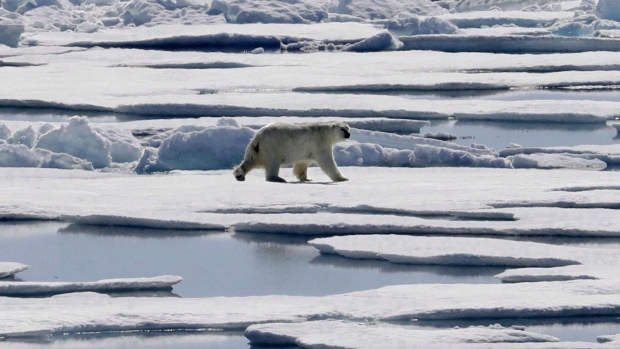
In this July 21, 2017 file photo a polar bear walks over sea ice floating in the Victoria Strait in the Canadian Arctic Archipelago. New research suggests that increased shipping is likely to make parts of the Northwest Passage among the most dangerous places in the Arctic for the whales and other mammals that live there. THE CANADIAN PRESS/AP/David Goldman

Labels: , , , , , , ,

 
()() Follow @rheytah Tweet