Ruminations

Blog dedicated primarily to randomly selected news items; comments reflecting personal perceptions

Friday, December 02, 2016

Health-and-Sanity Hazards : The Tenants From Hell

"I could tell you things that no human should know about what happens to mould when it grows on semen."
"It [the condition of his rental house] was a biohazard, it was a fire hazard, it was a health hazard."
"The law just does not protect people I'm the victim here. If I went to your house and did what they did to my house, I'd be charged criminally."
"I rented for 25 years, I'm all for tenants' rights, but that presumes reasonable people behaving normally."
"There's no law to stop anyone from keeping a goat in the house."
Simon Andrew, landlord, Kingston, OntarioTons of garbage were removed from Simon Andrew's rental house after his tenants left.
Photo courtesy Simon Andrew
A goat, yes, and oh well, rabbits, chickens and pigeons as well. Evidently, the goat slept on the sofa, pictured above. Free to go where they would around the three-bedroom house he rented out in 2014 to a mature couple and their adult son. At the time, they had "interviewed well", said Mr. Andrew, and appeared to him, as people with references, like "really nice people". To his anguish and cost, what he assumed was evidently not all there was to these unassuming, nice people.

To say merely that they trashed his property would represent a deliberately affected evasion of the truth. When it came time for housecleaning, this family went at it in a way that must have seemed to them most direct, using water by the bucketful -- literally, to clean the floor, sweeping the resulting slurry of detritus and filth, garbage and animal feces right through to the heating vents. When the landlord succeeded finally in ousting his tenants, cleaners took to chiseling dried feces off floors and walls.Tons of garbage were removed from Simon Andrew's rental house after his tenants left.
Photo courtesy Simon Andrew
In all, an impressive nine tones of garbage was removed from this unprepossessing house. Used tampons, hypodermic needles used to inject insulin, and trays of urine that had been left in drawers had to be withdrawn and discarded -- with as much distaste and care as can be imagined. Surely, the cleaners came equipped with biohazard uniforms?! It has been months since the family left the pigsty they had converted this rental property into, and the cleanup continues.

Evidently the house had suffered from the indignity of being "grease-bombed", as well. Fatty meat was placed in the oven, the heat turned to high, the oven door left ajar, and as fumes filled the house the grease settled on the top of walls, then ran down toward the floor. With the help of a ruling from Ontario's Landlord and Tenant Board and six months of effort, the family was finally evicted.

Discovered in the cleanp-up among the debris was evidence of the family's dedication to paying their way. Overdue bills in the thousands for utilities, propane and telephone and Internet remained behind. At a rough estimate, Mr. Andrew figures that repairs to his house will come to a total of around $30,000. "They are leaving a trail of destruction of other people's lives, that's what they are really doing. They are screwing up my life", he said, bitterly frustrated.

Can anyone blame this man for his hapless frustration?
Photos: courtesy of Simon Andrew, one very unhappy man.

Tons of garbage were removed from Simon Andrew's rental house after his tenants left.
Photo courtesy Simon Andrew

Labels: , ,

Wednesday, June 22, 2016

Normalized Canine Butchery

"Grandpa strokes my poodle on his lap and says, 'This is just the right size for a bowl of bosintang. He's joking, but whenever he says that, I snatch my dog from him."
Kim Yoo-na, 14, Wonju, South Korea

"It's the difference between heaven and hell [the life of a pet dog and one raised to be eaten in South Korea]."
"I was not ashamed of my way of making a living [raising dogs to be slaughtered for the table], but I was not proud of it either."
Gong In-young, dog-meat farmer, Wonju, South Korea
Thailand's Illegal Dog Meat trade
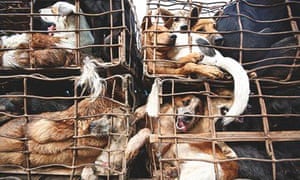
Trucks containing 130 dogs are seized on the highway between Thailand and Vietnam. Photograph: Luke Duggleby

Ten to twenty million dogs are slaughtered for their meat in China on an annual basis. A tradition that dates back to the time of Confucius. Dogs are bred, raised, kept in cages then sold to slaughterhouses in China, South Korea and other Asian nations where people consider dog meat an indispensable part of their cuisine. Mr. Gong, for example, keeps dogs locked up in steel cages, and there they are kept their entire lives; fed until they are mature enough to be taken to the slaughterhouse, their meat going to the marketplace.

That this is the tradition that keeps Mr. Gong in business supplying a market for ardent dog-meat aficionados has not kept this 55-year-old from loving and doting on an elderly Spitz on his farm, whom he has named Snow-White and who is viewed as one of his family. The dissonance in how he views the two, his beloved pet, well cared for and treasured, and the dogs that have no present and no future; his mind is shut, as a farmer and dog breeder-for-meat, to their plight.

Animal-rights groups have been attempting to reach people like Mr. Gong, to instill in them a humane reaction to the tradition of viewing dogs as table meat. Those groups estimate that 30 million dogs, most of which have been stolen or are feral, are slaughtered annually for meat throughout Asia. In South Korea the trade in dog meat is of an industrialized nature.

Over 17,000 dog farms, some raising over a thousand animals each, supply two million dogs to the marketplace for dog meat. This is a tradition held to be centuries-old, according to government data. Huskies, Rottweilers, Golden Retrievers and other breeds are held in Mr. Gong's cages complex, barking and struggling at the wires of the cages they're held in. As the dog-eating season in summer draws near, dog traders come to visit.

The value of a 36-kilogram dog is about $250. In transporting the dogs, they are crowded into cages unable to move; some suffocate before arrival at slaughterhouses where they are meant to be electrocuted. From there, wholesale meat dealers deliver the carcasses to dog-meat restaurants. Koreans name their special dog dish "bosintang", or "soup good for your body", popularized at a time when meat was in short supply.

It is a culinary history of which Koreans take great pride, including those who shun the dish, taking umbrage when foreigners criticize the practise. Yet South Korean tastes are changing as are their attitudes toward the practise of eating dog meat, particularly among the young for whom keeping pets has replaced eating dogs. The very idea of eating dog meat is grotesque and disgusting to young Koreans.

Mr. Gong's own son would never touch dog meat. Recently, he watched as the process of taking 17 of his dogs in flight to the United States under an agreement with the Humane Society International group whose campaign against dog farms in South Korea has made some inroads. Mr. Gong expressed his reaction, viewing photographs of the dogs now living abroad as pets, saying he "felt better".

Yulin, in southern China, has an annual dog-meat eating festival, where protests from animal rights activists have had no effect whatever. At dozens of restaurants across the city, vendors slaughtered dogs, cooking their meat for their avidly awaiting clients. In reaction, activists bought dogs from dealers planning to slaughter them, doing whatever little they could to ease the plight of individual dogs under the circumstances.

Labels: , , , , ,

Friday, February 06, 2015

Charges Pending....

"I've been authorized to confirm that it was in fact Jean-Claude Savoie who was arrested today.
Quite honestly, I can't say [the arrest] came as a surprise. Certainly for me, the surprise came when the RCMP, quite some time ago, seemed to be recoiling from their official position with me that no charges would be forthcoming."
"After they sort of recanted that position and announced that in fact the investigation was ongoing, then … I can't say that I’m surprised that we're at the point we're at today."
Leslie F. Matchim, lawyer, Campbellton, New Brunswick 

"Now, the investigation has furthered and has brought us to the point where an arrest was made today, so this person is now in police custody, but the investigation is ongoing."
"If at some point charges are laid, then more information will be available to you."
New Brunswick RCMP Cpl. Chantal Farrah

Janine Renaud / Canadian Press
Janine Renaud / Canadian Press    RCMP work at the scene of a fatal Python attack on Monday Aug. 5, 2013 at Reptile Ocean in Campbellton, N.B. Two young boys were believed to have been killed by a python snake as they slept in an apartment above an exotic pet store
.
The point 'we're at today' appears to be that a man, with the care of children his responsibility, also felt that he could accommodate his attraction to potentially dangerous reptiles without the two resulting in any kind of harm to the children concerned. Jean-Claude Savoie operated an unlicensed zoo which he converted into a pet store. He lived in an apartment above his pet shop, with his son. His son had two close friends who lived right next door.

A year and a half ago, in Campbellton, New Brunswick, two very young boys, aged six and four, Noah Barthe and Connor Barthe, were found dead, while on a sleep-over at the apartment occupied by Jean-Claude Savoie and his young son. An autopsy found that the boys had been asphyxiated. Mr. Savoie explained that he hadn't any idea that something had gone dreadfully wrong during the night-time hours. He simply awoke to discover the lifeless bodies of the two little boys.

Mr. Savoie, the proprietor of Reptile Ocean located on the bottom floor of the two-storey building, had started his business as a reptile zoo, and then transformed it to a retail operation. He had taken possession of an African rock python, which he considered a family pet after the SPCA took possession of it in 2002 in Moncton, and Environment Canada officials had handed it over to Mr. Savoie not knowing where else it could be accommodated. 

The snake was kept in what might have been considered to be a secure enclosure. At 45-kilograms in weight, the snake certainly weighed more than the little boys put together. Somehow, during the night the snake had broken free of its enclosure; travelled through the ventilation system of the building to crash through the ceiling of the room where the young brothers were sleeping. 

Facebook
Facebook   Noah, left, and Connor Barthe, with their mother Mandy Trecartin. 
 
The boys' mother, Mandy Trecartin, must have felt confidence in Mr. Savoie to permit her children to sleep over, let alone to feel pride allowing them to help Mr. Savoie from time to time in his pet store, including, it would appear, helping him to clean out Reptile Ocean's large animal enclosures. The tragedy of August 5, 2013, made headlines, shocking the nation that anyone would have a hobby of keeping such large, dangerous animals in a domestic setting. And then other similar stories started popping up.

FACEBOOK /MANDY TRECARTIN
FACEBOOK /MANDY TRECARTIN     The Barthe brothers cleaning a snake tank in an undated photo posted on their mother's Facebook page.

The RCMP investigated and decided, at that time, not to lay charges against the proprietor of the pet shop. But then, a year later the Office of the Attorney General in New Brunswick busied itself "reviewing the file". And, Mr. Savoie, who had moved in the interim from New Brunswick to Montreal, was arrested by New Brunswick RCMP, in Montreal. 

No more than a week had passed after the death of the two little boys when area locals organized a protest supporting Mr. Savoie and Reptile Ocean. "Don't make Jean-Claude Savoie the bad guy, he never meant for this to happen", read a 2013 post in the Facebook group "Save Reptile Ocean", with its 401-membership clout.

Misjudgements sometimes do have extremely dire consequences.

Should Mr. Savoie be charged with something like "criminal endangerment" of children, why wouldn't their mother be looking at charges of "child neglect"?

Labels: , ,

Tuesday, December 30, 2014

Crossing the Human-Canine Divide With Love and Trust

"If you take a dog with the weight of a pit bull and particularly when you cross it with something like a Rottweiler, you have a very powerful animal."
"People who cross breeds like that probably have no idea what they are bringing into the world."
Barbara Watt, president, Victoria City (B.C.) Kennel Club

"[Fat Boy, who attacked and killed owner Edward Cahill was] extremely aggressive and unpredictable [particularly when he had a bone to defend]."
"I don’t want people to think bad of pit bulls. They were playful dogs. One slept with the girls and the other slept with me and my husband. It was just a freak accident. He loved his dogs. That’s all I can say, and I think it’s something that just went wrong. He was a great man."
Blanca Rodriguez, Indiana

"Pit bulls get a bad rep. I think this incident has nothing to do with the dog’s breed. I’ve worked with some pit bulls that are therapy dogs and they’re great. An aggressive dog can be any breed. I’ve seen just as many good pit bulls as bad pit bulls."
Toni Bianchi, professional dog trainer
Most kennel clubs have refused to recognize pit bulls as an established breed. Amateur breeders have selected and promoted the animals for their fighting prowess.
Jeff Kowalsky/Bloomberg    Most kennel clubs have refused to recognize pit bulls as an established breed. Amateur breeders have selected and promoted the animals for their fighting prowess.

Yes, of course there are 'good' pit bulls. But how many 'bad' pit bulls can a society afford in terms of the potential harm they are capable of wreaking on the vulnerable and the unaware? These are muscular animals governed by an inbred instinct to be aggressive, and if something seemingly innocuous triggers their fighting spirit they don't differentiate and hesitate, but go into attack mode, but it against their owner, a stranger or a child. Their attacks are terrifying and often terminal.

Pit bulls and rottweilers and Staffordshire bull terriers are the types of dog, like bulldogs, whose muscular grip is difficult to dislodge. These are powerful animals, and like any such animals, can be unpredictable. Some people love their dogs, irrespective of their breed, because they are familiar with them, communicate with them, value their company, and feel their presence enriches their lives. Some people acquire dogs whose breed is known to be aggressive as a prestige item, one that helps them project a certain type of image.

And this last type most certainly does know what results when two such dogs are interbred; they hope that the characteristics that attract them to the breed are enhanced, the outcome being an even more fearsomely aggressive animal. One that they alone can control, is loyal to themselves alone, and will follow their direction, providing both assurance of 'respect' in the community in which they move, and a threat within that same community, a threat that they can keep in check, or not.

Although all dogs, regardless of breed, may have their breed-specific instincts kept in check with loving nurturance and direction, they can, given the right/wrong set of circumstances, surrender to the kind of instinctual reaction that will result in massively harmful aggression. Those people who treasure pit bulls for whatever they represent to them, and feel them to be harmless, enough so to entrust the safety of very young children to their presence, delude themselves.

Should nothing untoward happen with close proximity between dog and child, all to the good. But to rely on nothing happening, ever, that would endanger the child is to deliberately overlook the potential that it could. While even very small dogs are capable of biting and inflicting some measure of injury, some breeds simply go on the attack more frequently, inflicting immeasurably more harm than others. To leave a child unattended with such an animal, actually any animal without taking measures to ensure that no close encounter can take place, is to dally with danger.

In the same day that a family elderly pit bull mauled that family's newborn in the Vancouver Island community of Saanich, an elderly man was attacked by two pit bulls in Langley, British Columbia. Less than three weeks old, the tiny girl had been attacked by the family's 17-year-old pit bull-Rottweiler cross. While the infant is recovering, the future will hold reconstructive plastic surgery for her. The child's parents likely raised their pet and lived with it for all those years, trusted it and loved it.

A 17-year-old dog, like an elderly human, can become very miserable-tempered when its physical and mental faculties have disintegrated into the fog of advanced age and impaired health. The combination of youth and age, health and declining health do not make for a felicitous introduction. The parents of the baby may face a charge of criminal negligence, a hard lesson to learn, but one that simple common sense should have avoided. Their neglect harmed their child and the animal they loved. It could have been much worse.

Moreover, when dogs have lived within a comfortable household for many years, the object of their owners' attention for all those years, lavishing care and love on it, to introduce another creature into the household can be guaranteed result in some level of resentment perhaps leading to an effort to harm the interloper, on the part of an animal suddenly realizing that someone else is getting all the attention that used to be directed toward it. Not to be aware of such tensions arising, on the part of parents, is mind-boggling in its naivete.

According to the Canadian Veterinary Journal, a study of dog attacks that turned fatal  between 1990 and 2007 found that 85% of victims were children, the youngest one month of age. It is no surprise to veterinarians that such events occur, and more often than they should. Most veterinarians take an active interest in the puppies whose owners bring them in for initial health examinations, annual shots and other care. They talk to people, explaining what can go wrong, and how to avoid such complications.

Half of non-fatal dog attacks in the United States involved pit bull breeds or Rottweilers, followed by German shepherds and huskies; big dogs all of them, and conditioned by nature to be aggressive, a conditioning that is all too often enhanced by dog owners wanting to encourage that trait in their dogs, but not necessarily by all owner. How many have to indulge these childish whims for society to be badly impacted? With or without encouragement, the breeds do own those characteristics; with owners' encouragement they simply become more obviously overt.

The experience in Canada is that pit bulls are involved more frequently in non-fatal attacks than any other breed. Resulting in many jurisdictions banning the breed, to the anguish of those who defend pit bulls, insisting it is people, not dogs, at fault. To an extent that may be true, but we cannot control people whereas we can dogs. People trust the dogs they love and have lived with for many years.

As did 40-year-old Edward Cahill of Indiana. He and his wife had two pit bulls living with them and their four children, as beloved and trusted family pets. Mr. Cahill was found dead on Christmas Day. He had been home alone and eight-year-old Fat Boy, one of the two family pit bulls, attacked Mr. Cahill, who bled to death on the floor of his living room from multiple bites on his face and arms. There he was discovered by his wife.

Who, though admitting the short temper and aggressiveness she was aware of, permitted the dogs to sleep with their children and with her and her husband. Is this not the attention oblivion of blind love and arrogant dismissal of reality?

Labels: , , ,

Sunday, April 13, 2014

Food Safety - Human Health

"Successful implementation of this policy means that medically important antibiotics will only be used in food animals under the direction of a veterinarian when there is a specific disease challenge. [To] align to the extent possible] with recent American moves to curb use of growth promoters and increase veterinary oversight in the use of antimicrobials."
Canadian Animal Health Institute
The alarming spread of superbug growth as viral agents and other pathogens do what nature has designed them to do -- just as she has designed all of her living organisms -- survive represents an emergency. These malignant agents of disease alter themselves in response to the various types of successful antibiotics used to defeat their presence, in the tension between science achieving formula-driven methods to destroy them before they destroy us.

In the process, those bacteria most resistance to the antibiotics used to destroy them, alter their DNA structure and multiply madly. Medical and food science are closely aligned in this concern over tampering with the food source to increase yields, defeat the pathogens that prey on livestock through a regimen of pro-action, using antiobiotic growth promoters in animal feed to forestall the potential of illness and to promote growth acceleration, through "mass medication" of chickens, pigs and cattle.

Canadian drug producers have agreed with Health Canada to take active participation in a move "to phase out uses of medically important antibiotics for growth promotion", an proposal that will take a three-year period to entirely put into action. As the U.S. and countries in the European Union take steps to curb agribusiness antibiotic use in an effort to stall the spread of antibiotic-resistant bacteria making their presence in hospitals, on farms and at meat counters, Canada has recognized the imperative to join them.

Years ago, concerned health scientists, confronted with the growing phenomena of bacterial infections becoming resistant to normally useful antibiotics, began to point a finger of blame on the constant use of anti-bacterial chemicals in cleaning formulae, where cleaning fluids from hygienic products, hand-washing liquids to hospital- and kitchen-cleaning soaps were advertised as "anti-biotic". Those products swept the market, and, it was claimed had led the way to the biological response of super-resistance in bacteria.

Now, health officials finally state their considered opinion that the constant use of antibiotics require more control. Both in health care and hygiene and cleaning products and in agriculture use, reflecting the drugs' capability of influencing bacteria to transform genetically into resistant strains that have become increasingly difficult to destroy. "This could be a seismic shift", commented John Prescott, a veterinarian at the University of Guelph.

He had himself co-chaired a committee comprised of leading Canadian agricultural experts and veterinarians, submitting a report that had given Canada failing grades for not having exercised better monitoring techniques in the use and control of antibiotics in agriculture. The current monitoring system is cited for having too many gaps in its capacity for oversight. Even the number of antimicrobials currently in use in Canada is not adequately tracked, nor their number known.

"In Canada, more than three-quarters of antimicrobials are used in animals", stated a report issued in the fall by Dr. David Butler-Jones, the country's chief public health officer. Roughly 90 percent of the medication used on farms is for the promotion of growth, or to guard against disease and infection in animals that are confined in crowded pens and stalls. Dr. Butler-Jones's report raised practical as well as humanitarian objections to such practises.

About 1.6-million kilograms of antibiotics (1,600 metric tonnes) are sold and distributed each year in Canada by companies licensed to manufacture and distribute pharmaceuticals for animal use. A practise seen to benefit growers in producing market-ready products more expeditiously, the increased use of antibiotics ensuring that health impacts from infections are kept to a minimum, while the effect in the round, on a larger, extended scale, has made human health outcomes far more problematical.


It represents an obvious instance of primary food producers falling prey to an industry's claims of improving agricultural and animal husbandry practices for the benefit of the producers, vastly enhancing however, the bottom line of the pharmaceutical corporations whose business expands in lock step with the growth in antibiotic use. It's past time for health practitioners to be influential enough in their findings and the urgency of combating the emergency that growth bacterial resistance represents, to spur government to action.


Labels: , , , , ,

Monday, February 17, 2014

Trusting Refuge

"When they're both blind, they rely on other senses. They rely on touch, they rely on breathing, they rely on their hearing. They really, really need companionship."

"It was a really good thing for both of them because they're really happy. It gave Sweety a whole new life. It's amazing because we were laughed at in the beginning, with people saying, 'Who is going to save a blind cow?'"
2 blind cows, see how they bond: Rescuers cross borders to unite old cows
In this image Feb. 5, 2014 provided by Farm Sanctuary shelter, blind cows Tricia, left, and Sweety get acquainted at the shelter in Watkins Glen, N.Y. After the shelter tried to find ways to help Tricia, 12, and blind since birth, a Canadian animal welfare group sent Sweety, 8, via special transport. She arrived on Feb. 4, and they have become best female friends, playing in the grass, eating in the barn and grooming one another. (AP Photo/Farm Sanctuary)
"We said, 'Well, we can help her. They kind of all laughed. She was a very skinny cow, a very old cow, a cow with an abscess in her foot. They couldn't imagine why we would even want to help her."
Rose Gergely, RR Horse Refuge, Alexandria, Ontario
RR Horse Refuge, owned and operated by Rose Gergely, is located about 100 kilometres from Ottawa, in Alexandria, Ontario. The charitable organization gives shelter to abandoned, homeless animals, and tries to find permanent homes for them. The facility houses at present about three hundred animals. But as far as Rose Gergely was concerned, they had room for a few more.

She had come across a dairy farm that was preparing to send one of its cows for slaughter. She rescued that cow, toward the end of 2013. Then she discovered at the very same farm, another cow, this one blind, the mother actually of the one she had already rescued. And this old, blind cow, that had never left the confines of the barn, was to be slaughtered the following week.

Ms. Gergely negotiated with the farmer, and tried to find a home for the blind cow, whose name is Sweety. But there did not appear to be any sanctuary in Canada that she could find, with room for a blind cow. Her dilemma and the plight of the elderly blind cow somehow came to the attention of the Farm Sanctuary, located 560 kilometres away in New York State.

At the New York Farm Sanctuary charity there was a ready and needy companion for Sweety, a cow named Tricia who had herself been blind from birth. Tricia is 12 years old, compared to Sweety's eight years, and Tricia had lost her companion, it died of cancer a year earlier. A match made in cow heaven, surely.

"It was exciting to think that by giving Sweety a new life we might also give Tricia another chance to enjoy her own", Susie Coston, national shelter director for the sanctuary explained. And then the practical problem to complete the solution to two lonely old blind cows' companionship; how to move Sweety from a small town in Ontario to her new home in New York state?

Sweety was given a veterinarian check-up for her dismal physical condition; skinny, boney, looking anything but healthy. A veterinarian in Lachute, Quebec was  helpful, and then arrangements were made with customs to enable Sweetie's entry into the United States. On February 4, Sweety was delivered to her new home, and to a new life of companionship with Tricia.

For the time being Sweety was clothed with a coat to compensate for her lack of thick fur, inadequate to shield her from the cold, since she had always been kept indoors throughout her life in Ontario. The first night they were each held in separate corrals, but it seemed they were aware of one another, and made sounds indicating that they were.

2 blind cows, see how they bond: Rescuers cross borders to unite old cows
In this image Feb. 5, 2014 provided by Farm Sanctuary shelter, blind cows Tricia, left, and Sweety get acquainted at the shelter in Watkins Glen, N.Y. After the shelter tried to find ways to help Tricia, 12, and blind since birth, a Canadian animal welfare group sent Sweety, 8, via special transport. She arrived on Feb. 4, and they have become best female friends, playing in the grass, eating in the barn and grooming one another. (AP Photo/Farm Sanctuary)
 
The following day they met nose to nose. Sweety is tall and bony, a white triangular patch on her forehead. She bumped into Tricia, shorter, thicker, with black-and-white swirls on her pelt. They sniffed, and they nuzzled each the other. Tricia is helping Sweety to negotiate her way around her new physical environment, to avoid obstacles.

At last report they eat together, amble side by side, and sleep beside one another. Home at last.

Labels: , , ,

Monday, February 10, 2014

Condemning the Defenceless

"I'm actually proud because I think we have given children a huge understanding of the anatomy of a giraffe that they wouldn't have had from watching a giraffe in a photo."
Tobias Stenbaek Bro, Copenhagen Zoo
Marius, an 18-month-old giraffe, was put down with a bolt gun early on Sunday, zoo spokesman Tobias Stenbaek Bro confirmed.
KELD NAVNTOFT/AFP/Getty Images    Marius, an 18-month-old giraffe, was put down with a bolt gun early on Sunday, zoo spokesman Tobias Stenbaek Bro confirmed. 
 
The enlightened Danes. The zoo's decision allowed Danish parents to treat their children to a very special viewing event. Not the least bit bizarre, nor even macabre, since children's minds are open to curiosity being assuaged in the most peculiar ways, in any event. Residents of Copenhagen were treated to a very special occasion, one that gave parents the opportunity to expose their children to life in the raw, explained as a display of scientific knowledge about animals.

Mind, if those same children visiting the city's zoo were all that curious about giraffes, how they move, what they look like in the flesh, what their habits are, they could have watched any of the then-existing eight giraffes resident in the zoo. What need of mere photos? Evidently what began this little drama, seen as heartbreaking by many animal lovers, is Copenhagen zoo's commitment to 'animal welfare'.

The zoo is a member of the European Association of Zoos and Aquaria. Their pledge among the Amsterdam-based EAZA organization with its 347 members is vigilance to the responsibility of managing healthy biodiversity. Because among its membership are many large zoos in the capitals of Europe, the EAZA has a great reputation in the conservation of global biodiversity, and its commitment to championing high standards of care and breeding for animals.

That commitment was recently on display. The Copenhagen zoo had advertised its intention to slaughter a healthy two-year old giraffe in an expression of dedication to care and breeding of animals. Because, simply put, the European Association of Zoos and Aquaria has valuable standards and they are not to be lightly held.

Most 'responsible' zoos, stated Stenbaek Bro, have membership in this hugely respected organization. And so, in obedience to the philosophical values of the EAZA, the zoo forged ahead with its show-and-tell program. They destroyed the life of the young giraffe named Marius, despite that he was healthy. And as its visitors viewed the process, they skinned and dismembered the young giraffe's corpse, and fed the parts to the zoo's lions.

A healthy young giraffe named Marius lies on the ground after being shot dead at Copenhagen zoo on February 9, 2014 despite an online petition to save it (Scanpix Denmark/AFP, Kasper Palsnov)
Completely merciful, the killing procedure, with the use of a bolt pistol. Before the zoo proceeded with its plans a 20,000-signature petition was presented to its authorizing body. Copenhagen Zoo's scientific director, Bengt Holst, stated the zoo had turned away an offer from Yorkshire Wildlife Park in Britain, another member of EAZA. They refused; Marius' older brother lives there; the park's space should be used to host a "genetically more valuable giraffe".

Rasmus Flindt Pedersen / AP Photo
Rasmus Flindt Pedersen / AP Photo    The carcass of Marius, a male giraffe, is eaten by lions after he was put down in Copenhagen Zoo on Sunday, Feb. 9, 2014. 
 
A private individual had offered to buy the young giraffe for 500,000 euros ($680,000). In all good conscience, however, the zoo was unable to accept the offer for private ownership of two-year-old Marius, because of its commitment to the conservation of global biodiversity. Other zoos also had attempted to intervene to spare the life of Marius.

Stenbaek Bro explained that the philosophy that lies behind EAZA membership is a general agreement that its member zoos understand they don't own the animals in their care. They govern them. And as such the animals cannot be sold to any entity not a part of the organization, nor any that do not engage with the same set of rules.

Now that this is clear, one puzzling little omission raises its querulous head. If the concern relates to Marius' future as a sire, the problem would be readily enough solved with a veterinarian castrating the young male, eliminating the problem if gene-diversification identified as so critical by the European Association of Zoos and Aquaria.

Who decided that Marius must die because giraffes with similar genes existed in abundance in the group's breeding program.

If the message to children was animal anatomy and human arrogance, the lesson will not have been lost. Children, quick to emulate their elders, will now feel it is perfectly suitable and appropriate to decide which animals may live and which should be destroyed. Will this teach them compassion and personal responsibility?

Labels: , , ,

Thursday, January 09, 2014

Depends: Whose Seal?

"The Commission has constantly indicated that there are no reasons to be concerned about the conservation status of seals. [No] Article of the EC Treaty could be used as a legal basis for the adoption of the proposal."
European Union 2009 legal opinion
Adult female harp seal

When the politicians who collectively make decisions in the name of the European Union tasked their legal department to review their intention to bring in a ban on imported seal products in 2009, the response wasn't quite to their agenda. But that didn't stop them, in any event, and although there was no legal basis for the ban to be instituted under the EU's common competition rules, the emotional vulnerability of EU members upset by the propaganda issued by groups championing a ban, ruled the day.

When Canada protested and went to the World Trade Organization asking them to adjudicate in the matter, the WTO in turn was unimpressed by the case the EU made for justification for their ban; no WTO rules existed that would support it. However, they ruled that even while the ban effectively undermined international trade obligations, it was nonetheless seen to be justified under "public moral concerns". The European public was excited to emotional distress.

Adult female harp seal entering water through breathing hole

Celebrity activism has that kind of effect on people. What happens to animals in abattoirs where they are dispatched to a dismal end to satisfy the palates of Europeans is beyond sight and thus simply irrelevant as a matter of weighty comparison. The sordid and often brutal dispatch of animals-for-meat can be viewed through quite a number of screenings meant to shock people into demanding a more enlightened practise, but it hits too close to the dinner table for most to really care.

The Government of Canada will undoubtedly appeal that World Trade Organization ruling too. It has been a long uphill battle to attempt to refute the slanderous accusations that baby seals are clubbed without human compassion, their white pelts skinned off them while they're still struggling and alive. Though this may on occasion have been a wretchedly unfortunate part of the seal hunt, hunting baby seals has been outlawed since 1987.

The French conservationist Jacques Cousteau once observed that seal hunt opposition is pure emotional outlet. "We have to be logical. We have to aim our activity first to the endangered species. Those who are moved by the plight of the harp seal could also be moved by the plight of the pig -- the way they are slaughtered is horrible."

A report issued by the Independent Veterinarians Working Group released in August of 2005 stated they had reached the conclusion that a hakapik strike to the seal's skull, while having an obvious appearance of stark brutality to an onlooker, the method represents a humane method of killing, causing immediate loss of consciousness. The hakapik is the traditional weapon used by Inuit hunting and slaughtering seals for the table and for clothing.

According to government estimates in Canada some 6.9-million Atlantic harp seals representing three times 1970s numbers are thriving in the Atlantic. The industry harvested roughly 91,000 seals in 2012, representing far fewer than allocated through the federal quota of 400,000. Furthermore, there is growing pressure emerging from the fishing lobby representing various European countries, eager to cull the Harp seal population to conserve fishing stock of cod and salmon.
 Herd of male harp seals swimming

Fisheries and Oceans Canada states how closely monitored and regulated the Canadian seal hunt is to ensure enforcement of humane treatment of the seals: "a highly mobile enforcement team maintains a presence on the ice floes 24 hours a day, seven days a week throughout the sealing season, with the assistance of the Canadian Coast Guard and the support of local police forces." Fines, seizure of equipment or a ban on further hunting represent forms of punishment for violators.

Fishermen and fish farms in Scotland and Denmark have been given waivers to shoot seals to diminish the numbers threatening their fish harvest. The hunters are discreet, engaging in the hunt with great secrecy to protect them from animal rights campaigners' unwanted attention. In addition to which the European Parliament's reform of common fisheries policy has called as well for an investigation into fish stocks reduction resulting from natural predation from sea lions, seals and cormorants.

They are looking into formulation of a management plan "to regulate these populations". Sounds more than a little like outright hypocrisy.

Labels: , , ,

 
()() Follow @rheytah Tweet