Ruminations

Blog dedicated primarily to randomly selected news items; comments reflecting personal perceptions

Saturday, February 06, 2021

Brave New World of Robotic Aides

"Social robots like me can take care of the sick or elderly."
"I can help communicate, give therapy and provide social stimulation, even in difficult situations."
"Someone said, 'We have nothing to fear but fear itself'. What did he know?"
Sophia, humanoid robot, Hanson Robotics laboratory, Hong Kong 
https://static.reuters.com/resources/r/?d=20210125&i=OVDWPJHI3&r=OVDWPJHI3&t=2
Sophia's makers plan an 'army' of robots in 2021  Sophia: still from video
"The world of COVID-19 is going to need more and more automation to keep people safe."
"Sophia and Hanson robots are unique by being so humanlike. That can be so useful during these times where people a re terribly lonely and socially isolated."
David Hanson, founder, CEO, Hanson Robotics
https://static.reuters.com/resources/r/?m=02&d=20210125&t=2&i=1548913120&r=LYNXMPEH0O023&w=1600
Sophia, explaining her functionality at the Hanson laboratory in Hong Kong, China.  Tyrone Siu, Reuters

 First introduced to the public in 2016, humanoid robot Sophia's existence and proposed purpose has become a matter of great public interest. Motivating the company to envision a new, expanded role for their humanoid robots to enhance human existence; the mass-production of robots like her for greater acceptance in expanded roles to serve the public interest in a huge variety of ways by the end of this year of 2021. An obviously opportune time and a need in an era of a global pandemic shutting down human commercial enterprise at a time of great medical-health stress.

The company has produced four models of their robots with the inclusion of Sophia, and plans if all goes well to begin a rollout of these models in expansive numbers through their factories during the first half of the year. A clear response to researchers' prediction that the pandemic would open up new commercial opportunities for the industry of humanoid robotics. Hanson himself envisions robotic solutions to the presence of the epidemic to be unlimited, to go well beyond health care.

That the robots could readily be trained to service positions within the retail and airlines industry to name but a few, means limitless possibilities. He can foresee his company producing and distributing for sale "thousands" of the robots, whose sale and usefulness could conceivably become a bedrock industry in this new age of enhanced caution due to communicable diseases. 

https://static.reuters.com/resources/r/?m=02&d=20210125&t=2&i=1548913117&r=LYNXMPEH0O022&w=1600
Founder and CEO of Hanson Robotics, David Hanson in his robotics laboratory  Tyrone Siu, Reuters
 
 Johan Hoorn, social robotics professor at Hong Kong Polytechnic University, has worked with Sophia in his research. He feels that despite the fact that the robotics technology is in its relative initial stages, the pandemic could play the role of accelerating a human-robot relationship. "I can infer the pandemic will actually help us get robots earlier into the market because people start to realize that there is no other way", he explained.

Another robot named Grace is being launched by Hanson Robotics this year which has been developed specifically with the health-care sector in mind. But Hanson Robotics is not the only robotics firm with expansion ideas in mind. Soft Bank Robotics' Pepper robot was used in the fight against the pandemic to detect people who weren't following COVID safety rules by wearing face masks. Robotics company CloudMinds in China helped to set up a robot-operated field hospital during the novel coronavirus initial outbreak in Wuhan.

A report by the International Federation of Robotics stated that worldwide sales of professional-service robots had expanded by 32 percent to over $14 billion in sales between 2018 and 2019. Clearly, even prior to the current worldwide situation of grappling with the global pandemic, robot use was rising for any number of functions in a modernizing world of useful technology advances. 
 
https://static.reuters.com/resources/r/?m=02&d=20210125&t=2&i=1548913108&r=LYNXMPEH0O020&w=1600
Sophia, demonstrating a facial expression    Reuters

Labels: , , , ,

Thursday, August 04, 2016

Breathe Deep, Don't Panic. It Won't Help....

"I don't think we're heading toward a crisis, I believe we're already there. If we look at the reliability of a large number of pieces of equipment, it's really the worst it's ever been."
"We're into almost this downward spiral. Service technicians are getting loaded up with more and more, having less time to do preventive maintenance."
"The less preventative maintenance you do, the more problems you're going to have."
Rob Isabelle, mechanical engineer, elevator consultant

"It [the elevator she was in] started making a lot of banging noises. Then the lights went out. There was a lot more banging went on, and then it dropped to the basement."
"It jolted me when we came to a stop at the bottom. I didn't know what was happening or when it was going to stop. Everything was black. I kept trying to press buttons to try to make it open the doors but nothing would happen."
Nancy Lean, 46, Toronto

Elevator Crash at Philadelphia Criminal Justice Center, August 4, 2016, Critically Injuring Sheriff's Officer Who Was Thrown Like 'Projectile' NBC 10


This woman found herself trapped in an elevator at York Regional Police headquarters in Aurora. This was her workplace. She was on her way to the second floor when the elevator suddenly turned rogue and unamenable to responding to the instructions given it through the up-to-then reliable button system which simply failed to respond. This was, without doubt, an experience that anyone finding themselves in wouldn't be too anxious to repeat.

But it's an experience that is being repeated and repeated and repeated. Infrastructure, particularly mechanical-electrical types grow old and cranky; there is fatigue of the system and its various parts and eventually something will go wrong. Building owners know all this, that it is the cost of doing business to have insurable, reliable equipment in their buildings. To that end they contract for regular maintenance from the industry that services elevators.

Often enough these are the very same corporations that build them, huge multinationals like Otis, Schindler, Kone and ThyssenKrupp. There are also small, independents who also offer similar services. Understandably, they may have the expertise to compete, but the big corporate interests don't look too kindly at their presenting as alternative service ports. So it all comes down to marketing and undercutting competition by low-balling contract pricing.

The fact that there are so many elevators everywhere means that there's a lot of business to be had. It was profitable business at one time. But in the competition to grab greater portions of the market share, even as the elevators themselves were steadily aging and requiring more attention they began receiving less servicing and break-downs began to proliferate.

Imagine living or working on a floor above, say, the tenth floor of any building and the elevator/s break down. That's no mere inconvenience, that's a huge disruption and difficulty; not everyone is in the athletic shape it takes to trudge up and down stairs. According to Mr. Isabelle,  thirty years earlier the typical workload for a technician would be to service roughly 35 to 45 elevators for which the cost would be $1,000 per elevator per month.

Such maintenance contracts would be all-encompassing, inclusive of due diligence, repairs as needed, adjustments as required, and the elevators would be reliable in their workhorse capacity with no surprises. At the present time, that very same contract's price has been reduced to about $600 to remain competitive in the undercut-marketplace of opportunity and increased market share. Moreover technicians -- at that price -- are responsible now for 100 elevators.

The four large multinationals named above had their European operations fined over $1-billion in 2007 for having colluded on pricing, which exacerbated the prevailing, reasonable system of contract-and-service, to cut out the small independents which were taking business away from them, while doing a creditable job. The small independents just couldn't compete with the cut-rate pricing of the multinationals and went out of business.

Elevator Crash at Philadelphia Criminal Justice Center, Critically Injuring Sheriff's Officer Who Was Thrown Like 'Projectile' NBC 10

This has resulted in property owners and managers of older buildings in particular facing a dilemma. Parts and technicians capable of handling aging equipment have become few and far between. The option of replacing elevators with more modern ones can run to between $150,000 to $300,000 for each replacement, only partially recoverable from tenants over a prolonged period.

The crisis of elevator break-downs is on the rise. How common are those break-downs where people find themselves trapped on malfunctioning elevators, and in some instances are injured? In the province of Ontario alone last year firefighters responded to 4,461 emergency calls to extricate hapless people from elevators; a dozen a day, about double such occurrences in 2001.

Toronto had about 2,862 elevator-rescue calls to 911 last year. Montreal firefighters responded to 1,532 calls, and Vancouver responded to 428 calls, and in the nation's capital, Ottawa, 314 calls went out to come to the rescue of trapped elevator victims.
On Saturday, the Colorado Springs Fire Department confirmed that the reason Trump’s event started late was because he got stuck in a hotel elevator and had to be rescued by Colorado Springs firefighters.
The fire department said in a statement that Trump was trapped inside an elevator at The Mining Exchange Hotel with about 10 other people. Fire officials said Monday those inside were trapped for no more than 15 minutes.
Firefighters opened the top elevator hatch and lowered a ladder to get everyone out of the elevator.  The Denver Post

Labels: , , ,

Monday, June 22, 2015

Enterprising People of a Feather

"It will be a big deal. We've already had a fair influx of people selling us [eider duck] down."
"That's a big deal [the opening of 15 jobs in full-time employment]  in a town of 850 people."
"I wasn't going to do this unless I knew, long term, it was going to be feasible."
Daryl Dibblee, administrator, Sanikiluaq, Nunavut
With no caribou on their islands, Inuit on the Belcher Islands have relied on eider ducks for food and clothing for generations. Here, an Inuit woman wearing a traditional eider skin parka collects duck eggs in a still photo from the film People of a Feather.
With no caribou on their islands, Inuit on the Belcher Islands have relied on eider ducks for food and clothing for generations. Here, an Inuit woman wearing a traditional eider skin parka collects duck eggs in a still photo from the film People of a Feather. (Joel Heath/Handout photo/Canadian Press)

"How do they use their skills to come up with jobs that are meaningful to them? The eiderdown factory is a great example of that."
"Having long-term jobs for Inuit, working together to try and understand what's happening in Hudson Bay ... the idea is, in the long term (southerners) don't need to be there."
"The communities have enough knowledge to run the programs themselves."
Joel Heath, Canadian scientist
banner

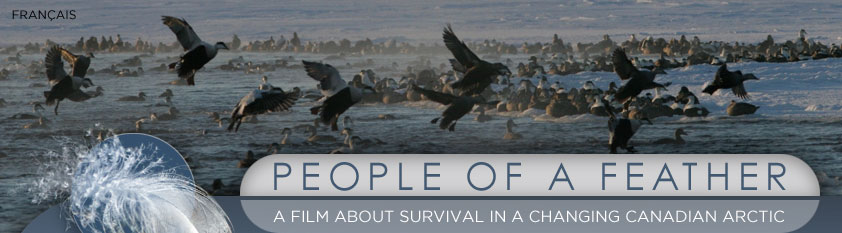
Dr. Heath has made it his interest to study the local Inuit culture on the Belcher Islands. The Inuit living there are called "people of a feather" reflecting their reliance on the birds that nest there in great abundance. The Nunavut community of Sanikuluaq has valued their proximity to nesting seabirds. They have used them as a survival resource for centuries, eating the birds for sustenance and making use of their feathers for comfort and warmth, made into parkas to enable the Inuit to survive the harsh climate that is their home.

A documentary titled People of a Feather was produced by Dr. Heath, demonstrating the reliance and relationship that the town has with the ducks in their provision of food and clothing. Perhaps the larger purpose of the film was to track changes gradually occurring to the environment. Immense hydro reservoirs in Quebec store freshwater that once teemed into Hudson Bay during the spring. Kept in reservoirs now, the water is released in the winter for the generation of power for cities in the south.

According to Dr. Heath, a 24 metre-deep layer of freshwater exists along all of Hudson Bay's eastern coast, as a result of this manipulation of nature. Ice is known to form earlier in the fall since freshwater freezes more quickly than sea water. The result is large flocks of ducks trapped on shrinking pools of open water. It occurred to Dr. Heath that since the Inuit communities are right there on site, observing the changes to their environment, who better to monitor the changes?
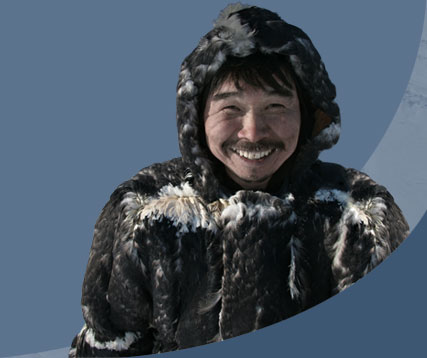
Inuit Hunter
Inuit man wearing traditional eiderdown parka

With the use of Google Maps technology, Dr. Heath has taught the locals how to gather and share real-time information along the coast. That information is timely and useful for dissemination, to alert hunters. Above all, it is increasingly critical to disseminate the information gleaned about weather and environment conditions to alert people planning to travel on the sea ice. Knowing the condition of the sea ice can avert tragedies.

While the indigenous residents are making use of that information they are also now reinvigorating an earlier eiderdown industry. In the town of Sanikiluaq an existing eider factory has begun buying up eiderdown that has been collected by Inuit families from the proliferation of nests nearby the town, built by the birds. The two are interrelated, since the birds are affected by ice conditions, and in turn the Inuit are affected by any deleterious effects on the birds which they rely upon.

The large seabirds nest in immense numbers in the Belcher Islands. The female duck plucks down from her breast to line her nest which will contain the eggs she lays. Down collectors pluck down from the nests before the eggs have hatched, taking care to take only a portion of the fluff. The down that is collected makes its way to the factory, is cleaned, sterilized and sewn into parkas and duvets. One nest is capable of producing 70 grams of eiderdown.
Photo from Sanikiluaq Hamlet website

And eiderdown just happens to represent the warmest, most durable insulation produced by nature. Iceland produces most of the world's eiderdown production, estimated at four tonnes. Its relative rarity accounts for its sky-high price. Uncleaned down brings in $330 a kilogram with finished duvets priced at up to $10,000. The hamlet located on Flaherty Island, the southeast corner of Hudson Bay, plans to sell cleaned down to manufacturers in Europe, along with parkas and duvets sewn traditionally by local women.

Belcher Islands Designs operates the eiderdown factory. The plant is forecasted to break even by its second year of operation and is expected to produce a $200,000 profit by its third operating year. To run the operation, fifteen full-time jobs will be created. People skilled traditionally are the fulcrum of the enterprise. The down sterilizers and the eight industrial sewing machines were imported into the community.

A map of Sanikiluaq, Nunavut

Labels: , , , ,

Monday, August 26, 2013

Living Crisis Laboratory

"Nobody knows when this is going to end. We've suspected (leaks into the ocean) from the beginning. ... TEPCO is making it very difficult for us to trust them."
Masakazu Yabuki, Iwaki fisherman

Experts are now of the opinion that underground seepage from the Fukushima's tsunami-crippled nuclear power station; the reactor and turbine building area -- is massively larger and more radioactive than has been thought. Tokyo Electric Power Co.'s response to the disaster has been ineffectual. Compounded by the fact that nowhere in the world has a situation quite like this one ever surfaced before.

Nuclear reactors are generally recognized to be a safe, reliable, relatively inexpensive source of energy. But because they are nuclear installations and radiation is such a powerful weapon of nature inimical to the survival at high enough levels of all life, they must be handled with sensitivity and care. Nuclear reactors should never be built on unstable ground; say for example, over sub-oceanic plates known to move and rub together.


And where there are earthquake zones there are also chances of high probability that tsunamis will result from the massive upheaval of the earth when tectonic plates abrade. This is called double-jeopardy, isn't it, when oblivious hubris results in catastrophe on the scale that Japan experienced two and a half years ago. It was touch-and-go for long enough as the national utility, politically driven as it was, desperately attempted to cope with their melt-down.

Two national, incompatible powerful energy grids, operated separately and in competition with one another is a sign of extremely poor planning to begin with. Now it emerges that the plant is increasingly incapable of containing vast quantities of radioactive water, with the discovery of a leak from a tank storing contaminated water used to cool the reactor cores.
http://assets.inhabitat.com/wp-content/blogs.dir/1/files/2011/03/nuclear-Jonathan-Ruchti-537x3582.jpg
This is a 300-ton leak. Its potential rates equal in fall-out to the March 2011 situation when three of the plant's reactors melted down when the power and cooling functions were knocked out thanks to the tsunami. Poor planning and construction screamed out all over the place; its cooling towers non-existent in conventional reactor core cooling.

Emergency generators were to come on line to power electronics and coolant systems (from sea water) but the tsunami flooded the low-lying rooms where the emergency generators had been placed rendering them completely useless. Another bit of really, really bad planning. Power was cut to the critical pumps meant to cool the cores when the generators flooded and failed.

Fishing in the area is banned already. But fishermen like Mr. Yabuki in nearby Iwaki City were hoping they might be able to conduct some test catches to evaluate the level of contamination. They no longer have reason to hope. A makeshift system of pipes and hoses funnelled water into the broken reactors, the resulting radioactive water treated and stored in aboveground tanks. Which have developed leaks.

But water has been found to be leaking into the basements of the reactors then through cracks into surrounding earth and groundwater; an estimated 400 tons seep into the reactor and turbine basements from mountain streams daily, becoming contaminated as well. Bottom-dwelling fish have been identified with high radioactive cesium levels, which led scientists to suspect the plant was leaking radioactive water, which TEPCO denied.

They no longer can. The ocean is about 150 metres from the Fukushima Dai-ichi plant turbine buildings. A Japan Atomic Energy Agency document states the contaminated underground water is spreading at a rate of about four metres a month toward the sea. "This is a race against the clock" said Toyoshi Fuketa, a commissioner on Japan's Nuclear Regulation Authority, of attempts to block the leaks.

About one thousand steel tanks built at the plant contain close to 300 million litres of partially treated contaminated water. A third of the tanks have rubber seams good for five years before deteriorating. "It's like a haunted house, one thing happening after another. But we must take any steps that would reduce risks to avoid a fatal accident", said Nuclear Regulation Authority chairman Shunichi Tanaka.

Japan has been hugely reliant on nuclear energy for decades, to fuel its manufacturing. The islands are mountainous, they sit over some of the world's most active tectonic plates. Earthquakes of various levels take place constantly. Although Japan prides itself on its engineering prowess, its superior products, its peerless product assurances of quality control, it missed the boat on this most critical of all areas of its power production capabilities.

Labels: , , , , ,

 
()() Follow @rheytah Tweet