Ruminations

Blog dedicated primarily to randomly selected news items; comments reflecting personal perceptions

Tuesday, March 06, 2018

AI: Studying Suicide Cluster Prevention

"I'm always in awe of the incredible power of big data but I don't understand how to make the leap from identifying group trends [such as in] elections to individual behaviour, which is suicide."
"I cannot reveal details of the Cape Breton case because I can't but there was absolutely no way, zero chance, that it could have been predicted which kids were going to die by suicide from the social media messages that those kids were sending because they didn't send any."
"You can't prevent the death of an individual by finding group trends. If you are able to spot a group trend then it's not going to help predict which kid is going to die by suicide and which is not."
Dr. Stan Kutcher, psychiatry professor, Dalhousie University, Halifax

"We also have additional safeguards in place to make it very difficult or even impossible for our own staff to look in and see who is having issues and finding out who that person is."
"What we would like to try and understand is what are the signals … that would allow us to forecast where the next hot spots are so that we can help the government of Canada to provide the resources that are … going to be needed to help prevent suicide before the tragedies happen."
"This is not Minority Report and we are not identifying individuals who … have risk of self harm. We are not knocking on doors or contacting individuals. We have nothing that is personally identifiable about any individuals in this study."
"So many times in AI research we hear the stories about AI is going to take jobs … Big Brother is spying on us. If you can show that [suicide] rates have gone down because we have deployed this sort of study, that would be most gratifying."
Kenton White, chief scientist, Advanced Symbolics Inc.

"The problem is you could [examine] the past like that but it's not necessarily generalizable to the future. There's such a unique set of circumstances that may not quite align themselves again that led up to that clustering in Saskatchewan."
"We had no confidence in those results [from an earlier 2015 study] but it also gave us a lot of doubt about these kinds of big data approaches [to predicting suicides]."
James Coyne, Emeritus psychology professor, University of Pennsylvania
Using artificial intelligence to analyze social media trends, the company hired by the federal government claims it could predict surges in suicide rates, including the precise region where they will occur.
Using artificial intelligence to analyze social media trends, the company hired by the federal government claims it could predict surges in suicide rates, including the precise region where they will occur. (CBC)

In Canada, daily deaths as a result of suicide impact eleven people, making suicide the second leading cause of death for those between the ages of ten and 19, according to the Public Health Agency of Canada. The Canadian government has undertaken an experimental study to be conducted by an Ottawa-based market research firm, Advanced Symbolics Inc. The pilot project will start off by working with health officials to define "suicide related behaviours".

Following which the company plans to scan random samplings of social media extracted from 160,000 public accounts, for the purpose of determining whether red flags can be detected -- particularly with a specific area -- to give warning it may become the locus of a group of suicides. Previous suicide hot spots, such as one in Cape Breton where three middle-school students committed suicide within a short period last year, will begin the focus.

The company plans to report its findings, if it succeeds in detecting patterns in suicide clusters, to the Public Health Agency of Canada, the information to be used to understand how and where and when mental health resources should be deployed preempting tragedy. Dr. Kutcher of Dalhousie University, a youth suicide expert, worked closely with the Cape Breton community and has expressed his considered doubts that any data collected through research into social media would be effective in discovering red flags in an efficient manner, connecting resources with those deemed at risk.

Suicide, points out Dr. Kutcher, is an extremely personal issue and as such behaviours flagged as suicidal are individualistic. He also points out that the age group representing the greatest numbers of death by suicide fall into the age 50 to 54 range, a demographic, he points out, less attuned to the regular use of social media. Moreover, even if the artificial intelligence to be used does pinpoint spates of potential suicide, no proof exists that rushing in with mental health resources at the area at risk would have any effect in lowering suicide rates.

PHAC plans to consider whether to proceed with the surveillance and "market research on the general population of Canada", as a follow-up phase of the project, should Advanced Symbolics succeed in accurately predicting patterns in suicide behaviours linked to past instances. Dr. Coyne, cited above, with over 350 research papers to his credit on big data and suicide, feels doubtful that examining social media samples would lead to suicide clustering predictions focusing on First Nations' communities.

Professor Coyne had worked with a graduate student on a project that gathered Twitter data to determine whether angry tweets could connect with increases in heart attacks in a number of counties in the United States. The algorithm proposed for use in this current study was used in their effort to determine whether angry tweets could be connected to an increase in suicides. Their study resulted in the realization that it was in fact positive tweets that predicted an increase in suicides.

Pilot will examine all parts of country including Indigenous communities

Labels: , , , ,

Wednesday, November 16, 2016

Disinterring the Past

Epidemics spread through First Nations communities in advance of explorers. Some researchers have suggested epidemics reached the Northwest Coast as early as the 1500s, believing the well-known epidemics from the Caribbean and Central America may have spread to the Pacific Coast through native trade networks and social contact. Some of the recorded epidemics in the Interior were known to have originated on the prairies during the historic period (early ​1800s). The introduction of infectious diseases from Europe and Asia into the Northwest Coast and adjacent areas, and an increase in the severity of warfare, had devastating effects on the people. 
Lacking biological or cultural adaptations to these diseases, First Nations were overwhelmed. Smallpox, influenza, measles, and whooping cough were recorded epidemics, with smallpox particularly recurring with devastating effects in the native population. In some cases, people who were sick may have otherwise survived if provided with basic care. First Nations health systems had never encountered these diseases and were unprepared to deal with them. These epidemics continued throughout the historic period and caused ongoing and dramatic population decline. When these epidemics struck, people died in such mass numbers that it was a common occurrence for bodies to remain unburied. 
With so many people affected by these diseases, at times regular food harvest was impossible. The disruption in harvesting during these times made matters worse with a lack of available food for the remaining tribe members and further reduced their immune systems’ resistance to disease due to lack of nutrients. Chronic diseases also entered the population at this time and included Tuberculosis and venereal diseases. It is clear that in some cases entire villages were significantly reduced in single disease events, with mortality rates ranging from 50% to 90% of the population. During this time there was a vaccine for smallpox, which was discovered in Europe in the late 1700s; however it was rarely provided to First Nations people. 
Without a written culture, First Nations lost large pieces of their oral knowledge when experts died off in large numbers during the epidemics. The population collapse seriously unbalanced traditional health care systems. These new diseases overwhelmed and infected the traditional healers themselves, while simultaneously discrediting their methods when they proved ineffective against new maladies. Healers were nearly powerless in the face of the new diseases. During this time, the smallpox epidemic undermined the power of many coastal First Nations, clearing the way for the colonization and repression that followed. The concept of terra nullius, or settlement of ‘empty land’ was advanced at this time, based on the recently depopulated landscape that resulted from these waves of epidemics. 
First Nations Health Authority
"This is the first -wide study - where we have population-level data, not just a few individuals - that spans 6,000 years,"

Read more at: http://phys.org/news/2016-11-nations-people-effects-european-contact.html#jCp
"This is the first genome-wide study -- where we have population level data, not just a few individuals -- that spans six thousand years."
"We saw that there was [a] signal of positive selection on this gene related to immunity. That can be interpreted as the ancient group had adapted to their environments. Because the gene was involved in immunity, we can infer that maybe it was adapted to the pathogens in their ancient environments."
"After Europeans arrived and changed the environment, those genetic variants that were possibly adapted to the environment were no longer well-suited."
"It [the old DNA] would have been not neutral, but possibly had some detriment [in its capacity to withstand physical introduction by Canada's indigenous people to the new European-influenced disease environment]."
"We don't know what the mechanism is. We can infer there's a possibility that it [the genetic detriment] might be associated with smallpox. It suggests a huge drop in population."
Ripan Malhi, anthropology professor, University of Illinois
http://memory.loc.gov/award/iencurt/cp11/cp11002v.jpg
First Nations Pedagogy Navigation Menu

Two Canadian First Nations, the Lax Kw'alaams and Metlakatia located close to Prince Rupert, British Columbia whose geographic heritage reflects their having lived where they are now located for at least the past six thousand years, agreed to cooperate with research undertaken by University of Illinois anthropology professor Ripan Malhi. Two people representing the communities undertook travel to the research lab in Illinois for the purpose of observing how the fragments of bone and teeth of their ancestors were handled throughout the research period.

There is a huge sensitivity to the disposition and respect given to aboriginal remains among Canada's First Peoples communities. The delegates from the First Nations communities being studied would obviously be curious about the conclusions that would result from the scientific anthropological investigation into their history and health background relating to conditions pre-contact and following European arrival in North America. When the conclusions were reached by the investigators courtesy demanded they be communicated for the First Nations' communities' information.

The paper that resulted from the investigation was published in Nature Communications. The genetic material that formed the basis for the study was on loan from collections held in trust by the Canadian Museum of History. And one of the results of their study was the affirmation that those two first nations had an uninterrupted heritage of belonging to the land for the past six thousand years. The DNA that was studied indicated that an immunity had been developed over evolutionary time protecting the tribal people from disease-carrying local pathogens.

A natural enough result within any geographically located population exposed to local disease-carrying elements in their environment through natural selection aiding survival odds. The DNA responsible for that level of local immunity was noted by the research team to have fallen from roughly the advent of European contact in the human remains under study. And a study of current members of the tribes indicated that most community members no longer share that particular DNA, according to Professor Malhi.

Dr. Malhi and his research team drew the logical conclusion that the old DNA, rather than providing a useful purpose at that point might instead have become harmful to the community members who had been subjected to a new, European-influenced disease-vector environment. The research team did not succeed in identifying precisely how that genetic detriment might have manifested itself, but pointed out that oral history out of the communities speak of massive outbreaks of disease corresponding to the time of contact.

Added to the exposure to virulent new strains of disease that the local population had no natural defences within their immune system toward, making them lethally susceptible to the effects of the diseases communicated to them, was the added reality of inter-tribal and tribal-European warfare and resulting social upheavals and the cultural alterations that would have resulted from these new threats to existence leading to fallen survival rates.

The research team's findings appeared to indicate that within the period encompassed between 225 and 125 years ago the tribes had lost approximately 57 percent of their genetic diversity. This data reflects a wholesale loss of population density as tribal people were felled by the calamitous incidence of diseases they had no natural immunity to.

Professor Malhi appears, from the success realized in this study area, to be prepared to continue this area of research, planning future similar studies on the genetic consequences of European contact related to other aboriginal groups who were located in Alaska, California and in Mexico.

https://upload.wikimedia.org/wikipedia/en/c/c0/Tsimshian_tea_party.jpg
Early history: First Nations -- British Columbia, Wikipedia

Labels: , ,

Tuesday, December 01, 2015

The Plight of Canadian Aboriginal Women

"At some point she awoke and was immediately physically attacked with a punch to the face, which knocked her out again." [attack on Rinelle Harper, 16]
"During the entire time she is being sexually assaulted by Hudson and [the co-accused teen], she is pouring blood from her face, the inside of her mouth and from a wound to the back of her head." [attack on unnamed 23-year-old woman]
Debbie Buors, Crown attorney, Winnipeg courtroom
Rinelle Harper speaks
Rinelle Harper speaks to CTV's Canada AM on Thursday, Sept. 17, 2015.

21-year-old Justin Harper's appearance, when he returned home after a busy night out with a 17-year-old friend/accomplice, startled his mother April Hudson with whom he had been living. He is the fourth of eight children, and did not always live at home but rather with with his aunt at one time as well as being in foster care. His dishevelled appearance, and the presence of blood on his clothing was explained by both her son, 20 at the time, and his 17-year-old friend, as the result of an altercation with another man.

When his mother continued questioning him about what he had been doing that night the finally responded: "Shut the f... up or I'll do to you what I did to that girl last night". In fact, that night his mother and his sister had gone to a local 7-Eleven to pick something up. While there, they saw a  woman in distress who appeared in dreadful shape, complaining that she had been violently attacked. The two women offered to  help the woman in such obvious need, but she fled the store and they returned home.

What had occurred that night was horrifically grisly. Young Rinelle Harper, 16 years of age and a high school student studying away from her First Nation reserve was out with friends celebrating the end of exams when two young men appeared who appeared friendly and she trusted them because they were also aboriginal. They led her to the banks of the Assiniboine River where they assaulted and raped her then threw her into the river. She gained consciousness and crawled out of the river and they re-assaulted her.


Somehow she managed to crawl away, to be discovered  hours later, severely wounded, by a passerby who raised an alarm and authorities intervened to take her to hospital where she was treated and where she remained in recovery for a week before being released to the care of her family. The horrific attack against this young girl effectively high-lighted the plight of aboriginal women facing violence that threatens their very existence.

She courageously agreed to allow her name to be made public in the hope that giving a name and a face to the victim of a vicious attack similar to those that other aboriginal women have been subjected to, and often with lethal effect, would bring the attention of the public to focus on the matter and move forward on the demands for a public enquiry on violence against First Nations women and children.

Rinelle Harper has no memory of the atrocities committed against her. She had been punched, and bashed with a baseball bat, her head and upper body stamped upon repeatedly, and she lost consciousness as a result. And then the two men took turns raping the unconscious girl. Once recovered, she resolved to do what she could in speaking as a voice of one who had suffered, to inform the world and to plead the case for aboriginal women's safety: "I was speaking for the missing and murdered indigenous women and girls, for those who don’t have a voice anymore."

That her attackers were themselves aboriginal speaks to the reality that the majority of such attacks appear to occur as a sinister dysfunctional undercurrent of the culture. Previous public enquiries and reports from the RCMP validate the fact that violence against aboriginal women and girls emanates mostly from aboriginal culture, that men simply lack respect and care for the vulnerability of women, preying on them, since most such attacks come at the hands of male family members as well as acquaintances and strangers.

When Justin Hudson and his companion had finished tormenting and brutalizing Rinelle Harper they turned their attention to the presence of another woman they saw on the street, a 23-year-old. They had originally started the night with the intention of breaking into vehicles. That morphed into a far more vicious undertaking when they came across Rinelle Harper. And now that they had left the teen for dead, the appetite to continue their dreadful predations appears to have been unsated.

They walked along with the 23-year-old in a manner similarly friendly to their initial link with Rinelle Harper. Soon enough they began assaulting and raping the older woman too. A male passerby shouted at the two men to leave the woman alone and his concern made him the next victim as the younger of the two assailants chased him and assaulted him with a baseball bat.

After Justin Hudson's outburst directed at his mother, a member of the family dialled 911. And that is when the two predators left the house. They were both arrested three days later. Both were charged with attempted murder, aggravated sexual assault and sexual assault with a weapon in relation to the horrendous attacks.

Labels: , , , ,

Thursday, November 19, 2015

21st Century Miscegenation Impurities

"They've taken 50 years of my life. I want the rights that I'm owed. I'm a Mohawk, I observed the Mohawk traditions, but some of my own people call me a white man."
"But when I was living outside of Kahnawake, people called me a savage. It's something a lot of us have had to face. So, no, I don't want mediation. I want justice."
Kahnawake complainant of mixed ancestry

"They are asking that people respect the law on residency and membership."
"One of the problems we've been having is that people, especially on the outside, not understanding that this is not about people not being able to have relationships or marriages with people from elsewhere. All it is, is that you can't live here. You can work here. You can play and you can visit every day."
Band council spokesman Joe Delaronde

"I woke up to the neighbour hanging ‘marry out, get out’ signs on the telephone pole at five this morning. Shortly after I noticed that my house and car was spray painted."
"[The lawsuit?] We just want there to be some point of peaceful resolution. My wife ain’t taking anything, she’s not from here, she can’t own anything. Land can’t get transferred to her even if I did pass away."
Marvin McComber, status Mohawk, married to a white woman

People in Kahnawake, Que., protested in front of the home where a Mohawk man and his non-native wife live. Mixed couples are prohibited by the territory's law from living on Mohawk land.
People in Kahnawake, Que., protested in front of the home where a Mohawk man and his non-native wife live. Mixed couples are prohibited by the territory's law from living on Mohawk land. (CBC)

The recommendation was made by the Canadian Human Rights Commission after an investigation was launched into the constitutionality of the band's membership law which doesn't permit its members to live within their territory if they marry outside aboriginal circles, that the band council of Kahnawake consider mediating with those living on the reserve whom they insist must leave, in respect of reserve rules on entitlements.

The unnamed man quoted above comes from a family forced to leave the reserve in the 1970s when his mother married a non-indigenous man. Under the law a woman's Indian status was automatically revoked if she married outside her aboriginal ancestry. The same rules did not apply to aboriginal men who married non-aboriginal women. The Supreme Court stepped in to exert its legal authority guaranteeing equality under the law, when it struck down that unequal law in 1985.

Once again, as seems to occur at regular intervals, letters have gone out from the Kahnawake Mohawk Council to Mohawks living on the reservation who are married to or living with non-aboriginals. These letters of eviction, duly signed by Grand Chief Joe Norton set out the band's rule that Mohawks living with non-indigenous people stand to have their band membership revoked. Eliminating a person's right to vote in local elections, to receive services and to live on Mohawk land.
our blood
APTNNationalNews

The law was adopted in 1981 for the direct purpose of ensuring that Mohawk land not be monopolized by non-indigenous people, and most of the band members in Kahnawake support that membership law. Although the federal Indian Act will not allow for local bands to revoke membership, the Kahnawake council has as a result never physically forced people off the reserve. But it is typical that they insist as a nation within a nation that they are subject to their own laws.

And if you make things uncomfortable enough for people it is likely they will no longer resist majority opinion, when they are subject to being ostracized, shunned, shamed and blamed. A year ago Waneek Horn-Miller, one of the daughters of a famed aboriginal activist mother from the reserve, and famous enough in her own right as a former Olympic athlete, helped launch a lawsuit with seven other band members claiming that their rights were being abridged.


Waneek Horn-Miller is a Kahnawake Mohawk, a former Olympic athlete and an avid human rights activist. She is fighting for her right to live in her community with her non-indigenous partner, Keith Morgan (left), and two children. (Waneek Horn-Miller)


People's homes were being vandalized, they have experienced sit-ins and protests by band members eager to see the last of them, carrying placards in front of their homes urging them to leave with the common refrain: "Marry out, get out". Those who are targeted feel bruised and abandoned, having no wish to leave the place that represents home for them, among others with whom they have grown up and felt as an extended family. But the town council is adamant, and the reserve members supportive.

It's a hugely divisive situation, one that pits family members against other family members. There are occasions when a band member marries outside the community, bringing his non-aboriginal wife to live on the reserve with their children, and finding support among some of his extended or close family members, but being picketed by protesters including other family members who want to see him and his family leave the reserve.

Vandalizing the property of those who are known to have received eviction notices since the band council publishes the names of community members affected by the membership law, brings ugly actions to the fore, dividing people and causing hard feelings. Those who have chosen to collectively bring law suits against the council are resented by other band members for taking action outside their community.

If the case ends up before the Canadian Human Rights Tribunal it's possible that the Mohawk council will be facing up to $100,000 in punitive damages. Eviction of status Indians or children of bi-racial marriages who qualify for status is a choice the band has made, ostensibly to ensure that their land ownership is not challenged by those outside the band, and to support the blood-purity of the band.

It's a concept one might have though was long thrown into the dustbin of human history.

Labels: ,

Monday, June 22, 2015

Enterprising People of a Feather

"It will be a big deal. We've already had a fair influx of people selling us [eider duck] down."
"That's a big deal [the opening of 15 jobs in full-time employment]  in a town of 850 people."
"I wasn't going to do this unless I knew, long term, it was going to be feasible."
Daryl Dibblee, administrator, Sanikiluaq, Nunavut
With no caribou on their islands, Inuit on the Belcher Islands have relied on eider ducks for food and clothing for generations. Here, an Inuit woman wearing a traditional eider skin parka collects duck eggs in a still photo from the film People of a Feather.
With no caribou on their islands, Inuit on the Belcher Islands have relied on eider ducks for food and clothing for generations. Here, an Inuit woman wearing a traditional eider skin parka collects duck eggs in a still photo from the film People of a Feather. (Joel Heath/Handout photo/Canadian Press)

"How do they use their skills to come up with jobs that are meaningful to them? The eiderdown factory is a great example of that."
"Having long-term jobs for Inuit, working together to try and understand what's happening in Hudson Bay ... the idea is, in the long term (southerners) don't need to be there."
"The communities have enough knowledge to run the programs themselves."
Joel Heath, Canadian scientist
banner

Dr. Heath has made it his interest to study the local Inuit culture on the Belcher Islands. The Inuit living there are called "people of a feather" reflecting their reliance on the birds that nest there in great abundance. The Nunavut community of Sanikuluaq has valued their proximity to nesting seabirds. They have used them as a survival resource for centuries, eating the birds for sustenance and making use of their feathers for comfort and warmth, made into parkas to enable the Inuit to survive the harsh climate that is their home.

A documentary titled People of a Feather was produced by Dr. Heath, demonstrating the reliance and relationship that the town has with the ducks in their provision of food and clothing. Perhaps the larger purpose of the film was to track changes gradually occurring to the environment. Immense hydro reservoirs in Quebec store freshwater that once teemed into Hudson Bay during the spring. Kept in reservoirs now, the water is released in the winter for the generation of power for cities in the south.

According to Dr. Heath, a 24 metre-deep layer of freshwater exists along all of Hudson Bay's eastern coast, as a result of this manipulation of nature. Ice is known to form earlier in the fall since freshwater freezes more quickly than sea water. The result is large flocks of ducks trapped on shrinking pools of open water. It occurred to Dr. Heath that since the Inuit communities are right there on site, observing the changes to their environment, who better to monitor the changes?
Inuit Hunter
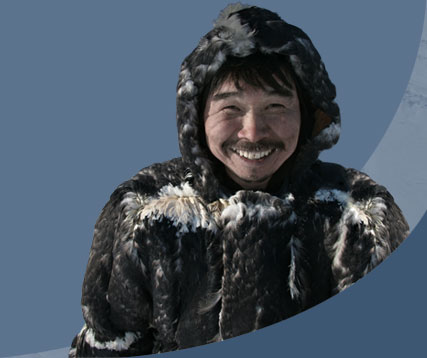
Inuit man wearing traditional eiderdown parka

With the use of Google Maps technology, Dr. Heath has taught the locals how to gather and share real-time information along the coast. That information is timely and useful for dissemination, to alert hunters. Above all, it is increasingly critical to disseminate the information gleaned about weather and environment conditions to alert people planning to travel on the sea ice. Knowing the condition of the sea ice can avert tragedies.

While the indigenous residents are making use of that information they are also now reinvigorating an earlier eiderdown industry. In the town of Sanikiluaq an existing eider factory has begun buying up eiderdown that has been collected by Inuit families from the proliferation of nests nearby the town, built by the birds. The two are interrelated, since the birds are affected by ice conditions, and in turn the Inuit are affected by any deleterious effects on the birds which they rely upon.

The large seabirds nest in immense numbers in the Belcher Islands. The female duck plucks down from her breast to line her nest which will contain the eggs she lays. Down collectors pluck down from the nests before the eggs have hatched, taking care to take only a portion of the fluff. The down that is collected makes its way to the factory, is cleaned, sterilized and sewn into parkas and duvets. One nest is capable of producing 70 grams of eiderdown.
Photo from Sanikiluaq Hamlet website

And eiderdown just happens to represent the warmest, most durable insulation produced by nature. Iceland produces most of the world's eiderdown production, estimated at four tonnes. Its relative rarity accounts for its sky-high price. Uncleaned down brings in $330 a kilogram with finished duvets priced at up to $10,000. The hamlet located on Flaherty Island, the southeast corner of Hudson Bay, plans to sell cleaned down to manufacturers in Europe, along with parkas and duvets sewn traditionally by local women.

Belcher Islands Designs operates the eiderdown factory. The plant is forecasted to break even by its second year of operation and is expected to produce a $200,000 profit by its third operating year. To run the operation, fifteen full-time jobs will be created. People skilled traditionally are the fulcrum of the enterprise. The down sterilizers and the eight industrial sewing machines were imported into the community.

A map of Sanikiluaq, Nunavut

Labels: , , , ,

Sunday, May 24, 2015

Examining, or Re-Writing History?


Where Are The Children? The Exhibition
Though some students have spoken of the positive experiences of residential schools and of receiving an adequate education, the quality of education was low in comparison to non-Aboriginal schools. In 1930, for instance, only 3 of 100 Aboriginal students managed to advance past grade six, and few found themselves prepared for life after school – on the reservation or off.
As late as 1950, according to an Indian Affairs study, over 40 per cent of the teaching staff had no professional training. This is not to say that past experiences were all negative, or that the staff were all bad. Such is not the case. Many good and dedicated people worked in the System. Indeed, their willingness to work long hours in an atmosphere of stress and for meager wages was exploited by an administration determined to minimize costs. The staff not only taught, they also supervised the children’s work, play, and personal care. Their hours were long, the pay below that of other educational institutions, and the working conditions exasperating.
Legacy of Hope Foundation extract

"In order to educate the children properly we must separate them from their families. Some may say that this is hard but if we want to civilize them we must do that."
Public Works Minister Hector Langevin, 1883

"When the school is on the reserve, the child lives with his parents who are savages; he is surrounded by savages, and though he may learn to read and write, his habits and training and mode of thought are Indian. He is simply a savage who can read and write."
Sir John A. Macdonald, Prime Minister of Canada, 1883

"I don't think I had a childhood."
"We were always fearful. I think we lived with fear all the time. Fear of being beaten or of being abused in different ways."
Doris Young, Manitoba
My mother is 75 and attended the Cecilia Jeffery School outside Kenora, Ontario. In the 60-some years that have passed since her experience, she has become a mother, grandmother and great-grandmother. She lives in a small house on a reserve outside Kenora.
When you enter my mother's house, there's one thing more than anything that strikes you. It's incredibly neat.
She cleans fastidiously. Every surface in her home gleams and everything is organized and arranged to make the most out of the living area.
There is a cross on the wall, a Bible by her bed and a picture of Jesus in the living room. It's a home not unlike the home of any grandmother anywhere in Canada.
She credits the residential school experience with teaching her domestic skills. While she was at the school, she learned how to cook, sew, clean, launder and take care of a home. Her house on the reserve is known as the neatest and cleanest and even though she's an elder, she takes care to maintain it. Her lawn is the only cultured lawn on the whole reserve, shorn, immaculate, stunning.
My mother has never spoken to me of abuse or any catastrophic experience at the school. She only speaks of learning valuable things that she went on to use in her everyday life, things that made her life more efficient, effective and empowered
Richard Wagamese, writer, Calgary Herald
Dene children at work in this undated shot from the Catholic-run residential school at Fort Resolution, Northwest Territories. The academic quality in most of the schools was very low.
Dene children at work in this undated shot from the Catholic-run residential school at Fort Resolution, Northwest Territories.  Canada. Dept. of Mines and Technical Surveys / Library and Archives Canada

Canada has been struggling for the last few decades with the knowledge that well-intentioned people a hundred years ago felt it was important to give aboriginal children the opportunity to have an education that would benefit their future years. The government of the day, when it initiated the first of the residential school programs exhibited a breathtakingly arrogant, Euro-racist attitude toward Canada's First Nations peoples in wishing to expose young aboriginals to European culture to pattern them as European-extracted future citizens, while hoping to expunge the 'Indian' in them.

An undated class photo at St. Mary’s Indian Residential School in Mission, B.C.
Courtesy of Mission Community Archives    An undated class photo at St. Mary’s Indian Residential School in Mission, B.C.

To that end, young children were taken from their families to be enrolled in a school system that was to teach them European values and customs with the purpose of draining their aboriginal culture from their immediate consciousness. The children mostly attended their residential school during the week, and returned home to their families on week-ends, although for some, returns home were far less frequent. When one thinks of the upper-class British social custom of sending young children off to boarding school it was a privilege of the wealthy, but a miserable experience for British children.

When Prime Minister Macdonald had a cabinet decision passed to create the initial three residential schools they were to be operated in conjunction with the Catholic and Anglican churches out West; the rationale was for complete assimilation of the indigenous youth into the European-based culture that prevailed in Canada. From the 1880s forward until the last of the 130 residential schools that were operated over the years closed in 1996, 150,000 indigenous children were placed in the schools. For some the experience was a worthwhile one, for many others it was a dramatic shift in their lives that left them devastated.

It is estimated that some 80,000 former students of the residential schools are still living. Estimates also give a figure of 7,000 for children who died at the schools, from accidents, from illness and diseases such as tuberculosis. Some researchers contend that deaths like those from tuberculosis were not more numerous among residential school children than they were among the general population of the time. There are accusations of underfunding of the system, of food in short supply, of children inadequately nourished. With no fire escapes and locked windows it was said that if fire consumed some poorly constructed buildings, children perished in them.

Much of the problems seen in aboriginal communities, on reserves, have been attributed to the culture shock and trauma experienced by former residential school students, unable to find their place in life, incapable of functioning normally, finding themselves confused and unsettled by their experience, turning to alcohol, struggling with suicidal tendencies, ignoring and failing in their duties as parents toward their own children whom they left to their own devices. And the violence in aboriginal communities where women are targets and children's lives totally neglected, also attributed to the residential school experience.

In the attempt to rid the children of the appeal of their aboriginal culture in favour of the European-based culture, children were forbidden to speak their aboriginal languages, their long hair was cut and tidied, many had their names changed, siblings were separated and many claim to have suffered physical and sexual abuse. Claims that their experience led to their later living in poverty and being the cause of social problems that plague reserves, from alcoholism to the commission of crimes all attributed to the residential school system.

Apologies, official in nature, from the government to the aboriginal community, by both Prime Ministers Jean Chretien and Stephen Harper have acted as admissions of wrong-doing by previous administrations. Financial settlements were sent to former students of residential schools, in a broad effort to bring about a sense of closure through moral and financial restitution. A Truth and Reconciliation Commission was launched that criss-crossed the country to hear first-hand accounts by former students, and the anguish they suffered in separation from their families; in other instances, how well the residential school system had prepared them for their future lives as adults.

While we can decry past decision-making impacting on the lives of so many we cannot change what has occurred. Clearly, for some among the aboriginal communities their experience was a positive one, one that enhanced, not degraded their lives. The Truth and Reconciliation Commission made no effort to probe whether testimony they heard reflected the truth, or was in some instances a reflection of a robust imagination by people eager to be seen as entitled to restitution. Alcoholism among First Nations people was not a voyage of discovery dating from the residential schools; it existed long before.

It is not quite possible to separate out the dysfunction that exists among aboriginal families on reserves, to determine how responsible, as it claimed it is, the residential school system was in the outcome that is now largely attributed to the experience of young aboriginals in that system, or whether the entire episode, unfortunate as it was for so many, simply serves as a handy excuse for a people insisting it has the right to live with its heritage and traditions, while living largely backward lives, where achieving an education and striving for a profession to be independent and have pride in themselves remains on the back-burner of the future.

An historical shot of the Anglican-run residential school in Alert Bay, B.C.  Natives have filed lawsuits alleging abuse while detained in the school.  An undated photo from the book, Shingwauk's Vision by J.R. Miller.
An historical shot of the Anglican-run residential school in Alert Bay, B.C. Natives have filed lawsuits alleging abuse while detained in the school. An undated photo from the book, Shingwauk’s Vision by J.R. Miller. Vancouver Sun

Labels: , , , , ,

Sunday, April 05, 2015

A Knife in the Heart of the Community

"I had no clue what was going on. All I knew was that my brother Charlie [Gunner] left to go hunting with his friends. I didn't expect bad news ... That's when I found out what they had discovered over there. That the cabin had burned completely, that they were certain that they saw three bodies."
"I didn't really want to take it in at first. I wanted to believe that he was on his way to come tell us. Maybe he got lost somewhere. I didn't want to believe it. That night, I was still expecting him."
Beatrice Gunner, officer, Mistissini police department 
Five Cree hunters from northern Quebec died in a cabin fire in Lac-Bussy, Que. Quebec provincial police say a search began when the five failed to return as scheduled to Mistissini at the end of March and a plane sent out by locals discovered the burned cabin in Lac-Bussy.  THE CANADIAN PRESS
"It was like a knife that cut deep into the heart of the community."
"These were men with a deep love of the land, with a deep love of their fellow man. They were good men, they gave back to the community."
Reverend George Westgate, Mistissini Anglican Church

"There is no greater loss that a family and a community can face than the loss of a youth."
"As a father, Mr. Speaker, I can’t even begin to imagine the pain that families and friends are feeling today."
"I want to send my support, my love and our prayers in these trying moments, in this dark time of need. May their memories be a blessing as we collectively attempt to come to terms with this sad and horrible loss."
Member of Parliament Romeo Saganash, House of Commons (federal riding of Abitibi—Baie-James—Nunavik)

The men died in a hunting cabin on Bussy Lake, a popular hunting and fishing area for many Cree in Mistissini, a Cree town 90 kilometres northeast of Chibougamau. The five young men went off on a hunting trip, heading for Bussy Lake, where they planned to say at a hunting cabin located there. The area where the fire occurred is 200 kilometres north of Mistissini, a popular destination for hunters despite the distance. During the winter, the last third of the trip to Bussy Lake is accessible only by snowmobile.

Or by plane, and the Cree villagers were so concerned when the five men with families -- friends who enjoyed seasonal hunting expeditions in each other's company -- didn't return from their trip at a reasonable time that they sent out a search party. Even taking into account the distance involved, they knew these were skilled outdoorsmen whose decision to go out moose hunting passing deep into the spruce forest to reach Bussy Lake, it shouldn't have taken a week for them to return. Which accounts for the town dispatching a bush plane to search out the wilderness for the missing men.

Cree deceased from Mistissini
Montreal Gazette
They succeeded in finding the whereabouts  of the men, David Jimiken, Emmett Coonishish, Chiiwetin Coonishish, Kevin Loon and police officer Charlie Gunner. And though the five hunters hadn't returned within the 48 hours they were expected back at their Cree village, it didn't take long for the search party to return, to inform the assembled villagers at Elder's Point, that they had found the log cabin burned to the ground, with three burned bodies within what was once a sturdy, intact cabin, now just a charred remainder. 

Mistissini police later announced they had discovered the whereabouts of the last two bodies. Investigators with the provincial Surete du Quebec will use family blood samples for positive DNA identification. About 800 kilometres north of Montreal, the village's loss has shocked the entire Cree Nation. Extended family, friends and sympathizers began to arrive in the silent, mourning village from across the James Bay area to attend a memorial service as heavy sleet howled in off Lake Mistissini.

Five years ago, Charlie Gunner, a member of the town's police force, had confronted with his partner a man who had been stalking the streets firing a shotgun. When face to face with the gunman, who fired at them, Charlie's legs and his face were pierced with steel pellets. He raised himself from the ground and ran over to where a few civilians were standing, screaming for them to take immediate cover. For his selfless dedication to safeguarding the security of civilians he was honoured by Gov.Gen. David Johnston, with the Medal of Bravery.

"At that time, when he got shot, he only told us the next morning. I remember he was at the hospital, his face was all bloody, but he told us not to worry ... he really didn't want us to worry. That was Charlie", his sister reminisced in her grief. The youngest among the five doomed men was Chiiwetin Coonishish, 22, well liked, a family man, active outdoorsmen and skilled hockey player. His uncle Emmett drove a snow plow and worked as a heavy machine operator.
 
"Emmett wanted to go into business with Charlie and Charlie was thinking about taking a break from the police force to work on the highways. He was always bugging me about that, he really wanted to work with his friend. They were close", recalled Charlie's uncle, Joseph Gunner. Friends also spoke of the kind and gentle man that was David Jimiken, another heavy machine operator.


Labels: , , ,

Monday, January 05, 2015

Abusing Aboriginal Women

"Women are bearing the burden of abuse, but they also have to bear the burden of advocacy to effect change, and this is a men's problem as much as it is a women's problem."
"People would ask: 'What is that?' [moose hide lapel token to end violence against aboriginal women] and we'd say, 'Thank you for asking. I'm speaking out against violence toward aboriginal women and children."
"Our culture was always to protect our women, not to hurt them, so that shift in our behaviour came from the residential schools, and to take our power back means to stop behaving like that and to stand up and protect our women, like healthy warriors."
"We have to have honest conversations in public now, or else this is going to continue."
"It's a way [Moose Hide Campaign] of cracking an uncomfortable subject for people who aren't necessarily steeped in it."
Paul Lacerte, executive director, B.C. Association of Aboriginal friendship Centres

"I want to make sure that it results in an action plan, that provincial, territorial, federal and aboriginal governments commit to creating the kind of socio-economic change that will have to occur to really begin to address the roots of violence against aboriginal women and girls."
Sylvia Maracle, executive director, Ontario Federation of Indigenous Friendship Centres

"A lot of the time, it's going to start with internal reflection about what we see in our communities. Even if you're not a perpetrator, standing passively by is equally as bad."
Jeffrey Cyr, executive Director, National Association of Friendship Centres, Ottawa

I AM a Kind Man Kids Site

So there is the partial admission from those who most certainly are aware of it, that violence against aboriginal women and children begins in the home, within the tribe, the Indian band, inside the community, the reserve, as an uncomfortable cultural tradition. It can be attributed to poverty, to ignorance, to lack of education, employment, opportunity, but it is a measure of contempt that women live with expressed by males violating their sovereign integrity as individuals equal in status.

Women are not equal in status to males within the aboriginal community; the very fact that should an aboriginal woman marry a non-Indian she must forfeit her place within the reserve, no longer may she live there as an inherited entitlement for she has gravely committed a cardinal sin; men on the other hand, need have no such concerns.

Forums on violence against indigenous women bring out women to express their outrage against their treatment, men see no reason to attend. Paul Lacerte decided to change that, to create a symbol with a square of moose hide whose purpose was to recognize that symbol as a responsibility by men toward women, in a campaign to persuade men to curb their violence directed at women.

Paul Lacerte, executive director of the BC Association of Aboriginal Friendship Centres, wears a piece of moose hide representing the Moose Hide Campaign, an initiative signifying a commitment to end violence against women and girls in his community.
ARNOLD LIM / Arnold Lim Photography   Paul Lacerte, executive director of the BC Association of Aboriginal Friendship Centres, wears a piece of moose hide representing the Moose Hide Campaign, an initiative signifying a commitment to end violence against women and girls in his community.

A program called Kizhaay Anishinaabe Nin: "I am a kind man" sets out to persuade men to model themselves as leaders within their communities on the very same issue. Which means that finally, enough individual consciences are at play here to realize that the problem of aboriginal male violence against aboriginal females is one that must be addressed and attempts made to change that behaviour from within the community.

The constant calls for a federal enquiry, when such and similar enquiries have taken place over the years, as a means by which the endemic problem can be addressed and reversed only skirts the issue of aboriginal responsibility for an aboriginal-based custom has been avoided and denied for far too long. It is still being denied, in a very real sense, when someone like Mr. Lacerte asserts that the residential school experience is responsible for indigenous men abusing indigenous women.

But admitting the problem exists within the community and the culture as a commonplace dysfunction among many others, is a start. The questions of how widespread it is, what the triggers are, and why men and boys succumb to the brutalization of the women among them is one that they must themselves address. And it's about time.

Labels: , , ,

Monday, December 15, 2014

Cultivating Cultural Sensitivities

"The child protection system for aboriginal children and youth is broken. We see the same type of things repeating: aboriginal children taken away from their community, taken away from their culture and usually ... these children find themselves, as adults, trying to figure out who they are, where they belong and are somewhat lost."
"We as a  country have been repeating the same mistakes over and over again. If we keep on doing the same old stupid things, we're not going to see it stop. We're going to see it continue to rise without real benefit and without real change."
"It is not going to be a quick and dirty solution. A lot of governments, they want a solution before the next election. You have to gauge your success by a different time game. The solution is not measured in months or years but maybe in ten years, or tens of years."
John Beaucage, (first) Aboriginal Advisor to Ontario's Minister of Children and Youth Services
Photo Credit: Liam Sharp
"We had social workers untrained in the experience of First Nations people; they'd walk onto these reserves, see all this poverty and devastation and children from the residential school system -- who are now parents -- in a lot of trauma and, instead of seeing that for what it was, they removed the kids all over again."
Cindy Blackstock, executive director, First Nations Child and Family Caring Society of Canada

"First Nations families are still experiencing the wrongful taking of their children on spurious grounds. There is still widespread, unnecessary and unwarranted removal of children."
"Many, many loving and perfectly good aboriginal homes don't meet a province's standard of requirements for being foster homes. There are different cultural norms on how children should be raised."
Katherine Hensel, lawyer representing First Nations and aboriginal organizations
Deaths of Alberta aboriginal children in care no ‘fluke of statistics’UBC professor Shelly Johnson says many First Nations foster parents do not have proper training and support to deal with high-needs children.
"If we deem a home to be a good home and a safe place for a child -- but it might not meet all the provincial standards -- we try to be as flexible and creative as we can."
"We have a mandate that is both from the government but also from our First Nations. We're not just in the business of child welfare, we are also in the business of rebuilding our nation by rebuilding our families."
Theresa Stevens, executive director, Anishinaabe Abinoojii Family Services

IMAGE DESCRIPTION
Photo: University of Regina professor Raven Sinclair laments that the number of aboriginal children dying in care ‘is not a fluke of statistics.’ Credit: Supplied.
"We don't need someone with a PhD to come and tell us what the problems are. We know what the problems are. Because they end up in child care, they end up in drugs and alcohol."
"It wounded us to our core and sometimes it is hard to move forward when you are wounded. But the answers do not all come from Ottawa [federal government]."
"We need to look at ourselves. We can do more as a community. We can do more as parents ... it's not only more money and more resources. We have the skill, we have the capacity, we have the experience -- now give us the way to help our own people."
Goyce Kakgamic, deputy grand chief, Nishnawbe Aski Nation

Chief Kakegamic, born in Keewaywin First Nation in Northern Ontario was raised traditionally but also had experience in a residential school. University educated, he is responsible for social services for member bands across northern Ontario, most so remote that they are fly-in reserves, with poor infrastructure as a result of their difficulty of access. He expresses faith in his people's ability to do better than they have. He also acknowledges that responsibility and guilt are two-way streets.

Some 15% of children in Canada that are in care are of aboriginal origin, even though aboriginals comprise only 3% of the general population. The reality is that children living on reserves are eight times likelier than children living elsewhere in the country to be identified as requiring state intervention, and to be placed in care. But it is now not only provincial welfare authorities that make that determination, since First Nations now have their own child welfare services.

Statistics and studies state that the majority of First Nation child removals from their family situations into care are not necessarily the result of abuse, but are due to concerns of neglect. And, needless to say, interpreting neglect becomes a factor of culture and poverty. Repeatedly, claims are made that government must tackle the root causes leading to child apprehension, and to find that middle place between respect for cultural integrity and the maintenance of standards of care.

The federal Indian Act was altered in 1955 to have provincial laws apply on native reserves which was when the provinces began providing aboriginal child welfare services, funded by the federal government. That led to the 1960s when an estimated 20,000 native children were taken in for foster care and adoption, most often into non-aboriginal families in Canada, the United States and Europe. Until a lash-back when bands began to refuse entry to provincial child protection workers.

A lash-back that led to the introduction of aboriginal child welfare agencies mandated to handle child welfare services. Now there exist at least one such agency in every province but the northern territories and P.E.I., with 108 such aboriginal-run agencies across the country, and more to come. Sensitivity to the issue of heritage status is increasingly acute in Ontario where the Child and Family Services Act was amended in 2006 to require child protection workers to ascertain whether a child has Indian status.


All child protection agencies across the country operate on the basis of suspicion of maltreatment; physical, sexual or emotional abuse to account for their intervention on behalf of a child. Such malign abuse is beginning to take second place to intervention spurred first by concerns relating to neglect, substance abuse, lifestyle and even living conditions. "It is quite heartbreaking", said Katherine Hensel, emphasizing that cultural norms are different in First Nations communities and to be taken into account.

To put another perspective on the problem and how to approach and try to solve it, an investigation conducted last year by the Edmonton Journal/Calgary Herald newspapers found proportionately more children died in the care of an on-reserve Delegated First Nations Agency than those in the care of the province's Children and Family Services Agency.


Photo: With a braid of sweetgrass on her table, an aboriginal foster parent grieves the death of a child in her care. Credit: Ryan Jackson, Edmonton Journal.
In Manitoba the death of a five-year-old girl in 2005 after experiencing abuse in her mother's home on the Fisher River reserve three months after being returned to her mother's care, became a focus for the very phenomenon mentioned above.

And then the shocking case of 15-year-old Tina Fontaine of Manitoba's Sagkeeng First Nation in the care of a child and family services agency, her lifeless body found wrapped in plastic in the Red River, amid signs of sexual abuse.

"More and more, there is recognition that we need to find unique solutions in unique community circumstances. But we also need to make sure that the kids are OK. Aboriginal parents don't want their kids in appalling conditions any more than anybody else wants their kids in appalling conditions", commented Mary Ballantyne, executive director of the Ontario Association of Children's Aid Societies.

And then there are two recent cases where aboriginal girls were diagnosed with leukemia. After initially undergoing chemotherapy and a medical protocol that has proven to be 90% effective in such cases, their parents pulled them out of the hospital program treating them insisting the treatment was killing their children, not the leukemia, opting for traditional herbal medical treatments and other 'alternative' treatments at clinics known to practise medical quackery.

Labels: , , , ,

Monday, October 20, 2014

That Stuff Is Amazing

"There's a fear of [aboriginal remedies] or denial of it. If things can't be quantified or qualified, to them it's irrelevant."
"Who are they [doctors] to say she will make it with their treatments? Just because they have a degree, that makes them more knowledgeable?"
Six Nations resident Laurie Hill
One of the traditional cancer treatments available at Ancestral Voices Healing Centre on Six Nations reserve. The community is embroiled in a court dispute over a girl who has refused chemotherapy for leukaemia.
TOM BLACKWELL/NATIONAL POST   One of the traditional cancer treatments available at Ancestral Voices Healing Centre on Six Nations reserve. The community is embroiled in a court dispute over a girl who has refused chemotherapy for leukemia.
"Even if we say there is not one child who has been cured of acute lymphoblastic leukemia by traditional methods, is that a reason to invoke child protection?"
Are we to second guess her and say, 'You know what, we don't care?' ... Maybe First Nations culture doesn't require every child to be treated with chemotherapy and to survive for that culture to have value."
Justice Gethin Edward, Ontario Court of Justice

Two mind-blasting statements. One issued in an ethnic-cultural fog of defiance, the other in a politically correct mindset of indifference to the fate of a child balanced against the social requirement to politely accede to the demands of an aboriginal community whose heritage must be recognized as hallowed. Sufficiently so to toss out all that medical science has achieved through research and successful treatments.

At the heart of the matter is how the courts will decide on the treatment of an eleven year old First Nations girl who was diagnosed with leukemia and who was being treated with the proven medical convention of chemotherapy at McMaster Children's Hospital in Hamilton. The little girl was distressed at the always-disturbing side-effects of chemotherapy and grasped at her mother's decision to use traditional native treatment instead.

The First Nations family ignored the pleas of medical specialists to have the child continue treatment at the hospital as the only way of saving her life, since the treatment has an acknowledged and verifiable cure rate of about 80%, whereas traditional native treatment is unknown, has never been shown to be effective in solving the medical dilemmas that plague society. The Children's Aid Society brought in by the hospital to become involved, washed their hands of the situation.

Which left only a court challenge. And here's what Justice Edward had to say, that physicians "impose our world view on First Nation culture". That the very idea of a cancer treatment judged on the basis of survival statistics is "completely foreign" to aboriginal culture. There must be many First Nations people who are not ignorantly defiant of logic and experience outside their immediate culture, living in a society for whom medical science has brought a saving grace to grave medical conditions.

It would seem, however, that at the Ancestral Voices Healing Centre where native herbal remedies are relied upon to improve all the troubling aspects of life from mental health, to earning a living, to coping with a threatening illness, and trust in 'magic', those concoctions take first place over proven medical interventions. Daphne Jarvis, the lawyer for McMaster Children's Hospital stated the girl's mother had claimed she wants a cure for her child.

In that spirit, and for that purpose she is using traditional native 'cures'. Despite that no evidence exists, either empirical or "experiential" to demonstrate that traditional methods are capable of successfully treating childhood leukemia. Doctors at the hospital point out that another 11-year-old First Nations child with cancer earlier this year dropped out of chemotherapy treatment and has now suffered a relapse. "That is clear and unequivocal", noted Ms. Jarvis.

TOM BLACKWELL/NATIONAL POST
TOM BLACKWELL/NATIONAL POST    Hayley Doxtater examines some of the traditional medicines available at Ancestral Voices Healing Centre on Six Nations reserve. The community is embroiled in a court dispute over a girl who has refused chemotherapy for leukemia.

At the Six Nations reserve, Hayley Doxtater, an employee of Ancestral Voices pointed out a typical cancer treatment represented by a collection of herbs including slippery elm and turkey rhubarb root. One customer, she stated, repeatedly travels an hour from Toronto to buy it for a sick friend. "We have people come in here who are so happy that something works. They'll say' That stuff is amazing'."

Labels: , , ,

Thursday, May 15, 2014

Culture Clash

"This chemo that I am on is killing my body and I cannot take it anymore. I have asked my mom and dad to take me off the treatment, because I don't want to go this way any more."
"Jesus came into my room, and he told me not to be afraid, so if I live or if I die I am not afraid."
Brantford, Ontario -- 11-year-old girl

"All in all, it's a very tragic situation. We have to decide as an agency how we wish to handle this."
"Hopefully, we can come up with something collaborative that can take the best interests of this child into consideration but also the perspective of the First Nation."
Andy Koster, executive director, Children's Aid Society of Brant County

"For the hospital to pump her full of pharmaceuticals and then degrade her spiritual experience is the exact opposite way of [her] culture. The hospital didn't seem to have protocol in place for Indigenous children whose families choose traditional medicine instead of pharmaceuticals."
"The ... family told me that [the hospital's lead oncologist] repeatedly used derogatory language ... regarding traditional medicines, calling them '100% ineffective' and 'anyone who says traditional medicine works should be thrown in jail'."
Nahnda Garlow, Two Row Times correspondent

"Her faith has been a constant source of strength throughout this great struggle. She told of her spiritual encounter with Jesus when he entered her hospital room and how everything began to turn around from that point on."
Child's father, evangelical pastor

"Health-care professionals have a legal obligation to notify the Children's Aid Society when any child requires medical treatment to cure, prevent or alleviate physical harm or suffering, and the child's parent is unable, does not or refuses to consent to the treatment."
Statement, McMaster Children's Hospital


The decision has been made by this little girl's family to remove her from all recognized and best-practise medical intervention in an attempt to treat her unique form of Acute Lymphoblastic Leukemia, a common form of childhood cancer. The condition has a survivability rate as high as 80% for children receiving properly recognized medical treatment.

The little girl had undergone the initial 11 weeks of chemotherapy at McMaster Children's Hospital in Hamilton. The child was distressed by the severe side effects familiar to most people who undergo such therapy; nausea, loss of appetite, weight loss. When the parents acceded to their daughter's wish, a tense standoff ensued between themselves and the hospital oncologists.

She is the daughter of a local pastor held in high esteem within his community. A crowd of several hundred attendees at a Sarnia, Ontario Evangelical gathering heard the little girl's testimony of having seen Jesus, which took place on May 5. Her epiphany most certainly impressed her father who fully supports his child's wish to be taken off chemotherapy treatment for her cancer.

The woman intervening on behalf of the family with the news media writes for a newspaper, freely distributed weekly to Ontario First Nations reservations. The Children's Aid Society, called into the situation by the hospital, plans to meet with members of the New Credit First Nation which represents the girl and her family, an Ojibwe group. The family plans to substitute chemotherapy with traditional therapy called Ongwehowe Onongwatri:yo:.

Details respecting that therapy have not been divulged, since it is considered to be "protected knowledge", according to Ms. Garlow: "herbs and other physical medicines but includes spiritual things such as faith, and love, and rest included in the treatments."

In their statement on First Nations medicine the Canadian Cancer Society states: "Although First Nations traditional healing practices have been valued by their people for as long as oral tradition has been alive, there is virtually no research on the effectiveness of these methods."

As a supplement to the story, the American Cancer Society unequivocally dismisses claims that "Native American healing can cure cancer or any other disease", while praising its "physical, emotional and spiritual beliefs".

Labels: , , , ,

 
()() Follow @rheytah Tweet