Ruminations

Blog dedicated primarily to randomly selected news items; comments reflecting personal perceptions

Saturday, March 17, 2018

Unintended Consequences and its Victims

"It's unexplainable. Suddenly they said, 'Now you can't come'."
"Most of us cannot go back to Iran; we're in complete despair. We are afraid they will give us a sentence [the Iranian regime view them as traitors, sentence them accordingly]. They could put us in jail."
H. Avakian, 35, Armenian Christian, Iranian refugee, Austria

"[The government of the Islamic Republic of Iran engages in] systematic, ongoing and egregious violations of religious freedom, including prolonged detention, torture and executions based primarily or entirely upon the religion of the accused."
United States Commission on International Religious Freedom
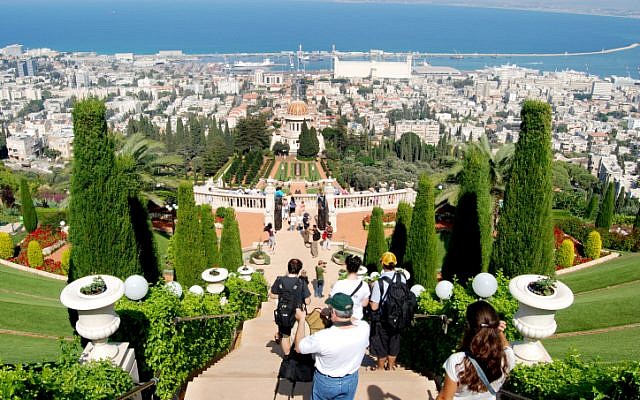
Terraces of the Baha'i Gardens in Haifa overlooking the Mediterranean Sea (Oren Fixler/Flash90)

Islam has a controversial and peculiarly polarized relationship with other religions. On one hand, it formally recognizes Judaism and Christianity as sharing some of Islam's precepts, even while reality is that Islam has lifted its sacred precepts from the religions it considers its predecessor 'try-outs' by a God dissatisfied with the earlier iterations, giving his final stamp of approval to the third, Islam, and on the other hand reserving the right to have a wholly negative view of their sacred legality, having spurned the Prophet's invitation to abandon Judaism and Christianity and submit to Islam as Allah has decreed.

So, even while Iran's Constitution proclaims Shiite Islam the official state religion, shunning Sunni Islam as an illegitimate version of true Islam, recognizing Christians, Jews and Zoroastrians as minority religions given Iranian protection, in point of fact the Republic goes out of its way to violate its own stated patronizing position on the protected status it so magnanimously offers religions with a connection to Islam, purporting to be separately quasi-divine, but in actual fact their presence an affront to Islam not taken lightly.
An Iranian woman prays as she attends Christmas Eve mass at the St Joseph Armenian Catholic church in Tehran on Dec. 24, 2016.        (Atta Kenare/AFP/Getty Images)
An Iranian woman prays as she attends Christmas Eve mass at the St Joseph Armenian Catholic church in Tehran on Dec. 24, 2016. (Atta Kenare/AFP/Getty Images)
According to the U.S. Commission, Iranian authorities have detained hundreds of Christians between the years 2010 and 2016. President Suhaib Nashi of the Mandaean Society of American states his fears for a number of Mandaean families who have temporarily established themselves as Iranians looking for asylum, hoping to be re-united with family members living in the United States. They have fled Iranian persecution in hopes of finding a place for themselves where their religion is treated with respect and equality among others.

And they felt so assured there would be a place for them in the United States that they liquidated all their holdings, left their professions and cut themselves away from their place of birth in Iran in a search for freedom for themselves and their families. They travelled to Austria as a safe transit site there to await the processing of their visas enabling them to arrive in the United States to begin their lives anew there. They are still waiting, some one hundred Iranian Christians a year later, their savings drained as they awaited applications for refugee status to be processed.

A return to Iran in recognition of U.S. failure to regard them as refugees, validating their requests and allowing them to emigrate to America, would result in their lives being endangered since the government of Iran regards them as enemies of the state. The 1989 U.S. law, the Lautenberg Amendment offers safe haven to persecuted religious minorities. Among those awaiting word from the U.S. that they may proceed as requested, are ethnic Armenian and Assyrian Christians, Mandaeans and Zoroastrians who have been mostly sponsored by relatives in the U.S.
Jewish Iranians casts their vote at a synagogue used as a polling station for the Jewish community in Tehran on February 26, 2016. AFP
Some 30,000 Iranians, members of the Jewish, Mandaean, Zoroastrian and Baha'i communities, all persecuted minorities in the Islamic Republic of Iran have received refugee status enabling them to settle in the United States since the Lautenberg Amendment saw expansion to include Iranians, in 2004. It is from among these families' relatives that those who see their futile applications being denied by U.S. authorities are being denied hope for the future.


One of the families already conditionally approved for refugee status later received a notice of ineligibility which stated their application "has been denied as a matter of discretion". Recent changes in the U.S. refugee admissions programs resulted, according to a State Department spokeswoman, in "a greater number of denials in the Vienna refugee program", leaving the U.S. Austria and others to work in tandem hoping to find alternatives for the anxiously waiting groups of Iranian Christians.
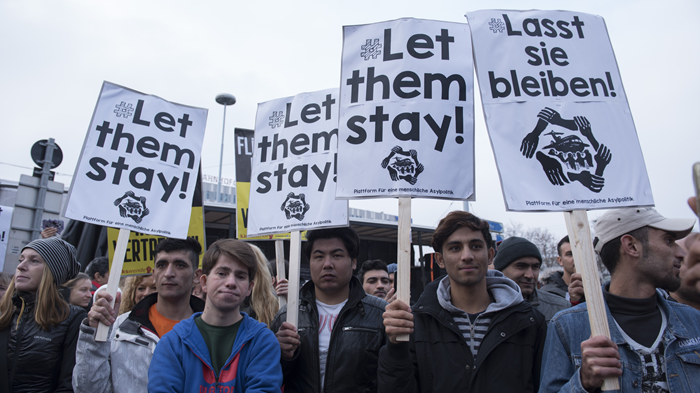
US Puts Scores of Iranian Christians at Risk of Persecution
Image: Omar Marques / Anadolu Agency / Getty Images
Asylum seekers join 2016 protests in Vienna, Austria.
 

Labels: , , , , ,

Tuesday, September 20, 2016

The Jewish Tradition in China

"Harbin is a modern city that has a deep tradition of music."
"We want to rejuvenate this tradition so we can bring it to the next level."
Liu Shifa, Harbin city deputy mayor

"[Harbin city officials have a goal] a vision of building a cultural bridge with Israel."
"So I came as a catalyst between the two sides."
Zubin Mehta, music director, Israel Philharmonic Orchestra

"The Jewish community made huge contributions to the establishment of Harbin's musical tradition."
Miao Di, director, Harbin Museum of Music

"Every city in China is trying to find its niche, and it's clear that Harbin discovered theirs early."
Jindong Cai, professor, musical conductor, Stanford University, California
Harbin
Main Synagogue in Harbin; 105 years old, refurbished by the Chinese government.. (photo credit:JEWISH COMMUNITITES OF CHINA)
Russian Jews, eager to escape pogroms and state persecution, began to settle in China in the late 19th Century. By the 1920s the city of Harbin saw up to 20,000 Jews settled there, propelled to escape the Bolshevik Revolution and World War 1. Other Chinese cities such as Shanghai had even larger Jewish communities, partly resulting from Japan's invasion of China, and the official Japanese penchant for regarding Jews as a superior race economically nimble believing that Judaism and Shinto had much in common. Going out of their way to give them protection from Nazi persecution even though Japan was an ally of the Third Reich.

A strange situation, given the reality that the Japanese invasion of Korea and China led to horrible atrocities committed by the Japanese, upon Koreans and Chinese, even while Japan thought highly enough of Jewish influence that they hoped to use their careful treatment of Jews to gain influence themselves by manipulating Jews of industry and wealth, believing that, as the Protocols of the Elders of Zion, that infamous piece of slanderous propaganda pointedly claimed, Jews were set on ruling the world.

There were Schindler counterparts that were Japanese and Chinese; just as the Swedish diplomat went out of his way, courting personal danger, to do what he could to protect Jews from the atrocities of the Third Reich which meant to obliterate Europe's Jews, so too did a Japanese and a Chinese diplomat issue visas to desperate Jews, enabling their escape from the Holocaust's annihilating agenda.

Classical music was introduced to Harbin through the presence of Jews throughout the early 20th Century, when the city was nicknamed the St.Petersburg of the East because of the presence of Russian Jews. Jews living in Harbin were cultural leaders, and one of the features of their presence was the introduction of a symphony orchestra, most of the members of which were Russian Jewish musicians.

An old wry joke illustrative of the kind of bleak, black humour common within the Jewish community, has never ceased making the rounds that Jewish affinity for music ensured that the violin was the instrument of choice for its portability; whenever Jews were expelled they could make a quick getaway with their beloved music-making violins.

Now, a "cultural renaissance" in China has been invoked by Chinese President Xi Jinping, and Harbin has decided to invest millions in its bid to highlight its rich cultural musical past. The city has built a new concert hall and a huge opera house, along with a $116-million music conservatory designed and built to traditional neoclassical architectural standards.

Musicians from around the world flocked to the city's 33rd annual Harbin Summer Music Festival. And at the same time that the city has revived its musical traditions, it has paid its respect to its Jewish past; even while giant sculptures of classical Chinese instruments have been erected, standing next to statues of Western composers, in the 49-hectare Harbin Music Park, the city has invested millions more in restoring venerable Jewish synagogues.

The city has set aside millions of dollars to be spent in the restoration of structures built by its former Jewish residents. It has recently refurbished and now maintains a once-neglected cemetery where former Israeli prime minister Ehud Olmert's grandfather, Joseph Olmert, is buried. Jews settling in Harbin were often of the merchant and entrepreneurial class as economic migrants who fled Europe and Russia in hopes of a safer and more prosperous future.

As a Chinese city noted for Western classical music as well as the site of the nation's first symphony orchestra dating from 1908, Harbin had 30 music schools where prominent international musicians received their training. In Harbin, jazz orchestras were established, ballet performances were featured, theatre companies thrived, and there was even an exclusively Yiddish theatre.
"Most Chinese will think Jews are smart, clever or good at making money, and that they have achieved a great deal. This logic - that the Jews are admired for their success despite their small numbers and historical oppression - has also led to a burgeoning industry of self-help books that use Jewish culture and the Talmud to preach business tips."
Professor Xu Xin, director, Institute of Jewish Studies, Nanjing University (one of over half a dozen centers in China dedicated to studying Judaism)
Tsarist Russia encouraged Russian settlement in their important Trans-Siberian-Railway outpost by waiving the then 25-year long military service obligation. For Jews who settled there, the restrictions applying in Russia were also waived. Photo: Harbin Ice        

Labels: , , ,

Wednesday, January 27, 2016

 Bagel, Bagelry, Smoked Meat and Deli

"We must conclude that Christian Montrealers did not widen their taste for bagels, bagelries, smoked meat and delis to a taste for Jews nor for Judaism [for most had no idea they were buying] an artifact [of Jewish culinary heritage]."
"It would seem that Montreal's gastronomical heritage corresponds ... almost exclusively to Jewish culinary specialties."
"It was a neutral zone [affinity for traditional Jewish cuisine on St.Laurent Boulevard] that was a meeting point between the French, English and Jewish communities, and which enabled the bagel to become this iconic food." 
"Bagels and smoked meat were originally intended for the Jewish immigrant community but they soon became popular with workers [particularly those in the surrounding garment industry] who saw in them hearty and affordable food."
Oliver Bauer, theology professor, University de Montreal
bagel- fairmount- Jewish Food
Jewish Business News
"Quebecers likely think of smoked meat and bagels the same way they think of poutine -- as local Quebecois culinary staples."
"Those who are aware of their origins -- regardless of whether they harbour prejudice or not -- may subscribe to the same view as those who believe Jewish doctors are tops. A kind of reverse, albeit more gentle, racism."
Bill Brownstein, columnist, Montreal Gazette
montreal smoked meat sandwich (2)
Jewish Business News
According to Professor Bauer, and more than certified by the history of the Jewish presence in the Province of Quebec, and Montreal in particular, a general taste for Jewish dishes did nothing to persuade Quebecois to look upon the presence of Jews in their midst with more sympathy and favour. The culinary gap may have been bridged with the attraction of mouth-watering Jewish food specialties, but the culture gap remained unbridgeable.

And the simple fact seems to be that most gentiles have no idea whatever that bagels originated as a Jewish bakery item. "Most people are not making a political statement by going to Schwartz's", stated Professor Bauer, quoting sociologist Morton Weinfield of McGill University maintaining that a deliberate dissociation between smoked meat and bagels from Judaism and Jews helped Quebecoise support their traditional stance on "les Maudits Juifs"; detesting the latter and obsessively devouring the former.

The very fact that the Quebecois had the presence of Jews in their midst to thank for the presentation of delectable food had no bearing whatever in the general opinion of French Canadians with respect to the Jewish presence in their province, and complaints about the expanding Jewish presence at University de Montreal and McGill in the 1930s, were not about to be limited because of smoked meat and bagels.

The Jews thrived in Montreal, despite the presence of lively anti-Semitism, and so did the delis and bagel bakeries. The Jews thrived thanks to their insistence that they had a right to live there and attend university and do anything that any other person living in Quebec could aspire to, and they pushed back against adversity. The delis and the bagelries thrived because they had the custom of not only their Jewish clientelle but an ever-expanding army of specialty-food-appreciating non-Jews.


Schwartz's deli in Montreal is considered "a Quebec place and not a Jewish place". It was a 'Jewish place' and it still presents Jewish deli food, but it was bought out by Celine Dion, the Quebec/Las Vegas superstar celebrity, renamed La Charcuterie Hebraique de Montreal. Now in gentile hands, tradition prevails; mayonnaise, thought to be a dairy-based product, is not served with meat presented Kosher-style. And it is hugely popular with tourists who flock there to sample 'Montreal smoked meat'.

A Tourism Montreal blog invited readers to "taste Montreal's culinary heritage", listing ten restaurants, six of which are Jewish. Tourism guides always recommend bagels and smoked meat when visiting Montreal. Typically eastern European Jewish foods which 19th Century immigrants to Canada setting in Quebec to flee Central European pogroms brought with them, for nostalgia and comfort. St. Laurent Boulevard, the Main, was the dividing line between the city's anglophone and francophone communities, and it was there that most of the bagelries and delis were established.

Professor Bauer theorizes that the hole in the centre of bagels symbolizes the vacuum in the Jewish diaspora representing the six million Jews who perished in the Holocaust. Others speak of the round shape representing infinity. Bagels are served at circumcision ceremonies for newborn baby boys, and during periods of mourning the death of a Jew. Symbolism galore.

Labels: , , , , , ,

Wednesday, July 22, 2015

European Maccabi Games to be held at Olympic venues built by Nazis

JTA Jewish Telegraphic Agency

http://www.jta.org

European Maccabi Games to be held at Olympic venues built by Nazis

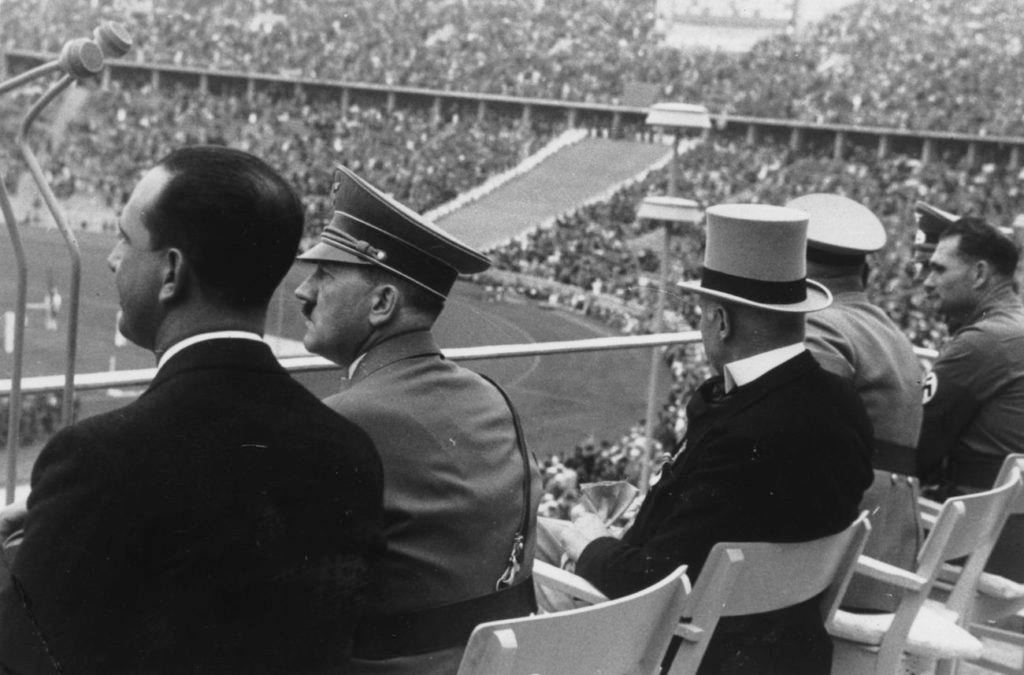
Adolf Hitler watching the Olympic Games in Berlin with the Italian Crown Prince, August, 1936. (Fox Photos/Getty Images)
Adolf Hitler, second from left, watching the Olympic Games in Berlin with the Italian crown prince, left, August 1936. (Fox Photos/Getty Images)

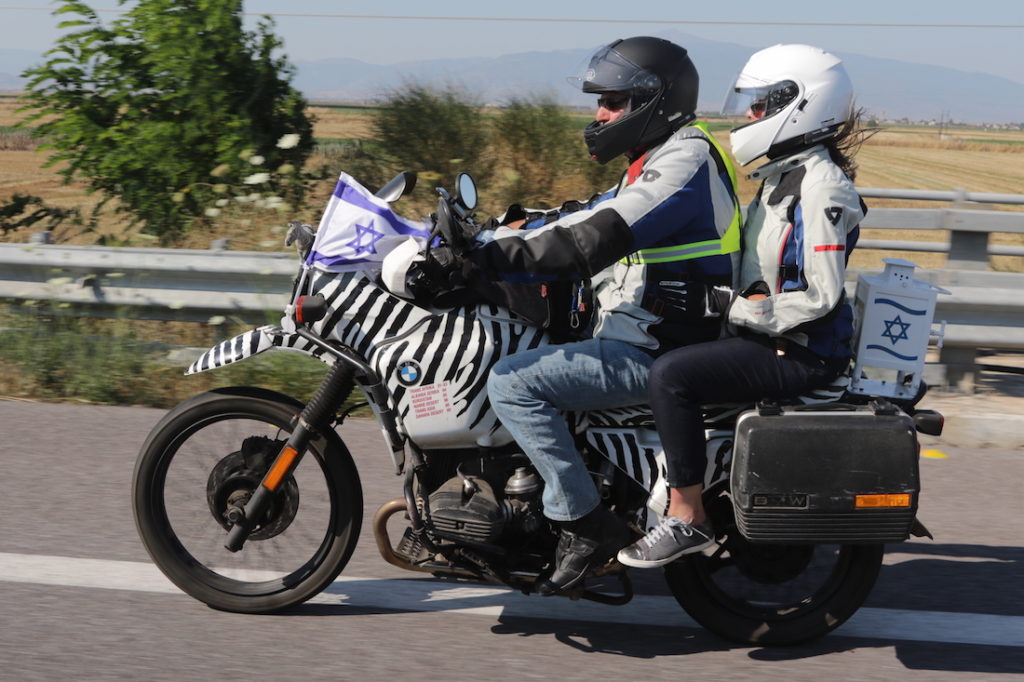
BERLIN (JTA) – They are roaring through Europe, raising dust as they go: Jewish bikers bearing an Olympic-style torch all the way from Israel to this German city.

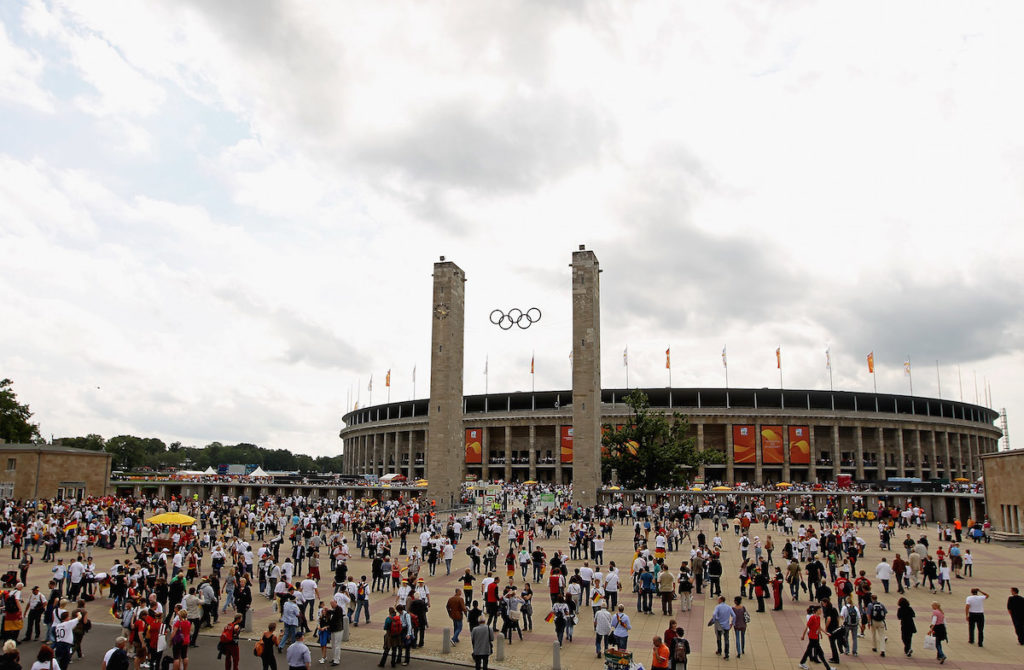
Next week, 11 core riders will pull their steel steeds into Berlin’s famous outdoor amphitheater, the Waldbuehne, to help usher in the 14th European Maccabi Games — the first ever in Germany — at a venue built by the Nazis for the 1936 Olympics. Other competitions will be held at the Olympic Stadium here, where Hitler presided over the opening of the games that year.

The riders are following in the treads of the Maccabiah Riders, who rode through Europe in the early 1930s to promote the games then being held under British mandate in Palestine.
The July 28 opening ceremony, which will feature remarks by German President Joachim Gauck and a concert featuring Matisyahu, Dana International and others, will usher in 10 days of sports, parties, a Limmud Germany learning event and more. Some 2,300 Jewish athletes from 36 countries will take part, cheered on by fans bused in from across the country by the Central Council of Jews in Germany. And the sports venues, including Berlin’s Olympiastadion, will be open to all, free of charge and under heavy security.


Elen Katz and Catherine Lurie-Alt participating in a motorcycle rally from Israel to Berlin for the opening of the European Maccabi Games. (Yosef Alony)

Athletes will compete in 19 sports, as well as a few exhibition games pitting Jewish athletes against German soccer and basketball stars. On July 31, they will try to break the Guinness World Record for the largest kiddush ever.

The European Maccabi Games grew out of the Maccabi movement, which traces back more than a century to Turkey when Jews, then shut out of local sporting clubs, founded the Israel Gymnastic Club in 1895. Jews elsewhere followed suit.

The first European Maccabi Games were held in Prague in 1929, and the second a year later in Antwerp. But with the rise of the Nazis, Jewish sports associations were banned. Germany’s Makkabi Club was reinstated only 50 years ago.

In 1969, the quadrennial competition resumed, alternating every two years with the Maccabiah Games in Israel.

Bringing the European Maccabi Games to Germany was a herculean feat, says Alon Meyer, head of Makkabi Germany.

“People told me they never could imagine setting foot in Germany because their parents and grandparents were sent away from there,” said Meyer, 41, a Frankfurt businessman whose father fled Nazi Germany for Palestine. “Now these people are coming back to see the changes [and take part in] the biggest Jewish event ever held on European ground.”

The Berlin Olympiastadion was originally built for the 1936 Olympic Games. (Scott Heavey/Getty Images)
The Berlin Olympiastadion was built for the 1936 Olympic Games. (Scott Heavey/Getty Images)

The change to which Meyer referred is the dramatic growth in Germany’s Jewish population. Only a few thousand of Germany’s prewar Jewish population of 500,000 remained in Germany after the Holocaust. Today there are some 240,000 Jews here, most of them immigrants from the former Soviet Union. Membership in Jewish sports clubs has grown, too.

Meyer wanted the competition to be held in the Olympic Stadium, those same stone halls where many Jewish athletes, though not all, were banned in 1936.

“They came all the way to Germany and in the morning they got a call, they were not allowed to run. They found out right before the race,” said Steven Stoller, 64, of New Jersey, a distant cousin of the late Jewish-American sprinter Sam Stoller, who was told he could not compete by Avery Brundage, then president of the U.S. Olympic Committee.

“I wanted to come to Berlin for my children, my future grandchildren, to have the story live on,” Stoller said.

Jed Margolis, the executive director of Maccabi USA, will fly in from Philadelphia to cheer some 200 participating American athletes aged 15 to 85.

“At one point in life I would say, ‘I will never go to Germany or buy a German product,’” Margolis said. “Yet there is a vibrant and growing Jewish community there. We want to support them and at the same time teach our next generation” about what happened there.

Security will be tight for the event, in the stadium and beyond. Berlin announced the creation of a new digital reporting system for anti-Semitic incidents just in time for the games.
“Security is the No. 1 priority,” said Lena van Hooven, spokeswoman for the games.

But Danny Maron is not worried. He and the other Jewish bikers have been traveling through Eastern Europe with Israeli flags attached to their bikes.
“We have no fear at all,” Maron said. “We are very proud.”

Maron’s father, Yoram, a Holocaust survivor, told JTA that he wanted “to show the whole world that after all the death, we are still alive, and we keep moving.”

At each stop, from Athens to Romania to Krakow, more Jewish bikers have woven into the pack. The Maccabi torch itself rides in a specially built case carried by Greek biker Kobi Samuel, 48.
“Two of our riders are descendants of actual Maccabi riders of the 1930s, nine are descendants of Holocaust survivors, and two of our bikers are actual survivors aged 73 and 78,” said filmmaker Catherine Lurie-Alt, who snagged Jewish talk show host Larry King as the narrator for her documentary about the motorcycle rally.

“This is where it all started,” Lurie-Alt said. “We are going through communities where Jewish populations were decimated, on our way to Berlin, where they will enter that stadium with jubilation and joy.”

Labels: , , ,

Sunday, July 05, 2015

His Compelling Conscience

"There were all kinds of things you don't talk about, even with your family. Everything that happened before the war actually didn't feel important in the light of the war itself."
"At the time, everybody said, 'Isn't it wonderful what you've done for the Jews? You saved all these Jewish people'. When it was first said to me, it came almost as a revelation because I didn't do it particularly for that reason. I was there to save children."
"Maybe a lot more could have been done, but much more time would have been needed, much more help would have been needed from other countries, much more money would have been needed, much more organization."
"I wouldn't claim that it was 100 percent successful, but I would claim that everybody who came over was alive at the end of the war."
Sir Nicholas Winton, British Holocaust rescuer, dead at 106
Kirsty Wigglesworth/ Associated Press
Kirsty Wigglesworth/ Associated Press   Nicholas Winton, centre, in 2009 at a 70th anniversary celebration of the Winton Train rescue of children 70 from Prague to Liverpool Street station in London.
"In a world plagued by evil and indifference, Winton dedicated himself to saving the innocent and the defenceless. His exceptional moral leadership serves as an example to all humanity."
Israeli Prime Minister Benjamin Netanyahu

"Winton knew how to correctly read the harsh reality and chose to leave his comfortable life and follow the voice of his conscience."
Avner Shalev, chairman, Yad Vashem Holocaust memorial, Jerusalem
He was in Prague, Czechoslovakia, a young British stockbroker, when the Nazis marched into the country to begin their program of subjugation of the populace on the one hand, and selection of Jews to isolate and transport them to death camps, on the other. It was a time of desperation when Jewish parents thought feverishly of any possibility of escape for themselves and their families, and settled finally for saving their children's lives.

And, on his own initiative, with no assistance from any organized humanitarian, caring source, Nicholas Winton responded to his conscience and undertook an organized protocol whereby he managed to bring 650 of the condemned Jewish children to safety far from the land of their birth and its lethal new atmosphere for Jewish existence.

The man's vigorous efforts to advocate on behalf of vulnerable children whose Jewish identity marked them as victims of fascist death threats identified him as a rare and compassionate human being. And homage was paid to the historical episode of his rallying efforts on behalf of those children whose families and they as well were marked for death through the machinery of Nazi German efficiency.

Matt Dunham/ Associated Press
Matt Dunham/ Associated Press    People look at flowers laid in memory of Britain's Sir Nicholas Winton on German-born Jewish sculptor Frank Meisler's "Kindertransport" (German for children transport) memorial statue outside Liverpool Street Station in London, Thursday, July 2, 2015.

On his return to Britain he ascertained that there was no agency concerned about rescuing children from their fate. He managed to convince the British government that it should permit entry to some of the Jewish children of Czechoslovakia to enter the country and the government agreed, with the proviso that he find a foster home for each child. And they also sought fit to levy a guarantee payment of fifty pounds per child.

The young man set about compiling a list of six thousand children deemed suitable for the program and published their photographs, hoping to appeal to British families to take them. He arranged a schedule of trains travelling from Prague to the Netherlands, and of ferries to convey the chosen children across the North Sea to Britain. In the event, eight trains and one plane carried 669 children to Britain before war's outbreak.

These children from Prague were among the ten thousand mostly Jewish children who had managed through the auspices of kindly agencies to arrive in Britain on Kindertransports [children's transports]. While the children survived the war, they lost what was most dear to them, their families whose lives were extinguished during the Holocaust years.

While British children were sent out of their cities of residence to live for safety in the countryside while London was being bombed during the dark days of the war, and even sent abroad to live to ensure their safety, these Jewish children were sheltered wherever haven could be found for them. That haven was not always ideal, for not all the Jewish children were treated with kindness; some foster parents viewed them as domestic servants.

Mr. Winton was knighted in 2003 by Queen Elizabeth and recognized in the Czech Republic for his humanitarian efforts. At Prague's central station a statue of Nicholas Winton was erected. At London's Liverpool Street Station stands a statue commemorating the Kindertransport children. Candles and flowers were set around Sir Nicholas Winton's statue in Prague on Thursday, the day following his death.

Niklas Halle'n/AFP/Getty Images
Niklas Halle'n/AFP/Getty Images   Cards and flowers in memory of Nicholas Winton are left on the Kindertransport memorial monument at Liverpool street station in London on July 2, 2015.

Labels: , , ,

Monday, April 28, 2014

Holocaust Remembered: Testimony

Holocaust survivors are a dwindling breed. They are elderly survivors of the modern century's blot on humanity. In its cold-blooded and determined sweep, institutionalized organization and rationalization the Holocaust represents the single most horrific attempt at genocide that has yet succeeded in a world gone mad with hatred.

The odiously wretched indecency of world leaders gaining knowledge of the extermination of Europe's Jews and deciding it was simply too inconvenient to grapple with the issue -- particularly at that time, and particularly as no one wanted to add to their nation's already onerous number of Jews -- gave their stamp of indifference to the cynical Nazis who knew there would be no interference with their resolute march partnering the Angel of Death.

The death camps were well considered with respect to their placement. Nazi officials involved in the Europe-wide venture to dehumanize Jews through slandering caricature as a venal, deceitful, controlling and vicious underclass of society striving to achieve dominance on the world stage of politics, economics and news promulgation, succeeded in deepening already-existing anti-Semitism. They understood where best to place the work camps, detention camps, death camps.

Among conservative, rural populations where that very specific kind of racism was already deeply entrenched.

Among the multitudes of disinterested bystanders preferring ignorance of knowledge of the proceedings to involving themselves in any manner to decry the inhuman isolation, victimization and slaughter, emerged a coterie of individuals who with their families quietly and with huge compassion risked their all to aid wherever and whenever they could those among them who were destined for slaughter; enabling some to survive the dreadful human-made cataclysm.
Detail from drawing by Warsaw Ghetto and death camp survivor Morris Wyszogrod of SS Untersturmfuhrer Reinhold Feix, commander of Budzyn camp, strangling a prisoner with the reins of his horse in 1943. - Photo:
"I remember looking down and I happened to be standing on my grandmother's tombstone. The Germans walked among us and anytime they saw a mother with a child, they tore the child from her arms and threw them into the back of trucks."
"I looked around and I just said 'Mother, this is where we are going to be separated."
"I didn't even feel it when the Germans hit me but every time they struck my mother and brother it was like they were cutting my flesh."
Asher Aud Sieradski, 86, (Poland)
"They asked me what my name was and I said 'Romka Vochick'. That is the name that saved me." Two sisters, 8 and ten fleeing the Nazi invasion of their hometown of Buchach, Ukraine. For years they hid, sleeping in fields, subsisting on scraps of food given them by non-Jews. They were eventually caught on the street and handed to the Gestapo. She lied; her sister couldn't bring herself to do the same. "She had an accent and was afraid." And so, she died.
Ester Koffler Paul, 82, (Galicia, Ukraine)
"I remember the scary things. I remember crying and being so hungry that I couldn't fall asleep."
"They burst into the house and started to search for documents, turning over furniture and tearing down wallpaper. One soldier stood and stared at me. I sat frozen, not daring to move. I was so frightened I almost couldn't breathe. Then came a Dutch policeman who was accompanying the German soldiers and he told the soldier that he saw something in another room. By luring the soldier away, he probably saved my life."
Jacob Philipson Armon, 76 (The Netherlands)
"The first thing they did was beat us and separate the women from the men. It happened so quickly, I couldn't even part from my mother and sister."
"I remember him [his father] begging: 'I am still young, I can run, I can work'. But it didn't help and I couldn't say farewell to him either."
"The hardest part is not having a Jewish grave for my parents in which to honour them."
Shmuel Bogler 84 (Hungary)

Labels: , , , , ,

Tuesday, February 18, 2014

Over 5,000 Attend Funeral for Akko Gas Explosion Victims

by Tova Dvorin Akko: 5,000 Attend Funeral for Explosion Victims  -- ArutzSheva 7, 18 February 2014

Over 5,000 people attended the Monday funeral of the families killed in Sunday's gas explosion in the northern Israeli city of Akko, according to Walla!. 

The procession began outside the Al-Jazzar mosque in the city's Old City neighborhood, where the local Mufti gave a eulogy. Former MK Abbas Zakour (United Arab List) was also present at the ceremony. 

"All of the residents of Akko - both Jews and Arabs - have united today in mourning over this terrible tragedy," Zakour stated. He added that several of the residents - not only medical rescue teams - joined lifesaving efforts immediately after the explosion. "We hope that the city never sees another incident like this." he added. 

Sunday's gas explosion killed five people: 43-year-old Muhammed Bader and his wife Hanan (39); Ra'eek Sarhan (40) and wife Najah (35), along with their eight-year-old son Hamed. Twelve people were also injured in the blast. Three of the injured have been released from hospital so far, according to Dr. Misad Barhom, the director of Nahariya Medical Center.  

An investigation into the exact cause of the incident - whether it was an accident or foul play - is ongoing. Officials have stated that a dispute between neighbors over a cell phone tower may have precipitated the tragedy.

According to Akko mayor Shimon Lankri, the problem is not new. 

"We received several complaints a few years back from the city's residents [over the towers]," he admitted. "At least 37 private cell phone antennae were erected on private residences without permits. [Since then,] the city has signed contract with the three major cell phone providers and built antennae far from the residential areas - which the residents agreed to, by the way." 

Businesses and schools in the Old City were closed for the funeral Monday, which was declared a day of mourning in the city. "We're still in shock," the brother of one of the deceased told Walla!. "This tragedy wiped out an entire family." 

"But this, everyone participating here, warms my heart," a family member noted. "Everyone shares our sorrow. The entire neighborhood did not go to work today in order to be with us." 

The Akko municipality officially closed off the Old city neighborhood Monday morning for safety precautions; officials are currently inspecting the area to determine if older apartments are in danger of collapsing due to aftershocks from the blast. A youth hostel has also been opened to house families displaced while the investigation continues. 


Labels: , , ,

 
()() Follow @rheytah Tweet