Ruminations

Blog dedicated primarily to randomly selected news items; comments reflecting personal perceptions

Saturday, January 31, 2026

The Predictable and the Unexpected

"The Chinese economy is designed to be, when it comes into a country like Canada, fundamentally parasitic. It sucks out capital, it sucks out IP, it sucks out jobs. It's designed to feed the parasite and to weaken the host."
"Another thing about China is that according to the 2017 National Intelligence Law, every Chinese citizen and Chinese company has to support China's intelligence efforts. They have to. They're punished if they don't, and they're rewarded if they do. If you're a Chinese citizen, you are a hostage, an unwilling hostage, often, of the Chinese state."
"[The Chinese Communist Party's] disintegration warfare [finds fault lines in communities, and exacerbates them]; to use countries' own weaknesses or strengths in the case of democracy, against itself, in order to weaken its resistance to China, in order to advance China's relative comprehensive national power."
"The Chinese are very good at identifying legitimate grievances, exacerbating them, and then leading you toward a solution that benefits China."
Canadian journalist Cleo Paskal, China politics expert 
https://i.cbc.ca/ais/89b827aa-a8e4-4b28-bdef-1980efcfbbc6,1768583894853/full/max/0/default.jpg?im=Crop%2Crect%3D%28392%2C25%2C8247%2C4638%29%3BResize%3D860
Models pose near the BYD Seal 06 Dmi, unveiled during the Auto China 2024 show in Beijing, on April 25, 2024. China's largest EV maker has been expanding rapidly into overseas markets, and could reach Canadian shores shortly following Ottawa's recent deal with Beijing. (Ng Han Guan/The Associated Press)
 
Canada's intelligence agencies are acutely aware of the danger that China poses to Canada's sovereignty. They issue reports, some portions of which are made public, others that go directly to the Prime Minister's office and a multitude of government agencies. Beijing's acquisition of state, scientific and corporate technology secrets of other countries through complex espionage schemes to further its own interests by shortcuts, undermines trade and military secrets of the countries it infiltrates. Its cyber-spy network has reaped great benefits for China at the expense of the countries whose classified material it accesses.
 
China uses and abuses, harasses and threatens expatriate Chinese who take up citizenship in other countries, considering them solely Chinese citizens and obligated to feed Beijing's hunger for data they can access willingly or unwillingly. Beijing does not recognize dual citizenship of its former nationals. In foreign countries of the West Chinese investment, the presence of elements of its United Front Work Department pose a threat to its expatriate community many of whom feel sufficiently pressured to do its bidding.
 
https://www.investopedia.com/thmb/AygIbTFLHGM8TQiAbipQPYwPqRk=/750x0/filters:no_upscale():max_bytes(150000):strip_icc()/INV_ChinaChipManufacturing_GettyImages-1917942474-adc957040449428b8a3e61abcc594f01.jpg
The Chinese economy thrives as a manufacturing powerhouse, and the nation’s products seem to be everywhere. The majority of tags, labels, and stickers on a variety of goods proclaim they are “Made in China.” ChinaChipManufacturing   Costfoto / NurPhoto via Getty Images
 
In the last several decades, invited to join the World Trade Organization, China used the opportunity to build upon its vast population of cheap labour to over-produce consumer goods, exporting them abroad as less expensive alternatives to similar products made in Europe and North America, establishing itself as the choice of consumers everywhere, leading to the failure of manufacturing elsewhere throughout the world as China mounted the summit of world production championship. 
 
China's trade piracy in government-subsidized production guaranteed it access to global markets through consumer demand. But manufactured goods are not the only items that emanate from China, as the world became acquainted with pathogens that made their presence first in the Middle Kingdom, then transited borders in human-to-human contact to spread wildly in a great global contamination wreaking havoc in illness and widespread deaths, overwhelming hospitals and medical science.
 
https://www.hhs.texas.gov/sites/default/files/assets/23d0744-one-pill-kills-hero.jpg 
 
Where the spread of population-levelling disease ran its temporary course, after China took advantage of the need of medical devices and supplies of face masks to a world hungry for any bandaid solutions to help ward off disease and death. China took recourse to other means of conquest, this time through the chemical production of opioids and precursor chemicals to supply the world community with lethal drugs like fentanyl and carfentanil leading to illegal street drugs cheaper to acquire while expanding core groups of drug users, when incidents of drug overdoses began to soar.
 
China's clever use of persuasive media while flooding Europe and North America with illegal substances in its control of pharmaceuticals and supply chains has created a desperate situation of drug addiction, homelessness, drug overdose deaths and criminal violence. All of which are well known in Canada, as it is elsewhere, including Beijing's organized interference in politics abroad in  efforts to ensure that during elections political parties soft on China are elected. Interference that includes persuading expatriate Chinese with dual citizenship to run for political office and once installed, able to influence outcomes in favour of China.
 
And this is the country whose ideology is in such contrast to that of any Western democracy that world leaders will visit, despite its hostile agenda, to pay homage to its commercial, technical, mercantile and trade success, at a time when economies worldwide face onerous trade tariffs brought into play by the world's most influential political and economic giant, the United States, seeking advantage by aligning themselves with the commercial/political savagery of China as an alternative.
 
China's President Xi Jinping (R) and Britain's Prime Minister Keir Starmer shake hands before their meeting at the Great Hall of the People in Beijing on January 29, 2026. China's President Xi Jinping told Britain's Prime Minister Keir Starmer their countries must "strengthen" ties to counter geopolitical headwinds, as the leaders met in Beijing on January 29. (Photo by Carl Court / POOL / AFP via Getty Images)
China’s President Xi Jinping (R) and Britain’s Prime Minister Keir Starmer shake hands before their meeting at the Great Hall of the People in Beijing on January 29, 2026.
Carl Court | Afp | Getty Images 
"These visits reflect managed, selective resets under rising U.S. policy uncertainty, rather than a strategic pivot to China"
"Keeping communication channels open with Beijing is increasingly seen as preferable to disengagement."
"Particularly as the gains from selective resets with China become more visible, and U.S. policy has grown less predictable."
Yue Su, principal economist, Economist Intelligence Unit  
https://www.fmprc.gov.cn/mfa_eng/xw/zyxw/202601/W020260116611442096096.jpg
 Canada's Prime Minister Mark Carney with China's President Xi Jinping, January 16  Ministry of Foreign Affairs \ People's Republic of China
 

Labels: , , ,

Friday, January 30, 2026

Canada, Diminished and Faltering

"One could argue that we've lost that unifying sense of right and wrong."
"The very sense of [the] liberal, permissive, non-judgmentally embracing society that our countries were fundamentally founded on is now being openly exploited for the purpose  of reshifting the balance." 
Former Vice-Chief of the Canadian Defence Staff, Mark Norman
 
"Symbolic politics has never been sufficient, it is a sign of weak leadership. Condemnations without enforcement, statements without consequences and gestures without policy are not leadership."
"Canadians do not need additional legislation layered over existing statutes. We need the consistent application of the laws already in force.e"
"Canada is lost and no longer immune. A nation cannot remain open if it forgets how to be a nation. The choice is not between tolerance and cohesion. It is between a confident pluralism anchored in shared civic norms, and a politics of endless accommodation that dissolves the very framework that makes diversity possible."
Larry Maher, CEO, Exigent Foundation
https://smartcdn.gprod.postmedia.digital/nationalpost/wp-content/uploads/2024/12/protest-prayer-1.jpg?quality=90&strip=all&w=564&h=423&type=webp&sig=cR05VijxOvQxlyMLZ2mhaQ
 
It took no more than a  decade to fundamentally alter Canada, reverse many of its values, not the least the outstanding human right assurance of equality and rights under the Canadian Charter of Rights and Freedoms. With that assurance came the expected responsibility of each member of society to respect the social contract that ensured equal opportunities (if not equal outcomes) to succeed and prosper for Canadian citizens who obeyed Canadian laws and whose experience in the general education system helped them to understand their citizen obligations to the country. 
 
In an earlier era those rights and obligations were unevenly applied and issues of discrimination against minority groups reflected a European heritage of entitlement and belittlement of the exotic 'others' who had made their way into North America, many as refugees fleeing persecution and conflict. Under moderately good governance evinced by leaders who at best understood their own guiding obligations to the people they served, laws were passed that ushered Canada into an era of fair justice and social cohesion.
 
Migrants from abroad who entered Canada in the first half of the 20th century as immigrants from impoverished backgrounds to make a home for themselves in a new country where opportunities abounded worked hard, obeyed laws, and accommodated themselves to a new culture with values that suited their own notions of being and belonging. Canadian authorities refined immigration rules to eventually reflect Canada's needs in a point system that rewarded education, professional qualifications, age suitability and an assessed philosophical fit.
 
A succession of Liberal governments in more recent times gradually morphed toward the kind of liberal progressivism that loosened qualifications and requirements of suitability to join the Canadian population. Sympathy for people searching for haven from authoritarian governments, from endemic poverty, from societal crime rates, from conflict zones opened the gates of entry to Canada wide, including the refugee class and illegal migrants who bypassed normal entrance procedures to declare themselves refugees. 
 
https://smartcdn.gprod.postmedia.digital/nationalpost/wp-content/uploads/2026/01/CP175643100-1.jpg?quality=90&strip=all&w=564&h=423&type=webp&sig=6A6W4-uztecW2wA-YBVNKQ
 
The intake swelled, fulfilling what government and business leaders professed to be a need to replace an aging, low-child-bearing population with new recruits to build Canada's working population. Entry to the country no longer relied on screening for adaptability and suitability for integration into the prevailing culture, its values and its laws. To the point where landed immigrants and new citizens openly declared their defiance of those values and accompanying laws, bringing havoc and division and open discrimination to the very streets of the cities throughout the country where they settled in influential numbers.
 
Newcomers to the country felt no loyalty to the country that had adopted them and there were no expectations from government that they should integrate and accept the prevailing social order as it was. Instead religious and ideological divisions erupted and with no amending reaction from government and institutions at any level, those divisions deepened, becoming more publicly expressed, including through deliberate acts of law-breaking.   
 
Canadians of long standing were treated to displays of overt challenges to the  public order in universities and cultural institutions where mass protests took to the streets, bringing foreign campaigns, conflicts, ideological convictions averse to Canada's own, to the fore, with no government intervention at any level. All the while Canada congratulated itself as a bastion of liberal democracy. Politicians rather than applying themselves to Canada's and its populations' defense, eyeing the numbers of voluble protests and the votes they represented, chose appeasement of activist groups.
 
https://static01.nyt.com/images/2026/01/17/multimedia/17canadaletter-CX-mfgv/17canadaletter-CX-mfgv-superJumbo.jpg?quality=75&auto=webp
Canadian PM Mark Carney : China's President Xi Jinping AP
 
And from the outside world, lax attention to the actions of foreign powers that invaded Canada's sovereignty through the infiltration of foreign agents acting on their behalf on the social, academic and political levels exercised the 'soft power' of authoritarian regimes and of extremist movements, effectively interfering in Canada's politics as well as the social contract unique to Canada. Russia, China, Iran, 
Qatar, Turkey and the Muslim Brotherhood all have made an indelible impact within Canada with their malign presence. 
 
The moral, institutional foundations of Canada's principles of equality and human rights have been assailed by Islamist, Marxist, socialist and other radical engagements in destabilizing Canada, as well as other Western nations they have entered both legally and under the radar. What all these Western nations appear to have in common is an attitude of oblivious disinterest in the interference and subtle changes being wrought in normalizing abnormal social behaviour and its effect on their institutions.
 
The exploitation of liberal societies, priding themselves on their Democratic principles of inclusion appear willing to accept the slow erosion of their adherence to the public weal rather than risk being labelled racist, exclusionary or 'Islamophobic'. Identity politics, moral relativism, and DEI guide governments content to do nothing in response to the unravelling of their nations' stability and social coherence. If there is a solution to Western democracies' inaction in the face of this dilemma, it has not yet shown its face. 
 
https://universityaffairs.ca/wp-content/uploads/2024/11/644x374-McGill-supporting3.jpg
Canadian universities have seen a surge of pro-Palestinian protests following similar demonstrations across North America.  University Affairs
 

Labels: , , , , , , , , ,

Thursday, January 29, 2026

Brokering Democratic Freedom From Corruption

"I acknowledge that we are dealing with, I told you, with individuals that have been involved in things that in our system would not be acceptable."
"By no means is our policy to leave in place permanently something that [is] as corrupt as you've described."
U.S. Secretary of State Marco Rubio
a man speaking with his hands up
Marco Rubio, the US secretary of state, testifies before the Senate foreign relations committee on 28 January 2026. Photograph: Nathan Howard/Reuters
 
Standing before a hearing, Mr. Rubio was responding to a question from U.S. lawmakers wanting to know why it is that their Republican-led Trump government had decided to cooperate with and permit the ascension of Venezuela's vice-President to act as president in the absence of Nicolas Maduro, removed by U.S. Special Forces in early January through a lightning raid against the Venezuelan regime. He hastened to assure his interlocutors that it is not the Trump administration's intention to leave acting President Delcy Rodriguez permanently in place. 
 
Soon afterward at the Senate Foreign Relations Committee hearing on Venezuela in response to a query over how long Delcy Rodriguez would be left to retain power as a continuation of the Maduro regime, Mr. Rubio's response was "No one here is telling you that this is what we want to see in the long term". The Venezuela raid to remove Mr. Maduro and bring him to the United States to stand trial on drug and gun trafficking charges appeared to mask President Trump's eagerness to control Venezuela's oil deposits.
 
https://ichef.bbci.co.uk/news/1024/cpsprodpb/98db/live/7f838830-ea5d-11f0-b5f7-49f0357294ff.jpg.webp
Barely 48 hours after US forces took Nicolás Maduro and his wife from a compound in Caracas, the Venezuelan leader stood in a New York court and pleaded not guilty to conspiracy charges brought by the US government.  Reuters
 
Perhaps a more fitting question to be put to the Secretary of State might be the logic inherent in allowing the Maduro regime to carry on under its former vice-president, when the whole rationale of the invasion was to effect regime change. In which case it should have been the opposition, ready and willing to take charge of the Venezuelan government that should have been installed with U.S. cooperation. That might have happened, perhaps, if the Nobel Committee had decided to honour Mr. Trump with the Nobel Peace Prize, rather than their selection of Maria Corina Machado, the Venezuelan opposition leader in exile.
 
Ms. Machado's effort to 'make amends' in the hope of forestalling just such a snub by offering her Prize to Trump aside. Its soothing effect as a placating gift of appreciation from this courageous woman to honour a man that she recognized as having involved his country and his prestige to rescue Venezuela from the grip of its socialist corruption appears to have had a best-before date. Rather than leave the government rudderless and usher Ms. Machado into the governing post she deserved with the legitimacy of the last election having been won by her stand-in Edmundo Gonzalez in 2024, he waved her off.
 
 https://ichef.bbci.co.uk/news/1024/cpsprodpb/513e/live/07618b20-f2de-11f0-b5f7-49f0357294ff.png.webp
 
In her place, in his great wisdom, President Trump announced his intention to permit the handover of government to Delcy Rodriguez. Mr. Rubio testified that the Trump government's intention is to see Venezuela return in good time to a democratically elected government. The raid removing Maduro, he asserted was a "law enforcement" operation targeting an indicted drug trafficker, despite the complicating issue that targeting "the  de facto head of a regime is not as simple as going after some fugitive hiding in the closet"
 
Indicted in very point of fact, by the U.S. Justice Department for charges of narcoterrorism to which Mr. Maduro pleaded not guilty. Acting President Rodriguez, wrote Mr. Rubio, has committed to opening Venezuela's energy sector to American companies, with preferential access to oil production. Three U.S. oil companies that had invested in Venezuela, lost their investment with the nationalization of its oil industry by two of Mr. Maduro's predecessors, including Hugo Chavez, his mentor.
 
Now, given the current situation with the U.S. standing over Venezuela with the cudgel of guidance toward democracy and a turn away from the massive neglect and corruption that enriched the government cabal, leaving Venezuelans in a dictatorship of enforcement in a steadily declining freedom index and economic failure, the U.S. has extracted several conditions from the country. 
 
The provision of preferential access to oil production for U.S. companies. Profit from oil sales must be used to purchase goods from the United States. And a pledge agreed to evidently by the acting president to no longer support Cuba through oil exports. Perhaps the sole worthwhile goal for Venezuela and its population; a promise to pursue "national reconciliation with Venezuelans at home and abroad"
 
"I presented the president of the United States the medal of the Nobel Peace Prize [as] a recognition for his unique commitment with our freedom."
"[The -- 1825 gift of a likeness of George Washington given by the Marquis de Lafayette to Simon Bolivar, one of the founding fathers of modern Venezuela -- was] a sign of the brotherhood [between her country and the U.S.] in their fight for freedom against tyranny."
"And 200 years in history, the people of Bolivar are giving back to the heir of Washington a medal -- in this case a medal of the Nobel Peace Prize -- as a recognition for his unique commitment with our freedom."
Nobel Laureate Maria Corina Machado 


Labels: , , , ,

Wednesday, January 28, 2026

Striking a Familiar Zoonotic Pathogen Chord

Medics wearing masks and hair nets wait to screen airline passengers.
International arrivals at Suvarnabhumi International Airport in Bangkok face extra screenings following the outbreak in India. (Suvarnabhumi Airport Office /Handout via Reuters)

"Nipah virus (NiV) is a member of the Henipavirus genus of the Paramyxoviridae family and is a zoonotic virus with a high case fatality rate. Our knowledge of the geographic distribution of NiV and the disease it causes, mode of pathogen transmission, and clinical manifestations of infection, have evolved over time."
"The first recognized human infection was in the Malaysian village of Kampung Sungai Nipah in 1998, initiating a deadly outbreak that lasted through 1999. Smaller sporadic outbreaks have since recurred nearly annually within South Asia with case fatality rates reaching greater than 90%."
National Library of Medicine...National Center for Biotechnology Information 
https://cdn.who.int/media/images/default-source/health-topics/nipah-virus/black-flying-foxes-hanging-in-tree-min.tmb-1920v.jpg?sfvrsn=99dedc73_1
Black flying fox bats ... World Health Organization
 
  • Nipah virus infection in humans causes a range of clinical presentations, from asymptomatic infection (subclinical) to acute respiratory infection and fatal encephalitis.
  • The case fatality rate is estimated at 40% to 75%. This rate can vary by outbreak depending on local capabilities for epidemiological surveillance and clinical management.
  • Nipah virus can be transmitted to humans from animals (such as bats or pigs), or contaminated foods and can also be transmitted directly from human-to-human.
  • Fruit bats of the Pteropodidae family are the natural host of Nipah virus.
  • There is no treatment or vaccine available for either people or animals. The primary treatment for humans is supportive care.
  • The 2018 annual review of the WHO R&D Blueprint list of priority diseases indicates that there is an urgent need for accelerated research and development for the Nipah virus. WHO 
Confirmation of an outbreak of Nipah virus in West Bengal, India, led to southwest Asia airports placed on alert. Checkpoints for passengers from West Bengal were implemented by Thailand on Sunday, while Taiwan's Centers for Disease Control announced that it planned to list the disease as a Category 5 threat. The Indian Ministry of Health confirmed two cases of the zoonotic infection, with 200 close contacts being monitored and tested. 
 
Nipah has a fatality rate of 40 to 70 percent, according to the Centers for Disease control and Prevention. No vaccine has yet been produced against the virus and there is no cure for Nipah virus. Outbreaks of Nipah occur annually in South Asia, while more broadly global awareness of the virus remains low. Transmitted to people from animals, the virus can be contracted from direct contact with infected animals, primarily flying fox bats and pigs.
Four people in white protective suits push a patient on a stretcher through an indoor area
Nipah virus has a fatality rate in humans of up to 75 per cent. (Reuters: CK Thanseer)
 
Fruit contaminated by these animals can be a source of infection for the unsuspecting. Raw date palm juice produced with sap contaminated by fruit  bats has been linked to outbreaks in Bangladesh. The virus, once it makes the leap from a contaminated animal's tissues or secretions, can readily spread person-to-person through close physical contact.
A man in protective goggles and a mask holds a bat in his hands
Scientists in Bangladesh have previously caught bats to test them for the virus. (Reuters: Mohammad Ponir Hossain, file)
 
A major outbreak among pig farmers in 1999 Malaysia killed over a hundred people, and this was the world's introduction to the presence of the virus,  highly contagious among pigs. Nipah outbreaks occur almost annually in Asia, most frequently in Bangladesh and India. A 'predictable season pattern' has emerged as routine outbreaks in Bangladesh between December and April, a research paper published in the Journal of Infection and Public Health established.
 
That research linked the pattern to peak harvesting season for raw date palm sap, a cultural delicacy and tradition, where fruit bats frequently live among date trees. The Philippines, Singapore and Malaysia have also been host to outbreaks. "This represents a return of Nipah to this area after a long gap, which is concerning from a surveillance standpoint", pointed out Lauren Sauer, director, Special Pathogen Research Network at University of Nebraska Medical Center.
 
🦠 What is Nipah Virus? Nipah Virus is a rare but serious ...
Within days of infection symptoms including fever, headache, cough, muscle pain and difficulty breathing emerge. Patients may experience neurological symptoms such as  brain swelling as the infection progresses. Patients who survive brain swelling (encephalitis or brain inflammation) can recover but still face a future life of consequences including seizure disorders.
 
No licensed treatments exist for Nipah, nor are there any available vaccines.  
 
In 2018 the World Health Organization  marked Nipah as a priority pathogen urgently requiring accelerated research and development particular to the virus. 
  

Labels: , , , , , , , , , , ,

Tuesday, January 27, 2026

The Gallantry and Honour of the French WWII Military

Image 
 
June 27, 1940: ...But from what I've seen in Belgium and France and from talks I've had with Germans and French in both countries, and with French, Belgian, and British prisoners along the roads, it seems fairly clear to me that:  
                                       France did not fight.
 
If she did, there is little evidence of it. Not only I, but several of my friends have driven from the German border to Paris and back, along all the main roads. None of us saw any evidence of serious fighting.
The fields of France are undisturbed. There was no fighting on any sustained line. The German army hurled itself forward along the roads. Even on the roads there is little sign that the French did any more than harry their enemy. And even this was done only in the towns and villages. But it was only harrying, delaying. There was no attempt to come to a halt on a line and strike back in a well-organized counter- attack.
 
But since the German chose to fight the war on the roads, why didn't the French stop them? Roads make ideal targets for artillery. And yet I have not seen one yard of road in northern France which shows the effects of artillery fire. Driving to Paris over the area where the second German offensive began, an officer from the High Command who had missed the campaign kept mumbling that he could not understand it, that up there on that height, dominating the road and providing wonderful artillery cover with its dense woods, the French must have had the sense to plant a few guns. Just a few would have made the road impassable, he kept repeating, and he would order us to stop while he studied the situation. But there had been no guns on those wooded heights and there were no shell-holes on or near the road. The Germans had passed along here with their mighty army, hardly firing a shot. 
 
At no point in France and at only two or three in Belgium did I see a road properly mined, or, for that matter, mined at all. In the villages and towns the French had hastily thrown up tank-barriers, usually of blocks of stone and rubbish. But the Germans brushed them aside in minutes. A huge crater left by an exploded mine could not have been brushed aside in a few minutes.
 
D.B. in Paris, having seen the war from the other side, concludes that there was treachery in the French army from top to bottom -- the fascists at the top, the Communists at the bottom. And from German and French sources alike I heard many stories of how the communists had received their orders from their party not to fight, and didn't... 
 
Many French prisoners say they never saw a battle. When one seemed imminent, orders came to retreat. It was this constant order to retreat before a battle had been joined, or at least before it had been fought out, that broke the Belgian resistance.
https://www.yadvashem.org/sites/default/files/styles/main_image_1block/public/07_69.jpg?itok=nR5E1Yno
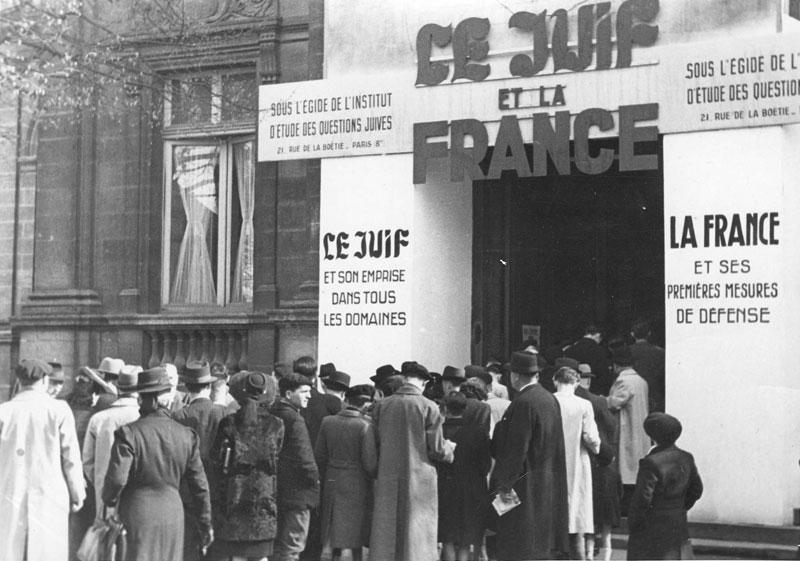
Bordeaux, 1942: the entrance to the anti-Semitic exhibition “The Jews and France”.
 
The Germans themselves say that in one tank battle they were attacked by a large fleet of French tanks after they had themselves run out of ammunition. The German commander ordered a retreat. After the German tanks had retired some distance to the rear, with the French following them only very cautiously, the Germans received orders to turn about and simulate an attack, firing automatic pistols or anything they had out of their tanks, and executing complicated manoeuvres. This they did, and the French, seeing an armada of tanks descend upon them, though these were without ammunition, turned and fled.
 
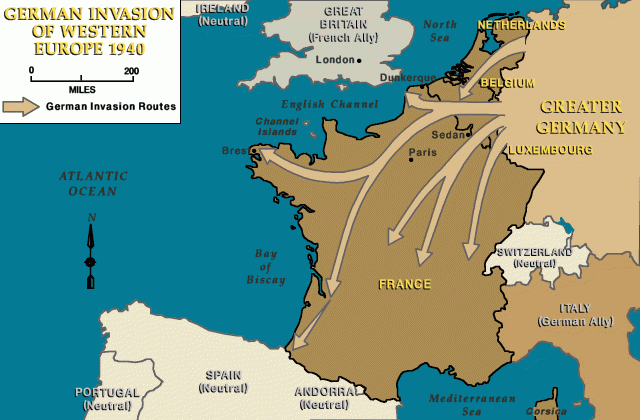
Another mystery: After the Germans broke through the Franco-Belgian border from Maubeuge to Sedan,  
they tell that they continued right on across northern France to the sea hardly firing a shot. When they got to the sea, Boulogne and Calais were defended mostly by the British. The whole French army seemed paralysed, unable to provide the least action, the slightest counter-thrust.
 
On the whole, then, while the French here and here fought valiantly and even stubbornly, their army seems to have been paralysed as soon as the Germans made their first break-through. Then it collapsed, almost without a fight. In the first place the French, as though drugged, had no will to fight, even when their soil was invaded by their most hated enemy. There was a complete collapse of French society and of the French soul. Secondly, there was either treachery or criminal negligence in the High Command and among the  high officers in the field. Among large masses of troops Communist propaganda had won the day. And its message was: 'Don't fight'. Never were the masses so betrayed. 
https://www.yadvashem.org/sites/default/files/styles/main_image_1block/public/01_314.jpg?itok=mQdXU__7
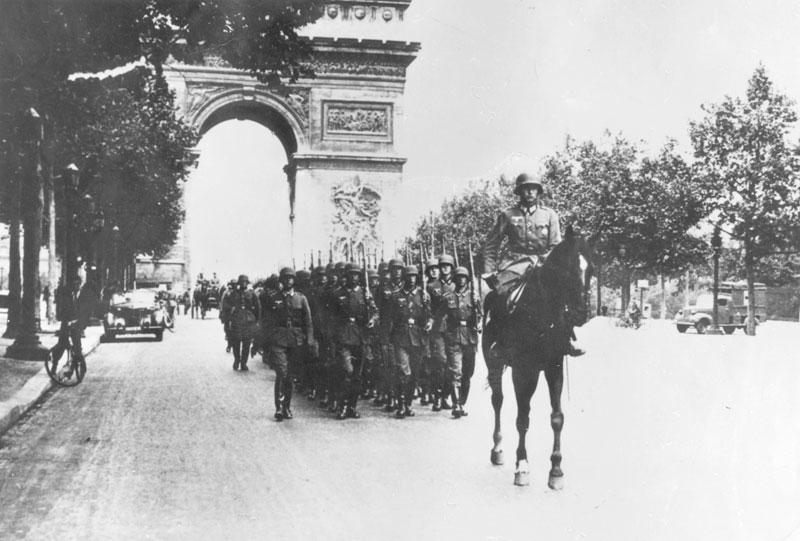
A German military unit, marching down the Champs-Élysées; Paris, 4 July 1940  Yad Vashem
 
July 8, 1940: Tomorrow France, which until a few weeks ago was regarded as the last stronghold of democracy on the Continent, will shed its democracy and join the ranks of the totalitarian states. Laval, whom Hitler has picked to do his dirty work in France -- the notorious Otto Abetz is the main go-between -- will have the French Chamber and Senate meet and vote themselves out of existence, handing over all power to Marshal Petain, behind whom Laval will pull the strings as Hitler's puppet dictator. The Nazis are laughing.
 
July 9: The Nazis are still laughing. Said the organ of the Foreign Office Dienst aus Deutschland, in commenting on Vichy's scrapping the French Parliament today: 'The change of the former regime in France to an authoritarian form of government will not influence in any way the political liquidation of the war. The fact is that Germany does not consider the Franco-German accounts as settled yet. Later they will be settled with historical realism ... not only on the basis of the two decades since Versailles, but they will also take into account much earlier times'.

July 10: Hans came in to see me. He had just driven from Irun, on the Franco-Spanish border, to Berlin. He said he could not get over the looks of Verdun, which he visited yesterday. Not a house there has been scratched, he said. Yet in the World War, when it was never taken, not a house remained standing. There you have the difference between 1914-18 and 1940.
 
William L. Shirer ... The Journal of A foreign Correspondent, 1934-1941 BERLIN DIARY   
 
https://encyclopedia.ushmm.org/images/large/0ce5f028-3213-4f95-a545-efe663fcaa34.gif
Holocaust Encyclopedia


Labels: , ,

Monday, January 26, 2026

American Universities Sliding Rank : Chinese Academia Rising

"There is a big shift coming, a bit of a new world order in global dominance of higher education and research."
"There is a risk of the trend continuing, and potential decline."
"I use the word 'decline' very carefully. It's not as if U.S. schools are getting demonstrably worse, it's just the global competition."
"Other nations are making more rapid progress."
Phil Baty, chief global affairs officer, Times Higher Education
https://insightintoacademia.com/wp-content/uploads/2024/05/lilartsy-xqC7hdLMpgk-unsplash-scaled-e1716387780694-2048x1607.jpg
A global realignment in higher education is underway, according to the Times Higher Education (THE) World University Rankings 2026. The data reveal a shifting balance of academic power: U.S. institutions are slipping, even as leading universities across Asia continue to climb. Insight Into Academia
 
In the early 2000s, global university ranking based on scientific output -- as an example, published journal articles -- was dominated by American universities based on the record that among the top ten rated academic institutions worldwide, seven U.S. schools of higher learning would be on that top list, Harvard rated above all others at number 1. During that same period one Chinese academy, Zhejiang University, would be recognized as among the top 25. 
 
The last quarter century has seen quite the change. Zhejiang University now sits at the number one position, nudging Harvard aside. The list, compiled from the Leiden Rankings from the Centre for Science and Technology Studies at Leiden University in the Netherlands, now places seven other Chinese schools as well among the top ten rather than the American universities that used to occupy the high ratings.  
 
While China has been committing billions in direct support to its universities, at the same time studiously focusing on creating conditions to make them appealing as top-rated academic institutions abroad, attractive to researchers globally, in the United States government funding for American universities has not kept pace. On the other hand, large philanthropic endowments ensure that American universities aren't running short of operating expenses, at the very least.
 
https://static01.nyt.com/images/2026/01/02/multimedia/00nat-harvard-global-02-ghkt/00nat-harvard-global-02-ghkt-superJumbo.jpg?quality=75&auto=webp
 
China has also been proffering visas for science and technology graduates of elite foreign universities to travel to China to study or for business. "China has a boatload of money in higher education that it didn't have 20 years ago", explained Alex Usher, president of Higher Education Strategy Associates, an education consulting company located in Toronto.
 
Harvard, so recently assured the top spot on global university rankings has dropped to number 3. Chinese universities have been steadily ascending in rankings that emphasize volume and quality of research production. U.S. schools dependent on the federal government to fund scientific initiatives now face an administration under President Donald Trump that is far less interested in propping up U.S. universities, a trend that predated his administration, even if not to the slashing method he employs. 
 
It is not that American universities suddenly fail to produce critical scientific papers published in scientific journals. Almost all continue to produce significantly more research at the present time than their output of several decades back. So the issue is not encapsulated as falling production. The six prominent U.S. universities once at the top of the pack -- University of Michigan; University of California, Los Angeles; Johns Hopkins in Maryland; the University of Washington in Seattle; the University of Pennsylvania; and Stanford University in California -- are all producing more research than they had, two decades earlier.
 
https://a57.foxnews.com/static.foxnews.com/foxnews.com/content/uploads/2025/11/720/405/harvard-001.jpg?ve=1&tl=1

Harvard is declining in the rankings of top research universities. (Photo by Aaron M. Sprecher/Getty Images)

The Leiden rankings take into account papers and citations contained in the Web of Science, a database set of academic publications which is operated by Clarivate, a data and analytics company, points out Mark Neijssel, director of services for the Centre for Science and Technology Studies. And, quite simply put, Chinese universities are now out-and-over-producing research papers to place them in the top rankings, as U.S. universities slip behind.
 
A former president of the Massachusetts Institute of Technology, Rafael Reif, stated last year on a podcast that "The number of papers and the quality of the papers coming from China are outstanding", and are "dwarfing what we're doing in the U.S." There is also a distinction to be made on where the research between the two competing nations focus on: China's prominence is in disciplines such a chemistry and environmental sciences, while the United States and Europe are dominant in general biology and medical sciences.
 
https://images.moneycontrol.com/static-mcnews/2026/01/20260116094924_Zhejiang.jpg?impolicy=website&width=770&height=431
Zhejiang University (Courtesy: X | @ZJU_China)


Labels: , , ,

Sunday, January 25, 2026

Culling the Shelves of School Libraries in Ontario

"[The cull began last January when Thames Valley District school board staff trashed thousands of books posing] harm [to students]."
"Many of them were irreplaceable and priceless -- we had an incredible history section, which was ravaged."
"[This was a] book purge [in an inclusive frenzy] but by definition if you choose to be inclusive, you're excluding. That means denying people access to information."
"[The board's move] has the net outcome of censorship."
Larry Farquharson, 58, teacher-librarian, H.B. Beal Secondary school, London, Thames Valley District 
 
"[The] revitalization project aims to revitalize the collections of [Thames Valley] schools to ensure they are culturally responsive, reflect our diverse student population and contain accurate and up-to-date information."
"The project will focus on deselecting texts with harmful images, messaging, slurs, and racial epithets to facilitate the safety and well-being of all students."
Thames Valley School Board document
https://i.cbc.ca/ais/864b1f25-3973-4b43-9078-8c85ac5f5c40,1767996769593/full/max/0/default.jpg?im=Crop%2Crect%3D%280%2C395%2C4032%2C2268%29%3BResize%3D860
Former H.B. Beal Secondary School teacher Larry Farquharson took a photo of some of the thousands of school library books tossed into the recycling last year. The Thames Valley District School Board says the book review was part of an inclusive libraries project. (Submitted by Larry Farquharson)
"[The loss especially of books on Canada's military history can be] notoriously hard to find [for those doing research or reading for pleasure]."
"[It's] a tragedy [if books are thrown out rather than given away]."
"Every year there is a very popular book sale held in Centennial Hall, where book lovers can find books that interest them and these books are not recycled into the trash."
Joe Murray, Canadian military historian 
 
"As a book-lover myself, I was definitely saddened. I can see why it wasn't brought to the trustees' attention if it was regular purging to make room for new books."
"But this amount should have at least been mentioned. I saw the [empty] shelves. It was wild."
Trustee Christian Sachs 
One of 13 elected Thames Valley trustees, Sachs explained that staff informed her they were not given permission to sell or give the discarded books away. They were only to be disposed of in the garbage. The 113-year-old downtown London high school once had an inventory of 18,000 books representing the largest collection in the Thames Valley board, according to teacher-librarian Larry Farquharson who resigned following 25 years of teaching, over the high school's 'book purge'. 
 
The library cull included 128 war history titles, and another 15 from the reference section of the library that were also purged. Books about Shakespeare, other writers and artists, residential schools, teen suicide, addiction, religion, bullying, family violence and child abuse as well as books on sexuality were all purged. Harry Potter novels, Anne of Green Gables, Lord of the Flies, Wuthering Heights, The Kite Runner, I know Why the Caged Bird Sings and The Color Purple were among the many books of fiction that were trashed. 
 
https://smartcdn.gprod.postmedia.digital/lfpress/wp-content/uploads/2026/01/Ldn20251205MH001-copy.LF_.jpg?quality=90&strip=all&w=564&type=webp&sig=NQ6fNRQv4Ua7iu_Jn4cH4g
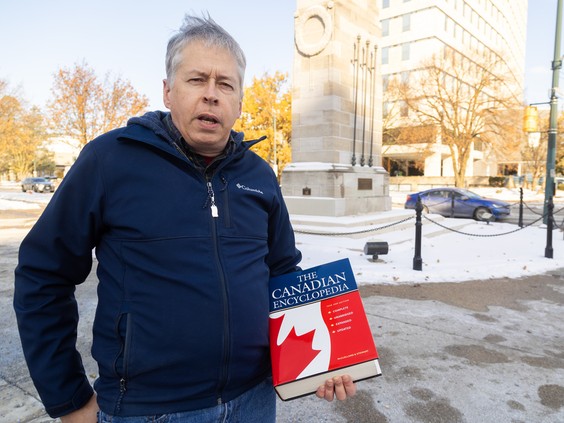
Larry Farquharson, a former teacher-librarian at Beal secondary school in London, says books are being ripped out of libraries to conform and not allow challenges to modern thinking. He is holding a copy of The Canadian Encyclopedia that he says is an example of the type of books being targeted. Photograph taken on Friday, Dec. 5, 2025. (Mike Hensen/The London Free Press)
  
The books at the H.B. Beal school were listed in a spreadsheet that gave their total value at $193,000, but many were irreplaceable. Topics such as the War of 1812, the First and Second World Wars, seven books documenting Canada's contributions during the wars, trench warfare and the Holocaust, and The Diary of a Young Girl by Anne Frank were all disposed of. The Gallant Hussars, a history of London's 1st Hussars Regiment from 1856 to 2004, also  trashed. Books by John Steinbeck, Lucy Maud Montgomery and Kurt Vonnegut, all pulled from the shelves. 
 
Schools in Ontario appear to have been infected with a virus of Critical Race Theory/DEI/Woke disease. Peel District school board based in Mississauga (Toronto) was  highlighted in 2023 through an article by author and retired teacher Marjorie Gann, of spurning books that "didn't conform to today's DEI (diversity equity and inclusion) standards".
 
Tom Ellard, Mississauga parent and spokesperson for a group called Libraries Not Landfills stated he can understand the rationale behind "removing old and outdated texts", but he is concerned that such a process can turn into "an ideological purity test". School boards should "trust the librarians and the professionals to manage their libraries".
 
Larry Farquharson had little option left to him but to reluctantly resign from his profession after having been placed on home assignment by the school board for his public resistance against the assault on world literature, depriving a younger generation of the opportunity to inform themselves about the world as it was and as it is. He had been punished with suspension for seven days for insubordination and "disparaging remarks" about the school board. 
 
https://i.cbc.ca/ais/d55e723f-956a-4e39-8a23-0c1ad31b65dd,1767995423270/full/max/0/default.jpg?im=Crop%2Crect%3D%280%2C0%2C4032%2C2401%29%3BResize%3D796
More than 10,000 books were weeded at H.B. Beal Secondary School's library between January and March 2025. (Submitted by Larry Farquharson)
"[Trustees were not informed that 10,000 books were tossed from the library shelves at London's H.B. Beal secondary school because the move was deemed] operational. [Trustees are] governance, not operational."
"Looking at our libraries and making sure we have  up-to-date books is always good, making sure we have books kids want to read."
"I don't know enough about why they culled these books, but I was looking at [the titles] -- Harry Potter, Lord of the Flies. I wonder why those were removed."
Lori-Ann Pizzolato, former chair, Thomas Valley District school board 
 

Labels: , , , , , ,

Saturday, January 24, 2026

Gene Editing: Optimists and Skeptics

"We're excited by the possibility that you could develop a single editing agent into a drug that may help many different types of patients, circumventing the need to invest multiple years and millions of dollars to develop each new genetic medicine for each individual."
"We are purposefully forgoing what is the most obvious way to treat a patient -- fix  their individual mutation back to the normal sequence."
"[The vast majority of people with genetic diseases] suffer from diseases too rare for companies to be able to recoup the costs of drug development." 
"We hope this research will eventually pave the way for a clinical trial of PERT, and will inspire other broadly applicable, disease-agnostic gene-editing strategies. If you don’t have to target one mutation at a time, the size of the patient groups that could be treated with a single drug becomes much, much larger."
"We hope the result will be many more patients that benefit, as well as greater incentives to develop gene-editing drugs for rare diseases."
David R. Liu, biologist, Broad Institute/Harvard University 
KJ in the hospital
KJ was only days old when he was diagnosed with a rare metabolic disorder and transferred to Children's Hospital of Philadelphia where doctors were actively researching new cell and gene therapies.
 
Gene-editing therapies for the treatment of rare diseases hold out great hope for the future, while facing some roadblocks comprised of time and resources committed to devise treatments that may be relevant to only a limited number of patients. A recently published study in the journal Nature sees a new approach outlined that has the potential to make the process more efficient and less costly, comprised of a gene-editing strategy that could over time be standardized for various rare diseases rather than personalized edits for each one.
 
Over 7,000 rare genetic diseases have been defined, affecting fewer than 200,000 people, in the United States alone. These are diseases that afflict some 400 million people globally. The focus on the study was on 'nonsense mutations' which have the effect of truncating proteins, similar to a sentence halted in its midst by a period inserted where it should not be. These erratic, out-of-place 'stop signs' are labelled as premature stop codons. Their effect is to stop truncated proteins operating as they should, causing or contributing to a number of rare genetic diseases.
 
A molecule identified as a suppressor tRNA which can insert an amino acid at the stop codon position allowing the cell to read through the area on the gene where it would have paused to produce the full protein was the key to the study. The research team engineered an optimal suppressor tRNA following exhaustive testing. With the use of a genetic search-and-replace method Dr. Liu's lab invented called prime editing, it was inserted into a cell's genome replacing an existing tRNA that had not served any purpose.
 
UdeMnouvelles, Universite de Montreal
 
The method was tested in human cell models of  four diseases -- Batten disease, Tay-Sachs disease, cystic fibrosis and Niemann-Pick disease type C1 -- as well as in a mouse engineered with another human disease, Hurler syndrome. Enough of the relevant protein's function in each case was restored to encourage the expectation that the change would alleviate symptoms of the diseases. The method did not create genetic or biological missteps, the team reported encouragingly. 
 
Dr. Liu explained there is variation within diseases. As a result ,truncated proteins are not the cause for every patient, though the out-of-place stop signs can lead to 30 percent of genetic diseases. The new method, he estimates, could apply to ten to 15 percent of patients with Duchenne muscular dystrophy or cystic fibrosis. The method, estimates Dr. Liu's team, might be of value to 252,000 people with Stargardt disease and 31,000 people with phenyelketonuria.
 
Funded by the U.S. National Institutes of Health and academic institutions, the study was spurred by a 'bottleneck' in the drive to make gene editing more available to desperate patients. Increased scientific capacity to fix disease-causing mutations aside, the very issue of the diseases' rarity among populations means the pharmaceutical producers would be expending great amounts of time and research to produce specific drugs, yet could only anticipate a limited distribution, making them unable to recoup the steep costs of production.  
"In some cases, the bottlenecks in genetic medicine aren’t the science anymore. They’re in meeting regulatory requirements, in the manufacturing costs associated with these treatments, and in the commercial challenges of drugs that treat very small numbers of patients."
"Witnessing gene-editing companies make the gut-wrenching decisions of which targets to pursue — synonymous with the gut-wrenching decisions of which patients are left behind — made it clear that we need creative scientific ways to help address some of these problems."
Dr. David R. Liu, Broad Institute  
Dr. Liu spoke from personal experience, having co-founded gene-editing companies that faced the situation of ebbing funds making it difficult to enable clinical trials treating a limited number of patients. Efforts in the creation of drugs based on suppressor tRNAs face challenges; among them that patients would require repeated dosages indefinitely at the risk of toxic effects over time. 
 
A graphic displaying an oval containing a DNA double helix with several base pairs highlighted, connected to four icons representing patients.
Credit: Agnieszka Grosso, Broad Communications
PERT, the reprogramming of cells by a process of a single prime editing system could potentially treat multiple genetic diseases. Dr. Liu's method would result in a one-time edit, producing no toxicity nor errors in other proteins. His study was not universally acclaimed, however. Several experts in gene-editing cautioned considerable further testing and other steps must be considered before the new approach could represent a trusted protocol to meet patients' medical needs. 
 
"[While the new approach is years away from potential use, it might ultimately apply to] a significant fraction [of those patients; conservatively about ten percent]."
"How do you deliver this to all cells in the body that would need to be corrected to prevent the worse outcomes from the disease?" 
Dr. Richard P. Lifton, president, Rockefeller University, head, laboratory of human genetics and genomics

Labels: , , ,

Friday, January 23, 2026

Female Indigenous Victims of Male Violence

"[The IJB's findings reflect] important systemic problems [that impact the outcomes of cases involving female Indigenous victims]."
"If police don't see the life [of Indigenous girls and women] as being as important ... how does that affect how they collect the evidence that goes before the prosecutor? Or a prosecutor says, 'I'll take a guilty plea to manslaughter so we don't have to clog up the courts with three months' or two months' worth of  trial time."
"We Indigenous women, for the most part, live in the margins -- in the shadows. Our lives just simply aren't as valuable as other people's lives."
Lawyer Marion Buller, former judge, elder, Mistawasis Nehiyawak First Nation
https://amnesty.ca/wp-content/uploads/2023/09/stolensisters-banner_2-1.jpg 
 
According to the Investigative Journalism Bureau [out of University of Toronto],  Indigenous women and girls are killed far more frequently than other women in Canada by their intimate partners, perpetrators of murder, yet they are all too frequently convicted of lesser offences than murderers of non-Indigenous women. In their research the IJB concluded that in virtually all instances of the deaths of Indigenous women, the victim was familiar with her killer. 
 
There were 1,329 identified cases where women and girls died under suspicious circumstances in Canada between the years 2019 and 2025. Of that total, 25 percent -- 340 victims -- were Indigenous. Of those, 46 percent concluded in court with a finding of manslaughter (lack of intent to kill); the most common outcome in Indigenous female homicides. The single most common outcome in the deaths of Indigenous females is deemed to be manslaughter with its lesser criminal penalties.
 
https://i0.wp.com/ijb.utoronto.ca/wp-content/uploads/2026/01/By-the-numbers-23-01-2026-09-57-10.png?w=1080&ssl=1
On the other hand, of the 384 court cases involving non-Indigenous victims 24 percent concluded with a verdict of manslaughter. Second-degree murder, the outcome in 137 or 36% of cases was the most common conclusion which carries a minimum sentence of ten years, while manslaughter comes with no minimum sentence in the absence of a firearm. 
 
"When you look systemically ... lives and their health and their safety are not valued as highly. It is something that should cause further inquiry", noted Michael Spratt, Ottawa criminal defence lawyer. Several unusual characteristics were revealed by the IJB analysis in the manner in which the Canadian justice system manages meting out justice in cases of Indigenous female deaths. First-degree murder which carries a mandatory life-sentence represents the most serious charge in the country's justice system. 
 
Yet a mere 25 percent of the accused in the deaths of Indigenous women and girls were charged with first-degree murder. In contrast, first-degree murder charges were laid in instances of non-Indigenous female victims, at the rate of 37 percent. Further, 64 percent of cases in the killing of an Indigenous woman conclude with a plea bargain, in comparison to 57 percent of non-Indigenous victims.
 
A plea bargain results in 64 percent of cases when an Indigenous woman is killed, in comparison to 57 percent with a non-Indigenous victim. Reasons? The Indigenous community is over-represented in the Canadian justice system, far exceeding their share of the population, both as victims and as perpetrators, affirms Statistics Canada. This over-representation has led to the justice system creating a special category for Indigenous offenders, one that takes into account their status as Indigenous people who have suffered discrimination, poverty, disproportionate lack of schooling and troubled childhoods. 
 
A Jordan principle is applied that takes all these issues into account, citing as well the circumstances of Residential Schools in operation for a century, where children were separated from their families to be taught a curriculum that deliberately sought to introduce students to the Western European way of life, muting their Indigenous roots, culture and language in favour of the children adapting to general life in Canada. Out of these schools came students who could aspire to higher education and life in the professions. At a cost of root self-identification.
 
The courts and the entire criminal justice system adjusted to treating Indigenous offenders more lightly than criminal cases involving non-Indigenous, and that extended to cases of  serious criminal offences like murder. "[Perpetrators] know they're not going to get anything (punishment for ill deeds). And the reason is that the justice institution has failed us", states Ann Maje Raider, executive director, Liard Aboriginal Women's Society, Yukon, responding to a perception of greater leniency around the deaths of Indigenous women exacerbating the problem.
 
IJB's database illustrates that almost all -- some 97 percent -- of female Indigenous victims were killed by someone they knew. Although the figure is 90 percent for non-Indigenous victims, their killers are treated to a harsher, more appropriate penalty for their crimes. Available histories of accused in Indigenous crimes revealed that 94 percent were red flagged for previous arrests and convictions, contact with child services or significant mental health problems.
 
Remote areas such as reserves see restraining orders ineffective in maintaining a separation between victim and perpetrator. As a result, Indigenous women and girls face unusual and difficult challenges to self-protection from violence. Access to resources and shelters is limited or non-existent. The risk of community response when women and girls speak up about their fears and the violent abuse they are exposed to risks alienation from a disapproving community.
 
Indigenous women speak up, complaining about their vulnerability and faulting a justice system that too often fails them. They can carry signs that read "Where Are My Sisters", as they did in 2023, during the International Day of Action Search the Landfills for missing and murdered Indigenous women, but there are no organized protests by these women placing the blame on their 'Brothers' from within the Aboriginal community who prey on them, nor do they campaign for the responsibility of their communities to protect them.
 
https://amnesty.ca/wp-content/uploads/2023/08/cambra-harris-1-edited.png
Summer 2023: Winnipeg’s Cambria Harris addresses a rally calling for the Manitoba government to walk back its refusal to search two local landfills for the remains of her mother, Morgan Harris, and two other Indigenous women allegedly murdered by a serial killer. (Photo credit: Melissa Robinson)
  

Labels: , , , ,

Thursday, January 22, 2026

Canadian Immigration, Population Growth

"Immigration is really fuelling not just population growth, but also the economy, because immigrants are generally younger than the average Canadian. The average Canadian now is  41, and immigrants tend to be younger."
"Now, because the religious composition of immigrants is so different from the religious composition of native-born people, we're seeing really fast increases in the Muslim community, in the Sikh community and the Hindu community, and this has really big implications for everything."
"I think that's part of the story about how immigration is changing Canada and Canadian families."
"This is the first time that I feel like all of Canada's problems aren't economic problems. They're actually demographic problems."
"When more money goes to support older people, we have less money for things that go to younger people. Like our daycare programs, our primary schools, our secondary schools, our labour force training programs, our universities, etc." 
Demographer and sociologist Rachel Margolis, Professor, Western University
 
"Canada has always been a country of diversity. We've always been a country with multiple nations, multiple languages, multiple ethnicities, multiple sources of newcomers."
"I don't think it's a matter of saying, 'Who is Canada?' It's some kind of plural version of the question: Who are Canadians?"
"I'm very interested in the 2026 census, whether we see a bigger share of newcomers, not only from India, but also from some of the African countries, such as Nigeria, Ghana or Tanzania, that also have highly educated populations and would be viable economic migrants."
"In Canada, religion has become an important variable that's at the centre of a lot of debates. So, if you look at, for example, some of the secularization legislation in Quebec, it's front and centre to public debates there."
"When we look at some of the discrimination that's been experienced over the last five years [or] post-October 7, as well as longer than that, 9/11, we see that religion becomes quite important and it often intersects with newcomers from different parts of the world." 
Political sociologist Howard Ramos, Professor,Western University 
https://smartcdn.gprod.postmedia.digital/nationalpost/wp-content/uploads/2026/01/Canada-census-demographics-faith-immigration-main-NU.jpg?quality=90&strip=all&w=1200&h=675&type=webp&sig=x4hugRS7t53iMBKobCUzeg
Older, 70% white, plunging fertility and lost faith: Who Canada is now, National Post
 
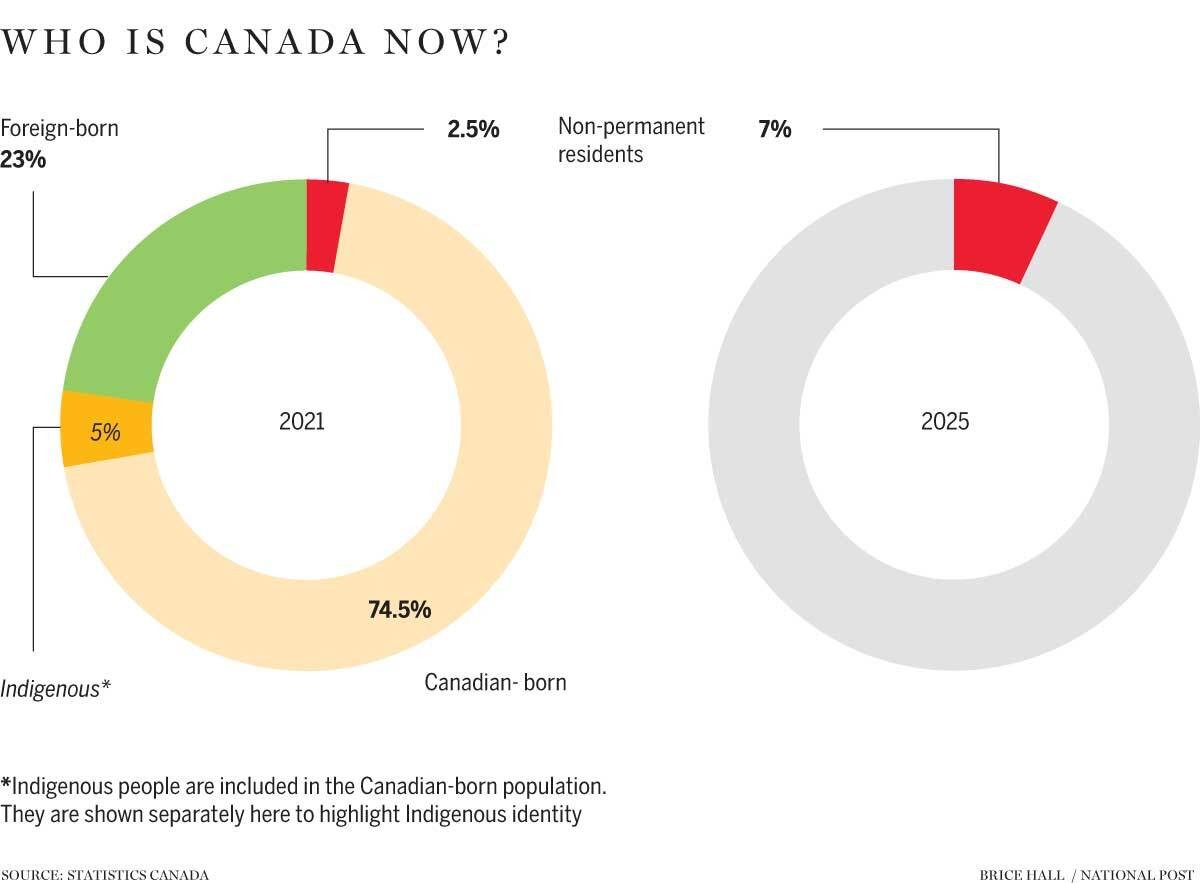
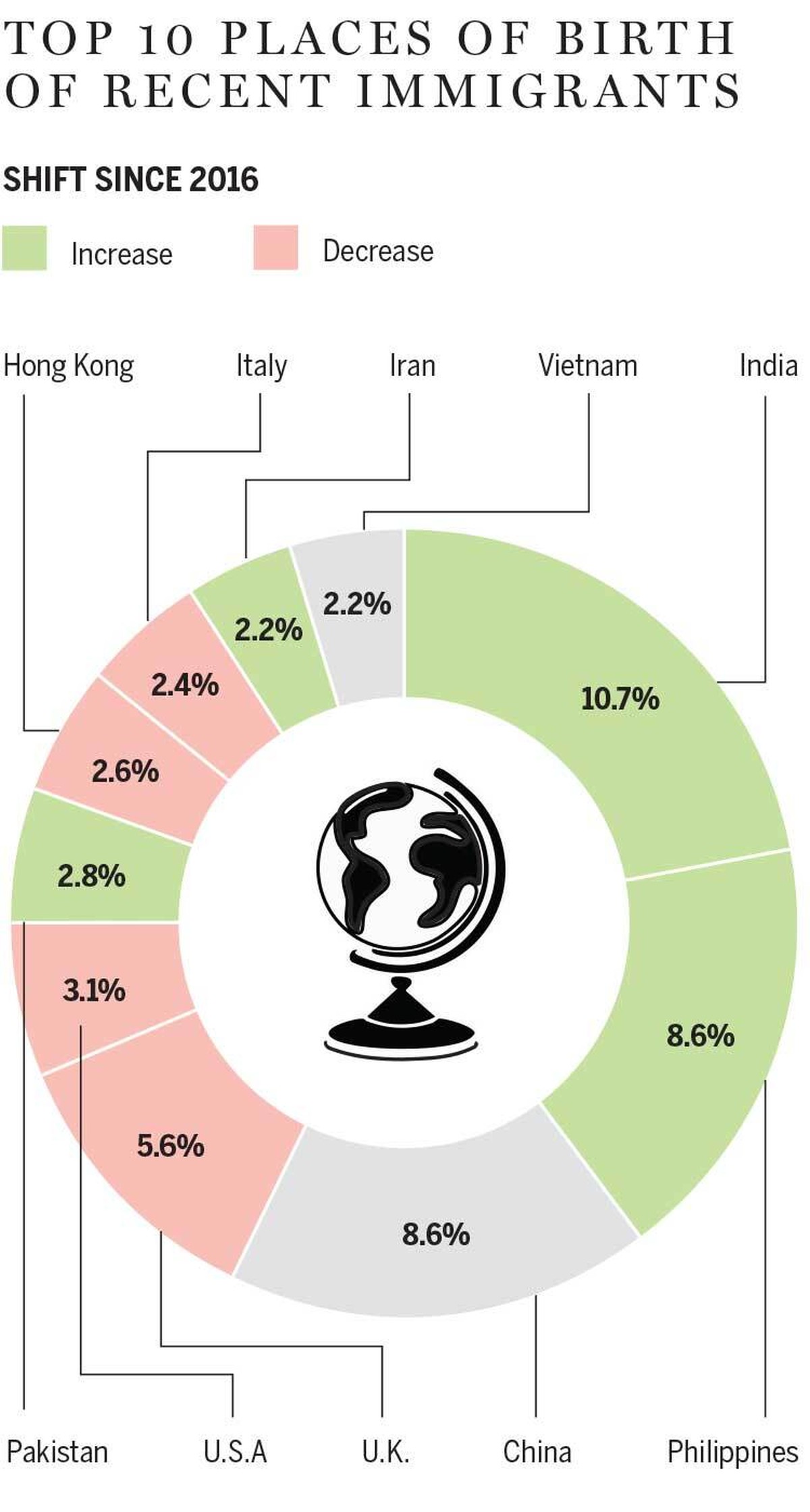
Canadian population growth is driven by immigration with close to one-quarter of the population being or having been a landed immigrant or permanent resident. This represents the highest intake of immigrants among the G7, as well as representing the largest share of immigrant intake since Confederation. Canada's 8.4 million immigrants are comprised thusly: India (10.7 percent), the Philippines (8.6 percent) and China (8.6 percent) as the top origins of birth. Immigration from Europe has declined in the last half-century (going from 61.6 percent in 1971 to 10.1 percent in 2021). 
 
New immigrants from Asia, on the other hand, inclusive of the Middle East has increased, with Asia now the leading continent of birth for new immigrants (62 percent), and India the top country of new immigrants; close to one in five (18.6 percent) having originated from India recently. India represents the lion's share of the 1.4 million South Asian immigrants, followed by Pakistan, Sri Lanka and Bangladesh. Of one million immigrants from South-east Asia, the Philippines is first, Vietnam following, then Malaysia, Cambodia and Thailand the top countries of origin.
 https://smartcdn.gprod.postmedia.digital/nationalpost/wp-content/uploads/2026/01/na0107-whoIsCanadaNow-07-BH-W.jpg?location=full_width&quality=90&strip=all&w=1200&type=webp&sig=bCFrqnX2na2za67br0rW5g
749,415 immigrants born in West Central Asia and the Middle East headed by Iran, followed by Syria, Lebanon, Iraq and Afghanistan, in that order as the top five countries of origin. Statistics Canada has recently released its latest report on the country's population and how it has been comprised with the immigration of global migrants. Canada now has 450-plus ethnic or cultural origins reporting for the latest census with the fastest population growth n the G7. What the statistics reveal is the shift in countries of origin with close to two-thirds of recent immigrants born in Asia, including the Middle East.
 
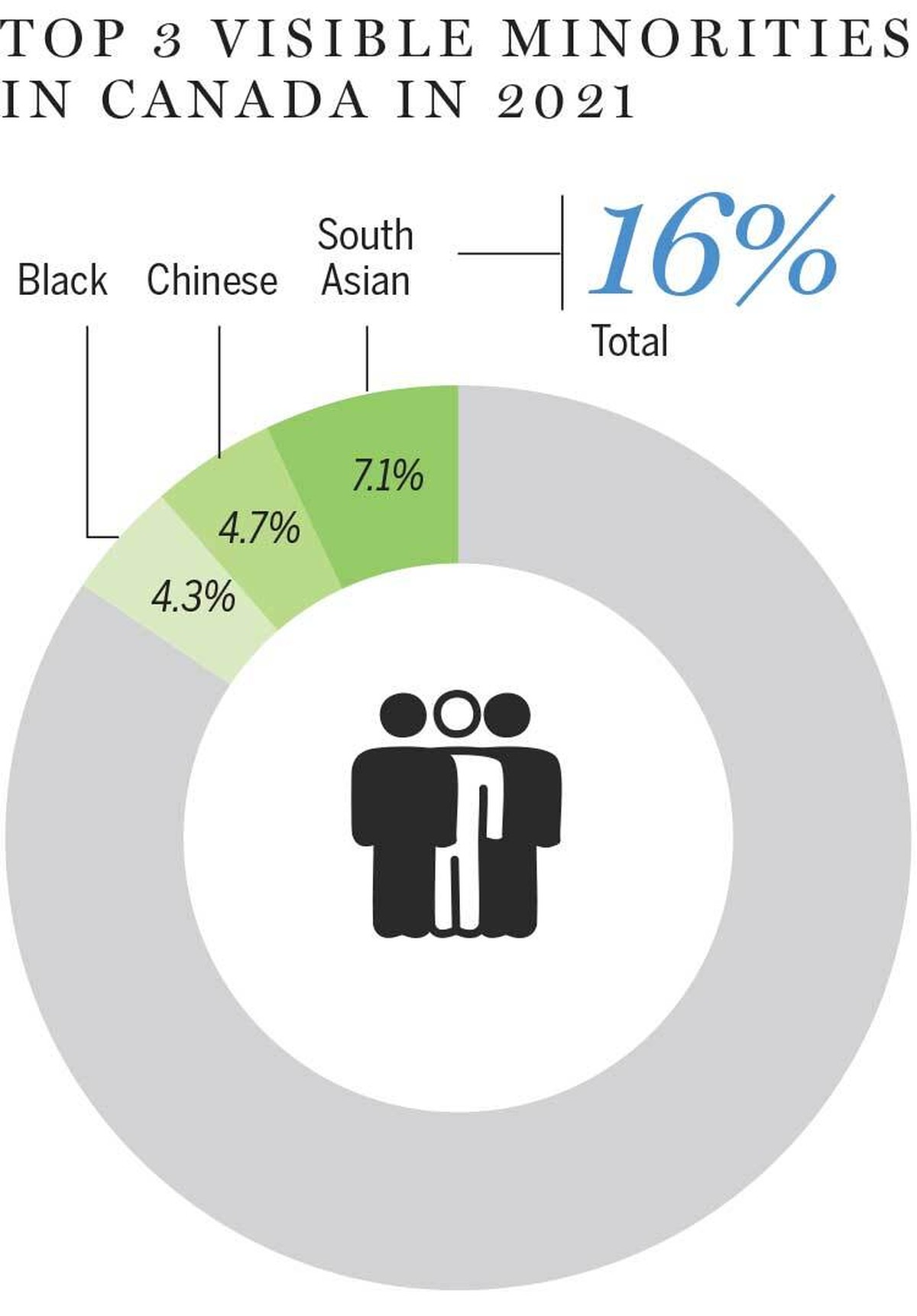
Over 95 percent of visible minorities domiciled in one of Canada's 41 large urban centres, with Toronto home to the largest populations of those of South Asian, Chinese, Black, Filipino, West Asian Latin American, South-east Asian and Korean derivation. The country's largest share of its new Arab population, at 35.5 percent of the group, settled in Montreal. There has been an eight percent increase in people identifying as First Nations, Inuit of Metis between 2015 and 2021, in comparison with 5.4 percent growth for the non-Indigenous population. 
 
https://smartcdn.gprod.postmedia.digital/nationalpost/wp-content/uploads/2026/01/np-chart-visibleMinorities.jpg?location=column&quality=90&strip=all&w=1200&type=webp&sig=cZobckHc7knunIGdp-HVag
Against a backdrop of Canadians losing interest in religious devotion, doubling in the last 20 years, most Canadians who are religious reported they are Christian; the numbers shrinking from 77.1 percent in 2001. Those identifying as Muslim (Islam being the second-most reported religion), Hindu or Sikh more than doubled in the past two decades. There has been a steady growth in numbers of Canada's aging population, the result now being that there are more Canadian seniors 65-plus (8.2 million), than there are Canadian children 14 and under (6.3 million). 
 
More than two in five (42.3 percent) of newborns in 2024 were of a foreign-born mother, according to a 2025 Statistics Canada study which pointed out that without immigration, Canada would have had negative population growth since 2022. In the most recent Canadian census over 450 ethnic and cultural origins were reported, 200 places of birth, 100 religions , and 450 languages. The country, once 97 percent Protestant and Catholic, has changed enormously.
 
In the last census about 335,000 people reported being ethnically Jewish, a smaller share of the population, as a result of population growth through immigration; their share in 2001 was 2.2 percent of the population, while in the two decades since it was reduced to 0.9 percent. The second-most common religion after Christianity -- one in 29 people reported being Muslim, at close to 1.8 million. Muslims rose from 2.0 to 4.9 percent of the population since 2001.  
"There's been a really big decline [in the fertility rate with a record low of 1.25 births per woman in 2024, as compared to a century earlier when Canadians on average had just over three children] just in the last 15 to 18 years."
"And the reason why that's important is that it took us from kind of low fertility to very, very low fertility. And the problem with very, very low fertility is that without large immigration, it leads to pretty rapid population decline and pretty rapid population aging, which changes the needs of where we put resources."
"[There's more freedom in how people choose to see their lives. Younger generations, they say they want few kids... They say it's less important for them to get married than it used to be. And I think that younger people feel more uncertain about what their path is."
Professor of sociology, Western University, Rachel Margolis  
https://smartcdn.gprod.postmedia.digital/nationalpost/wp-content/uploads/2026/01/np-chart-top10mmigration.jpg?location=half_width_right&quality=90&strip=all&w=1200&type=webp&sig=DXfitq7E6DYggpePMxYicw

The downside of this steady surge in population growth can be seen in Canada's universal health care system, hard pressed to provide timely and reliable health care to a growing population, with insufficient numbers of medical personnel, hospitals stressed to their coping limits and millions within the population without a primary health care provider. So too has the housing market been impacted; not enough houses and rentals to meet the demand, with rising prices for accommodation making it more difficult for young people to strike out on their own.

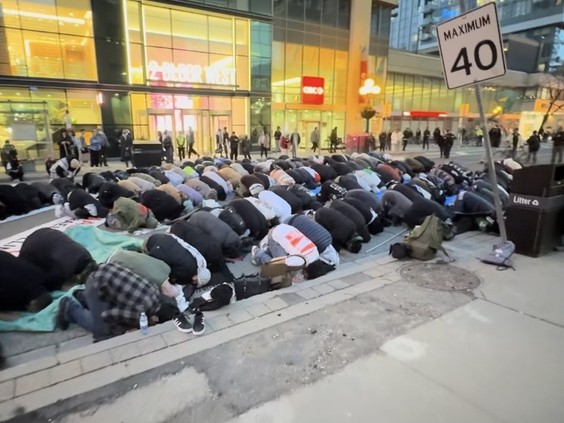
From within the large and still growing Muslim population a phenomenon of public protests against Israel and Jews has arisen, leading to an acute rise in antisemitism. Authorities at every level, while decrying rampant antisemitism have done little to uphold the law when 'pro-Palestinian' groups harass Canadian Jews, threaten their communities and vandalize Jewish businesses, synagogues and parochial schools. Mass Muslim public prayer sessions that block traffic and intersections have assaulted the Canadian social contract. 

https://smartcdn.gprod.postmedia.digital/torontosun/wp-content/uploads/2025/03/TS2025319JB059.TS_-e1742424265860.jpg?quality=90&strip=all&w=564&h=423&type=webp&sig=JPuu2XQoopNZ8S6AhQYu6w

The incidences of crime, youth crime, gun violence, car thefts, home break-ins has also increased, in part due to the formation of criminal gangs from within immigrant groups. The cost of living in Canada has also soared, making it difficult for many families to make ends meet. The use of Food Banks has increased exponentially, by foreign students, by economically stressed immigrant families, along with native-born in a depressed economy. Shelter use and homelessness has also been impacted by migrant groups arriving in Canada, awaiting the disposition of their claims for haven as refugees. 


Labels: , , , , ,

 
()() Follow @rheytah Tweet