Ruminations

Blog dedicated primarily to randomly selected news items; comments reflecting personal perceptions

Sunday, June 24, 2018

Vision Zero

"In every situation a person might fail, the road system should not."
"Every crash with serious injuries or fatalities is something you need to carefully look at and say what was wrong here, what should I have done, not the citizen -- what should I have done as a professional and responsible person in the system?"
Claus Tingvall, director of traffic safety, Swedish National Road Administration
module_small
Vision Zero Traffic Safety by Sweden The Vision Zero is the Swedish approach to road safety thinking. It can be summarized in one sentence: No loss of life is acceptable. The Vision Zero approach has proven highly successful. It is based on the simple fact that we are human and make mistakes. The road system needs to keep us moving. But it must also be designed to protect us at every turn.

"We were quite surprised to see that separated bike lanes made such a big difference."
"For a driver, there are so many more vehicles and the catastrophe for a driver is being hit by a moving vehicle."
"So what are they looking for when they're turning right or left? They're looking for other vehicles."
"And look but fail to see is the classic problem."
Kay Teschke, professor emeritus, School of Population and Public Health, University of British Columbia, Vancouver


Traffic-caused deaths have been close to halved in Sweden, the country with one of the lowest rates of road deaths among developed countries. Sweden's traffic-related deaths are 2.7 per 100,000 people. New Zealand and the United States' statistics are both 10.3 per 100,000, according to 2015 statistics from the Centres for Disease Control. Third highest among ten high-income countries is Canada, with 5.4 deaths per 100,000. Nothing is static; things go up or they go down. In Sweden traffic deaths have markedly descended, in Canada they have increased.

In 1997, Sweden initiated a life-saving enterprise they named Vision Zero, with the intention of bringing traffic deaths down, and finally eliminating them altogether; a vision perhaps impossible in its final intention, but on the other hand, quite possible in its early aspiration. According to the drive behind the Swedish initiative, there is no acceptable number relating to loss of life through traffic accidents. And so, Sweden's enterprising initiative bore fruit from the tree of its intention.

And now other countries are looking to repeat Sweden's ongoing success, emulating and repeating what they saw being done in Sweden. More roundabouts are being built in Swedish cities to replace intersections, with the intention of reducing the risk of head-on crashes. Vehicles may not turn at intersections when pedestrians and/or cyclists are in the process of crossing. Pedestrian bridges are being built. There are separate lanes for bicycles. Drinking and driving has elicited an appropriately sterner crackdown by police.

In Toronto, the Vision Zero policy was adopted along with a five-year action plan for implementation, with the goal being the reduction of traffic-related serious injuries and fatalities with an eye to six vital areas; pedestrians, schoolchildren, older adults, cyclists, motorcyclists, aggressive driving and distraction. A selection very obviously comprised of the most vulnerable to come to harm through vehicle-derived accidents. Despite which, traffic accident deaths continue to increase in Toronto.

Toronto has been tardy in adopting all of the improvements listed in their own Vision Zero targets, still awaiting implementation. According to a study of bicycling in Toronto and Vancouver undertaken in 2012, cyclists using special bicycle-specific cycle tracks risk one-ninth the serious injuries leading to hospitalization, in comparison to a cyclist using a major street absent bicycling infrastructure.

To date, approximately one thousand cities in the United States and throughout Europe have reached their goal in achieving Vision Zero, with no traffic-related fatalities in a year's time, a long-sought record that they have every intention of maintaining through diligent effort, appropriate infrastructure and social engineering through education.

rallyImpromptu Ottawa City Hall rally hours after the death of cyclist Nusrat Jahan on 2 Sept 2016, where Coun. Catherine McKenney calls for Vision Zero. Photo: 1310 News

Labels: ,

Sunday, May 13, 2018

Driving While Under the Influence of Distractions

"There's an increasing public safety issue of operators of vehicles who are distracted while driving."
"It's analogous [to a bar owner or party host taking responsibility for an intoxicated client/guest] --you're putting someone in a position [dialing someone on their cellphone if you know they're driving] where they could cause harm to themselves or [to] a third party."
"I think it's a [consequence] unfortunately of living in a highly connected world where, if someone doesn't respond immediately to an email or a text, your concern is they are ignoring you."
Jordan Solway, lawyer, vice-president, claims, Travelers Canada
1. Losing focus or being lost in thought
2. Cell phone use - talking, texting, dialing
3. Objects, events or people outside the vehicle
4. Passengers
5. Reaching for things – such as a GPS
6. Eating or drinking
7. Adjusting the radio or climate controls
8. Using vehicle controls – adjusting mirrors, seats, using navigation system
9. Moving objects - pets
10. Smoking-related distractions  
ThinkInsure Logo, Ontario Insurance Broker 
"The aspect of determining liability or fault in cases like that would rest with the courts."
"It has to be a whole host of instances in terms of not just the act of texting, but also the act of reading the text or responding or having that phone in your hand."
"It's a concern that we share as an industry because that will impact [insurance] premiums."
Pete Karageorgos, spokesperson, Insurance Bureau of Canada 
Texting and driving will be illegal in Texas as of Sept. 1.
Five seconds is the average time your eyes are off the road while texting. At 55 mph, that's enough time to cover the length of a football field. McClatchy

Read more here: http://www.star-telegram.com/news/politics-government/state-politics/article170457212.html#storylink=cpy
     
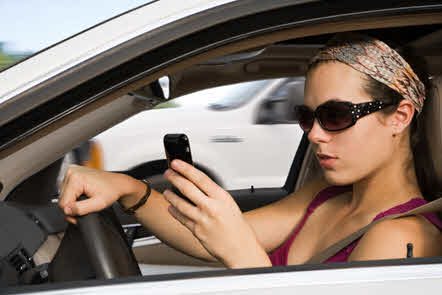
Concerns over drivers' wandering minds and hands have led to laws weighted by fines and demerit points making it unlawful for people to text while driving, much less use a cellphone at all in many jurisdictions. Some permit hands-free use of cellphones but the distraction element is still present regardless. Now something new has been added to concerns about cellphones and their interfering quality while driving. Driving while distracted, despite laws and penalties continues as people still mire their minds in cellphone conversations, oral or text.

Accidents will and do occur. And now a new element is being recognized, one that points a finger of responsibility at anyone knowingly dialing a cellphone in the knowledge that its owner/user will be in their vehicle and driving to a destination. Peoples' impulses are to immediately respond; it has become second-nature to the current generations of cellphone users to 'pick-up' as though each and every call has an urgent component to it.

Leading insurance and legal experts to express their concern over liability when harm ensues. Texters, they point out, could in future be held liable should they message a person whom they know is driving and in the course of events that follow, an accident occurs. A 2013 New Jersey court ruled that a text sender causing a driver to become distracted and have an accident, may be held liable for their part in the incident; the initiator of it, in fact.

In the case that stirred the court to action, an 18-year-old was driving a vehicle when his girlfriend texted him some 25 seconds before his pickup truck crossed a median. A motorcyclist and his wife came out of the ensuing collision seriously injured; both lost their left legs in the 2009 accident. Losing eye contact with the road ahead, pausing however briefly to focus on a text message instead has the potential to swiftly invite catastrophe.
Tips To Avoid Being A Distracted Driver
According to Jordan Solway, an insurance legal expert, it's just a matter of time before such incidents occur more frequently, though Canada has not  yet experienced a similar accident. A recent online survey to study the matter of distracted drivers focusing on texts was commissioned by Travelers Canada. Thirty-one percent of those questioned responded that family obligations require their constant attention.

Divided by gender, 40 percent of women reasoned concern over family matters led them to immediately respond to their cellphones when driving, while for males the same concerns reflected the responses of 23 percent of those questioned. There were even provincial differences, where in Quebec 23 percent cited family obligations whereas in Ontario the figure rose to 41 percent.

But there were other reasons as well, with 27 percent stating they had no wish to miss important issues that might be conveyed via a cellphone message, while another 14 percent explained it is their wish to always be available for professional purposes. Finally, 8 percent claimed they were fearful of upsetting their employer should they decide not to answer while driving.

According to the Insurance Bureau of Canada's Karageorgos, some insurers are coming across more frequent instances of rear-end collisions, typical of drivers being distracted by their cellphones and briefly losing awareness of their driving responsibilities.

Distracted driving laws and statistics in Ontario
ThinkInsure Logo, Ontario Insurance Broker


Labels: , ,

Tuesday, June 13, 2017

The Strangeness of Fate

"I'm still trying to convince myself it's a dream. They were both gone on the same day. I thought, my God, it couldn't be real, it couldn't be. But at least they're both together now."
"Koorosh was so attached to his dad after Maryam passed. It's going to be hard, very hard for him. We just hope that he will be strong through these hard days."
"It's not easy when you immigrate here and you don't have anybody. You come with a big hope for your life, for yourself and your kid, and to end up being like this is a tragedy."
Gina Masnadi, Calgary
Maryam Rashidi and her son Koorosh, 6
Maryam Rashidi and her six-year-old son Koorosh are seen in this family photo. (Submitted by the family)

In Calgary two years ago, two young thugs decided they would fill the vehicle they were driving at a gas station, and just casually drive off. The attendant at the station, Maryam Rashidi, took her employment seriously. Perhaps too seriously. So seriously that it cost her her life. It's doubtful that her employer, any employer for that matter, would want someone to endanger themselves as she did by running after the vehicle, in an effort to stop the driver and passenger, and remind them that they hadn't paid for the gas that was enabling them to drive off.
"'Go, go, go, go, there's somebody following us,' so I hammer the gas,. He [his passenger] told me some bitch was chasing us down."
"I kept reversing to go around and she kept f--king jumping in front of the car,  I told her to move."
"We tried for option two [driving off; option one was spraying the woman with bear spray as a deterrent] because we didn't want to hurt anybody."
"We were going 160 [km/h] down the road. That thing can go 250 K. This guy [the rightful owner of the truck they stole] put money into that truck ... over 100 grand."
"I could rock that truck forever ... it turned on a dime going 160."
Joshua Mitchell, 22, Calgary thief, guilty of manslaughter
Maryam Rashidi and her husband Ahmad Shallo had engineering degrees when they emigrated from Iran to Canada three years ago. They both found employment in Calgary, but both lost their jobs shortly after arriving and working for several months. So Maryam took a job as a gas station attendant. She hadn't been very long in her new job when her path in life intersected with that of a young man who would later be charged with second degree murder in her death.

Days earlier the young man had stolen a charged-up truck and was driving it around, a friend beside him when he gassed it up at the service station where Maryam worked.

The powerful truck, one with a take-off speed and handling that quite impressed the two young men, had taken $133 of fuel, when they drove off without paying. Maryam Rashidi was outraged and she pursued the truck and its driver. Who had debated with his passenger whether they should rid themselves of the woman chasing them by spraying bear spray at her, or evading her insistence that they pay, by driving off.

The station attendant, just days into her new job, had chased them to a red light which stopped the truck, and was pounding on the driver's window for attention, insisting they pay for the fuel.

The debate between the two young men ended with the choice to simply ignore her and drive off quickly. When they did, the truck smashed into the woman, but they kept driving, while behind them witnesses -- a doctor, a nurse and a firefighter, attempted to save the woman's life. As the truck had pulled away, they saw her foot caught in the wheel well, and the truck running over her as she fell. She later died in hospital.

And the two men hid out at a friend's house for several days. Until police came calling and made the arrest.

The driver who had remorselessly resisted the frantic woman's demands that they do the decent thing and pay for what they had taken, later wrote a letter of apology to Maryam Rashidi's husband Ahmad Shallo, and to their son, Koorosh.

Just a month ago, the case finally went to trial and Joshua Mitchell was found guilty of a lesser charge of manslaughter. He is to be sentenced at a later date, this summer. Maryam's husband, Ahmad, will not be present at the sentencing hearing. If friends like Gina Masnadi, are successful, they will help to bring Maryam's mother over from Iran to visit and to attend the August sentencing.

Ahmad Shallo had moved with his motherless son Koorosh, to British Columbia, to take up residence there. This week he was driving back to Calgary to remember Maryam on the anniversary of her death, to visit her grave. With him was his new wife, and his son, seven-year-old Koorosh. On a highway in British Columbia as they were driving to their destination, they were involved in a collision.

Ahmad Shallo died in that collision, while his new wife was seriously injured. Koorosh, sitting in the back, was uninjured. He is now in the care of family friends, hoping somehow to be able to cope with a child traumatized by being recently doubly orphaned.

Labels: , , ,

Thursday, August 11, 2016

The Anguish of Failure

"When he got there, he could see the steering wheel was up against the man's chest and he was trapped because the front of the cab was demolished."
"He could hear the man screaming in French 'please help me. I don't want to die'. He couldn't see the driver any more because the truck was covered in smoke."
"Carol was in shock. He doesn't want to be treated as a hero, but all of us here at Givesco consider him to be a hero. Carol is so human, he would help anyone he could, even a total stranger. That's the kind of man he is."
"Not being able to open that door just demolished him. Seeing the fire, and knowing it was a petroleum truck, going back to get a crowbar. Not too many people would do that. He stayed there with the truck on fire."
Jean Carriere, general manager, Givesco, St.-Leonard, Quebec
fire
Gilbert Prince died after the truck he was driving, which was transporting diesel, caught fire. (Simon-Marc Charron/Radio-Canada)  

Carol Bujold, a man of courage and conviction. He was also a man in shock, despite which he reacted to a dreadful situation with the thought uppermost of saving a man's life. And right behind that thought was another, that he could himself lose his life as a result of a dramatically threatening situation. Yet he did what he could, attempted to free the driver of a tanker truck carrying diesel fuel from the cab he was trapped in.

"I had to save myself, I have a family, too, so I ran. And before I knew it, the whole truck blew up", Mr. Bujold explained to his boss, after he had been released from hospital. He had tried. Under frightfully difficult circumstances he had done his utmost to save another human being. And it is entirely likely that the sound of the terrified driver's voice begging to be freed from the death-trap he was in will haunt him the rest of his life.

Directly after the accident that had trapped the tanker driver, Mr. Bujold exited his own flat-bed truck which the tanker drive had rear-ended. He ran directly to the truck to see what he could do for the driver despite that the truck was already on fire. He was unable to open the cab doors, they were fast stuck and smoke from the fire was obscuring his vision. He returned to his own truck for a crowbar then ran back to the trapped driver.

His efforts were to no avail, he was unable to release the driver, later identified as Gilbert Prince. Imagining the fear that impending death registered in Mr. Prince's mind knowing he could not save himself, and the attempt at rescuing him had failed as the fire began to consume him will be a vision accompanying Mr. Bujold's future. He expressed the thought that if he had had help from others in his failed efforts he might have succeeded.

But no one else had the strength of character that nature had endowed this man with. No one else stepped forward to risk their own life to help free a trapped and desperate victim. The dreadful accident occurred as a series of trucks rear-ended each other one after the other. A truck had stopped in the middle lane of Highway 40 in Montreal on Tuesday. A cube van hit the stopped truck, and Mr. Bujold rear-ended the cube van.

None of those vehicles had the combustibility of a tanker truck carrying a diesel load. And it was that truck that finally in the string of rear-enders, slammed into Mr. Bujold's flat-bed truck. With the impact seizing the doors of the tanker cab, trapping the unfortunate, horrified driver. And the tanker immediately burst into flames.

Mr. Bujold knew that time was of the essence in this horrible situation. Once his attempts to free the tanker driver had completely failed he was very well aware how vulnerable a situation he had placed himself in. Six other people had been injured as a result of the collisions. He knew of a certainty he could count in seconds the time left to him to escape the inevitable. And so, he finally ran for his life. 

fire 40
An aerial view of the collision Tuesday afternoon. (Alexandre Leduc/Radio-Canada)

Labels: ,

Saturday, November 28, 2015

Casey Family Agony Lives On

"In light of the trial judge’s strong findings of bias against the Crown’s main accident reconstruction witness it was unreasonable for him to conclude that he could nonetheless accept the aspects of the evidence bearing on the key question in dispute."
Natsis notice of appeal
mi-ott-brian-casey-350
The family of Bryan Casey, seen here at left with his wife and three children, is suing the woman accused in the fatal crash that killed Casey. (Submitted photo)
A man returning home from a day of work to his family has the dismal misfortune to be on the highway with his pick-up truck at the very time when an intoxicated woman driving her own vehicle passes the centre line and rams his vehicle, causing morbidly massive injuries leading directly to his death. And when 50-year-old Bryan Casey died in that head-on crash on Highway 17 near Arnprior on Mach 31, 2011, his wife was left bereft, his three children fatherless.

The woman who drove recklessly inebriated was a Pembroke dentist. Her dangerous driving was directly observed by many people who were witnesses at a trial that found her guilty of causing this man's untimely death. They spoke of seeing a heavily intoxicated woman, unsteady on her feet, enter her Ford Expedition van as she exited the Crazy Horse bar in Kanata, backing her vehicle into a parked car, accelerating at high speed onto the nearby highway, swerving and speeding at estimated speeds of 130 km/hr.

Witnesses testified that this dangerous driver almost collided with a concrete wall during the 24-minute drive that ensued before she slammed head-on into the Dodge pickup that Mr. Casey was driving. She was seen to exit her vehicle at the accident site, having difficulty walking, slurring her speech, her face and eyes reflecting her drunken state. She was querulous and self-absorbed in her verbal exchanges with investigating authorities, demanding to be taken to hospital, never once enquiring about the condition of the man she hit.

Her entitled, arrogant behaviour throughout the episode gave ample clue to the type of woman she is, negligent of others' safety, insistent on her own right to special consideration, as though she were the victim, not the perpetrator. Expert testimony given at trial by investigating RCMP officers was challenged by her high-priced lawyers who picked apart the evidence and insisted it be ignored in light of claims that errors had occurred and the officers were biased against this woman.

The sitting justice agreed to set aside her blood-alcohol reading of two and a half times the legal limit, but while acceding to some of the defence charges, did take note of evidence signalling that Mr. Casey who also had a lower but elevated blood-alcohol reading, was driving capably and attempted to evade the vehicle heading directly for him, while Ms. Natsis never attempted to swerve away or brake. The 'black box' recovered from her vehicle also testified to the speed she maintained.

Two weeks earlier Ms. Natsis was sentenced to five years in prison. She has decided to appeal her conviction on the grounds that the judge erred in considering evidence that her lawyers insisted should be discarded as unreliable. Those same lawyers made every effort to de-legitimize testimony given by every witness for the prosecution. Ultimately trial judge Neil Kozloff found the woman guilty as charged and she was convicted.

She has now hired a new set of criminal lawyers known for their expertise in the courtroom, at huge expense. Her trial took 55 sitting days, over a four-year period, unheard of, but for the efforts extended on behalf of a woman able to afford to turn justice on its head. Now she has the expertise of several Toronto lawyers, one of whom is representing the hugely-popular former CBC radio host, Jian Ghomeshi in his sexual assault trial.

This is a woman whose addiction to alcohol coupled with a monumental ego poses an ongoing threat to society. Her previous bail conditions throughout the trial period mandated that she no longer consume alcohol and not go anywhere near a liquor outlet, but a violation of her bail conditions took place when she purchased two bottles of vodka at a downtown Ottawa Liquor Control Board outlet. A violation for which she was sentenced to 40 days in prison.

Now this woman who has put the family of the man she killed in a vehicular homicide through hell for years, is determined that she does not belong in prison, since she has pleaded innocent throughout their ordeal and hers. She and her lawyers have centered their appeal on alleged errors committed by the trial judge. They are asking an appeals court to set aside her impaired and dangerous driving convictions, to find her not guilty, or to order a new trial.

Labels: , ,

Tuesday, November 17, 2015

Solomon on the Bench

"Imposing a custodial sentence will not make S.K. more accountable. S.K. is already serving a life sentence. He is a prisoner in his own body."
"I find fleeing the traffic stop was an impulsive and irrational act, but not an act of viciousness."
"I find S.K.'s medical needs are extensive, profound and all-encompassing, requiring virtually 24-hour, seven-day-a-week diligence. Presently those needs are unable to be addressed [in institutional incarceration]."
"Accountability is a central issue in this case. S.K. by his own folly, which culminated in the catastrophic injuries he sustained, has already been rendered accountable for the murder of Constable Styles."
"I find that rehabilitation is not necessary. S.K. is rehabilitated."
Justice Alex Sosna, Newmarket, Ontario courtroom, 16 November 2015
Aaron Lynett / National Post
Aaron Lynett / National Post   The scene on Highway 48 where Styles died after being struck by a vehicle at a traffic stop June 28, 2011.

He is now nineteen years of age, a quadriplegic. Fifteen at the time when he was the principal in an episode that took the life of a York Region police constable aged 32, the father of two young children. This was a 15-year-old boy given to problem behaviour. A teen who often took his parents' van without their permission, let alone their knowledge. He had done so yet again, was driving without a licence, and had three passengers, when Constable Garrett Styles pulled him over for speeding.

This was in June 2011 in East Gwillimbury, and the teen, anticipating his parents' reaction to their son getting a speeding ticket and far more given the other traffic infractions he would be charged with, asked the police officer to simply allow him to carry on. Needless to say, if the reason he would have articulated to the officer was that he was trying to evade having his parents know what he was up to, that argument would have, obviously and for all the right reasons, fallen on deaf ears.

When Constable Styles refused that request, the boy simply refused to exit from the vehicle as ordered. Suddenly the teen who because of his age, is not named -- reflecting the law in protection of under-age individuals involved in criminal offences -- accelerated, dragging along Constable Styles who hung on to the driver's door, across the highway and into a ditch. When the youth lost control of the vehicle it rolled on top of the policeman.

Peter J. Thompson/National Post
Peter J. Thompson/National Post    Police march down Yonge Street in Newmarket July 5, 2011 in remembrance of fallen comrade Constable Garrett Styles.

The judge, noting the "horrific and painful impact" of Constable Styles' death on family and friends and the "profound" effect the manner of his death imposed on the police community, forged on nonetheless, and set aside the Crown request for a prison sentence of five years in "open custody" along with four years of community supervision, recommending a wheelchair accessible prison located in Milton, Ontario for the open custody portion of the sentence.

In view of the fact that the youth, now 19, has no use of his hands or feet and requires assistance with ordinary everyday living tasks like bathing, feeding and washroom use, needing to be rolled over in bed twice nightly, and regularly monitored for medical complications, Justice Sosna felt that justice would better be served with a modicum of compassion for the teen who has suffered the consequences of his actions.

The teen's youth, the fact he had no previous record and was a good student, along with the unconditional support of his family, and in view of his life-altering and -shortening injuries, compelled the judge to suspend sentencing and impose instead a requirement that S.K. speak publicly three times annually for the next four years to explain how his injuries were caused, to deter others who might make "the same inappropriate decisions".

Labels: , ,

Thursday, September 10, 2015

Honouring Seasonal Farm Workers

"Eight years, me and my family go through this. It was a hard time. I don't want anybody to go through this difficult time again."
"Both stories are the same. I was very upset. Both drivers did not follow the law. I think too much -- day and night. I was very upset, then I made a decision. I wanted to do something for awareness."
Jagjeet Sidhu, Abbotsford, British Columbia

"The concept was all about how to transform such a horrific event into something that would be a monument to farm workers and not a memorial to tragedy."
"The three women -- the maid[en], the matron, the matriarch -- which roughly represent the three women [killed in the crash], came into it really powerfully as well. We really felt like we were on a sacred wave to do this...."
"It is a living, nurturing, sustaining entity. This was a terrible, devastating loss for them, so it means a lot for us to have some form of healing in this memorial.... Instead of the memorial being about mourning and devastation, it's about looking to the future."
Christine Lauze, creative artist

"I think the design's beautiful. I think that people spend a lot of money focusing on safety -- as in keeping terrorists out of the country. Why is there not so much safety concern regarding things that are happening inside the country?"
"This is not an angry daughter speaking from her perspective. This is just a citizen saying that justice was not served."
"I hope that when this tree is built that people will not just admire its beauty but will also understand why it's there... a reminder of the hard work of farm workers, and as a reminder to passersby that their lives are just as important."
Avneet Sidhu, 16, daughter of Sarabjit Sidhu, Abbotsford

"She was a healthy person who went to work and never came back. It's still really hard for the families. Everything comes back again to face us every year."
"When he's having a hard time, my father can sit there and relax under the memorial."
"When you see that tree there, with its arms up to the sky, it's like they're saying, 'Look at us, we are the ones who work on farms to bring food to your homes'. They should be treated as human beings. It's a great memorial and a good message to all the other employers who treat their workers like animals."
Harsharan Bal, son of Amarjit Kaur Bal
Golden Tree to honour B.C. farm workers
 Sukhman Sidhu, 7, left, and Avnoor Sidhu, 9, look out at a model of a sculpture which is being created in memory of their mother Sarabjit Sidhu and two other women farm workers who were killed after their overloaded van crashed March 7, 2007. Photograph by: Ric Ernst Ric Ernst , PNG

There really wasn't enough room in the van into which 17 women farm workers were crowded. They sat crammed together, and of course there wasn't a seat belt for everyone; in fact there were no seat belts. The women were on their way to work in a van whose seats had been exchanged for wooden benches, driving on bald tires with a fraudulent inspection permit ... and no seatbelts and the driver was not properly licensed.

Three women were killed when the overloaded van rolled over as they drove along Highway 1 near Abbotsford, British Columbia. There was Sarabjit Sidhu, wife of Jagjeet Sidhu, a 31-year-old mother of three young children; a 13-month-old boy and two daughters. The crash in 2007 killed two other farm workers, Sukhvinder Kaur Punia, 46 and Amarjit Kaur Ball, 52.Their families were distraught, bereft, devastated.

The 2007 crash of a van transporting farmworkers killed three people and sparked a push for safety that continues to this day. - File photo
The 2007 crash of a van transporting farmworkers killed three people and sparked a push for safety that continues to this day.— image credit: File photo
Several months after the loss of his wife, Jagjeet, travelling along a B.C. highway witnessed a tractor-trailer travelling at high speed passing him and smashing into a deer, then racing off. Jagjeet stopped his vehicle, saw an uninjured deer walk toward the dying animal, to nudge it back into life. He approached the deer and it seemed evident to him that it was a nursing doe. He held a water bottle to the deer's lips, and felt helpless and newly bereaved.

And then he went on to spend the next eight years struggling to inform the public about the rights of workers and the lack of safety standards on their behalf that made them so vulnerable. His campaign led him to speak to mayors, to radio hosts and to labour leaders. The most visible manifestation of his efforts now is set to be installed next to the Clearbrook Library in Abbotsford in a month's time when the Golden Tree, a monument to farm workers, is to be unveiled.

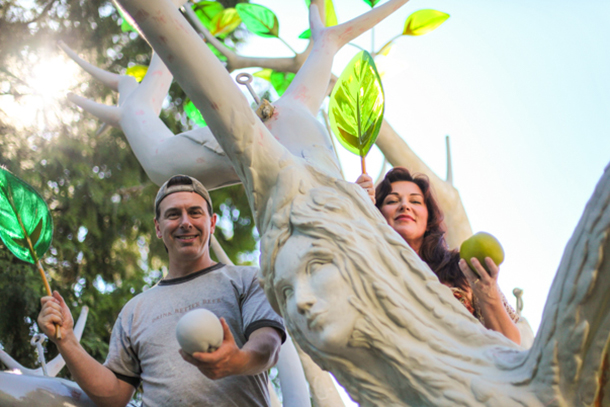
The sculpture is seven-metres in height, of an apple tree into which has been incorporated three female figures within the gilded trunk and branches. Artists Christina and Dean Lauze took on the challenge of creating a monument that would speak to human rights, the vulnerability of blue--collar and farm workers, and the hopes of the future.  Sculpted fibreglass covers the 1.5 tonnes of steel in the tree's creation. Its upper branches will be covered in 23.5-karat gold leaf to symbolize both lofty aspirations and earthly realities.

The BC Federation of Labour and its member unions along with the provincial government collaborated to largely fund the $310,000 memorial, the first of its kind in Canada to commemorate seasonal farm workers. Last year the provincial government in British Columbia stated it had implemented many of the coroner's key recommendations, following the 2007 crash. Random inspections of 15-passenger vans were increased and they were reclassified as "high risk vehicles" ensuring each passenger has a seatbelt.

The province replaced 40 kilometres of concrete freeway barriers in the Fraser Valley, Delta and Surrey with flexible steel cable, with the intention of reducing impacts on passengers in the event of a crash.The B.C. Federation of Labour remains to be impressed. Its president, Irene Lanzinger, points out that other key recommendations were ignored. And though there was a recommendation to change legislation so agricultural business recognizes seasonal workers as full employees, they are still treated as second-class in employment standards, living conditions, and health and safety.

"Vigilance around health and safety just has to be constant," she says. "There are many good employers out there, but there are always employers who want to cut corners or cut costs, who don't put the safety of their employees at the top of their lists."

GoldenTree_610px.jpg
Memorial bears fruit: artists Dean and Christina Lauzé bring together families of killed farmworkers. Photo by David Ball.

Labels: , , , , , ,

Tuesday, August 11, 2015

Large Vehicles: Killing Machines

"The thing just rolled right up and into the cab and crushed her. On the positive side, it was instant death for my wife."
"From the dad's perspective, it was the smartest thing he could have done [parental equipping of a son with a 'monster truck']. 'I have an irresponsible young lad who wants to drive, I'm going to give him the biggest possible thing on the road so he doesn't get hurt', and sure enough, he never got hurt."
James Taylor, Toronto

"For every pickup truck driver killed in a side impact, 25 were killed in a car. I thought, what if we turned this on its head and found the most lethal vehicles out there?"
"I'm no sociologist, but people look after themselves and their family. It's a very human thing to do, I think."
Clay Gabler, "crash compatibility" specialist, Virginia Tech
Mischa Lopiano/Muskegon Chronicle via AP
Mischa Lopiano/Muskegon Chronicle via AP    Emergency personnel respond to a fatal traffic accident at the intersection of Evanston and Maple Island Road on Wednesday, July 22, 2015, in Egelston Township, Mich.

Auto safety researchers had conventionally focused on which vehicles were best selected to keep their occupants safe in traffic accidents. Dr. Gabler through his studies reached the conclusion that U.S. highways were full of cars "not designed to play nicely with each other." One study year, 1997, revealed that 5,373 Americans involved in crashes between a van or truck were killed. Of that total, 81 percent who died had been passengers in cars.

The result of his research first saw publication during the trending toward SUVs. His research zeroed in on the fact that trucks and vans were quite a lot weightier than passenger cars, their profile giving them a higher "ride height" resulting in their tearing through the passenger compartments of cars, the car bumpers or door sills presenting as no protection whatever in competition with the higher-riding, heavier vehicles.

Medical researchers at the University of Buffalo discovered that when an SUV impacts a car, even if the car has a better crash test rating, the driver of the car was four times likelier to end up dead. "In frontal crashes, SUVs tend to ride over shorter passenger vehicles ... crushing the occupant of the passenger car", according to Dietrich Jehle, an author and professor of emergency medicine.

So here's the dissonance in short; cars like the Honda Civic and the Nissan Cube which pass the crash tests with impeccable results, in reality represent the deadliest vehicles on the road; light-weight, low profile, sitting-driver targets. Scientists in Montreal studied data on three million Canadian crashes to discover that driving an SUV (rather than a car) ensures the driver has a 224% greater chance to cause a fatal crash.

Every life saved in a large vehicle resulted at the expense of 4.3 dead pedestrians, motorcyclists and car drivers, according to a study from the University of California, San Diego. Selecting an unnecessarily large vehicle is the choice of drivers likelier to lead to the maiming or killing of someone driving a smaller, lighter car.

"What does this idiot think he's doing?", were the last words that Michelle Taylor of Toronto ever uttered, speaking to her 83-year-old mother in the passenger seat, while driving Highway 9 in Ontario in her Buick Regal, in response to a truck drifting over from the opposite lane. This wasn't just any truck, but a customized pickup with off-road tires and a "lift kit", driven by a drowsy teenager whom sleep had overtaken while driving.

Ms. Taylor, 53, slowed her vehicle to a virtual stop, pulling as far as she could manage off the shoulder. The driver of the truck sustained no injuries. He was charged with careless driving, and lachrymosely lamented "miss you" to his truck, on Facebook. A year later he began posting photographs of his latest rig: a GMC Denali complete with custom front bumper, off-road tires and a lift kit.

Large vehicles are killers; their bumpers fail to line up with sedans and station wagons; they have stiff frames, they're heavier. Every 450 kilograms in added vehicle weight transforms a vehicle into a 40 percent more likely cause of a fatal collision, from that of a potentially survivable crash. Low gas prices have ramped up the sale of big cars. Pickup trucks claimed the first, second and fourth spots for bestselling vehicles in Canada in the first half of 2015.

(AP Photo/Tony Gutierrez, File)
(AP Photo/Tony Gutierrez, File) - In this July 14, 2015, file photo, employee Efren Martin II inspects a Cadillac Escalade as it nears the final process of assembly at the General Motors plant in Arlington, Texas.

"I care most about the people in MY vehicle", a forum post of a SUV driver of  a stated, claiming their intention is to protect their family from "moronic drivers Facebooking their way to oblivion." Another telling comment on yet another forum had another driver stating: "My SUV protects me from the actions of IDIOTS."

A 1981 study found that 93 percent of American drivers self-rated themselves better than the average driver. It's human nature to be sensitive to the errors made by others, while contrarily rationalizing driving errors they make themselves. "Safest vehicle" lists come complete with SUVs topping the choices. The authors of the University of Buffalo study emphasized the "increased safety of SUVs", even while critically assessing the propensity of SUVs to roll over passenger cars.

"The other guy has a big car, so you're going to feel unsafe unless you have a big one too", explained Michael Anderson, an economist at the University of California, Berkeley; someone who examined the social cost of driving increasingly larger vehicles. The world is a dangerous place; all the more so when Escalades are smashing into Civics.

National Post

Staff Sgt.Jamie Johnston, traffic services co-ordinator for the Royal Canadian Mounted Police, said, "There really isn't an enforceable legislation that restricts you from adding suspension modifications -- and we don't track any other modifications." He can't recall crashes where a lifted truck caused otherwise preventable fatalities, but in his 20-year career in crash reconstruction he's familiar with the sight of small cars crushed by larger vehicles.

"The smaller car is always going to feel the bigger bump. Mass is always the deciding issue."

National Post

Labels: ,

Thursday, May 07, 2015

Teenage Tragedy

"What can you say when you lose three young gentlemen in the prime of youth?"
"Losing three young, energetic gentlemen, we just can't seem to grasp that right now."
Carrot Lake Mayor Robert Gagne

"The community is always in a state of shock when you have children involved in a tragedy."
North East School Division superintendent Rob McKay
Spalding crash siteThe scene of a four-vehicle collision near Spalding, Sask., where three teens died Sunday. A highway worker was also critically injured in the collision and is in hospital in Saskatoon.  Photograph by: Liam Richards, The StarPhoenix

There are always no end of sad news items about young teens, usually boys, hurt or killed in vehicle accidents. Young men in company with one another tend to be impulsive, sometimes reckless, since the young always tend to feel invulnerable, that the world is theirs to experiment with and to discover, and nothing could ever occur that would blemish in any measure their expectations of their future.

Matters, however, are not always what they seem. And in small-town Saskatchewan in a town of a thousand people roughly 300 kilometres northeast of Saskatoon, there is grief and mourning at the death of three young boys, in a town where everyone knows the families and their dreadful loss impacts the entire community.

The teens were aged 17, 15 and 14, and they were pronounced dead on Sunday afternoon on Highway 6 close to Melfort, Saskatchewan. "It's shock here, absolute shock. It's sombre here today on Main Street", stated town administrator Kevin Trew, uttering the general dismay that has assailed the entire population.

So were these reckless kids, driving erratically, too fast and careless, causing an accident that proved fatal to them? They were driving in a Chevrolet Cavalier when their vehicle approached a construction site. The 17-year-old driver stopped behind a stationary Dodge pickup truck in the northbound lane, driven by a 48-year-old man.

Along came a semi-tractor-trailer driven by a 38-year-old man from Manitoba, which crashed into the Cavalier, shoving it violently into the back of the pickup. The struck vehicle hit a 21-year-old British Columbia man at work on the highway as a flagman, and continued its passage across the highway to collide with a construction pilot vehicle.

The flagman, rushed to a hospital in Saskatoon was in critical condition while the drivers of the Dodge truck, the construction pilot vehicle and the semi-tractor trailer escaped with minor injuries, taken by ambulance, and treated at a hospital in Melfort, then released. RCMP traffic reconstructionists based in Saskatoon arrived on scene to investigate.

Alcohol was ruled out as a possible cause, and no charges were laid as yet.

Labels: ,

Thursday, February 19, 2015

Where Empathy and Compassion Are Called For

"I can still use my arm, I can still use a computer and I can still talk. I'm thinking, if they give me a chance to stay I can still work, or I can still study."
"But still right now I’m able to move around on my own, and I’m starting to be more independent."
"Even though I’m in a wheelchair, I’m still hoping and trying to still help my family."
"We're still hoping they can allow me to stay here. I was so blessed and thankful for all my friends and church friends who came here to support me."
Maria Victoria Venancio, 29, Filipina, temporary foreign worker, Alberta
Filipina temporary foreign worker Maria Victoria Venancio (screenshot from CTV News footage)
Maria Victoria Venancio (screenshot from CTV News footage)
"She’s told me recently she’s been able to stand on her own, which from when we dealt with her car accident a few years ago was almost unimaginable.""She is working with her doctors and the University of Alberta here and actually making some tremendous progress in her mobility."
"[In the Philippines] her family lives 3 hours from a major center and the simple lack of infrastructure would present incredible challenges to her. She's becoming more independent. And here in Canada, where we have things we take for granted, like paved streets and DATS buses, she has the opportunity to progress and live a relatively fulfilling life."
Chris Bataluk, pro bono lawyer for Ms. Venancio

This young woman came to Canada under the country's Temporary Foreign Workers program, as many young women do from the Philippines, hoping to find employment and to earn their way eventually into recognition as potential future citizens by achieving permanent resident status.  Many  young Filipinas come to Canada to work as domestic aids, as minders of other people's children, leaving their own young children behind in the Philippines, hoping to be reunited with them once they've been able to settle in Canada, and to sponsor family members for emigration to Canada where they feel they will find a better life with greater opportunities to advance themselves economically.

The federal Temporary Foreign Workers program was established as a way to fill employment needs in areas where employers claim Canadians have no interest in working at those jobs. Many of those jobs fall into a professional category where there may be a shortage of such skills within the country, but many more fall into the more pedestrian category of poorly-paid unskilled labour in the service industry. At a time in Alberta when, as a result of the oil boom, many such jobs went unfilled, Maria Victoria Venancio applied to the program, to work for an Edmonton-area McDonald's outlet.

She was doing very well in her area of employment, so much so that it appeared that she was on track to a supervisory position. One day in 2011, en route to work by her usual method of bicycling, she was struck by a vehicle on her commuting route. This was no brief clip that knocked her off her bicycle and little harm done. The accident was serious enough to render the young woman a quadriplegic. And she now finds herself in a double bind. Not only has her mobility been utterly impaired and with it her prospects for future employment, but as a visitor to Canada so to speak, she does not qualify for universal health care. And since she no longer works, she is facing deportation.

Appealing to a Citizenship and Immigration hearing gave her no reprieve on the compassionate and humanitarian grounds she might have hoped for. The hearing ruled that she had no legal status in Canada. But there yet remains hope that her lawyer is determined to explore, that the Canada Border Services Agency, next in line to hear her case, will schedule a hearing to decide whether an order to send her back to the Philippines will be enforced. In her native country she would have limited access to health care.

Wheelchair-bound, her life would be even more difficult than it is in Canada, since in the Philippines, an impoverished country that cannot afford to pave all its roads and sidewalks, or to ensure that public help for the handicapped is recognized in accessible ramps and elevators, her ability to function in the public sphere would be minimal. The young woman has friends and supporters in Edmonton. She had won a modest settlement in compensation for the accident which cost her the use of her limbs. She has made application to be granted permanent residency in Canada.

She had spent three weeks in hospital at the time of the accident. The compensation she received resulting from the accident was relatively small, her lawyer pointed out, since the adjudicators found her to be partially at fault for the accident's occurrence. "She would be leaving what is essentially one of the better situations someone like her could be in and going to a very, very dismal situation", pointed out Mr. Bataluk. At the present time, she has been receiving assistance from doctors at the University of Alberta who have themselves been absorbing the cost.

The rehabilitation she has undertone has been extensive, enabling her to regain partial use of an arm, not quite enough to have her write, but sufficient to give her some degree of independence. She is also able to stand briefly. Doctors have advised her that she will always be wheelchair-dependent. But she remains optimistic about her future and that in and of itself is a tremendous boost toward the possibility of further rehabilitation, however slight.

Labels: , , , ,

Tuesday, February 17, 2015

Enjoying Life

"We won't start driving around all night to find out where the car is because [OnStar] they're involved."
"A needle in a haystack."
"OnStar called again. Should we file a harassment complaint against them?"
"I'm fed up with that nonsense ... I missed my supper hour .... This is the third time I deal with them for nonsense. I can't take it any more."
Surete du Quebec
A Surete du Quebec police officer near a cruiser in this 2012 file photo.
Graham Hughes / Canadian Press A Surete du Quebec police officer near a cruiser in this 2012 file photo.
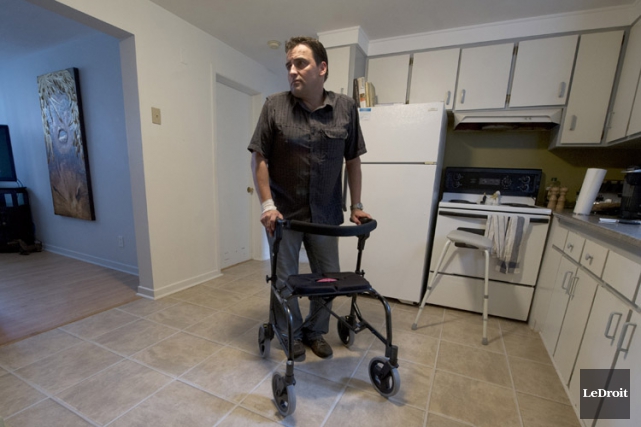
"It's just so illogical. Six years after the crash, I still can't actually believe how the SQ [Quebec provincial police] behaved."
"I've got a prosthetic, but it's not even comparable [to what his physical life was before the accident]." "My anger toward the police, it will never pass."
Gilles Gargantiel
Gilles Gargantiel croit qu'il ne se serait pas... (PHOTO Martin Roy, ARCHIVES LE DROIT)
Gilles Gargantiel croit qu'il ne se serait pas fait amputer le pied si la SQ avait agi plus rapidement.
PHOTO Martin Roy, ARCHIVES LE DROIT

Gilles Gargantiel was an outdoor enthusiast, a tennis instructor, an avid skier, an active man. He is that no longer. He spent seven months in rehabilitation after his October accident on a rural road in 2009 when his new Pontiac G3, equipped with an OnStar system to send an automatic alert when airbags deployed went out of control and crashed into a ditch. Fifteen minutes after the crash an OnStar operator advised the Surete du Quebec of the accident.

They also provided precise GPS co-ordinates. Lucky man; involved in a one-car crash, no observers, no other vehicles, no one to witness his plight, but modern electronics to the rescue! Well, the OnStar system worked the way it was meant to, guaranteeing the user that should an accident occur authorities would be notified and help would be expedited. Only that's not what happened in Mr. Gargantiel's unfortunate experience.

Transcripts of communication between the SQ dispatcher and patrol officers who responded to the notice of accident made it clear that the officers had spotted nothing amiss, were irritated by the repeat calls from OnStar to respond, and decided to give up the search, secure in the intuition that the driver who occasioned the alert was in all likelihood trespassing on some farmer's property, getting himself good and drunk.

Mr. Gargantiel was actually face down on the ground about 30 metres from his car, with a fractured neck, six broken ribs and two broken vertebrae. He was in no condition to move on his own, and when the search for his whereabouts and welfare was abandoned by those who had been alerted to the need for a rescue, he spent 40 hours with no relief from his dreadful predicament.

Perhaps a little more diligent searching would have revealed his whereabouts. But two hours was all that the officers on patrol were willing to dedicate to that search, not believing there was an actual need for them to continue. Eventually, a train engineer saw a car in a ditch between the tracks and Highway 148 in the Outaouais region of Quebec. And there was Mr. Gargantiel.

He was dehydrated, suffering from hypothermia and frostbite. His condition necessitated that his right foot be amputated. Six years later he still suffers physical and psychological effects of his traumatic accident and injury. Feeling no better when he discovered last week that his suit against the province for negligence had been unsuccessful when the Quebec Court of Appeal ruled the amputation to be related to the car accident.

That being the case, he was found not entitled to additional compensation beyond what Quebec's no-fault insurance regime would allow. He had submitted medical evidence validating that the amputation was directly the effect of frostbite, in turn caused by police negligence in failing to make the effort to effect a rescue of the man injured in the car crash. The car crash itself needn't have resulted in the amputation had he been rescued in time.

But the three-judge Court of Appeal felt justified in concluding Quebec's Automobile Insurance Act, providing compensation to victims while also preventing them from suing for damages is sufficient to cover Mr. Gargantiel's amputation. "In Quebec, the protection offered by the law is very ironclad. In the recent case law, I have never seen the law being softened", observed the lawyer who represented Mr. Gargantiel.

Mr. Gargantiel's case, held Leonard Kliger, Montreal lawyer, represented a "clear break in the causal connection between the automobile accident and other injuries that result from a third party.", And so, the devastated man received a lump-sum payment of $104,000 from the province's automobile-insurance board for loss of enjoyment of life and psychological and physical suffering with an additional $16,000 annually for lost income.

He'll now just have to lump it, and use that payment to continue enjoying life with his disability, and forget about psychological and physical suffering.

Labels: , ,

 
()() Follow @rheytah Tweet