Rare Earth Elements : Canadian Natural Resources
"We all know that is not a geopolitically acceptable situation [Beijing's monopoly of rare earth minerals].""This is a once-in-a-lifetime shot [for Canada and rare earth minerals stability] at being in a position to have a degree of control in a very large market."Robert Fung, chairman, Torngat Metals mining firm, Canada"[The world faces an] increasingly uncomfortable reliance [on China for commodities, particularly for rare earths and other critical minerals. China declines to] play by our rules [in development of such minerals, its style is to undercut the free market].""For decades, China has held monopoly-like control over critical minerals production and distribution, rendering the rest of the world reliant on procurement, and creating a level of risk that deters investors from entering these markets.""If we can get to it and create the right conditions, we could be in a very, very strong place going forward."Pierre Gratton, head, Mining Association of Canada"Natural graphite is the poster child for minerals dominated by China and, in the face of a near monopoly wielded by one of the most powerful governments in the world, no combination of attributes could convince prospective sources of capital to invest in required expansion.""Supply chains around the world seemed mostly content with heavy reliance on a single nation."Jamie Deith, chief executive, Eagle Graphite mining firm.png)
In testimony before the House of Commons natural resources committee, mining executives and national security experts warned the federal government over the current situation whereby China dominates strategic mineral supplies through its decades-long plans for market control of critical minerals -- inclusive of the 17 rare earth elements -- through the rapid expansion of its processing capacity; alternately by acquiring foreign assets with a plan to dominate supply chains.
Used to develop strategic products such as solar panels, wind turbines, electric car batteries, mobile phone components and guided missiles, minerals include magnesium, lithium and scandium. Among Canada's natural resources there exists an abundance of these minerals, from a large deposit of neodymium in northern Saskatchewan (for the manufacture of magnets), to large pockets of lithium to be found in Quebec.
According to experts advising the government, those natural resources should be viewed for the strategic advantage they represent, to support Canada's supply chain and in the process protect against China's coercive foreign policy tactics at the very time that Canada-China relations have deteriorated in the detention of Canadians Michael Kovrig and Michael Spavor, in a deliberate attempt to pressure the government to release Meng Wanzhou, CFO of Chinese communications giant Huawei, arrested in Canada on a U.S. extradition warrant.
 |
China has, over the years, amassed roughly 80 percent of global processing capacity for strategic minerals, using that position to manipulate prices in a strategy meant to punish and eliminate its competitors. Canada, it was stressed, with its abundance of natural deposits of minerals such as lithium, nickel -- and a long list of others, appropriately protected, could result in a significant strategic edge in coming years for Canada.
Australia and Canada have the geological resources in minerals used in the manufacture of magnets for electric cars. Australia has lost little time in development of those strategic assets. Policy makers were urged to create a framework for the development and protection of Canadian supply chains for batteries and associated products; the federal government receiving urgent recommendations to establish a $250-million program over a five-year period to incentivize investment in demonstration projects.
According to Simon Moores, managing director of Benchmark Mineral Intelligence, China will likely possess 67 percent of global capacity to build lithium-ion batteries by 2030, reflecting its significant investments, including in "mega factories". In comparison, North America will have a mere 12 percent of the market, according to BMI research. "We are in the midst of a global battery arms race, where the world's major economies are building a base to the energy storage revolution."
As an example of China's strategies to achieve monopolistic advantage, it has engaged in flooding markets with supply to lower prices, thus making it less economically feasible for competitors to develop rare minerals. It is a strategy that Beijing has launched from day one, successfully utilized in establishing itself as the world's premier, low-cost, low-wage production facility for all manner of consumer goods, in the process putting established production across Europe and North America out of business in a failure to compete with China's winning-edge cheaper production costs.
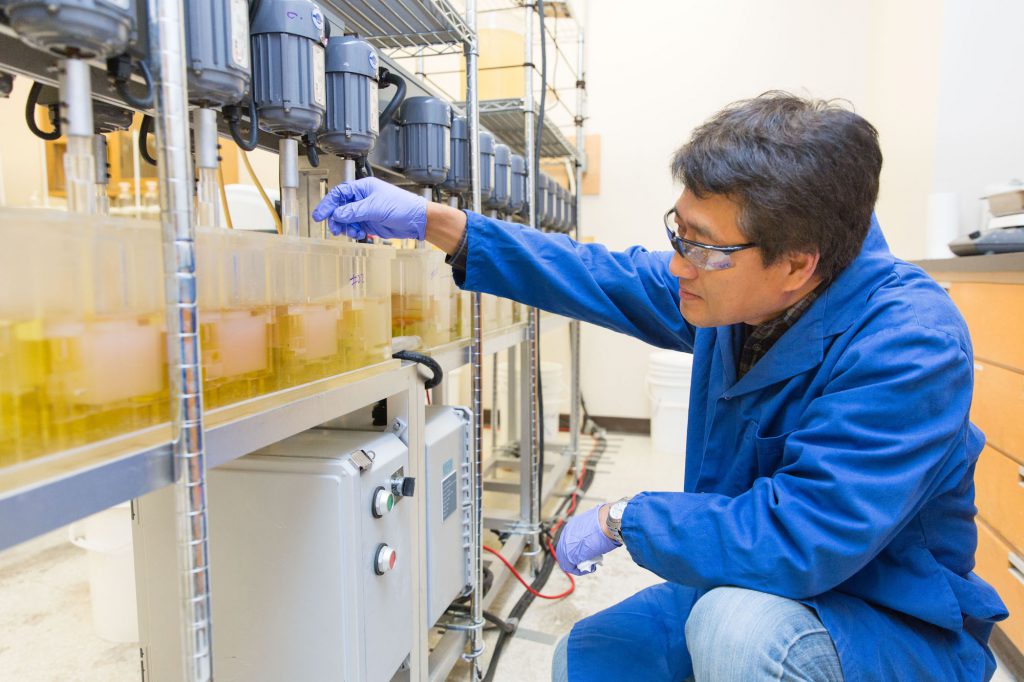 |
| Rare earths experts will be part of the team running the new processing plant. (Image courtesy of Saskatchewan Research Council.) |
Witnesses before the House of Commons committee stressed the importance of developing deeper ties with Europe,the United States and Japan to strengthen their collective non-Chinese supply chains. A proposal that government work with industry to develop 'battery hubs' as one way to make certain Canada has control of a part of the market through the entire supply chain, was put forward by Vale Canada.
"We will definitely have to expand. Not only do we need to promote the auto industries into making EVs [electric vehicles], which means promoting them with consumers, but we also have to support the development of that supply chain.""The processing of the minerals, the development of the battery cells, the battery materials, all need to be brought together and incentivized."Nancy Concepcion, executive manager, Vale Canada
.png)
Labels: Canadian Rare Earth Minerals, Chinese Monopoly on Rare Earth Elements, Natural Resources
posted by Pieface @ 7:31 PM
0 comments