Ruminations

Blog dedicated primarily to randomly selected news items; comments reflecting personal perceptions

Wednesday, November 26, 2014

The Living Chastity Belt

"It must be carried out, because that's the way to maintain the purity of girls, to make sure that the girl is not out of control. We don't care if it's against the law or if they're trying to stop it. We know doctors who are willing to continue and have done so."
Egyptian woman, 53, interviewed for BBC documentary


It is against the law. It defies morality and human rights. Infibulation, genital cutting, consigns girls and women to a lifetime of pain and often enough dire medical conditions associated with the cultural practise. Also called clitoridectomy or excision or female circumcision, it is the surgical removal of a female's integral anatomy related to sex, the clitoral hood. The cultural tradition associated with some primitive religious rites is meant to ensure that women take no pleasure in the sex act.

Theoretically it is meant to make certain that a woman will not stray from the bed of her husband. In practical terms it often makes a semi-invalid of the woman, one for whom the sex act is fraught with pain. And the process and procedure make her dependent on her husband. To do otherwise is to flaunt societal custom and the heritage tradition of male custodianship of female dependants. It is to make certain that dishonour does not blemish the family honour code.

Women, under such social customs are little more than possessions, treasured for their capacity endowed by nature to usher new life into the world and in so doing provide the male with an heir to inherit his genes, the means by which nature presents to her creatures a mode of survival from one generation to the next. And patriarchal societies have developed this scheme of altering a woman's capacity to be fully female to suit their ends.

Throughout the Middle East and Africa and parts of Asia, the practise is dangerous to women's health, demeaning to their dignity but in those cultures a girl who has not been 'prepared for marriage' by circumcision is not considered to be marriageable. The procedure is often carried out without attention to hygiene, and crude tools used in the process. It ranges from snipping off part of the clitoris to the entire removal of all external pudenda.

And it can lead to health issues running the gamut from problems with urination, cysts and infections to severe bleeding, infertility or serious childbirth complications.
photograph
Road sign near Kapchorwa, Uganda, 2004

Ethnic groups who familiarly practise this rite of passage continue to do so when they migrate elsewhere in the world, in Western societies where they take up their new lives, bringing with them the odious custom of female genital mutilation, where mothers and aunts continue to cleave to tradition claiming they are thinking of their daughters' futures which, without circumcision will be bleak with no prospect of marrying and bearing a family.

UNICEF estimates that of the 125 million women worldwide have have suffered genital cutting in the 29 countries where it remains prevalent, mostly Africa and the Middle East, one in five lives in Egypt. Egypt is the most populous Arab country in the geography straddling Africa and the Middle East. According to the government of Egypt, the rate of female genital mutilation among women aged 15 to 49 is 91%.

Egyptian activists have been striving to eradicate the practise that girls as young as five are forced to undergo. It is not only Muslims but Egyptian Christians as well that honour the practise. Female genital mutilation is considered internationally to represent a violation of the human rights of girls and women. UN secretary general Ban Ki-moon in October announced a global campaign to end it within a generation.

But like banning child poverty and striving to bring about an alleviation in the condition of children throughout the world whether they lived in impoverished countries of the world or First-world economies yet live with privation, it is easier said than done. Egypt has banned the practise, imposing a universal ban in 2008. Though the practise is often referred to as circumcision, it is nothing like male circumcision where the hood of the penis is removed with no lingering ill effects.

The World Health Organization's description of the custom is succinct enough: "[It] comprises all procedures that involve partial or total removal of the external female genitalia, or other injury to the female genital organs for non-medical reasons." There are no health benefits attached to the custom. It reflects only a society's obsession with virginity and chasteness; that a woman is endowed with sexuality remains a taboo subject.

Even though in Egypt there is a penalty of up to two years in prison or fines of up to 5,000 Egyptian pounds (roughly $800), the custom has proven impossible to stamp out. "Medicalized" cutting, which is to say surgery taking place in hospitals by medical staff has actually risen to 77% from 55% decades earlier. To eradicate this custom is paramount in achieving "social justice and human dignity", a pledge by women battling the practise, intent on protecting the quality of life of girls and women.

Labels: , , , ,

Wednesday, February 19, 2014

Homelessness, Addiction, Mental Health

"It's criminalizing mental illness. How will we be viewed, 20, 30, 50 years from now? We'll be looked on as the ones who locked up all the mentally ill people."
"It really is one of those things so rich with irony: The same society that abhorred the idea that we lock people up in mental hospitals, now we lock people up in jails."
"Fiscally, this is the stupidest thing I've seen government do."
"We've systematically shut down all the mental health facilities, so the mentally ill have nowhere else to go. We've become the de facto mental health hospital."
Thomas Dart, Cook County sheriff, Chicago
Canada’s correctional authority continues to face increasing costs and challenges in managing a higher proportion of the offender population with mental health concerns. The most recent data available indicates that the Correctional Service delivered at least one institutional mental health service to 48.3% of the total inmate population, with 47% of Aboriginal offenders and 75% of women offenders receiving services in FY 2011-12. Just over 90% (or 4,065) of newly admitted offenders were comprehensively screened for potential mental health problems last year; nearly two-thirds were flagged for follow-up mental health interventions. The Service also delivered Fundamentals of Mental Health training to 2,438 staff in fiscal year 2011-12.20
It was no doubt costly to maintain mental hospitals where people whose mental instability represented a danger to themselves and others around them, were locked into these facilities for their own good and that of society. Except that it wasn't a happy solution to the people who were incarcerated in these facilities, regardless of the medical treatment they received, never quite adequate to really help them, just to sustain the status quo.

And so, under the subterfuge of releasing these people who actually did require ongoing medical intervention, although a more useful type of intervention more suited to their individual needs, not necessarily institutional, but institutional if no other solutions could be found, society agreed that it would be more humane to release them, to allow them to care for themselves. Whether they would then take their medications, whether they might be able to function adequately, another story.

In the end, the growing incidence of homelessness, people living on the streets, the societally marginalized, the lost and confused, petty criminals, those incapable of keeping body and soul together grew, and one of the constituents of that growing base of the homeless was in fact individuals with mental illness whom no one was prepared to care for any longer. The institutions that once housed them, after all, were closed 'for their own good', allowing them liberty and freedom.

For many it meant the freedom to cope as best they could, and often enough their best wasn't good enough. But they were free to live on the streets and to persevere. Psychiatric disorders are now recognized as commonplace enough in general society; those who have family support and access to good medical care are able to function. Those without all of those supports turn to other means of survival and at times those means come up hard against the yardsticks of the permissible.

Infractions of the social order means that an arrest and prison are inevitable. Who speaks for the homeless, after all? Over half of the prisoners in the United States are adjudged to possess a mental health problem, according to a 2006 Justice Department study. The figures are even larger when it comes to female inmates; almost three-quarters live with a mental disorder. There is no reason not to believe that the numbers are similarly reflected in Canada.

Sheriff Dart speaks of working days when 60% of the jail's intake report some mental illness diagnoses. It's his opinion that the system is senseless and quite dreadful, on top of which it's an extremely expensive way to treat mental illness. The choice is not his, however. He takes in schizophrenic, bipolar, depressive and psychotic individuals delivered by local police forces to become prison inmates.

Not that facilities do not still exist for the mentally ill; they do. In 1955 there was a single bed in a psychiatric ward for every 300 Americans; there is now one for every 3,000 Americans, according to a 2010 study. More effective pharmacological treatments are available, freeing up the necessity to welcome patients into care, as long as they are adequately monitored and enabled to function. They also must be able to afford medication.

"Some people come here to get medication. They commit a crime to get in", observed a superintendent of a women's unit at the jail.  "When I'm not on my medication on a regular basis, I don't make decisions well", explained one female inmate diagnosed with depression and anxiety disorders. Outside of jail her prescribed medication costs $100 monthly which she cannot afford.

Researchers at the University of British Columbia surveyed hundreds of homeless people in three B.C. communities where substance abuse is particularly acute. They found that homeless people who regularly attend church or other religious ceremonies are less likely to consume alcohol, cocaine and opioids.

"Religion may have a protective effect on substance-use behaviours. Indeed, several of our participants indicated ... that their faith 'keeps them clean'," the paper by Dr. Iris Torchalla and Prof. Michael Krausz of the UBC School of Population and Public Health declared. The study appears to link an association between less substance use and religious attendance without proving a cause-effect relationship, in the opinion of Dr. Lisa Lefebvre, head of addiction medicine at the Centre for Addiction and Mental Health in Toronto.

A homeless man rests in a pew at a Times Square church on December 12, 2013 in New York City.  A Canadian study has found homeless people who attend religious service once a week are less likely to indulge addictions to alcohol or drugs.
Spencer Platt / Getty Images     A homeless man rests in a pew at a Times Square church on December 12, 2013 in New York City. A Canadian study has found homeless people who attend religious service once a week are less likely to indulge addictions to alcohol or drugs.
 
Of 380 homeless adults surveyed in Vancouver, Victoria and Prince George who claim some religious faith, 60 reported they attend services at least once weekly, according to the report published in the Community Mental Health Journal. "When people are homeless or suffering from a mental illness, there is often a stigma, or a feeling of not belonging", said Shawn Lucas, head of the spiritual care department at Toronto's Centre for Addiction and Mental Health. 

Spencer Platt / Getty Images
Spencer Platt / Getty Images    Participants in a Canadian survey of the link between addiction and religion told researchers their faith 'keeps them clean.' 
 
"Usually when people attend a religious organization, there is a sense of belonging." It is not only a sense of community that all human beings require to satisfy their emotional needs. It becomes incumbent on their community to pay attention and commit to services and humanitarian aid to help the homeless find a home for themselves, irrespective of their mental condition; at the very least to help them find safe haven.

Labels: , , , ,

Saturday, February 15, 2014

Syria's Searing Failure: Failure of the International Community to Intervene

It is inconceivable that the world looks on, moved yet unmoved by the plight of Syrian civilians, men, women and children who have no wish but to go about their daily lives in peace, but who have been recognized by the Syrian authorities as a veritable fifth column which has welcomed among them rebel militias battling the government. They are deemed to be at one with the enemies of the regime. And as such, they have been fodder for brutal vengeance.

News Photo: Men carrying children run out of a burning…
Men carrying children run out of a burning building following a barrel bomb attack reportedly dropped by government forces in the northern Syrian city of Aleppo on February 8, 2014.  AFP PHOTO/BARAA AL-HALABI


Their neighbourhoods in the suburbs of cities, their towns and wherever else they live as a majority Sunni Syrian presence, have been surrounded by the military of what was once their country. They are completely penned in, their neighbourhoods have become a huge dungeon of despair, a barred jail from which they may neither exit nor enter. Nor can any life-saving food aid, potable water, medical supplies enter.

They are left to starve, to perish one by one. They are also being mercilessly bombed. This one-two punch by the regime of Syrian President Bashar al-Assad to the Sunni population of the country ruled by a minority Shia population leader is meant to diminish the number of Sunnis who can conceivably plot against him and aid the "terrorists" and "Islamists" who threaten the Assad regime which has long oppressed the people of Syria; its Sunni and Kurd demographics.

Many people have died as a result of the "starvation sieges", and many more will join them. The brief pause arranged during the frigidly useless negotiations in Geneva sponsored by the UN and the Arab League managed to have a days-brief interregnum during which roughly 400 starving people were permitted to leave Aleppo and food aid was delivered to the starving. And the Syrian Red Crescent and humanitarian volunteers in the process were attacked by military artillery.

The prevention of food and medicine from reaching desperately trapped people represents a war crime of horrendous proportions; slow death by starvation can be balanced against death achieved through bombardment of toxic chemicals, both achieving like ends. The chemicals were removed by dual agreement, the food is being denied through inaction. In the besieged areas, disease has come visiting along with its companion, death.

Chapter VII of the United Nations Charter allows the Security Council to have its directives enforced through military action. From past efforts to have the Security Council embark on an ameliorative course of action, it's well enough recognized that both China and Russia stand in the way of achieving consensus. Non-interference in a country's internal affairs guides China, lest any interfere in theirs, and Russia's long useful alliance with Syria guides it, irrespective of the horrors.

Yet it is obvious that an external, international force must be put together in an effort to extract those helplessly desperate people from their agony. At the very least to enable the safe passage to haven by those who want to leave their besieged neighbourhoods which have also been bombed to virtual smithereens. And to allow the security of producing food and medicine for ill and starving Syvian civilians.

Russia is on record as promising it would support measures on humanitarian issues. But there is a slight blip there; it will approve such a rescue mission only if Syria would agree to it. A more cynical approach to a desperate situation could never be encountered, let alone countenanced. Either a multinational force could be assembled to step into the situation to rescue the abandoned, or a coalition of those sufficiently outraged to assemble themselves could and should intervene.

That intervention could resemble the operation which took place when NATO with UN approval, decided it would give air cover over Libya, and advisers on the ground to help the rebels fashion themselves into a well-ordered resistance. Alternately before the mounting of a potentially effective solution, President Assad and the opposition might be given the opportunity to act together of their own accord to settle the conflict.

Failing that there is always the much-celebrated, but little-used Responsibility to Protect resolution passed in the United Nations that could be called upon. The Assad regime certainly over-qualifies for representation as a government inflicting atrocities upon its vulnerable population. This horrendous conflict which has taken over 130,000 lives, created millions of refugees, pounded civil infrastructure into rubble, maimed people through detention and torture, and effectively destroyed a country must cease.

Labels: , , , , , , , ,

Saturday, January 11, 2014

The Fruit of Unfettered Capitalism

"Almost every wealthy developed nation has done a better job than we have, I am sorry to say. I think by commonly used measures, Canada has lower child poverty rates than the U.S. does, but so does most of Europe and others. And I think what this shows is we have something to learn from most other wealthy developed nations."
Arloc Sherman, poverty expert, Center on Budget and Policy Priorities, Washington

"We shall not rest until that war ['war on poverty'] is won. The richest nation on Earth can afford to win it. We cannot afford to lose it."
U.S. President Lyndon B. Johnson, 1964

"After 50 years, isn't it time to declare big government's war on poverty a failure?"
"If you are a farmer you don't need a war on drought, you need a functioning irrigation system and we need a functioning anti-poverty and pro-opportunity system."
Republican Senator Marco Rubio, Florida
The Homeless of New York City
Spencer Platt/Getty Images   The US Census Bureau reports that 49.1 million Americans live in poverty. 
 
President L.B. Johnson was a good man with his heart in the right place. He undertook to launch an American "war on poverty" program meant to "cure and, above all to prevent" poverty in his country. Thirty million Americans (one in five) lived in 1964 below the poverty line. With President Johnson's program to alleviate poverty and make America a more inclusive, fairer, opportunity-sharing place, the poverty figure had been slashed in half by 1970.

Yet after 1970 the poverty rate began its slow creep back up, affecting a greater number of Americans. Now, despite the colossal Treasury dedicated to combating poverty in the United States through a multitude of social welfare aid programs, the U.S. now represents the industrialized world's greatest poverty level among its population, with 50-million Americans beset by grinding poverty. The U.S. Census Bureau attests that 16% of Americans live below the poverty line.

National Academy of Science Report Shows US Poverty Rate To Be 15.8 Percent
The war on poverty continues: nearly 50 million Americans were defined as poor in 2012. Photograph: Spencer Platt/Getty Images
 
A high proportion of children and single mothers live below the poverty line in the United States; 20% and 33% respectively. Senator Marco Rubio of Florida has a plan for a "flex fund" to be paid from federal coffers to the various states to spend as they identify the areas most in need of attention. But perhaps that isn't really the solution to the escalating problem of income disparity in the country. Income inequality has killed the initial results of the 'war on poverty', throwing greater numbers into debt and poverty than ever before.

In a recently published study, Sharon Parrott, a poverty analyst at the Center for Budget and Policy Priorities notes that in the years between 1964 and 2012 the share of national income flowing to the top one percent of households effectively doubled. On the other hand, between 1979 and 2012 the share of income dribbling to the poorest fifth of American households steeply descended. "If the benefits of economic growth had been more widely shared, poverty would be lower", she concluded.

Raising the minimum wage, altering the tax code for the purpose of redistributing wealth might begin to address the problem of income disparity, if those measures could rise beyond the levels of acrimonious partisan debate in Congress. Those possible measures are contested by Republicans; that jobs will be lost, and thus people will be kept poor. The natural forces of the marketplace is their preference, with the argument that consumer spending will end up trickling down to aid the poor.

A homeless man sleeps on a bench in Brooklyn, New York. As of June 2013, there were a record 50,900 homeless people in New York City, including 12,100 families with 21,300 children.

A homeless man sleeps on a bench in Brooklyn, New York. As of June 2013, there were a record 50,900 homeless people in New York City, including 12,100 families with 21,300 children.  Spencer Platt, Getty Images, File


The just-released job figures offer scant hope for an improved economy on the near horizon. A mere 74,000 jobs created in December, and what looked at first glance like other more optimistic numbers with the unemployment rate dropping to 6.7% from 7%, turns out to be another disappointment when looking a little deeper into the meaning. Which is that over 200,000 job-seekers have given up and stopped looking for work; no longer considered 'unemployed'.

Labels: , ,

Wednesday, January 08, 2014

Venezuela 'to be tough' on beauty queen Spear's killers

BBC News online -- 8 January 2014
Catharina Moh reports on the investigation
Venezuelan President Nicolas Maduro has announced he will act "with an iron fist" after former beauty queen and actress Monica Spear was murdered.

Ms Spear, 29, was shot dead along with her British-born ex-husband Thomas Berry, 39, in their car on Monday.

Their five-year-old daughter, who was shot in the leg, is reportedly in a stable condition.
The attack, thought to have been a botched robbery, has highlighted Venezuela's skyrocketing murder rate.

President Maduro said the couple had been "slain with fury".
He told a delegation of actors who had come to his office to demand those behind the crime be brought to justice that "violence is an evil we have [in Venezuela]".

He assured them the full weight of the law would be brought to bear on the perpetrators.
'Vile killing'
 
At a news conference, Interior Minister Miguel Rodriguez said five people had been arrested on suspicion of committing the "vile killing".
Monica Spear competes at the Miss Universe competition in Bangkok, Thailand on 31 May, 2005 Monica Spear was a popular actress who had starred in a number of soap operas
 
Mr Rodriguez said he had called an emergency meeting of the governors of Venezuela's 23 states and of the 79 towns with the highest levels of violence in Venezuela.

"The fight against violence has to involve all the authorities so the criminals know they'll face the full rigour of the law, because we've had enough already," he said.

He promised to "use everything we have, the police, the army, against those who will not go down the path of peace,"
Venezuela has one of the highest murder rates in the world.

Armed robberies and kidnappings are not unusual, but the death of Ms Spear, who was a popular actress after being crowned Miss Venezuela in 2004, has had huge impact in the country.

Fans of Ms Spear, actors and other people in the entertainment business have said they will rally in Caracas on Wednesday to demand more be done to improve Venezuela's security.

The opposition leader and defeated presidential candidate, Henrique Capriles, posted a message on his Twitter account calling for a nationwide drive against violence.

"Nicolas Maduro, I suggest we put aside our deep differences and get together to fight the lack of security, as one bloc," he wrote.

Ms Spear, Mr Berry and their daughter were travelling at night from the city of Merida to the capital, Caracas, when they hit a sharp object "placed on the road", according to Venezuela's investigative police chief Jose Gregorio Sierralta.

Venezuelan Monica Spear poses after being elected Miss Venezuela, in Caracas, on 23 September, 2004 Ms Spear was crowned Miss Venezuela in 2004 
 
At least two of the four tyres were punctured, he said.
According to Mr Sierralta, five people attacked the family after their car had been lifted onto a tow-truck.

The three locked themselves in their car, and according to Mr Sierralta, the attackers opened fire when they could not reach the family inside the vehicle.
He said the drivers of the tow-truck were being questioned.

Ms Spear was a popular actress who had scored a number of roles in soap operas after winning the Miss Venezuela pageant in 2004.

She starred in Flor Salvaje (Wild Flower) and Pasion Prohibida (Forbidden Passion) for the US-based Telemundo network.

Local media said that even though she had separated from Mr Berry the two still went on holidays together for the sake of their daughter.

They lived in the United States but often travelled to Venezuela, where both of them had grown up.

Labels: , ,

Thursday, September 12, 2013

The Child, Abandoned

"I think ... he would have suffered greatly."
"I've never seen anything like this."
"For me it was a unique case."
"I hope there will never be another one." 
Dr. Gregory Wilson, pathologist, Toronto Sick Children's Hospital

Jeffrey Baldwin
Jeffery Baldwin (second from right) is shown in a coroner's inquest photo. A Toronto woman and her husband who starved their five-year-old grandson to death had subjected two of the woman's children to "eerily similar" abuse more than two decades earlier, an inquest heard Wednesday. Photo: The Canadian Press/HO

 It does happen in some families. That among siblings one child will be ignored, its needs unmet, the child viewed as different and less entitled to affection and support, care and direction. It does happen and then often that child grows to adulthood, understanding what happened to him but not why, and living his own very special life of rejection and pain, feeling a sense of lack of value, finding it difficult to fit in anywhere, doubting that anyone might ever care about his well-being.

That won't happen to Jeffery Baldwin. It's true that he was set aside from the other children who lived in the house where six adults and four other children lived. Not counting Jeffery and his older sister. It was Jeffery and his older sister who were given very special treatment. The other children appear to have lived what might be construed under the circumstances as 'normal' lives.

Jeffery and his sister were confined to an unheated room where they were kept securely locked in. They slept on two urine-soaked mattresses. And they were fed in a bowl set on the floor.

They weren't exactly fed as children might be expected to be, with full attention to their nutritional needs. They were, in fact, starved. Jeffery was almost six, his sister two years older, and she was permitted to attend school. As a starving child she ate ravenously when the children in her school were served snacks.

Those snacks maintained her at a minimal rate of nourishment where she hovered between life and death. For Jeffery there were no snacks, he just perished of disease brought on by starvation.

The haunting question lingers in one's mind. It is known that the local children's aid societies failed in their professional duty to ensure that these children whose records rested with them, were kept in good health. But what about the school that Jeffery's sister attended? Could it not be seen that the little girl was in dire distress? It had been noted how she scarfed the food available there. No one intervened to enquire about anything.

At age almost-six, Jeffery weighed what a one-year-old infant would, 21 pounds. At the Ontario coroner's inquest now ongoing in Toronto, photographs of his autopsy showed him to be physically stunted and horribly emaciated. His limbs resembled mere sticks, every rib could be separately traced.

His small body was covered in ulcers, bruises and abrasions with a scaly rash on part of his body. Four of the five lobes of his lungs wee covered with bacterial pneumonia, his lungs full of fecal flora representing a condition of  dangerous dimensions where "bacteria from his bowel were growing in large quantities in his lungs."

In the house where the child and his extended family lived were his grandparents who had official custody of Jeffery and his sister. With them lived two daughters of the grandparents and their partners; aunts and 'uncles' to Jeffery and his sister. The four other children in the household were theirs.

As for Jeffery and his sister, no one entered their room. The children were lovingly called "the pigs" and perhaps there's a certain justice then in their being served slops in a bowl on the floor, but never enough to sustain life.

"He died", said Dr. Wilson, "when he went from pneumonia to septic shock"; the underlying cause of death being "starvation, pure and simple."

The sad death of a child; the sadder life of that child.
 Jeffrey BaldwinPhoto of Jeffrey Baldwin at the time of his death from evidence provided by the coroner. The inquest into the murder of Jeffrey Baldwin, whose grandparents beat and starved him to death began Monday, September 9, 2013. Jeffrey weighed less than 10 kilograms and was emaciated when he died of starvation in November 2002.


Labels: , , ,

Friday, August 23, 2013

Failing Aboriginal Children

"It's an interesting process with respect to First Nations. We [the provincial government] are accountable, essentially, for children in protection and that gets delegated to First Nations authority. But the funding is from the federal side, so the accountability is to us, but the funding is from the federal government.
"We have a number of people working with them directly as role models and mentors. We've been working with those boards and we have a very good relationship and we're doing a lot of work with them on processes and procedures."
Dave Hancock, Alberta Minister of Human Services
First Nations children are over-represented in their high numbers in the province's child welfare system. Of all children in the care of the province, fully 68% are First Nations children. First Nations are jealous and protective of their sovereignty. For they are, after all, nations, and they consider themselves to be fully capable of administering all of their own services. Funded, of course, by the province and by the federal government.

Which is to say funded by the tax-paying component of the Province of Alberta and all Canadian taxpayers in general. With the exclusion of aboriginals living in tribal First Nations reserves. Native Canadians living on reserves do not pay taxes; they are excused from this onerous civic obligation because they are First Nations; the first nations to live on the land we now call Canada. They were first, all others mere late-comers and as such colonialists.

Aboriginals living on reserves need not pay taxes, in fact general tax revenues are the means by which the federal government is able to pay huge sums of money to all First Nations reserves. Where housing, schools, medical services and all other civil infrastructures are paid for by the universal collection of taxes and reserve-transferable funding. One might think that people who have lived forever on the land know how to raise their children and how to employ themselves gainfully, living off the land.

The traditional way of living is always extolled as hugely desirable for any number of reasons; not the least is that it represents a noble way of life and a way in which ancestors can be honoured. The mystery here is why people who declare themselves to be sovereign, capable and spiritedly proud of their heritage are so fiscally dependent, and so sadly incapable of looking to their own devices. The worst thing is the common failures in raising children in secure and loving homes.

Perhaps it is a matter of transitional values being so utterly confusing. Too many families raise too many children on reserves with no regard to those children's welfare; they are not adequately cared for, fed, valued, educated. Their exposure all too often is to alcohol and drug addiction, sexual abuse and a nasty lifestyle of semi-abandonment. Which accounts for the numbers of aboriginal children in care.

The home of Ethan Yellowbird is pictured after his fatal shooting July 11, 2011 at the Samson Cree reserve.
Ian Jackson / THE CANADIAN PRESS FILE PHOTO   The home of Ethan Yellowbird is pictured after his fatal shooting July 11, 2011 at the Samson Cree reserve. 

Just as First Nations strenously object to their children being adopted outside their First Nations communities, they also insist on administering themselves the many types of civil programs that exist within their communities to provide social welfare, as is done elsewhere, in all other communities. The trouble appears to be the lack of accountability, of professional behaviour, of commitment to the welfare of the children they are tasked to support.

A recently-released report on the activities of the Kasohkowew Child Wellness Society which manages child welfare in the Samson Cree First Nation is a case in point. A 13-month-old girl in their care died as a result of gross incompetence in best practises relating to child welfare. "An ordinary reasonable caregiver with average education would have sought medical intervention for a child with symptoms of pneumonia serious enough to have caused her death", wrote Judge Bart Rosborough.

He made a number of recommendations in the interests of providing better health-care training for foster parents, for the child died in the custody of a foster parent. A foster mother who, in fact, worked as a caseworker at the same child welfare agency that managed the child's file. The little girtl had been in and out of hospital ten times prior to death for respiratory problems, including pneumonia and a bout of meningitis being suspected as well.

The judge pointed out inequities in financing care for aboriginal and non-aboriginal children. At the time of the enquiry he sat on, the Samson Cree Nation had two thousand children, and 322 of them were under permanent guardianship orders. The disparity in funding is a grave problem. On the other hand, he saw misuse of funds at the time of the baby's death, with staff members sent on expensive out-of-country 'educational' seminars.

Funds being diverted to activities described as "cultural activities", were also mentioned. Where choices were made to fund these types of events even in the face of case workers being fired because of tight budgets. Another issue was impossibly sloppy filing where one client's files could be scattered over a number of different places, difficult to pull together for a well-rounded picture of the client's history and needs.

All of the recommendations issued by Judge Rosborough had been accepted, said one of the women who sits on the board of directors at the Kasohkowew Child Wellness Society.

Labels: , , , , ,

Saturday, April 27, 2013

Causative Affect

In her column, Christie Blatchford explores why there might not be a case against Rehtaeh Parsons' alleged rapists, who are also accused of passing around a cell phone picture of Rehtaeh, then 15, having sex as she vomits out a window.
Facebook
 
A  young girl is dead. That is the final paragraph of a story that has shocked Canada. Not for the first time, nor the last. Each time brings its own shock of disbelief. That a young boy, a young girl, hovering on the brink of maturity acts on the impulse to end what has only just begun. There should be a much, much longer space between birth and death. There should be episodes enough of happiness and inspiration, expectations and satisfaction reached to expunge the bitterness of episodic disappointment and regret.

Someone in their teens deciding that they cannot wait for deliverance from the anguish they find themselves in has made that precipitate determination that theirs is a future without value for them. In depriving themselves they deprive those who love them who will bear the burden of sorrow. They have left behind their legacy to the world, a truncated life of imagined triumphs that will never be realized. Their future is surrendered.

From the perspective of a mature mind the puzzle will always be what could possibly have been seen as so horribly painful that a young person would prefer death over life? The silent, blank and very dark finality of it is so irretrievably and unmercifully final. From death there is no return, no lingering uncertainty whether after all one regrets the decision and prefers to turn time back, a rescue from the finality of non-existence.

It is the depth of that despair that should be remembered in the case of Rehtaeh Parsons, who committed herself to the unforgiving forever of death. Her belief that life no longer held any value for her, that the pain she was suffering was so intolerable that death was preferable. Leaving behind everything that ever might have held her to life in favour of abandoning it all.

A brief time of abandonment to a hedonistic pleasure that held consequences she was not prepared to face. Hormone- and youth-culture, thrill-seeking abandonment, an innocently guilty foray into the forbidden territory of adult yet teen-centric sexual activities. And then, the dreadful pangs of regret, of concern for reputation, of pain that accompanies peer contempt and derision.

Rejtaeh Parson was not as resilient as many other young girls. She hadn't the self-confidence that would carry her over the demeaning period of regret, conscience and confusion that alienated her from her decision to defy convention for a brief foray into the complete relaxation of acceptable behavioural standards. She was unwilling to pay the price for liberating herself however briefly from the social contract.

Not when that liberation came complete with the social judgement that so swiftly followed. She was a more than willing participant in the partying event that sullied her reputation as a slut. It was freedom from convention and caution, and it was light-headed fun. It was without doubt all of that for the boys whose adventure it represented to take advantage of an opportunity while they and she were both under the influence of alcohol.

That those boys chose to display evidence of her having succumbed to that reckless behaviour that bespoke a certain amount of self-abuse, speaks hugely of their lack of compassion for another young person living in a world where males are excused rudely abusive behaviour and females are not. Rehtaeh's girlfriend was clearly invested with a greater sense of self-awareness and self-respect.

She anxiously attempted to guide her friend, but was rebuffed. Which did not stop her from trying again, returning with her mother to attempt to convince Rehtaeh to remove herself from her dangerously compromising activities. That they both failed represented a complication in the ability of others to influence the behaviour of those other than themselves absent common values and perceptions.

The episode in juvenile exploration of freedoms for which they are unprepared and as yet unfit, ended horribly for one participant. If there is any guilty party it is perhaps the blatant culture that has evolved of youth entitlement to shun adult advice while taking on adult behaviour as practised by children incapable of understanding the realities of consequences.

The stupidity of young boys parading and celebrating a conquest emulates the behaviour of many adult men whose emotional level of maturity has never been satisfactorily attained. But the fault lies also in a teen culture that seeks to find victims to deride, to make examples of, to hold in contempt, while secretly being grateful that they are not themselves like those losers.

Labels: , , , , ,

Sunday, April 07, 2013

Sex-Crime Leniency

"I have not been the mother and grandmother I should have been because of the path of life which Mr. Smith's crimes have done.... Trust is not a part of my world and never has been since I was violated by Mr. Smith and then told I was a liar by the CAS workers when I went to them for help."
This now-almost 50-year-old woman suffers chronic sleep problems, eating disorders and nightmares. Little wonder she has nightmares. Her early life, at her most emotionally needy period of development as a human being, had been a dreadful nightmare of immense proportions. In and out of care with the Catholic Children's Aid Society since age 6, she had been given over to the care of various foster homes no fewer than twenty-two times in eight years.

A family known as the Smiths were approved as foster parents in 1978, and the-then 14-year-old girl had been rendered to their care. This foster home seemed different to her than the others had been. There were other children, the couple's own, but she had a bedroom all to herself, and what was even more wonderful to this lost child, she felt she was treated just the same as the other children, and she felt secure and safe.

Soon after moving into the Smith home, however, Mr. Smith was recovering from a car accident and spending considerable recuperative time at home. In the spring and summer of 1978 over a four-month period, he forced intercourse on the girl just as she turned fifteen years old. She had never experienced anything of that kind before, despite being in the care of other foster parents whose care of her was less than ideal.

She became pregnant, and the Catholic CAS removed her from the household to place the fifteen-year-old in a home for unwed mothers, without reporting anything to the police. They tried to persuade the girl to surrender her baby but she refused. And they refused to believe her when she informed them of what had happened. Mr. Smith had denied doing anything wrong, that he was the father of the baby.

The now-mature woman in 2010 went to Toronto Police. Mr. Smith was asked for a DNA sample, confirming he was the biological father of the now-grown daughter. During the trial that took place, Mr. Smith addressed the woman whom he had raped as a child, apologizing for his 'uncharacteristic' behaviour. His apology did not impress the woman, but it did the presiding judge.

Judge Jane Kelly expressed her opinion this way: "He regrets what he did 35 years ago and he has taken full responsibility for his actions." Full responsibility? For expressing regret? Regret that it came to his having to appear in court charged with a criminal act against a minor? Quoting Mr. Smith the judge said it was his hope "that now she has closure and will be able to move forward with her life", that he was "sincerely remorseful" and "thoroughly ashamed".

Pity he hadn't acted on decent impulses back then when he forced a child to a warped future of desolation. Later, the young woman had married, but an intimate relationship failed her. The knowledge of what had happened to her, she believed, soured her partner to her. And her life was irremediably altered from its potential for normalcy into one of misery and loneliness and regret, true regret.

Because Mr. Smith was perceived by the judge as a man of "good character", as "a contributing member of our society", leading a "productive life", except for an unfortunate "monstrous error in judgement", compassion led her to hand out a conditional sentence of house arrest for two years.

Labels: , , , ,

Wednesday, March 27, 2013

Humanitarian Charity

Medecins Sans Frontieres (Doctors Without Borders) operates their teams all over the world wherever people's lives and their health are in jeopardy as a result of political instability, refugee situations, civil wars or other human-detrimental conditions, including natural disasters such as earthquakes or torrential rains leading to massive flooding, leaving migrants exposed to deprivation and risks to health.

Doctors Without Borders has its teams working in Syria, amidst the conflict, in small towns and in cities where it is felt that the teams can be reasonably safe and enabled to conduct their healing and life-saving procedures on behalf of the civilian populations under threat from both the regime's attacks and those of the undiscriminating rebel militias.

These teams open up small temporary clinics in the hopes of providing maternal-child health care, treating children and pregnant women. The country's own medical system has been understandably devastated by the two years of unrelenting conflict and destruction of infrastructure. Basic health care is lacking for a desperate population caught between warring factions.

Doctors Without Borders face a shortage of routine vaccines, of antibiotics, pain medications. Let alone protocols for chronic medical conditions like diabetes, anaemia or epilepsy. Before the onset of the conflict it was standard procedure that pregnant women would have their babies delivered in hospital. It has now become standard for women to deliver at home, often without help if anything occurs out of the ordinary in childbirth.

Vulnerable children are routinely sent for their nighttime safety from shelling to sleep in caves nearby their towns where the cold, damp conditions prevailing there increases risk of pneumonia and other respiratory conditions. Children living in refugee camps for internally and externally displaced, suffer winter conditions of exposure to cold and damp living in tents and suffer perpetual colds and fevers.

The medical teams work in place for as long as they can be assured they may do so with relative safety. They are able to tolerate being shelled several times weekly, hoping to remain unscathed. When the attacks accelerate in frequency they understand it is time to evacuate, to remove themselves and move on to areas which are less frequently under fire.

Having to do so, leaves them feeling dejected and miserable, being forced to leave the anxious and the ill, deprived of both standard and emergency medical treatment and procedures that help make their lives just a little bit more tolerable. The medical teams, in reluctantly leaving, have hopes that they will be enabled to return once the situation becomes less violently volatile.

Many of the village residents who have already perhaps left their own villages under more frequent bombardment, have nowhere else to go, and remain there, hoping that salvation will eventually arrive through a cessation in hostilities. Leaving them free to return to their home villages, free to live once again in peace and security in a country rent by dire tribal and sectarian misery.    

Labels: , , , , ,

Monday, March 25, 2013

Human Nature/The Lessons of History

"Silently, with no lights on, cars kept coming, one after the other, full to bursting with baggage and furniture, prams and birdcages, packing cases and baskets of clothes, each with a mattress tied firmly to the roof. They looked like mountains of fragile scaffolding and they seemed to move without the aid of a motor, propelled by their own weight down the sloping streets to the town square. Cars filled all the roads into the square. People were jammed together like fish caught in a net, and one good tug on that net would have picked them all up and thrown them down on to some terrifying river bank."

"They look so tired, so hot!" everyone kept saying, but not one of them thought to open their doors, to invite one of these wretches inside, to welcome them into the shady bits of heaven that the refugees could glimpse behind the houses, where wooden benches nestled in arbours amid currant bushes and roses. There were just to many of them, too many weary, pale faces, dripping with sweat, too many wailing children, too many trembling lips asking "D you know where we could get a room? A bed?"... "Would you tell us where we could find a restaurant, please Madame?" It prevented the townspeople from being charitable. There was nothing human left in this miserable mob; they were like a herd of frightened animals. Their crumpled clothes, crazed faces, hoarse voices, everything bout them made them look peculiarly alike, so you couldn't tell them apart. They all made the same gestures, said the same words."

"They hadn't yet been shelled. When it happened, they didn't know what was going on at first. They heard the sound of an explosion, then another, then shouting: "Run for it! Get down! Get down on the ground!" They immediately threw themselves face down."

"The people arriving off trains would ask, "Is it an air raid?" and be told, "No, it's over", only for the faint bell to be heard again five minutes later. There was laughter. Shops were open, little girls played hopscotch on the pavement and dogs ran through the dust near the old cathedral. The Italian and German planes were ignored as they glided calmly overhead. People were used to them. Suddenly, one broke loose and swooped down at the crowd. He's going to crash, no he's going to fire, he's firing, we're finished.. The bombs had fallen on the train station and, a bit further along, on the railway tracks. The glass roof shattered and exploded outwards, wounding and killing the people in the square. Panic-stricken, some of the women threw down their babies as if they were cumbersome packages and ran. Others grabbed their children and held them so tightly they seemed to want to force them back into the womb, as if that were the only truly safe place."
Irene Nemirovsky, Suite Francaise

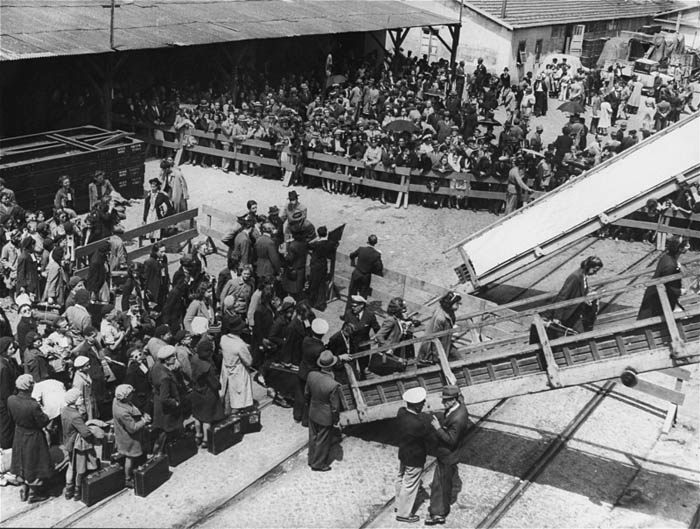
Jewish refugees board the SS Mouzinho for the voyage to the United States. Among these refugees is a group of Jewish children recently rescued from internment camps in France. Lisbon, Portugal, ca. June 10, 1941.

An old manuscript, never published, was unearthed, its contents digested by a relative, then finally published seventy years after it was written painstakingly by hand, under a dire and constant threat, during the Second World War by an emigrant whose Jewish family from Ukraine had sought haven in France during the Russian Revolution, but whom the Nazi juggernaut caught up with, when the writer was deported to Auschwitz, where she died in 1942.

Irene Nemirovsky, a Sorbonne graduate, had attained some measure of fame as a novelist with her succession of novels in France. The world knows her now as the author of Suite Francaise, a moving account of the panic and fear that enveloped the French when they were forced to understand that the impossible had occurred; their defending French military had been defeated by the advance of the Axis military.

She described the suffering of ordinary civilians fleeing their fears of occupation and death, and meeting it when German and Italian warplanes flew over congested highways packed with terrified migrants, bombing and strafing, or awaiting the arrival of trains to take them further into the countryside and imagined safety, only to have them bombed, and they within the rail stations.

Reading her novelistic account of the history of the time during the Nazi invasion of France, turns the reader's mind to the dreadful suffering of the Syrian people at the present time, caught between an armed insurrection comprised of rebel forces contesting the legitimacy of the Alawite Baathist regime of President Bashar al-Assad whose war machine answers the challenge of those they describe as "terrorists" by aiming their deadly artillery at their own civilian populations.

That there are indeed within the forces of the rebels, jihadists whose deadly pursuit of extreme violence to be committed against all those whose brand of Islam does not match their own, and who victimize people indiscriminately for the sheer love of vicious bloodshed in the commission of their fanaticism to uphold the vision of pure Islam, is undeniable.

Humanitarian aid agencies and United Nations observers give testimony to the plight of fleeing men, women, children and the elderly and the injured from the deliberate fog of war. One million estimated to be internally displaced, and two million become refugees in bordering countries themselves fearing the overlap of hostilities that might succeed in sucking them into the vortex of war through tribal antipathies and sectarian reactions.
Syrian  refugees arrive at the Turkish town of Yayladagi,  where two camps have been set up
Syrian refugees arrive at the Turkish town of Yayladagi, where two camps have been set up   Picture: David Rose

Labels: , , , , , , , , ,

Sunday, March 24, 2013


A shocking series of brutal attacks has led to a national debate on sexual violence. The Observer asked a group of young men in Goa for their views. The talk revealed a disturbing mindset

24 March 2013
Indian woman at food stall
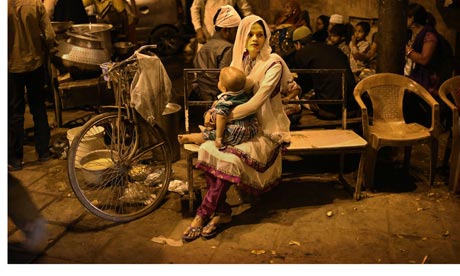
A woman waits at a food stall in Delhi. Many in the country say women should not be allowed out at night on their own. Photograph: Kevin Frayer/AP
 
"Rape is a big, big problem. It starts with the woman. They drive the man fucking crazy." Papi Gonzales leans back in his chair and surveys the other young Indian men around the table in his beach bar, seeking approval. They nod in agreement, eager to make their own points. "When the girls look sexy and the boys can't control themselves, they are going to rape. It happens," said Robin Shretha, one of the waiters.

Since a 23-year-old medical student was gang-raped on a bus in Delhi in December and later died in hospital from her injuries, the issue of rape has been hugely prominent in India. Last week headlines were dominated by the gang rape of a Swiss woman on a cycling holiday in Madhya Pradesh. In the same week a British woman leapt from her hotel window in the northern city of Agra at 4am to escape the unwanted attention of the hotel manager, who was trying to get into her room.

According to government figures, a rape takes place in India every 21 minutes. The number of reported rapes rose by 9% in 2011 to 24,000. Yet conviction rates are falling, down to 26% in 2011.
The recent cases have led to worldwide outrage, and demonstrations led by women have filled the streets of major cities. But what do India's young men think? The Observer gathered a group in the western region of Goa to hear their views. They were: Abhijit Harmalkar, 28, a driver; his brother, Avinash, 24, a factory worker; Bhivresh Banaulikar, 26, an auditor; Brindhavan Salgaonkar, 20, a factory worker; Robin Shretha, 21, a waiter; and Papi Gonzales, 32, the owner of the bar.

One word to describe their views would be "unreconstructed". Others would be "alarming" and "frightening". Plenty of Indian men have joined the recent demonstrations. Plenty of Indian men are committed to the cause of women's rights. But this discussion revealed the deep moral conservatism of some young Indian males, coupled with confusion about gender roles in a society where economic modernisation is outstripping social attitudes.

We are getting the blame, these men claimed, while no one is paying attention to the actions of young women, who need to understand that they should not be out on their own at night. "Our culture is different," said Abhijit Harmalkar. "Girls are not allowed outside after six [pm] because anything can happen – rape, robbery, kidnaps. It is the mentality of some people. They are putting on short and sexy dresses, that's why. Then men cannot control themselves."

Banaulikar nodded. "I have a sister. If she is out late at night, then I would be worried. After 7pm I would be worried. Men can't control themselves."

The men sit around a table in a bar overlooking the Arabian Sea. It is an idyllic scene: coconut palms edge the beaches, the sea is a deep blue, the temperature in the mid-30s. It is mid-morning, but already there are a few western tourists wandering along the beach – the men bare-chested in shorts, many of the women in bikinis. Groups of local men watch the women, discreetly taking pictures with their phones. When night falls, nearby bars will be packed with young people. This bar is only a couple of miles from where the body of British teenager Scarlett Keeling was found five years ago.

The 15-year-old had been raped and murdered. An on-off court case against two men has dragged on for years. No one believes that those responsible will face justice, and there appears to be no impetus among those in authority in the state to bring it to a conclusion. The truth is that in India there are many people who think a 15-year-old western girl out drinking in bars in the early hours of the morning was asking for trouble.

This collection of young men is a small, random sample, and plenty of Indians would find their views abhorrent. Foreigners thinking of visiting India – particularly young women – will find these views not only repulsive, but dangerous. Though this is a small sample, it is telling that they speak so openly, and it is clearly the case that other young Indian men would express similar thoughts – even if large numbers of their compatriots would find them shocking.

Sometimes the women lead the men on, those around the table said. Sometimes men are frustrated that women who have earlier flirted with them then ignore their advances. This is not how they themselves behave, but this is what happens, they said. "The Indian girls who come here, they don't behave, maybe there are some boys and the rape happens," said Shretha. "But sometimes they are not behaving sexy, not talking to the boys, and the boys are angrier and they think, 'I'll rape'.
"If they find them in a blind place, they are going to combine together with friends and they are going to rape them. If they [the women] talk nicely, they are OK. If they behave rudely, then they [the men] are going to be angry."

This group, while expressing these views, still maintain that the idea that women are second-class citizens in India is out of date. Everyone is equal now, they said, with women going out to work and making money too. "Before, for many years, girls were neglected, boys got opportunities. Girls did not get opportunities, but now it is equal. It is a new generation, no difference between girls and boys," said Shretha. Their notion of "equality" is impossible to square with the casualness with which they understand and even expect young men to visit sexual abuse on women.

The trouble is, they claim, that this new assertiveness among women is causing confusion for the men. "The main thing is the bank balance. Women are in love with the bank balance," said Gonzales. "And a nice shiny car. Then everything is OK," said Salgaonkar. "You should not blame the boys every time," said Banaulikar. "If you have four girls, sometimes one is a prostitute type," said Avinash Harmalkar. "The others don't know their friend is a prostitute. It is common in college life," he claimed.

Such attitudes are not unusual. Abhijit Mukherjee, the son of president Pranab Mukherjee, himself an MP with the ruling Congress party, dismissed protesters after the Delhi rape as "dented and painted women". And religious guru Asaram Bapu suggested that the victim was not blameless, asking provocatively: "Can one hand clap?" Maybe if there were more prostitutes, there would be fewer problems for young women, the men suggested. "It keeps men happy," said Gonzales. "In Bombay, there are 20 places that I go sometimes. There are hundreds of places there. In Goa there are no places like that. And when we see the goras [whites] showing their bodies off, the Goan people react badly."

One answer, said the men, would be for the women's families to be stricter, preventing them going out at night. That is the traditional solution to keeping girls safe. "In Indian culture, our generation has grown up with respect for families," said Gonzales. "That's why we are scared of our parents. We behave as we are told to behave. Mum and Dad shout 'do this, do that' and we listen. But in the next generation everything has changed."

"Parents should stop the girls going out late at night," said Avinash Harmalkar. "Parents should set them free to live their own life, but parents should be strict about late nights, then this kind of crime will not happen." None of the men could understand why the medical student and her boyfriend had taken a bus in Delhi alone at night, the bus on which they were attacked. "At night-time no one goes in the bus," said Salgaonkar.

"You don't go as a single boyfriend and girlfriend in a late bus at 8.30pm. At that time anything can happen, because no one is in the bus," said Harmalkar. As for men who assault women on crowded buses, which happens frequently, they do so because they have the safety of numbers, he said, and because they don't understand that what they are doing is wrong. "They can't have a girlfriend. If they had a girlfriend they wouldn't act like this. In fact, if they had a sister they would not do this," said Salgaonkar. It was not the rape itself that provoked such anger, he said, but the violence. "The boys who raped her also violated her with a steel rod. If it was only sex, they would not have been so angry."

No one around the table had a simple solution, though Banaulikar said that the only way to stop rape was to keep young people busy and off the streets. "In my job I am always busy," he said. "I don't have time to do these things. If you keep them busy, you can stop them. It is the jobless men who are doing these things.

"If they see others doing this stuff, they copy them. It is the same for the girls. In the daytime she is a good girl, but no one knows what she does at night, and she persuades her friends to do the same." Parents should teach the difference between right and wrong, they said, and also schools.

Then there was the world of higher education, seen by these men as little more than dens of iniquity. "College life is different," said Avinash Harmalkar. "Anything can happen there. Girls and boys know everything about sex. The girls go from boy to boy."

Banaulikar added: "Some girls are doing things for money. They use the boy and then throw them away. So some boys are taking revenge. If someone wants to have sex, no one can stop them. And if you do not want to have sex, people will say you are not a man."

For anyone interested in the promotion of women's rights in India, this was an alarming, even frightening discussion. Last week the lower house of parliament passed new rape laws, which include the death penalty for the most extreme cases, and introduced punishments for stalking and assaulting women. But the all-male conversation by the sea in Goa ended on a note that did not offer much hope for the thousands campaigning on the streets for an end to sexual violence. "Nothing will be changed," said Avinash Harmalkar. "Things like this happen every day and nothing will be changed. Only if the world ends will anything change."

Labels: , , , , , ,

Friday, February 22, 2013

White Rose: The Germans who tried to topple Hitler

Lilo Furst-Ramdohr in 1942 - and today (picture: Domenic Saller)
Seventy years ago today, three German students were executed in Munich for leading a resistance movement against Hitler. Since then, the members of the White Rose group have become German national heroes - Lilo Furst-Ramdohr was one of them.

In 1943, World War II was at its height - but in Munich, the centre of Nazi power, a group of students had started a campaign of passive resistance.

Liselotte Furst-Ramdohr, already a widow at the age of 29 following her husband's death on the Russian front, was introduced to the White Rose group by her friend, Alexander Schmorell.

"I can still see Alex today as he told me about it," says Furst-Ramdohr, now a spry 99-year-old. "He never said the word 'resistance', he just said that the war was dreadful, with the battles and so many people dying, and that Hitler was a megalomaniac, and so they had to do something."

What was the White Rose?

Hans and Sophie Scholl, members of the White Rose resistance group
  • Resistance group formed in 1942 by group of Munich University students and their professor
  • Horrified by Nazism, they wrote and distributed leaflets urging Germans to oppose Hitler's regime
  • Also painted anti-Nazi slogans on buildings around Munich
  • Produced six leaflets before their arrest
Schmorell and his friends Christoph Probst and Hans Scholl had started writing leaflets encouraging Germans to join them in resisting the Nazi regime.

With the help of a small group of collaborators, they distributed the leaflets to addresses selected at random from the phone book.

Furst-Ramdohr says the group couldn't understand how the German people had been so easily led into supporting the Nazi Party and its ideology.

"They must have been able to tell how bad things were, it was ridiculous," she says.
The White Rose delivered the leaflets by hand to addresses in the Munich area, and sent them to other cities through trusted couriers.

Furst-Ramdohr never delivered the leaflets herself but hid them in a broom cupboard in her flat.
She also helped Schmorell make stencils in her flat saying "Down with Hitler", and on the nights of 8 and 15 February, the White Rose graffitied the slogan on walls across Munich.

Furst-Ramdohr remembers the activists - who were risking their lives for their beliefs - as young and naive.

One of the best-known members of the group today is Hans Scholl's younger sister Sophie, later the subject of an Oscar-nominated film, Sophie Scholl: The Final Days. Furst-Ramdohr remembers that Sophie was so scared that she used to sleep in her brother's bed.
The sixth leaflet produced by the White Rose was smuggled out of the country and scattered over Germany by Allied planes. 

The day of reckoning has come, the reckoning of German youth with the most repellent tyranny our nation has ever seen... 

For us there is only one slogan: Fight against the Party! Get out of the party hierarchy, which wants to keep us silent!

The German name will be dishonoured forever if German youth does not rise up, to revenge and atone at once, to destroy their tormentors and build up a new spiritual Europe. Students! The German nation looks to us!
Translation: Lucy Burns
 
"Hans was very afraid too, but they wanted to keep going for Germany - they loved their country," she says.

On 18 February, Hans and Sophie Scholl set off on their most daring expedition yet. They planned to distribute copies of their sixth - and as it would turn out, final - leaflet at the University of Munich, where students would find them as they came out of lectures.

The siblings left piles of the leaflets around the central stairwell. But as they reached the top of the stairs, Sophie still had a number of leaflets left over - so she threw them over the balcony, to float down to the students below.

She was seen by a caretaker, who called the Gestapo. Hans Scholl had a draft for another leaflet in his pocket, which he attempted to swallow, but the Gestapo were too quick.

The Scholl siblings were arrested and tried in front of an emergency session of the People's Court. They were found guilty and executed by guillotine, along with their friend and collaborator Christoph Probst, on 22 February 1943.

Hans Scholl's last words before he was executed were: "Long live freedom!"
A copy of the sentences against members of the White Rose at the Munich district court The Scholls were tried at the People's Court of Law, now Munich's district court
 
The rest of the White Rose group was thrown into panic. Alexander Schmorell went straight to Lilo Forst-Ramdohr's flat, where she helped him find new clothes and a fake passport. Schmorell attempted to flee to Switzerland but was forced to turn back by heavy snow.

Returning to Munich, he was captured after a former girlfriend recognised him entering an air raid shelter during a bombing raid. He was arrested, and later executed.

Lilo Furst-Ramdohr was herself arrested on 2 March. "Two Gestapo men came to the flat and they turned everything upside down," she says.

"They went through my letters, and then one of them said 'I'm afraid you'll have to come with us'.
"They took me to the Gestapo prison in the Wittelsbach Palais on the tram - they stood behind my seat so I couldn't escape."

Sophie Scholl's grave
Lucy Burns interviewed Liselotte Furst-Ramdohr for the BBC World Service programme Witness

Furst-Ramdohr spent a month in Gestapo custody. She was regularly interrogated about her role in the White Rose, but eventually released without charge - a stroke of luck she puts down to her status as a war widow, and to the likelihood that the Gestapo was hoping she would lead them to other co-conspirators. After her release she was followed by the secret police for some time. 

She then fled Munich for Aschersleben, near Leipzig, where she married again and opened a puppet theatre.

The final White Rose leaflet was smuggled out of Germany and intercepted by Allied forces, with the result that, in the autumn of 1943, millions of copies were dropped over Germany by Allied aircraft.
Since the end of the war, the members of the White Rose have become celebrated figures, as German society has searched for positive role models from the Nazi period.

But Furst-Ramdohr doesn't like it. "At the time, they'd have had us all executed," she says of the majority of her compatriots.

She now lives alone in a small town outside Munich, where she continued to give dancing lessons up to the age of 86.

Her friend Alexander Schmorell was made a saint by the Russian Orthodox church in 2012.

"He would have laughed out loud if he'd known," says Furst-Ramdohr. "He wasn't a saint - he was just a normal person."

Labels: , , , , , , , , ,

Saturday, February 09, 2013

The New South Africa

"Somehow, somewhere there must be a tipping point where society is so convulsed by a collective anger over rape that we begin to turn the tide against this terrible scourge.
"Each of us needs to ask what we can do to stop this awful trend. And then we must act accordingly. You can help."
"Stand up. Speak out. Help us turn this evil around once and for all."
Makhuda Sefara, South Africa Citizen
Sexual violence, brutal rape against women and children is so common in South Africa that when the present head of the African National Congress, and then-presidential candidate, Jacob Zuma was accused of having raped a woman who regarded him as an uncle, an old family friend, he was elected to the post of the country's president, regardless. This is a man so ignorant that he claimed he protected himself against AIDS by showering after raping the HIV-positive young woman.

One in four women in the country is raped. And it is not only mature women who are viciously violated. Babies of several months of age, as well as 94-year-old grandmothers meet similar atrocities. Studies of the phenomenon substantiate these events; they are not claims or allegations meant to embarrass the country or portray it in a condemnatory light. These are actual cases, and this is what afflicts its society.

The Talk Radio 702 station reminds its listeners of this part of their culture every four minutes to inform them that statistically another and another and yet another child or woman in their country is being raped. The station has undertaken its own campaign, hoping to deliver a message that should shock the country into a response. That a popular movement would emerge to condemn and begin an assault on the noxious crime.

India's mass revulsion over the dreadful gang rape and subsequent death of a 26-year-old woman on a bus, drew attention to that country's horrible statistics on the prevalence of sexual abuse of Indian women. India, with its population of 1.2 billion people reported 24,206 rapes in 2011. Needless to say that figure hardly represents the true number of women molested and raped in that country, but it is an institutional yardstick.

In contrast, and without doubt equally under-reported, South Africa with its far lesser population of 50-million people officially reported two and a half times that number of rapes occurring in the last year of report statistics.  Lindiwe Mazibuki, an opposition politician in South Africa spoke of "a silent war against the children and women of this country ... We live in a deeply patriarchal and injured society where the rights of women are not respected."

What this unspeakable cultural practise represents is a crime against humanity. And the ultimate hypocrisy: President Jacob Zuma stated his personal  opinion and official position: "that government would never rest until the perpetrators and all those who rape and abuse women and children are meted with the maximum justice that the law allows."

That can be taken as a guarantee that never again will an atrocity as horrible as the one that saw a gang rape of a teenager mutilated with her body carved open from her stomach to her genitals, left for dead, occur. That 17-year-old girl's mutilation was so dreadful that the doctors who tried to save her life and the nurses in the operating theatre are undergoing trauma counselling.

Labels: , , , ,

 
()() Follow @rheytah Tweet