Blog dedicated primarily to randomly selected news items; comments reflecting personal perceptions
Tuesday, November 01, 2022
Linking Hearing Loss and Dementia
"It's really common, it's treatable, and there are interventions that come at no risk [that are underutilized]."
"[Preserving the ability to hear is foundational to public health] strategies that can best optimize the health of older adult populations, so older adults are living a long and full life 'till the very, very end."
"[Like daily step count, cholesterol level or weight], it's another metric that you would know about a dimension of your own health."
Dr. Frank Lin, director, Cochlear Center for Hearing and Public Health, Johns Hopkins Bloomberg School of Public Health
Global statistics tell us that worldwide, over 50,000 million people since 2019 are living with dementia. The forecast to the year 2050 is that the number will rise to over 130 million people in an aging population coping and living with dementia. Middle age hearing loss beginning at age 45 to 66 is considered by science to represent a significant risk factor for dementia. Hearing loss accounts for over eight percent of all dementia cases.
A Lancet report published in 2020 calculated that hearing loss generally doubles risk of dementia, similar to the increased risk caused by traumatic brain injury. Since hearing ability exists on a continuum, subclinical hearing loss can also contribute to a greater risk for dementia arising. According to Dr. Frank Lin, director of the Cochlear Center for Hearing and Public Health, remedially addressing hearing loss is a superior method of reducing the occurrence of dementia.
There is a hypothesis that suggests poor hearing increases the cognition load on the brain which in turn needs to work harder at the expense of other mental faculties in its attempt to decipher the garbled signals ears send to the brain when they're compromised. On the other hand, those with hearing loss and declining cognition struggle as well on tests not dependent on hearing, according to Dr. Tim Griffiths, professor of cognitive neurology, Newcastle University, Britain.
Animal model research and those with humans find that loss of hearing causes the brain to atrophy faster, particularly in the temporal lobe, possibly as a result of diminished use and lack of stimulation. Aberrant activity in the temporal lobe may also be caused by hearing loss, rendering it more susceptible to damage and pathologies associated with Alzheimer's disease, explains Dr. Griffiths.
Hearing loss -- the inability to connect with others -- can lead to social isolation, loneliness and depression, all factors known for the risk of dementia onset. The cochlea's sensory cells in the inner ear leads us to hear. Hair cells are sensory cells that translate the vibration of sound waves hitting eardrums into electrical signals sent to auditory regions of the brain to be decoded into sound.
Once hair cells become degraded or expire, the signals sent to the brain become garbled. Hair cells cannot be regenerated. Preliminary studies appear to affirm that the use of hearing aids tend to protect against dementia. Dr. Lin at the Johns Hopkins Bloomberg School of Public Health currently leads a large, randomized controlled trial with close to a thousand older adults in anticipation that the answer will more definitively emerge as to whether treating hearing loss with hearing aids reduces risk of cognitive decline.
"We don't really have a [positive] handle on why they're more transmissible [newly emerged mutant strains of SARS-Cov-2 virus], so what aspect of general prevention is most important is not yet clear."
"There's a lot of really cruddy masks, like the ones that are most comfortable to wear, are extremely breathable and not very good at filtering, and that's why they're more comfortable."
Dr.Lynora Saxinger, infectious diseases expert, University of Alberta
"I think what we have to keep in mind is, even though they [new virus strains] may be more transmissible, the way they're transmitted is still the same -- so it's still coughing, sneezing, those kinds of things."
The basic measures are still the things that are going to help to prevent transmission."
"Everyone would like the vaccine rollout to be much faster than it has been, because I do think that's going to go a long way in helping to prevent the spread of this variant. What are we left with? Well, we're left with unfortunately having to do the same things that we've done over the last eight, ten, twelve months."
"If we can actually decrease transmission, then we're going to decrease the ability for the virus to be replicating and therefore decreasing the chance that it's going to develop a mutation that is significant."
Dr.Stephanie Smith, infectious diseases expert, University of Alberta
As vaccine coverage surges in Israel, scientists are watching virus transmission and variants closely.Credit: Emmanuel Dunand/AFP via Getty
The virus variants of SARS-CoV-2 are proving to be infinitely more contagious than the original virus. The U.K. version, as an example, has now become the dominant virus infecting people in far greater numbers than the original virus, in the United Kingdom. That variant has begun to make inroads abroad and Canada is no exception to its entry, leaving health authorities to warn of the potential for vastly increased contagion via the variants. They have the capacity to spread more effectively and more widely than the original that has caused worldwide disruption of every facet of daily life, private and public.
Public health officials in Ontario have given warning that beyond a 'transient' exposure to the variant identified as coming from the U.K.; a hand briefly outstretched and touching that of a cashier in the supermarket handing you your receipt or a bag, or happening to walk past an infected person in a hallway offer the potential of instant transmission of the virus eager to invade as many human bodies as it can to wildly replicate itself and continue contaminating other hosts in a deadly cycle of mass contagion.
What was once common interchanges between people has now become high risk exposure. Three variants have distinguished themselves out of the hundreds that may have over time developed harmlessly; those three are anything but harmless in the characteristics they have developed to make them even more communicable and possibly more lethal; they are identified as the U.K. variant that emerged first in the fall of 2020, another variant that came out of South Africa in December, and more recently a third variant from Brazil, first identified in early January.
Each of these variants have found their way into Canada; the first to emerge in greater numbers than the last whose initial presence has just now been detected, and thought to be the most dangerous of all, to date. Case counts for these variants are still relatively low, in the hundreds, but their presence represents an alarming uptick in prevalence and danger coming on line, persuading the medical/scientific community of the need to begin screening all positive cases for their variant genomes.
According to evidence leading to studies, the U.K. variant's mutation is such that it latches more readily to human cells with some estimates placing the variant transmission capacity at around 50 percent and more -- greater than the original virus. The larger concern over these variants is the possibility that as well as being far more infectious, they are also deadlier, a fear that is yet to be fully established according to the Centers for Disease Control and Prevention in the United States.
Whether or not the vaccines now being used globally are capable of working as well with the variants to help prevent illness or infections from these vaccines is also yet to be established, but early studies appear to indicate that such properties tend to vary from vaccine to vaccine. In any event, the best advice health and government authorities stress is to carry on with the established protocols of distancing, mask-wearing and hand hygiene. Hanging in until vaccines arrive in sufficient doses to immunize the entire population.
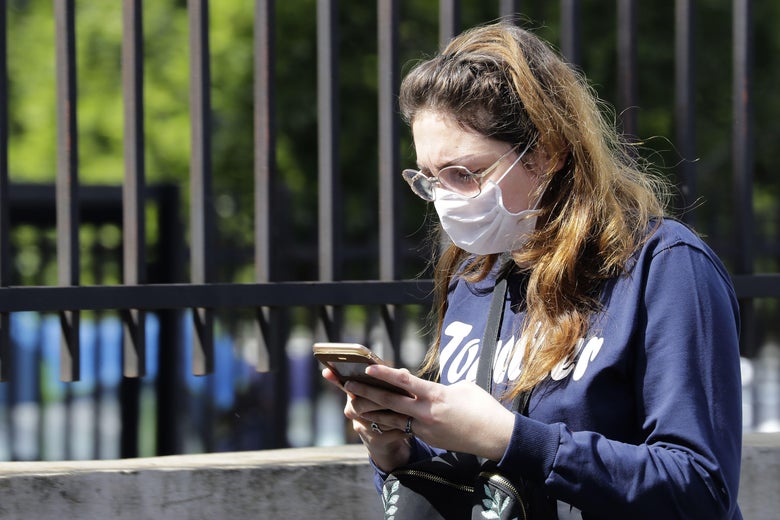
The broad measures currently expressed as the best possible methods of avoidance; relying on distant contact with others is seen to be the most effective tool to avoid transmission, for the general public. Three-layer masks come highly recommended, the middle layer meant to filter out really fine particles. Failing that, the standardized medical masks. Although it remains unclear what may occur next with the variants, reaction and adjustment accordingly is paramount: "It throws a wrench into the whole reopening plan a little bit", mentioned Dr.Smith ruefully.
Multiple variants of the virus that causes COVID-19 are circulating globally:
The United Kingdom (UK) identified a variant called B.1.1.7 with a
large number of mutations in the fall of 2020. This variant spreads more
easily and quickly than other variants. In January 2021, experts in the
UK reported that this variant may be associated with an increased risk
of death compared to other variant viruses, but more studies are needed
to confirm this finding. It has since been detected in many countries
around the world. This variant was first detected in the US at the end
of December 2020.
In South Africa, another variant called B.1.351 emerged
independently of B.1.1.7. Originally detected in early October 2020,
B.1.351 shares some mutations with B.1.1.7. Cases caused by this variant
have been reported in the US at the end of January 2021.
In Brazil, a variant called P.1 emerged that was first identified in
travelers from Brazil, who were tested during routine screening at an
airport in Japan, in early January. This variant contains a set of
additional mutations that may affect its ability to be recognized by
antibodies. This variant was first detected in the US at the end of
January 2021.
These variants seem to spread more easily and quickly than other
variants, which may lead to more cases of COVID-19. An increase in the
number of cases will put more strain on health care resources, lead to
more hospitalizations, and potentially more deaths.
"Unless you treat your phone the same way as your hands, it's hard to keep all three clean." "A petri dish in your pocket [is the description that PhoneSoap website uses to describe the viral breeding state of a cellphone]." "Warm places like pockets and purses are breeding grounds for bacteria." Dan Barnes, co-founder, Mashable
"Specifically, mobile device hygiene was a major and fast-growing concern even before coronavirus came on the scene." Taylor Mann, CEO, CleanSlate UV
Clean your phone.
Joseph Eid/AFP via Getty Images
Both UV lights and anti-bacterial wipes are equally effective in sanitizing a cellphone, according to a study by MIT. Evidently, however, all UV sanitation do not clean phones in the very same manner, and they don't reduce like amounts of bacteria lodged on the cellphone.
Crunchbase News reported UV sanitizing companies everywhere are noting a dramatic rise in the sales of their devices. PhoneSoap's sales have grown exponentially, about 1,000 percent year over year the past week alone. CleanSlate UV based in Toronto, has managed to raise $2 million in start-up funding. The global hysteria over contracting COVID-19 has alerted people to become more vigilant in protecting themselves from infection.
Up to the present, very few people thought to bother cleaning their cellphones. It simply wasn't considered necessary. Despite that cellphones are in continual use, and the fingers that fly over cellphones also touch all manner of public surfaces, readily conveying whatever pathogens might be present to the very personal device that never leaves the possession -- and the hands -- of the owner.
Pick up viruses, bacteria, spread them on the cellphone unknowingly, and just tuck it safely away in a pocket or purse. Allowing the pathogens to find a nice warm haven, a perfect growth environment.
So, while Health Canada and the Centre for Disease Control caution the public to be aware that there are certain steps to be taken to avoid contracting COVID-19, and the most effective is to carefully wash hands for at least 20 seconds, lathering in the soap and reaching every digit, every fold of skin before rinsing, and once done, a sigh of relief. Then, out with the cellphone and re-contaminate those nice clean hands after which rub your eyes, scratch your chin and smooth your lips. Gotcha!
If maintaining clean hands in the prevention of infection is important, then cleansing the item of possession that most often finds its way into those hands is critically important. Of course the cleaning technique will be somewhat different. You're not about to immerse your cellphone in warm, soapy water, not if you intend to preserve its usefulness. PhoneSoap which sells UV sanitizing devices for phones conducted a new study and its finding was that the surface of the average device is no less than 18 times more soiled than a public washroom.
PhoneSoap UVC Cleaner
Of all the various categories of ultraviolet light -- A, B and C -- it is C only which is strong enough to kill germs, with its wide range of effectiveness. Different light modes for strength of purposeful cleansing is a feature of most UV-C cleaning devices. However, the light penetrates only superficially and is most effective on surfaces that are smooth. Germs securely in place beneath a button, or finding haven in a phone case, are germs the light misses.
Isn't modern technology truly wonderful? Nature throws another zoonotic infection at the world and medical science has to scramble to figure out how to meet another new public health challenge, but the science of technology isn't far behind, presenting ever-new gadgets to help us deal with avoiding transmission of said infections. But just as humanity is grateful for pharmaceuticals that help us live with dire health conditions, there always seem to be downsides, as in drugs with their side effects. UV-C exposure over a long term may have health effects technology and science are not yet aware of.
Oh, and while we're at it, think of all those other metal and plastic objects that we're in frequent contact with on a daily basis. Keyboard, headphones, house/vehicle keys. Don't dip your keyboard in soapy water, but do by all means, scrub those house/vehicle keys on occasion, to remove the nasty bacteria you'll be certain to have picked up over time, without ever considering the possible effects on your well-being...
"If you are able to identify inflammation in the arteries of the
heart then you can say which arteries ... will cause heart attacks. With the new technology that we have we can achieve this by analyzing simple CT scans." "[Until now physicians could only see the] tip of the iceberg [with respect to heart risks]." "It [new scans to detect alterations to blood vessels] is massively important because it will direct treatment and it will save lives." "A machine can read the scan and give you the accurate information. It can give you the specific risk of the patient. It can tell you that you need treatment or you don't need treatment." "Just because someone’s scan of
their coronary artery shows there’s no narrowing, that does not mean
they are safe from a heart attack. By harnessing the power of AI,
we’ve developed a fingerprint to find ‘bad’ characteristics around
people’s arteries. This has huge potential to detect the early signs of
disease, and to be able to take all preventative steps before a heart
attack strikes, ultimately saving lives." "We genuinely believe this technology could be saving lives within the next year." Professor Charalambos Antoniades, Oxford Division of Cardiovascular Medicine
"Every five minutes, someone is admitted
to a UK hospital due to a heart attack. This research is a powerful
example of how innovative use of machine learning technology has the
potential to revolutionize how we identify people at risk of a heart
attack and prevent them from happening." "This is a significant
advance. The new ‘fingerprint’ extracts additional information about
underlying biology from scans used routinely to detect narrowed
arteries. Such AI-based technology to predict an impending heart attack
with greater precision could represent a big step forward in
personalized care for people with suspected coronary artery disease." Professor Metin Avkiran, Associate Medical Director, British Heart Foundation
A breakthrough scan can predict the risk of heart attacks up to nine years in advance, experts claim Credit: Getty - Contributor
A new study funded by the British Heart Foundation and published in the European Heart Journal holds great promise in helping to avert heart attacks in potentially huge numbers of people susceptible to heart disease. In Britain alone it is estimated that 350000 people annually could receive benefits from the new protocol which was found to be close to 90 percent accurate.
Oxford University researchers used artificial intelligence to peer "beneath the surface" of CT scans to identify changes to heart-supplying blood vessels. The new scan protocol could be in operation in at least two years -- doing its part to make certain that high-risk patients are prescribed specific treatments designed for their needs and which are meant to avert potential heart problems. People between the ages 40 to 70 experiencing chest pains, or those who are considered on the basis of conditions such as obesity, smoking or diabetes to be at high risk will be offered the scans. At the present time, the success rate with routine CT scans reflecting blockages for people experiencing chest pains has been found to be useful in around 25 percent of cases. Most of these patients are sent home without treatment, while some are offered surgery. Many of the patients will at a later date have a heart attack and it is foreseen that the new technology, able to detect a dangerous buildup of fat and scarring around the heart up to nine years before dangerous levels are reached, will be of enormous help in deterring such heart attacks. In the case of those patients considered to fall into a high-risk category, medication and closer monitoring can be prescribed in prevention of a deadly episode occurring. Deaths from heart attacks and other heart complications remain the number one killer of people on a global scale. Should the new AI-assisted scan prove to have the utility and accuracy that the study indicates, it would represent a great leap forward in decreasing the numbers dying of heart attack.
A patient receives a CT scan at Buda Health Centre in Budapest, Hungary, June 27, 2019.Tamas Kaszas /Reuters
"Those with type-O blood are about twice as attractive to mosquitoes as those with type- A, with type-B somewhere in the middle." "Your skin bacteria can have an influence. We all have lots of different skin bacteria, but some are more attractive and [alternately] repulsive to mosquitoes. Heat is also important, so if you're the sort of person who tends to be running a little warmer than others, you probably attract mosquitoes a bit more." "The classic advice is covering up. Humans are large, warm, and easy to spot. When it's warm, we're wearing shorts, T-shirts, and swimming costumes, so we have this perfect storm of behaviour." "Darker colour and reds might make you easier to spot because mosquitoes have quite good eyes." Professor Adam Hart, entomologist, University of Gloucestershire, Britain "If you're outside at a time of day when insects are particularly active, such as sunrise or sunset, cover your skin wearing loose sleeves and trousers and wear shoes, not flipflops when outdoors." "The bite causes inflammation, which causes itching. If you scratch it, it'll make the inflammation worse." "And you may break the skin. The bite is a microscopic puncture, but if you scratch and scratch it then pretty soon you'll open the skin a lot more, and end up with secondary infections. The best advice is always the boring advice: not to scratch." Dr. Nick Scriven, president, Society for Acute Medicine, UK
Like so much else, your genetics mandate how attractive mosquitoes will find your presence. Anyone who is a secretor ; whose saliva contains their blood type antigens; is more likely to be bitten by mosquitoes. One in five of a population are non-secretors, the lucky ones that don't attract the attention of mosquitoes. Famously it is female mosquitoes who bite to extract blood to enable them to lay their eggs to reproduce.
Sweat enables mosquitoes to detect warmth and chemicals and to track carbon dioxide that mammals exude. Metabolic rate affects susceptibility to mosquito bites; giving off higher levels of carbon dioxide is a guaranteed attractor to mosquitoes. Pregnant women with their higher-than-normal breath rates are consequently more prone to mosquito bites. Resting metabolic rate is raised as well, after drinking alcohol as well as post-exercise.
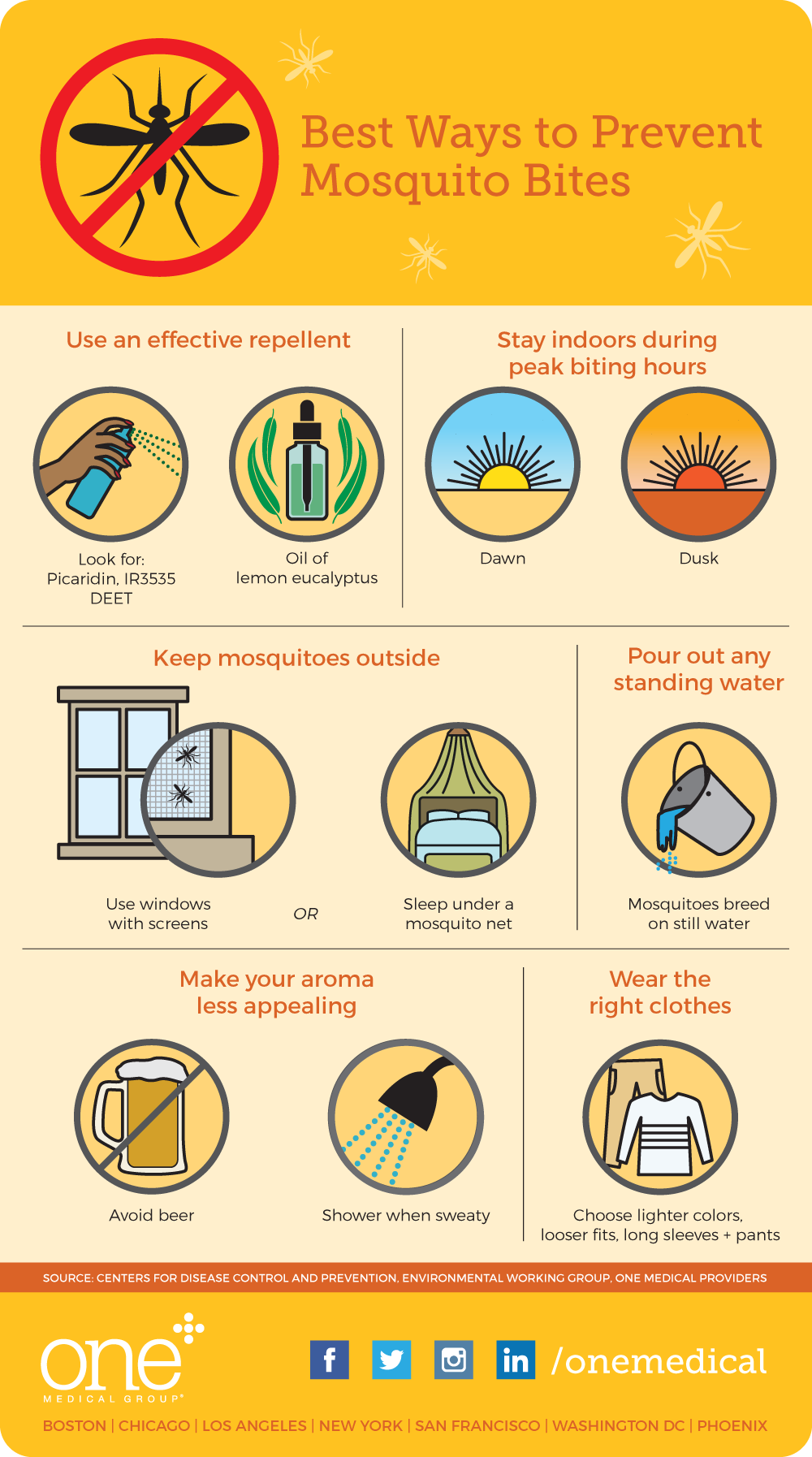
Avon's Skin So Soft gained a reputation as an effective mosquito repellent due to the citronella it contains. But Professor Hart's professional advice is to use repellents containing DEET, a liquid that people would prefer to avoid, citing its unpleasant odour. The imperative is to prevent mosquito bites "...they are really driven to feed on you. People think, 'Oh, we'll get away with it this time', but you probably won't", advises Dr. Hart.
DEET
Picaridin
IR3535
Oil of lemon eucalyptus (OLE)
Para-menthane-diol (PMD)
2-undecanone
Cover up: Wear long-sleeved shirts and long pants.
Keep mosquitoes outside: Use air conditioning, or
window and door screens. If you are not able to protect yourself from
mosquitoes inside your home or hotel, sleep under a mosquito bed net.Centers for Disease Control and Prevention, U.S.
The itchiness can be relieved with the use of antihistamines. Alternatively an ice cube placed directly on the bitten area of the skin serves to soothe the affected area. Also recommended by Dr. Hart is "that old faithful, Anthisan cream and just washing the bite with soap and water". Oil-based "bite ointment", comprised of lavender oil, coconut oil and beeswax has been produced by a number of pharmaceutical companies even though Dr. Hart "can't find any studies" testing lavender oil.
Additionally, Britain's National Health Service warns -- tea tree oil, herbal remedies, garlic and yeast extracts or anti-mosquito buzzers are all a waste of time and money and hope. None of them are known to be effective, despite the glowing promises of efficacy.
"There is a point where I feel cognitively drained; after about twenty patients, there is not an iota of empathy left." Dr. Jonathan Harte, Nottinghamshire GP
"I did feel suicidal. That's what sparked my interest and desire to talk about it [physician job pressure, depression]." "A lot of people do a pretty good job of hiding it [high rate of depression among medical students, residents and doctors]." "I'm doing really well and I want people to know that recovery is certainly possible." Dr. Sarah Tulk, family doctor, Milton, Ontario
"When I did this research [for his new book] and I saw there were these
families where the [doctor] husband or wife went from well to ill, to
death, without going to anyone, like a family doctor, an internist, a
psychologist, a social worker, the clergy, a psychiatrist, none of that." "They killed themselves. And I thought, this is unprecedented in
medicine." Dr. Michael Myers, professor, clinical psychiatry, SUNY Downstate Medical Center, Brooklyn
Doctors say that burnout and stress can lead to higher rates of suicide in their profession. (David Donnelly/CBC)
"Some operations you go into knowing that you’re likely going to produce
a neurological deficit for this patient." "You do
an excellent job; you do everything right. But despite that there’s a
decent chance the patient is not going to be a perfectly happy camper at
the end of the day. And, that weighs on you." "If all the family doctors and neurologists who send me brain tumour
patients, if they all read this article [a theoretical admission of deep depression through a piece of creative fiction] and said, ‘this guy is
depressed, I better not send him any more cases,’ I could have seen a
drop in referrals." "It didn’t happen. Instead, I had people reaching
out." "So her parents [of an 18-year old patient], these lovely, lovely people, were there with their
precious daughter, who they know is probably going to die of brain
cancer before she sees her 20th birthday. If that doesn’t get you, then you’ve got to hang up your spurs and get another job. Because you can’t stop caring." "I think the bigger piece is
the workload, the bandwidth issue — the making patients wait, the
not-having-enough-hours-in-the-day …. the administrative crap, the
system imperfections, the constant worry that you’re not going to serve
patients well enough… It’s that sensation of drowning all the time. And
that’s the way a lot of doctors are functioning in our system. It’s frightening and it’s exhausting and it leads to
depression." Dr. Mark Bernstein, Toronto
Western Hospital, Neurosurgeon
In her mid-30s, Pamela Wible experienced suicidal thoughts after becoming disillusioned with the medical profession. (Submitted by Pamela WIble)
Dr. Tulk for one, began thinking suicide. The pressure while training as a resident on her way to achieving her medical degree sapped her of a normal life and normal thought processes once depression set in as a result of having to work up to 24 hours at a time. She managed to complete her residency in family medicine at McMaster University in Hamilton, but while she did so she witnessed first-hand a system that was too demanding of normally resilient people already hard-wired toward hard work through their competitive drive.
The system failed them to the extent that they became burnout victims. Victims who remain silent in the face of the misery they feel for fear that if it became known that they were unable to cope with the stress, their careers would suffer as a result of a personal 'weakness'. She, on the other hand, sought help through a physician health program, in 2016. A program geared to raising awareness and to lead to the change so badly required speaking to her own experience, leading her to become involved.
The very fact of hearing about doctors taking their own lives in despair, as a result of deep depression led her to make common cause with psychiatrist Joy Albuquerque, medical director of the Ontario Medical Association physician health program. Five critical areas relating to physician suicide were related in a paper they had published in the Canadian Medial Association Journal, where they wrote that suicide has become an occupational hazard in the medical profession.
The suicide rate for male doctors came close to doubling in comparison with suicides taking place among the general public. For female physician that rate was two-and-a-half times greater than that of the general public. Doctors, as an example, are aware of how much drugs they would need to efficiently poison themselves to death, occasionally using benzodiazepines. Firearms are also used to speed the process from an agonizing depression to death.
In their paper, Drs. Tulk and Albuquerque point out that physicians face barriers to care in comparison to care provided to the general public, among people whose suicidal thoughts can begin in medical school. Those thoughts can be associated with complaints to regulatory bodies by patients. The realization that self-care in the medical profession while negotiating the professional challenges of a medical practise has been neglected in the academic environment at medical schools has led to changes there.
Dr. Tulk herself has undertaken the teaching of undergraduate programs at McMaster University. A 2007-08 Canadian Physician Health Survey conducting a random sample of over 3,200 doctors elicited the data of close to a quarter reporting a two-week depressed-mood stint. A flattened emotional numbness called "Anhedonia" was reported by one-fifth of the group. There are 300 doctors on disability, mostly for mental illness in Ontario today.
Dr. Michael Myers, professor of clinical psychiatry at SUNY Downstate Medical Center in Brooklyn, NY, explained: "We’ve done pretty well with the general public in terms of reducing the stigma associated with going for help, but we still have so far to go in the house of medicine". He recently published a new book: Why Physicians Die By Suicide: Lessons Learned from their Families and
Others Who Cared, where he chronicles "the inner conflict and the irony of
self-destruction and despair" among doctors.
"We just really need to make it normative for physicians to get help if
there’s a problem." "We need to help them realize it doesn’t
make them a worse physician or a worse person." Dr. Katherine Gold, department of family medicine, University of Michigan
In the United Kingdom. the advice to patients is to avoid appointments to see their GPs in the afternoon since overworked doctors are empathy-drained by noon, according to research. Over half of family doctors in Britain feel the pace of their work places them above safe limits, with too many cases seen each day. Overload places patients at risk and fatigue leads to poor decisions, errors and irritability.
Pulse magazine polled 1,681 general practitioners to discover they deal, on average, with forty-one patients daily at the very time when they feel thirty patients should represent a 'safe' number. Risks to safety for patients rise as the day wears on. And concomitantly, the risk to the physician's well-being is on track to overwhelm him/her leading down the path to uncertainty that they are practising their chosen profession well.
"Because of its social acceptance, we have lost sight of the fact that continued high rates of problematic alcohol consumption are [sic] leading to a wide-range of harms." Dr. Theresa Tam, Chief Public Health Officer, Canada
"Too many physicians in this country still advise women that it's okay to drink a little bit during pregnancy." "But what does it mean to drink a little bit? Or is that just an enabling statement that says, 'Oh I really don't have to change my lifestyle because I'm pregnant'." Dr. Kwadwo Oheme Asante
Originally from Ghana, Dr. Asante came to Canada on a student visa to study science at the University of British Columbia. Following medical school in the 1970s he set up practise as a pediatrician in a large area of northwestern British Columbia and the Yukon, the only pediatric specialist in the region. His intention was to remain in the vast area long enough to pay off his medical training debt.
Soon he began seeing patients that he hardly expected to be confronted with; babies with small heads, thin upper lips, flat cheekbones. These were children missing critical developmental milestones and who would never 'catch up' to what other, normal children were achieving in their development, physical and mental. His initial thoughts were that these were children symptomatic of a chromosomal or metabolic disorder. Nothing existed in the medical literature to describe his cases.
A colleague in 1973 alerted him to a new paper published in the influential journal the Lancet produced by two pediatricians at the University of Washington, describing children exposed to alcohol in utero -- exhibiting symptoms that Dr. Asante recognized immediately. This was an era when doctors might prescribe alcohol for morning sickness, when hospitals made use of ethanol drips in the prevention of early labour. When beer was considered a nutritional drink for expectant mothers.
The medical community viewed this new information with shock since the uterus had been regarded as a protective barrier, impenetrable by harmful agents, a trust that was only shaken in the early 1960s with the advent of the anti-nausea drug prescribed for pregnant women called thalidomide which went on to produce grossly malformed limbs in babies whose mothers trustingly used the drug.
Dr. Asante set out with a team of doctors across the country for the purpose of ensuring that doctors and their patients, policymakers and the press became alerted to the risks of Fetal Alcohol Spectrum Disorder (FASD). Later studies definitively proved alcohol to pass from mother to foetus through the bloodstream, with the potential to deleteriously impact development of the central nervous system as well as sensory and immune systems, among others.
The first large-scale study on FASD surveyed over 2,500 seven- to nine-year-olds in the Greater Toronto Area was released last year, its conclusion suggesting that up to three percent of the general population could be victims of the disorder. FASD could turn out to affect greater numbers in the Canadian population than does autism and cerebral palsy together. This, at a time when social culture has changed, when more women drink, more frequently than ever.
The most recent national survey out of the Society of Obstetricians and Gynecologists of Canada estimates that 61 percent of women between ages fifteen and fifty have reported an unplanned pregnancy at a time when social drinking has been recognized as a symbol of female empowerment. A symbol that does not hesitate to lapse during pregnancy, as far as some women are concerned, resentful of being reminded that their social habit may harm their foetus.
A fifth of respondents to a survey of Canadian physicians on an online medical community, Figure 1, suggests that physicians may themselves be aiding in the normalizing of this reaction by women to alcohol consumption during pregnancy, by informing their patients that the occasional drink during pregnancy is safe. This, in startling contrast to the official position of Health Canada.
It has been well understood for close to a half century that drinking during pregnancy is harmful. Given the current social climate, it is little wonder that eradication of FASD has failed. Some children diagnosed with FASD resulting from their pregnant mothers imbibing alcohol are born with visible physical features typifying their condition, while others suffer with impaired motor and sensory control.
Embryonic stem cells exposed to low levels of alcohol "led to the abnormal development of parts of the brain responsible for executive function -- critical for self-control, organizational skills and goal attainment" according to a 2010 study out of the Emory School of Medicine in Atlanta. Drinking appears to be most detrimental during the first three to eight weeks of gestation when cells are dividing to form the baby's organs.
And during the third trimester, alcohol consumption is similarly detrimental, at a time that the brain undergoes rapid development, and when specific organ functions are being determined. Research such as this with their definitive conclusions along with the dedicated work of campaigners like Dr. Asante have led most bars and liquor stores in Canada to post prominent signs outlining the risks of drinking during pregnancy.
In the United States, warning labels are mandatory by law to be placed on alcoholic beverages, informing and reminding women of the harms that drinking results in during pregnancy. Not all children of the estimated 10 percent of Canadian mothers who flaunt this cautionary advice are born with FASD. Many risk factors for the disorder -- genetics, maternal nutrition, exposure to other toxins, poverty and trauma -- also exist, but their influence is not settled.
Just exactly how much alcohol may cause FASD, or the type of alcohol -- 13 percent alcohol red wine as opposed to 70-proof tequila may make a difference in the threat, is also unclear. Leading, according to James Reynolds, professor of biomedical and molecular science at Queen's University to an impression that only "problem" drinking places a foetus at risk.
One Figure 1 user posted the statement that "I've known fellow medical professionals who are open about their own consumption during pregnancy".
A new report found up to three per cent of Canadians could have fetal alcohol spectrum disorder. Ian Kucerak/Edmonton Sun
"People with borderline [Borderline Personality Disorder -- BPD] have a very fragile existence. Often they have volatile relationships, with impulsivity and a fear of real or imagined abandonment. They are difficult patients. They have very difficult lives. Suicide cies to the mind as a solution because life is constantly breaking into a thousand pieces. They [BPD patients] are always skating on thin ice." "They create chaos. It's hard for them not to. One of the things to do [for BPD patients] is to accept the unacceptable. This is what you have to do." "Suicide is a public health epidemic. But very little is being done. Hospitals in the '90s had more services available than there are now. It's all bare bones now." Dr. Antoon Leenaars, psychologist, suicide researcher, former president, Canadian Association for Suicide Prevention
"The scientific question is whether we know enough to predict and prevent such events. Unfortunately we don't. And that is why I have suggested working with suicidal patients in outpatient therapy rather than hospitalizing them. Most experts on BPD agree with me on this point." "This is understandable [feelings of familial guilt], but fails to take into account that some patients have such a strong wish to die that they come to believe this is the only way to relieve their pain. And we don't know whether we could reduce the suicide rate with a better mental-health system. Suicide prevention remains a hope rather than a proven thing." "One cannot compare different studies to show that we are succeeding in prevention suicide in BPD. I would like to believe that this is the case, given all the effort we have put into helping clinicians and their families identify this disorder. But I see no way to prove it. We do not have good data on how many BPD patients in Canada die by suicide. Again, you cannot generalize from following a clinical sample, and we have no population data." "Our group in Montreal has shown that the vast majority of patients we treated over the past 15 years went on to recovery. BPD is a disorder that usually gets better with time and responds positively to well-designed psychotherapy." Dr. Joel Paris, psychiatrist, expert in BPD, professor emeritus, McGill University
Eric Audras/ONOKY/Getty Images
Each day in Canada an estimated eleven people die by suicide, according to the Canadian Association for Suicide Prevention; another 200 Canadians make a suicide attempt daily -- this number considered an underestimate. The Canadian Community Health Survey states that 14.7 percent of Canadians think about suicide while 3.5 percent have attempted suicide during their lifetime, making suicide ranked as the ninth-leading cause of death in the country; the second-leading cause of death, after accidents for people between 15 and 34 years of age.
The Ottawa Hospital emergency rooms of the General and Civic campuses alone in one city yearly see about six thousand people seeking help for a mental-heath crisis. Roughly half of these people have suicidal thoughts. Borderline personality disorder, a condition characterized by fraught relationships, impulsiveness, extreme emotions and occasionally recurrent suicidal behaviour has as its hallmark instability, described as an unsteady sense of self and one's emotions. Depression, eating disorders and substance abuse also mark some people with BPD.
Patients with BPD are frequently dismissed as merely needy drama queens relating to the constant roller-coaster of emotions they can suffer from. Even some health professionals consider them to be attention-seekers. One to two percent of the population is affected by BPD, but between five and ten percent of people who have BPD end up dying by suicide. And when most suicides are diagnosed, the cause is either depression or BPD, according to Dr. Leenaars. Patients describe the emotional pain that assails them as intolerable.
When a suicide is successful, guilt is the most common reaction from family members and friends. They wonder what else they could possibly have done to prevent the unthinkable from happening. Yet youth suicide in Canada has decreased in recent decades "But we really have no idea why", comments Dr. Paris, once chair of the department of psychiatry at McGill University. Although no research is available to show that organizing safety networks of supportive friends and family is beneficial, Dr. Paris believes they do make a difference in death by suicide.
Still, for people with BPD suicide is not inevitable. Some people move forward in their lives to eventually acquire happiness and stability, and manage well. Once they're in that situation they may look back and wonder at the intensity of the negative emotions that assailed them to the point where they once wanted to die. According to Dr. Paris these changes take place and they're common where patients eventually arrive at a highly improved state. He cites less impulsivity after age 30, linking it to brain maturation where people learn to avoid situations difficult to face.
In addition to which, patients who have been through therapy learn to apply effective skills taught there.
Warning Signs:
Ideation: thinking about suicide;
Substance use: problems with drugs or alcohol;
Purposelessness: feeling like there is no purpose in life or reason for living;
Anxiety: feeling intense anxiety or feeling overwhelmed and unable to cope;
Trapped: feeling trapped or feeling like there is no way out of a situation
Hopelessness or helplessness: feeling no hope for the future, feeling like things will never get better;
Withdrawal: avoiding family, friends or activities;
Anger: feeling unreasonable anger;
Recklessness: engaging in risky or harmful activities otherwise normally avoided;
"To see Sandra age and then quickly lose her cognitive ability, her speech, her memory, her ability to walk and care for herself ... It was all gone very quickly." "To me, it's ass-backwards. You have all these millions of dollars of cancer treatment stuff, and then you have a dinky little cupboard [tiny, understaffed office], basically, for [cancer] prevention." Alan Huggett, Prince George, British Columbia
"It's why the cancer problem is as big today as it was when [President] Nixon declared the war on cancer." "We haven't won that war because we have been fighting on the wrong front, or at least we haven't been fighting on the front where we could have a major impact." "Curing cancer gets votes. There are no grateful people saying, 'Thank you for preventing my bladder cancer'." Jack Siemiatycki, cancer epidemiologist, University of Montreal
Sandra Huggett and her daughter Lia in 2014: Photo provided by Alan Huggett
Mr. Huggett of Prince George, B.C. is mourning his wife, stricken with lung cancer, diagnosed at stage-four at a point where the malignancy had already spread to her kidneys and bones. A year after her diagnosis the cancer had invaded her brain and she was in palliative care. She lingered for another few months and died before her 56th birthday, leaving behind her husband and their two young daughters. Sandra Huggett had never been a smoker.
After her shocking diagnosis a test for radon was conducted on their family house. That test revealed that she had been exposed to radon gas, a colourless, odourless gas found naturally throughout Canada. Her home was revealed to have three and a half times the level of radon considered to be safe. Radon, though considered to be the second greatest cause of lung cancer after tobacco, is not on most people's radar; most have never heard of it, have no idea what its exposure can cause.
And its presence and what it can cause is considered to be an avoidable source of cancer. Sandra Huggett's husband Alan and their daughters Lia and Kimberly still live in the family home in Prince George. But it no longer presents a dire health threat. The presence of radon has been for all practical purposes eliminated, and at a fairly modest cost. Retrofits that ensured the radon could no longer penetrate the house and affect the lungs of the remaining three of the Huggett family cost less than $1,500.
Research into cancer and treatments for cancer is a multi-billion dollar industry. Yet work hindering the disease from invading vulnerable humans to begin with appears to be treated as a casual afterthought, with barely five percent of the total expenditure on research and treatment going toward prevention. According to a 2015 federal survey less than three percent of homes have been tested for the presence of the deadly gas.
As well, according to Dr. Siemiatycki, holder of the Guzzo Cancer Research Society chair in environment and cancer, Canadian scientists researching the causes of cancer have dwindled to half of their number involved in that work in 1985. Dr. Siemiatycki points out that the Canadian Institute for Health Research, the major federal medical-science body providing funding, is complacent over providing one to two percent of its cancer budget to prevention.
One day, he believes, scientists will have succeeded in identifying preventable risk factors for all cancers, once the tide turns and sufficient resources are allocated to ensure that outcome. Some experts feel that 40 to 50 percent of malignant cancers are now avoidable, as the result of lifestyle or environmental influence, ranging from sun exposure to obesity.
Dr. Siemiatycki feels that most cancers in all likelihood have both a non-preventable, genetic aspect along with an aspect relating to the individual's behaviour or environmental exposure. Tobacco, recognized as the most powerful carcinogen, relates to behaviour as well as exposure. Yet roughly ten percent of heavy smokers will end up with lung cancer, pointing to a hard-wired genetic propensity for acquiring cancer, working alongside the habit of exposure.
But science must repeatedly prove the theories that arise to convince doubters. In 2015 the journal Science published a paper written by Cristian Tomasetti and Bert Vogelstein, two Johns Hopkins University researchers who hypothesized that the lung is 11 times likelier than the brain to be affected by cancer, related to the frequency at which stem cells divide, leading to resulting DNA mutations. Their conclusion was that a random process is involved relating to the development of tumours adduced to stem-cell divisions.
Two thirds of cancer risks, according to these two researchers, can be attributed to "bad luck". Dr. Tomasetti, a bio-statistician, recommends a sharper focus on early detection to allow patients diagnosed with cancer an enhanced opportunity for survival. Inherited, environmental and random triggers represent the trifecta he and his research partner identified in their study. "This really is a paradigm shift and it has strong implications for research direction", he said.
The wholesale plummeting of smoking rates from the 1960s forward has saved 800,000 lives in the United States alone on an annual basis, accounting for most of the drop in cancer mortality, according to a 2012 U.S. study. A new study involving 300,000 Canadians is currently underway where subjects are to be closely followed over time, with blood tests and questionnaires, in an effort to obtain data on why some people contract cancer and others don't.
Estimates by Cancer Research U.K. suggest that societal obesity reduction has the potential of preventing up to 187,000 cancer cases a year in Britain; that eating more fruit and vegetables would reduce cancer numbers by 15,000 annually; consuming less alcohol 13,000 fewer cancer cases; and more conscientious sun protection would result in 11,000 fewer cases yearly of skin cancers.