Ruminations

Blog dedicated primarily to randomly selected news items; comments reflecting personal perceptions

Sunday, April 14, 2019

An Obscure and Timeless Manuscript

"Realistically, it's [the ambition to collect every book every published in a single, privately-held collection] not doable. There were too many cities printing too many books."
"It's great to have it all [an immense library representing the sum total of all the world's published books], but it's pointless if you can't find your way around it [know where each book is in its specialty niche, filed in order and readily retrieved]. That's one of the great things about his thoroughness, and how meticulous he was. He annotated all his books the same way."
"When you see a book that belongs to him, you know right away. He always puts the call number in the same place, int he same way. Any scholar that was not familiar with Columbus's library and its very unique cataloguing and referencing system couldn't have recognized it [the "book of summaries"].
"I didn't know it was THE missing catalogue. I had found the only surviving copy. I didn't think for a second it would interest anybody. Most of us [historian-scholars] go through our entire careers looking at documents that interest our colleagues, a relatively small circle of scholars. I didn't really realize  how important it was, the magnitude when I saw it."
Guy Lazure, historian, University of Windsor, Windsor, Ontario
The Libro de los Epítomes, a manuscript summarizing the contents of Christopher Columbus' son's library, was discovered at the University of Copenhagen. ( Suzanne Reitz/Arnamagnæan Institute)

"It's an extraordinary object. He was trying to prove himself his father's legitimate spiritual heir even if he wasn't his father's legitimate son by building a universal library which had every book in the world in it."
"He personally went around and bought books on these extraordinary book shopping sprees where he was purchasing thousands of titles at a time."

"How print really revolutionized the world was by making it possible to distribute cheap print — you know, information in news sheets and popular ballads and erotica and weather forecasts and things like that. But no one at the time actually thought of collecting this stuff."
"This was someone who was, in a way, changing the model of what knowledge is. Instead of saying ‘knowledge is august, authoritative things by some venerable old Roman and Greek people’, he’s doing it inductively: taking everything that everyone knows and distilling it upwards from there." "It’s much more resonant with today, with big data and Wikipedia and crowdsourced information. This is a model of knowledge that says, 'We’re going to take the breadth of print – ballads and pornography and newsletters – and not exclude that from the world of information'."

Edward Wilson-Lee, literature professor, Sidney Sussex College, Cambridge, U.K. 

Books have a special place in the human imagination; books that chronicle history, botany, medicine, science, geography, wars, and human experience. Novels are actually chronicles of human experience. One of the most serious crimes against intellectual freedom was to condemn certain books as unworthy of existence, and to destroy them. Bonfires to burn books proscribed by dictatorial regimes, libraries, like the fabled library at Alexandria, Egypt with its vast collection of manuscripts of the ancient world represented an irreplaceable loss when it was burned in 48BC as an act of war.

Bibliophiles and just ordinary people who love reading books aspire to own their own libraries of books. They provide education and entertainment for the fertile mind, eager to learn. Ownership of a vast store of books enables a busy mind to take its choice of stimulation at any given time, but it is entirely feasible that private libraries holding copies of classic literature as well as scholarly treatises, histories and technical books will never be entirely read; the human trait of acquisitiveness leads people to amass collections and take pride in them.

Image result for what date, the gutenberg press
Printing Press - HISTORY
www.history.com 
 
Christopher Columbus's illegitimate son took his inner resources in a direction to explore that which appeals to the human mind and spurs the imagination, just as  his father used vast material resources in his exploration and discovery trips around the unknown Americas. He was said to have acquired a library of 20,000 books of his day representative of every book ever published, but not actually every book ever published was represented in his collection; some 4,000 volumes remain in existence now, housed in the cathedral in Seville, Spain.

Professor Guy Lazure had gone to Copenhagen for a research project looking for a manuscript in a Scandinavian archive, holding some 20 books from 15th-Century Spain. Known to be an expert in the history of Seville the archive's director asked if he would examine whether within that modest collection anything of note was represented. A massive book of 973 folded leaves of paper with close to 2,000 pages caught his interest, as perhaps representing an index but it had no title page, no author credit and no indication what the tome might represent, much less why it would be among old Icelandic and Scandinavian literature.

It took him a bit of thought before the realization struck that he had come across the only surviving copy of two originals of the collection of summaries of Hernando Colón's collection of summaries of his book collection, called the Libro de los Epitomes; "book of summaries". A Danish ambassador to Spain in the 17th Century bought it from a Spanish noble at a time of economic decline in Spain. It languished in obscurity ever since, its historical value and provenance unrecognized. This discovery was made in 2013, when Professor Lazure spent a few hours poring over the vast manuscript.

It was only much, much later, when his attention focused on a biography written by a colleague of his, Edward Wilson-Lee, in his The Catalogue of Shipwrecked Books that focuses on this story of the vast book collection, that it dawned on Professor Lazure that his experience and discovery had great current importance. Out of this coincidental discovery has come a resolve to digitize the manuscripts for a virtual reconstruction. It will be done eventually, as long as the financing becomes available.

Hernando Colón was the son of Christopher Columbus, born out of wedlock and therefore not his father's heir. (Insitucíon Colombina, Seville)


Labels: , , , ,

Wednesday, September 05, 2018

Social Media Bondage

"This decline in reading print media -- particularly the decline in reading books -- it's concerning."
"Reading long-form texts like books and magazine articles is really important for understanding complex ideas and for developing critical thinking skills. It's also excellent practice for students who are going on to college."
"Does digital media displace the leisure time people once spent on legacy media? We find that the answer is yes."
Jean Twenge, professor of psychology, San Diego State University

"This is not the way we treat things that we want to teach children are pleasurable. [by coercing children to read, by temporarily restricting their Internet time until a time-frame dedicated to reading has passed] I mean, think about it. You would never think of coercing your child into having a piece of cake."
"[Modelling good reading through example is fundamental]. That almost goes without saying. If you're nagging your child to read and you're just sort of on Instagram [yourself] all the time, why in the world would they take that seriously?"
Daniel Willingham, professor of psychology, University of Virginia
Image – iStockphoto: Disobey Art

Dr. Willingham wrote Raising Kids Who Read, and Dr. Twenge is the author of iGen: Why Today's Super-Connected Kids Are Growing up Less Rebellious, More Tolerant, Less Happy -- and Completely Unprepared for Adulthood -- and What That Means for the Rest of Us, one title snappy and to the point, the other groaningly verbose for a title, but both indicating the concern that these two academics feel for the generations for whom reading is no longer a valued skill nor a source of limitless pleasure and entertainment.

According to research published by the American Psychological Association, adolescents in North America are twinned to their electronic devices; texting, scrolling and engaging in social media for hours on end daily, vastly preferring that medium to reading books and magazines, in print or long-form media. In 2016, one in three American high school seniors chose not to read a book at all for pleasure, while 82 percent of those in 12th grade daily succumbed to the social imperative of visiting Facebook, Twitter and Instagram.

In contrast, back in the 1970s, about 60 percent of high school seniors read a book, magazine or newspaper each and every day; now, only 16 percent of high school seniors reported having done so. Early in the 1980s the slide in rates of reading legacy media began and steadily increased in the next several decades. And then along came smart-phones and high-speed Internet with widely available access, sweeping everyone along in the frenzy of being cool and connected.

Image – iStockphoto: Disobey Art

Screen time for high-schoolers -- including television -- rose steadily, tripling from the late 1970s to the mid-2010s, the study points out. And while 12th-grade students reported about six hours devoted every day to digital media, tenth-graders devoted five hours and eighth-graders four hours, amply demonstrating that given the choice, teens prefer to pick up their devices in favour of a book any day of the week, any hour, any time.

As in most things, a gender differential was noted, with girls visiting social media sites more frequently than boys, who preferred to spend more of their leisure time on video games, in a predictable twist. Dr. Willingham recommends parents focus on the need to separate their children from their screens, but without resorting to enforced reading; not to deprive the teen of his/her phone assuring a return in 30 minutes once that time has been gainfully spent reading.

To begin with, the environment in which children live should be one where books are a casual yet important part of what is on offer as an option, rather than banning devices. A good way to impress the importance of reading on teens is to ensure that they are familiar with books being the first choice of leisure-time reading for their parents; setting that vital example as a subconscious clue to values and choices.

"Litter your house with eye-catching titles", is the advice of Dean-Michael Crosby, teacher at a school in England, whose advice to parents is that leaving books in the living room, the kitchen, even bathrooms has the potential to provoke interest in young people, curious about their contents.

(iStock)

Labels: , , , , ,

Monday, May 07, 2018

'Till Death Do Us Part

"While wedding planners have fashioned an entire industry centered on that 'special day', Canadians themselves appear unconvinced that the day -- or the institution it represents -- is all that special anymore."
Angus Reid Institute report

"You see really significant numbers of people across those age demographics [18 to 34-year-olds] who are not convinced of the importance of marriage, whether it is civil or religious; who are not convinced of its relevance; and who are not convinced its necessity or relevance even when there's a child involved."
"The flattening of that across age demographics -- where you only really see people in the 65-plus age group likely to say that it is important across all those questions -- really stands out. We're now of an age where you see Baby Boomers or Gen-Xers telling their children or their nieces and nephews, 'It's not that important."
Shachi Kurl, executive director, Angus Reid Institute
Vancouver couple Nathaly and Jeff Nairn arrive at the Waterfront station following their wedding on a SkyTrain platform.
Vancouver couple Nathaly and Jeff Nairn arrive at the Waterfront station following their wedding on a SkyTrain platform.  (Jennifer Gauthier/ For StarMetro)

How social convention changes over time! The sanctity of the marriage bond is no longer regarded as a 'must-do' for people deciding to spend the rest of their lives together. At least in Canada. Perhaps this is as much a reflection of the fact that divorce is readily attainable and so many marriages end up in separation and divorce, with or without children. Perhaps it's an indication that in such a distracted, busy lifestyle there's little patience for ceremonies that are costly and all too often temporary, and with such short attention spans prevailing in the general population it's just a nuisance factor.

So people, getting on with life, give short shrift to the customs of yore, with their heritage value and religious overtones in societies shifting inexorably away from organized religion. The poll undertaken by the Angus Reid Institute identified patterns reflecting the variant values of defined age groups. Where 18- to 24-year-olds and people over 65 appear to reverse the national trend in clear majorities feeling marriage is "very important", or "somewhat important" in their estimation, to consolidate romantic partnerships.

All women appear, irrespective of which age group they're in, to claim that in their opinion marriage is of least importance in a committed relationship, matching the opinion of men in general. Men over 55 years of age, feel the opposite. And nor do unmarried couples with children feel any different; for they too state that marriage is "not that important" or "not important at all" for a legal marriage to take place in circumstances where children are involved, any more than when there are no children in a conjugal relationship.


Among people between the ages of 35 to 44, that marriage-negative response represents the majority, reversed in the age range over 65 where, perhaps predictably, that age group feel positive about the importance of marriage in a family situation;  upholding a tradition supported by religious advisers advocating for the sanctity of the marriage vows and the stability and legality offered to offspring. Among visible minorities, people are far likelier to regard the institution of marriage as important.

Those differences aside, the aggregate rule the day; the cultural-social importance that marriage was once held to have is negated in Canada where over one-fifth of all couples now live common law, according to Statistics Canada, representing a greater than three times rate than in 1981. In addition, one-person households have become the most common type of households for the first time, surpassing those households of couples with children.

In 1971 among 18- to 34-year-olds who married, there was a 56 percent margin, which has now, since 2011, descended to 22 percent.


This is not a North American phenomenon; there is an observable difference between Canadian and American attitudes to marriage. The Angus Reid poll used questions previously asked by Pew Research in the United States, to enable them to measure the differences. American results indicated a much more robust sense of the importance of marriage to couples intending to spend their lives together; over two-thirds of Americans responded that marriage was important to them, with half claiming it to be "very" important.

And while two thirds of Canadians feel that society does just as well should people cling to priorities other than marriage and children, their American counterparts shared that view by only 50 percent of the population.

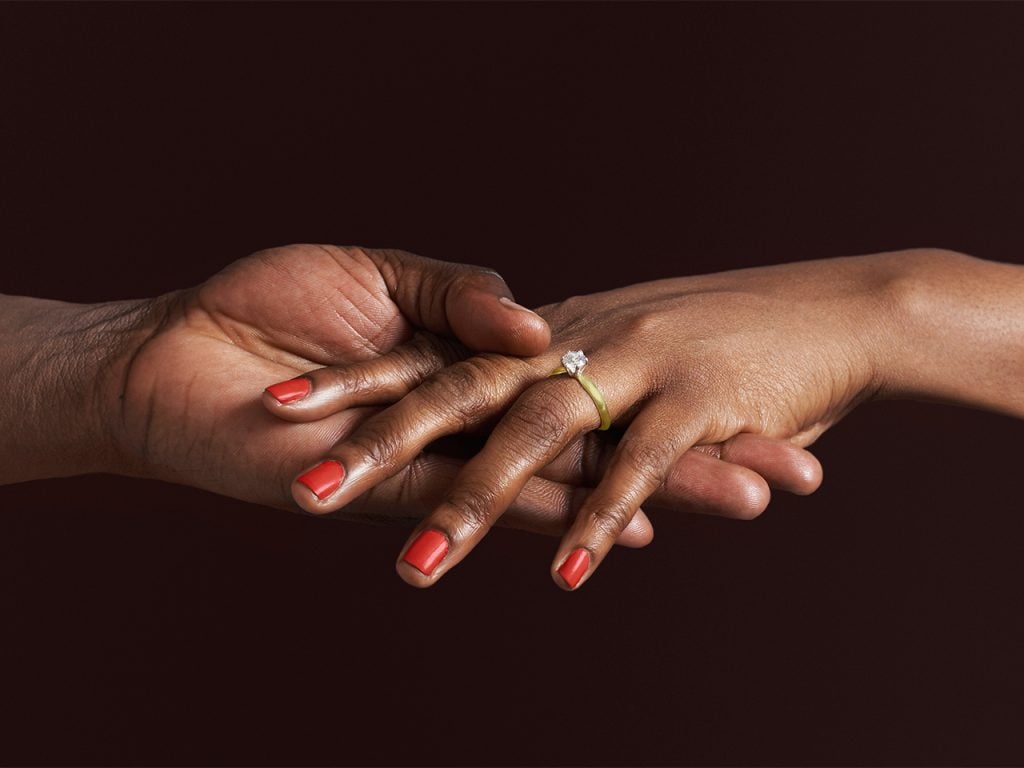
Engagement ring — A new survey finds many Canadians don't think much of marriage
Photo, Roy Hsu

Labels: , , , ,

Saturday, December 12, 2015

Discriminating Against Discrimination

"Even if I am wrong, and the benchers had the authority to delegate the decision to the members, I find that the decision was made without proper consideration and balancing of the Charter rights at issue, and therefore cannot stand."
"I conclude that the benchers permitted a non-binding vote of the LSBC [Law Society of British Columbia] membership to supplant their judgement. In so doing, the benchers disabled their discretion under the LPA by binding themselves to a fixed blanket policy set by LSBC members. The benchers thereby wrongfully fettered their discretion."
"There is no basis upon which a conclusion could be drawn or any evidence from the special general meeting or the October referendum proceedings that the LSBC's membership considered, let alone balanced, the petitioners' Charter rights against the competing rights of the LGBTQ [Lesbian, Gay, Bisexual, Trans, or Questioning] community." 
B.C. Supreme Court Chief Justice Christopher Hinkson

"This decision is important to the public and the legal profession. We will be reviewing the reasons for judgement carefully and consulting with our legal counsel regarding next steps."
Ken Walker, president, Law Society of British Columbia

"At least if it is in your favour you are happy for the day, but we know there is more process to come."
"It's a good day, but there's always tomorrow."
Guy Saffold, TWU spokesman

"We are very disappointed that the decision did not engage with the human rights issues at stake in the case, instead deciding the case on procedural grounds."
"B.C. lawyers voted twice and made it very clear that they want an inclusive profession that respects equality."
Kendra Milne, trial intervener, West Coast LEAF representative
Law students and lawyers protest Trinity Western University's proposal for a law school -- Photo Heather Gardiner

'Inclusive' in this instance signifies the politically correct view that if an individual, a group, or a religious community takes exception to social mores that transgress their own values, they will not uphold those social mores and in so doing absorb the hysterical opprobrium of those dedicated to turning society away from diverse opinions where people have the freedom to observe their own values system, at risk of censure.

If we are all equal under the law and all Canadians are free to believe in a cultural paradigm that identifies a customary alliance between a man and a woman as a marriage, all others social unions; that identifies chastity before marriage a primary step in moral values, this too should be respected. Those beliefs have validity for many who, voicing them in today's politically correct climate, are instantly labelled social dinosaurs and much worse.

The private Langley, British Columbia evangelical institution known as Trinity Western University aspired to open their own law school and sought the required approval from the Canadian Federation of Law Societies along with that of the BC. government in 2013. The school's proposal was given preliminary approval in 2014, but a backlash from B.C. lawyers resulted from the schools "community covenant", where a pledge is made to respect religious ideals revolving around heterosexual marriage and avoidance of sex outside marriage.

Suddenly, Trinity Western University became a magnet for condemnation from every 'progressive' group within Canada, lawyers leading the way in sanctimonious lashings-out against values no longer held by the majority of the population. Trinity Western is the largest Christian university in Canada requiring its four thousand students to sign that covenant and they do so presumably because the covenant expresses their own values and they feel free to commit to the covenant, having sought their higher education through TWU.
Protesters gather outside Osgoode Hall, York University -- Photo Heather Gardiner

The situation impinges on no one's human rights, protected under the Constitution. How likely is it that a transgender or gay person would wish to attend TWU, given the prevailing social atmosphere led by its religious roots? The inference is that anyone who signed such a covenant would have a warped sense of social justice, and through attending the TWU proposed law school, would be incapable of viewing law and justice through a social-justice lens.

What followed the B.C. lawyers' placing the school's reputation in disrepute was that 74 percent of the approximately 13,000 LSBC members voted in denial of the university's accreditation of a proposed law school, and the approval was withdrawn. According to the Chief Justice, in his considered legal opinion the original permission was more than adequately supported by weighing issues and balancing constitutional rights.

Not that the controversy was restricted to British Columbia. The Nova Scotia Barristers' Society and the Law Society of Upper Canada also refused to give recognition to any potential TWU law school graduates. In Nova Scotia, a court ruled in favour of the university, while in Ontario a court ruled against the university; both decisions under appeal.

The school has not surrendered its ambition to open a law school, but it will keep its plans in abeyance until such time as the situation is fully resolved. The Chief Justice had ruled that the law society had infringed on the Charter right of freedom of religion of the university, as well as any students that would be enrolled at the law school whose freedom of religion would also be impacted by the adverse reactions.

Freedoms of association, expression and equality should ideally work for everyone; for the LGBTQ community, certainly, but not at the expense of the religious community whose values are not reflective of those of the LGBTQ community and their supporters. The LGBTQ community has been busy insisting that square pegs be pounded into round holes. They and their supporters label any within society who prefer values other than those insisted upon as indices as equality that society must bow to, infringe on the rights of others.

Some of those 'others' cringe at the very mention of a man marrying his husband, and a woman with a wife. If these same-sex couples believe they can raise children who will not be confused and puzzled by the absurdity of those labels or alternately owning them though they have not been genetically programmed to these gender differentials, they are bypassing reality.
"It’s a behavioural covenant and for students it means while you are attending TWU you commit to this. It is not a statement against same sex marriage or against gay and lesbian people. It is a statement that says when, in this community, we agree to act in this way and we will commit to one another to do that. Here is the Christian biblical basis that this community follows for why they have the behavioural covenant. You don’t have to believe in those or be Christian or be straight, you just have to understand this is how we are going to work and stay together. We invite you to join us if you want to commit to us in the same way."
"I think there’s a real threat that if the denial of accreditation to TWU by any of the individual law sites in Canada, if that is upheld, I think it brings into question the ability of people of faith to actually participate in the public sphere in Canada to actually manifest their beliefs as our Supreme Court of Canada repeatedly said we should have the right to. I think it affects all people of faith as well as institutions of faith including the universities."
Earl Phillips, executive director, Trinity Western University

Labels: , , , , ,

Wednesday, July 08, 2015

Surrendering Values to Discriminatory Accommodation

"I remember vividly and give thanks for being granted Canadian citizenship many years ago in the citizenship court presided over by Joe Young in Regina. I came here as a boat person and had to learn Canadian ways, work hard and assimilate while often facing slurs like "You can be sent right back on the boat to where you came from if you cause us any problems". Under the tutelage of my parents, excellent teachers and members of the nurturing community of Lafleche, Sask., I learned to respect the two founding cultures of Canada and those of Canada's First Peoples; to adopt and live by Canadian values, norms and laws; and to use both official languages, French and English, correctly.
"Millions of immigrants to Canada from all over the world have done the same. They join me in their valid expectation new immigrants, however they got here, including other boat people like me, to do the same or leave, taking their attitudes and baggage with them."
Dennis Hall, Saskatoon [Letter to the Editor, National Post]

"Allowing immigration without checking cultural attitudes is like buying a motor for a canoe. You don't know whether it will speed things up or sink the craft."
Jonathan Usher, Toronto [Letter to the Editor, National Post]

"If we don't engage in the (cultural) discussion, we won't fully understand their health needs and they won't get met."
"So ultimately they will get sicker and be a greater cost to the health-care system." 
"For some cultures who do not generally take pharmaceutical medication, this [drug treatment] is very frightening."
Marie Serdynska, head, Montreal Children's Hospital, socio-cultural consultation and interpretation services 

"It's challenging to the caregivers in that situation, when the mother is at the bedside and the father is able to visit only in the evenings."
"And we believe that both equally have decision-making power, both should have information."
Dr. Jonathan Hellman, neo-natal intensive care unit, Toronto's SickKids Hospital

"Some might respond very categorically, 'Nope, in this place all beds face the same way'. Someone oriented another way might say, 'Yeah, they are all faced that way, but maybe if we got an extension cord, there is actually something we can do' [to have hospital bed face Mecca]."
Randi Zlotnik Shaul, director of bioethics, SickKids, Toronto

"It's about reasonable accommodation and understanding. When people are ill, you're dealing with very vulnerable people, so empathy goes a long way."
Khadija Haffajee, spokeswoman, National Council of Canadian Muslims

"It's ugly, it's unfair. To ... have someone say you're not good enough [to deliver medical care] because of the colour of your skin is offensive."
Linda Wright, bioethicist, University Health Network, Toronto

Carefully seeking out methods whereby social and health-care workers can accommodate cultural variances in the immigrant community, to make newcomers or those of other faiths and heritage and cultural backgrounds feel 'at home' in Canada represents a social industry of a benevolent society, one that has no apparent wish to expect that new immigrants accommodate themselves to learning all that they can and should about the new society they are entering.

Canada is a country comprised of immigrant stock. West European at first, but then increasingly from countries other than Britain and France throughout Europe. Asians were brought to Canada for their labour potential, Africans gradually made immigration passage to Canada; all immigrants and refugees who arrived in Canada other than from France and Britain faced discrimination and cultural insensitivity on the part of those already settled considering themselves the dominant players.

But the immigrants from Eastern Europe, the people of colour, the visible minorities all managed to find places for themselves in the country, as they learned the social covenant, the culture, and immersed themselves in Canadian values, managing at the same time to honour their ethnic, religious and cultural heritage. In the new, culturally-sensitive Canada, government agencies at all levels, and church and social-work enterprises go out of their way to extend 'understanding' and 'assistance', while a general laxity of expectations that new Canadians and landed immigrants do their part is missing.

Catering to cultural preferences in some instances becomes a lesson in the practise of unethical and even immoral enablement, when those 'aids to understanding' contravene Canadian values and even laws. Dr. Hellman of SickKids discussed at a national pediatric and bioethics conference his reaction when a father from a patriarchal society asked doctors not discuss a child's medical condition with the mother outside the presence of the husband/father.

An examination room at Stollery Children's Hospital.
Bruce Edwards / Postmedia News   An examination room at Stollery Children's Hospital.

The issue of two First Nations girls with leukemia who decided withdrawal from standard life-saving chemotherapy was more consonant with their aboriginal traditions, enabling them to be treated with native remedies instead, and to attend a bogus health facility, leading to the death of one of the children came under discussion. In Halifax some hospitals convinced the fire marshal that smudging should be permitted in patients' rooms. Requiring smoke detectors to be shut off.


Media placeholder
Massage clinic treats First Nations girls for cancer -- CBC video still

In other instances dying patients can make requests that their bed be turned to face Mecca. St. Joseph's Health Centre in London, Ontario operates a clinic during Ramadan to aid the city's three thousand Muslims with diabetes. An observance of heightened privacy for female hospital patients is practised for Muslims, as though all female patients wouldn't appreciate that same level of privacy whereby they are advised in advance of staff bedside arrivals.

In 2013 reports emerged of doctors in Quebec issuing virginity certificates. The province's medical regulatory body responded that physicians must refuse to comply with such requests. The issue of patients asking for a physician of a particular gender or specific race another case in point, to which accommodation should never be given. When patients insist they will not accept treatment by a doctor or nurse of a certain race, the issue is one of human rights gone awry.

Labels: , , , , , ,

Monday, January 12, 2015

The Biases of Humankind

"Academic freedom is a foundational principle of university life."
"Often, such academic debate expresses views that may be perceived as controversial and unpopular."
Robert MacKinnon, vice-president, University of New Brunswick

"The administration [of UNB] doesn't want bad publicity, that's all it's thinking about. I'm sure they wish I would just stop this research [into aspects of immigration and multiculturalism]."
"I emailed them [Vancouver city councillors] to see if they would reply to me. I wanted a debate."
"[Vancouver has been transformed from a] serene, community-oriented British city [to] a loud, congested Asian city (still attractive only because of the architectural and institutional legacy of past White generations)."
Ricardo Duchesne, professor of sociology, University of New Brunswick

Professor Duchesne, ironically enough is an immigrant, originally from Puerto Rico, but now a true Canadian. He joins tens of millions of other true Canadians, all originally of immigrant stock, since Canada is a country comprised of immigrants, but for its indigenous native population. The country hasn't done a too-bad job of integrating people who have come to Canada to plan new lives for whatever reason, making up a major part of the social fabric of the country.

But there was a time in the past when immigration was encouraged only from among Anglo-Saxon or white European populations, a time when racist discrimination was alive and doing very well in Canada, even though its population base was comprised of migrants. The decision was made, reflexively by those in power, and in fact reflecting the biased opinion of most Canadians derived from those white-sourced populations abroad, that exotic 'ethnics' be excluded.

And so, Jews and blacks and orientals were viewed as undesirables, their unwanted presence certain to blight the population stock; they were viewed as incapable of melding into Canadian society, and because they were mostly visibly different, they wouldn't present as desirable in a culture that celebrated its white Christian heritage. Those in Canada emanating from a heritage other than the desired one were excluded from polite society, from academia, social clubs, and political standing.

The Chinese head tax imposed by the government of the day attached to the Chinese Immigration Act of 1885 represented a disgraceful piece of racial bigotry, even though Chinese labourers were brought to the country to slave conditions working on the railways to link the country from coast to coast to coast. The horrors of World War II might have been absent some thousands of Jewish children and women sent to the gas chambers but the government of that day shuddered at the very thought of taking in Jewish refugees.

The Japanese Canadians who were interned during the war years, as enemy-aliens, though they were loyal Canadians and had been for generations represent another colonial-mindset horror story of white entitlement biased against orientals. Sociology Professor Duchesne, himself of immigrant stock, appears to find it an atrocious situation that official Canada has apologized for the social misdeeds of previous administrations, and he is downright apoplectic at the thought of financial redress.

He has written an essay, Chinese Head Tax, White Apologies, and 'Inclusive Redress', deploring all of the above. In a sense, apologizing generations after a wrong has been done is a formality, recognition that justice takes its time. As for redress, the emotional anguish suffered by the oppressed and the discriminated against cannot be wiped out of the past. But that $500 was imposed as a 'tax', a monumental sum back then, slapped on Chinese immigrants, and the confiscation of Japanese properties as they were sent to wartime internment camps does require some level of reckoning.

In a spirit of provocation, Professor Duchesne emailed links to his essay to a number of people of Asian descent, living in Vancouver, among them Kerry Jang, a psychiatry professor at University of British Columbia who also happens to be a member of Vancouver city council. Professor Duchesne wrote that financial compensation linked to ancestral repression and oppression and seeking to ensure that this particular civic history be included in school textbooks leads to "the goal of taking Canada away from the Europeans and transforming the nation into a multicultural and multiracial society".

A claim that cannot perhaps be denied, but on the other hand, the reality is that Canada is a multiracial society; this is the fundamental bedrock of the country's population base and becomes increasingly so since Canada stopped its discriminatory, human-rights defying previous prejudicial selection making in immigration. That it is also a multicultural society in the sense that recognition is given to the cultural underpinnings of immigrants is also true. But this is what makes Canada uniquely welcoming.

Yes, many within Canadian society, irrespective of their cultural-heritage-ethnic backgrounds feel there is too much emphasis on the multicultural aspect, and not enough on a common, historical culture reflecting Canada's values and heritage as a Christian-majority, liberal democracy, and they have a valid point. Professor Jang was perturbed at the actions of Ricardo Duchesne, and asked senior UNB administrators to reflect on the fact that the man's "blog postings" are "troublesome in that they go beyond fair comment and abuse the privilege of academic freedom by their pejorative nature that is based on poor scholarship".

UNB's response was unsatisfactory in the opinion of Professor Jang in upholding academic freedom. Nor did the response please Professor Duchesne who felt that the endorsement given his work by the university was somewhat less than enthusiastic. He admitted that he would have been sanctioned by the university's administration in all likelihood had he not been a tenured professor. He doesn't plan, however, to relent on his campaign to discredit open immigration for Asians to Canada.

He maintains a website he has named the Council of European Canadians, focusing on immigration, intent on ensuring that Canada is kept as "white" as conceivable, promoting "European values", opposing "the massive immigration of non-European and non-Western peoples into Canada that threatens to transform our nation into a non-European majority within our lifetime". His founding Council's purpose is to "arm people with the ideas and courage to speak and fight against those who seek to demonize us and in our efforts to recruit and persuade Canadians".

In a sense, though it might seem somewhat premature, this man of immigrant stock is following the example of conservative Europeans reacting to the influx of Muslims sourced from various dysfunctional hot-spots of the world in wild, destructive conflict, sending refugees scattering to all corners of the world, bringing with them the seeds of future conflict through sectarian violence and a basic Islamist jihadist conquest message to the faithful, creating upheaval wherever they congregate.

It's a very uncomfortable place to be in, that frame of reference and of mind. Solutions to what is happening in the world with the wide-ranging discord, violence and criminal action on the part of governments and non-state militias alike, roiling and ruining societies, creating massive bloodshed on an incredible scale, sends some kind of message of hoped-for avoidance. It's as though we must always have some creed circulating that casts suspicion, fear and slander on some group or other.

Humankind seems biased against itself, without end.

Labels: , , , ,

Saturday, March 15, 2014

Canadian Values

"Canadians seem to have a nice balance between a freedom to do what you want to do, a freedom from fear of poverty or violence and the freedom to be me. With Canadians, the multicultural diversity, sexual orientation diversity, the abled and disabled, we have a very inclusive attitude that everybody is in the family and we've got to help everybody."
"Not that we're that close to each other, what with the differences in provinces, Quebec, the Atlantic and so on, but that we are close enough to have the common programs that we all embrace."
Michael Adams, president, Environics Institute
View of Centre Block at night.
PWGSC - Parliament Hill, Ottawa, View of Centre Block at night

In a speech delivered to the Wilson Center's Canada Institute Mr. Adams, whose firm is involved in "original public opinion and social research on important issues of public policy and social change" points out the variances in social culture between Canada and the United States. And his conclusions might seem counter-intuitive to many who have always regarded Americans as compassionate and kind, involved in community.

Stands to reason, after all, since Americans typically are more generously giving to charitable causes than are Canadians. And in the United States, social philanthropy is far more developed than it is in Canada. Some might suggest that this is guilt at play, not necessarily altruism, since the most generous of philanthropists in the United States have typically been fabulously wealthy industrialists who gained their fortunes riding roughshod over the public interest to attain them.

In any event, Mr. Adams spoke of research that led to certain conclusions. Pointing out that Americans and Canadians respond far differently to society's needs in their personal perceptions of how they should react. The differences, he says are stark. Canadians have a more robust sense of community, aligned with a greater sense of individual freedom than do Americans. It's the 'I'm All Right, Jack' syndrome, one supposes.

Americans, on the other hand, speaking with a broad brush of generalization obviously, are burdened with a strong sense of patriotism and conformism. Unlike Canadians, Americans tend not to consider their country representing one community pulling in tandem for the public weal. Americans have a religious belief that success is the result of virtue, and failure goes to the undeserving. In the American view, he posits, a just world is one in which the rich are admirable, the poor are not.
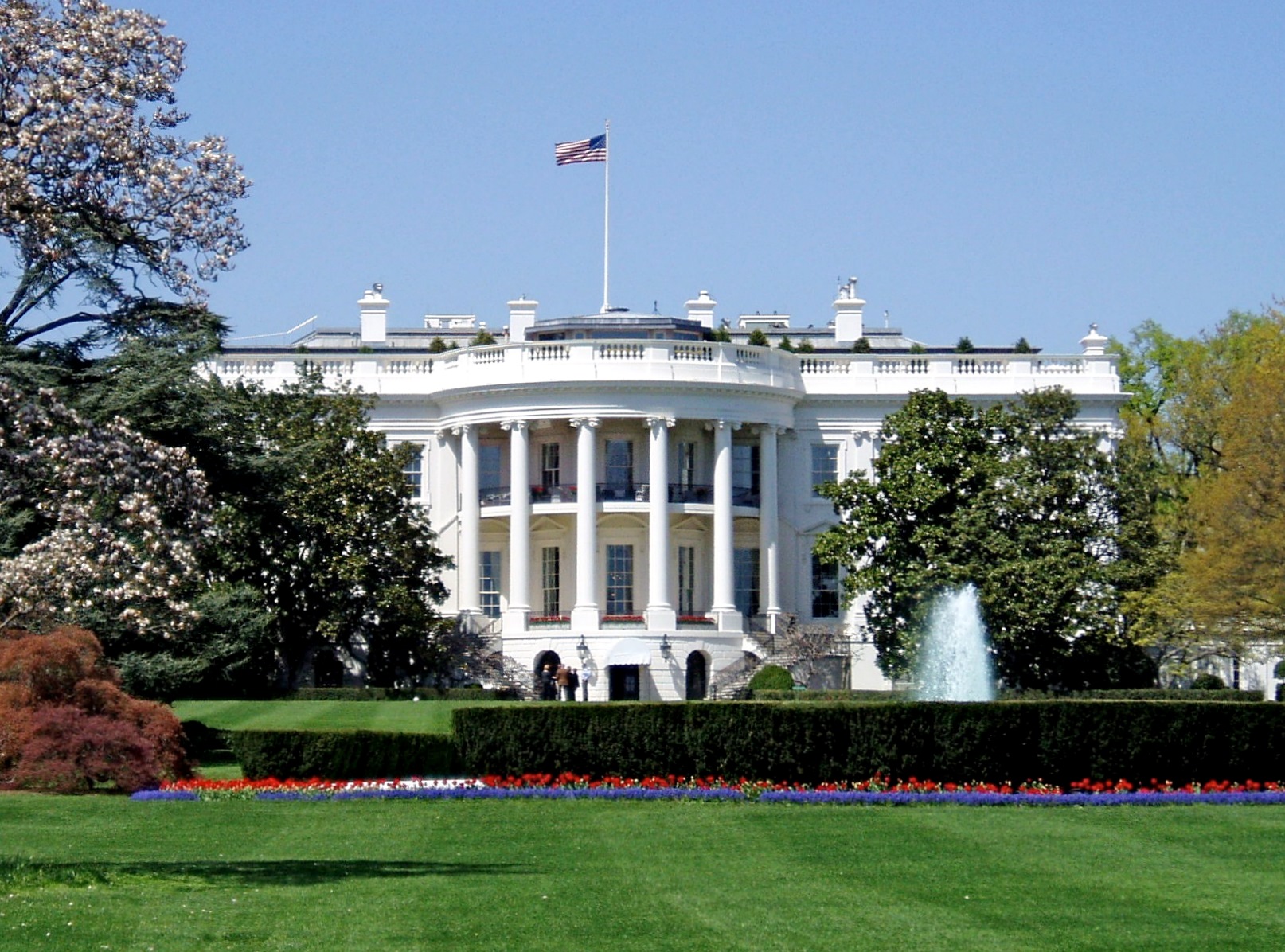
The south portico of the White House -- Wikipedia

"If you don't deserve it, then you really don't deserve my tax dollars and you don't deserve my charitable dollars", he explained. "So you are on your own." Rather a harsh condemnation of perhaps what came out of the frontier mentality and individualism. A new Pew Institute study posited the question : Is belief in God essential to morality? Fifty-three percent of Americans responded in the affirmation while 31% of Canadians did so.

Issues of authority, patriotism, work ethic, ownership, religion and patriarchy represent the important issues on the American values landscape. Separated out somewhat and moderated by necessity in view of whether Americans are drawn to the Republican or to the Democratic agenda in the public discourse, scale of priorities and realization of core needs. Perhaps going a long way to explaining why millions of Americans were left catastrophically adrift with no health insurance.

Republicans, averred Mr. Adams, attract conformists and authoritarians (conservatism), while Democrats are attractive to the idealists in society. And then there's this last little adjustment in the scale of opposites and political affiliations relating to ideology and moderation. The American Democrats are more aligned to the Canadian Conservatives in values and priorities. There really is no Canadian-style Republican party.

Canadians represent themselves as being more idealistic, self-reliant and open-minded socially and culturally. The American public retains its strong sense of duty and work ethic, risk-taking and attention-craving (think celebrity-culture!). Needless to say these are all issues that seep over from one camp to the other in varying degrees. But by and large it's safe enough to conclude that the two societies really are different.

Labels: , , , ,

Monday, May 20, 2013

Graduating From Despair

"I came to Canada (from Jamaica) as a teenage single mother fleeing domestic abuse. That was my story -- my only story -- from which I could not escape. At Homeward Bound, I started to understand that my life was more than one story. Now I am an honours graduate from George Brown in early childhood education, a cake designer, an event planner and a working mother."
 Melicia Clark

She is not alone. There are countless women, young and younger, older as well, and just as likely to be a victim of spousal abuse, anxious to escape a life of misery and potential harm to come to their children through their abuser's anger. Not necessarily that it is only women who are exposed to marital or partner abuse but it is women overwhelmingly who make up the majority, and it is women, by and large, who are in danger of violent physical abuse.

Volunteer charitable groups proliferate in society, dedicated to the welfare of these desperate women and their fearful children. They are aided by being given a temporary home at refuges for single mothers, by the encouragement and support they find there, giving them some measure of confidence for the future, even when that future looks unbearably bleak. To know that there are people who care sometimes improves considerably the measure of their lives.

And then there is the opposite within society, people who have high profile and extremely well remunerated jobs. Salaries that soar into the financial stratosphere of outstanding success. Yes, there are some women who are included in such executive positions, but mostly they are men. And these men are capable of earning multiple millions in annual salary, often topped up by additional bonus funds in reflection of stockholders' appreciation of a CEO's outstanding performance.

One of these men is Ed Clark, chief executive of the TD Bank. This is a man who obviously gave quite a bit of thought to the condition of these lost single mothers. He provided personally $1.35-million in startup funding for an enterprise named Woodgreen Community Services. It was set up to provide housing, education, child care, academic upgrading, a two-year community course and a job placement for single mothers in desperate straits.

On a four-year committed course that provides for women living in shelters -- sheltering their identities behind false names, fearful for their future and that of their children -- single-mother graduates of the Woodgreen Services program become capable and reliable employees working in banks, law offices, high-tech firms or within Woodgreen's network of early learning centres. Earning salaries ranging from $35,000 to $55,000; their lives imbued with pride and purpose.

Recently on the 54th floor of the TD Tower, 22 single mothers took part in a graduation ceremony. They had all been recommended by various agencies as representing individuals who would benefit from the four-year program, Homeward Bound, an offshoot of the Woodgreen Community Service.
Since the inception of the Homeward Bound program nine years earlier 176 women with 216 children between them have lived on the campus.

The campus consists of a central nucleus; two apartment buildings, and child-care facilities. Of the 176 graduates, each and every one found a job.  The cost for graduating each student comes out to about $65,000. It is dependent on the generosity of corporate sponsors who provide jobs for the graduates and donors who agree to support the charity. It isn't an easy transition for the women; they must commit themselves to hard work to gain their diplomas and to graduate the program.

"It gave me security. It gave me a sense of community. Now I have the opportunity to set a new bar for my life", said one of the women who had arrived alone at a women's shelter, a pregnant teen with no idea how to take care of a baby or how she might survive on her own. Now she knows she can, and she knows how she can for she has been enabled to do so. She has a diploma from Seneca College in business management.

Labels: , , , , , ,

Sunday, May 19, 2013

Extreme Ins(As)piration


Mt. Everest
Japanese mountaineer Takao Arayama, 70, in blue, scales Mt. Everest, the world's highest peak, Nepal, Wednesday, May 17, 2006. (Kenji Kondo / AP Photo)
It takes the vigour and strength of youth, the prowess of well developed athletic ability, the passion of an explorer and the determination of a mind set on conquering the vicissitudes of unpredictable and sometimes catastrophic geological and atmospheric conditions hugely hindering progress -- let alone the dangers inherent in clambering to such heights where oxygen is too thin for normal human activities, both cerebral and physical to be relied upon -- to hope for a successful outcome.

Despite all of these harrowing and most difficult conditions -- including the rather nasty occurrences when climbers come across the stiff and frozen bodies of those who have not managed to succeed, and who remain as sad reminders of human hubris and conditions inimical to human endurance at altitudes and in dangerous places where no rescue missions to retrieve and give proper burial can take place -- aspirants still flock to the fabulous Himalaya.
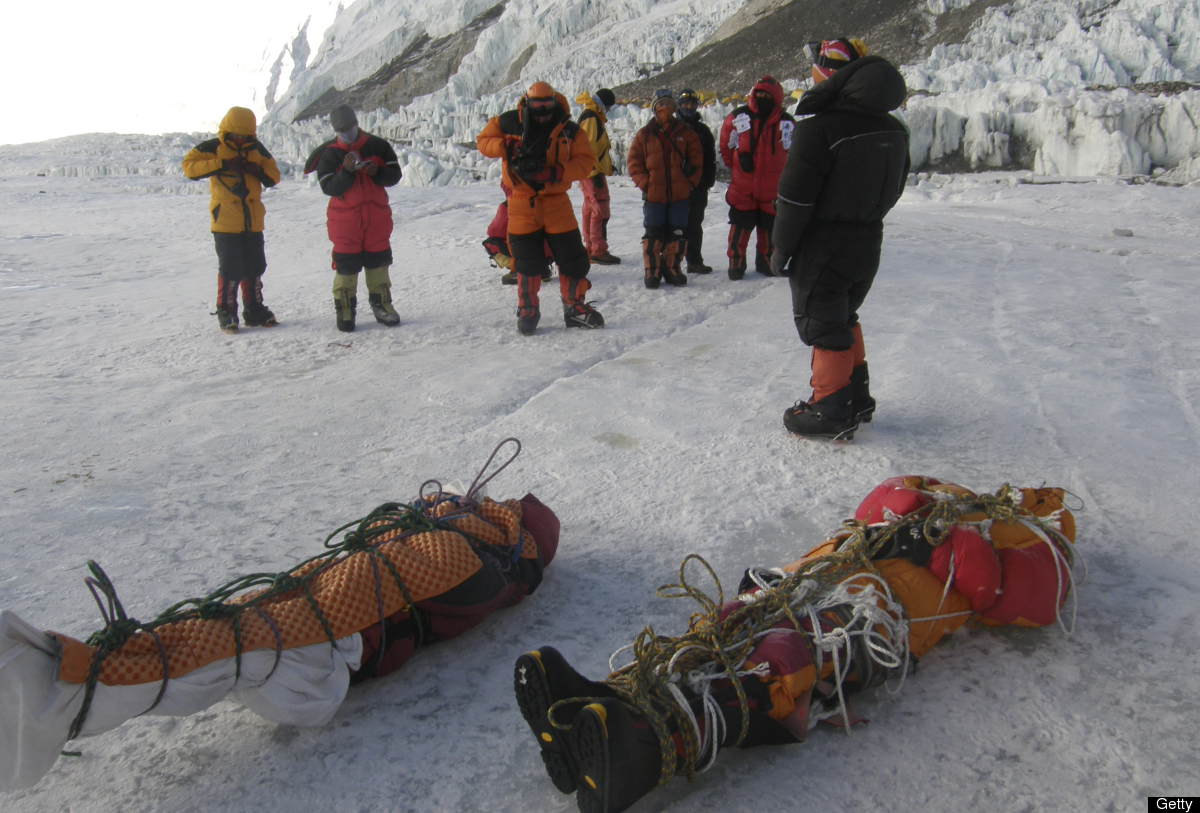
Two bodies retrieved by a Sherpa mission

There are those for whom it is no longer enough of a prestigious plaudit to simply manage to summit Mount Everest. Now there are the 'firsts' that have assumed monumental proportions of acclaim. The youngest to summit the mountain, taking the obligatory photograph as proof. And just recently a very fit and determined woman from Saudi Arabia became the first from the Middle East to achieve the summit, alongside her companions, also from the Middle East.

But these are young, energetic and fit people. How about older people? There was one occasion where a quite elderly man insisted he needed to repeat the feat of climbing the mountain, too many years after his first initial success. And it was left to the patient prowess of the long-suffering Sherpas to manage to manoeuvre him in his mission to succeed. Many make the ascent without supplemental oxygen; something not just anyone can succeed at in that oxygen-starved atmosphere.

And now two octogenarians are competing against one another for the honour of achieving the summit, representing the oldest people to manage that stunning feat. Most people in their 70s struggle to clamber up a gentle sloping hill of several hundred feet in height. Mount Everest's height is a monumental 8,848 metres. From base camp there are a series of other camps toward which aspirants climb and then acclimatize before moving on to the higher camps and finally the summit.


Yuichiro Miura of Japan, 80 years of age, set out to claim the record of oldest mountaineer to reach the summit of Mount Everest, to best his own record at age 75, achieved in 2008. He happens also to be the first man to ski down Everest -- another historical first. This attempt will be his third climb to the summit. In 2003 he scaled Mount Everest at age 70. When he made his second ascent at age 75 he discovered that Min Bahadur Sherchan at age 76 had reached the peak before him -- by a day.


Now the two are locked in a conquest that each is determined to win. British Army Gurkha pensioner Min Bahadur Sherchan is a year older than Yuichiro Miura. Mr. Miura has begin his climb, starting out from base camp and determined to set a new world record: "We plan to stand on the summit on May 24 ... We are all doing well, getting in position to tackle the mountain", he wrote on his website.

The man rivalling his efforts planned to begin his ascent a few days later. He claims that he would take back the record within days if Mr. Miura was successful, believing himself to be a better climber, even while acknowledging Mr. Miura's technical ability. "I am sure I will break my won record", 81-year-old Sherchan said, confident he would make his own country proud of his achievement once again.

File:Min Bahadur Sherchan.jpg
Min Bahadur Sherchan, Nepali ex-soldier, who reached the summit of Mount Everest on May, 25 2008 at the age of 76 years 340 days and is the oldest summitteer of Everest. Here shown at Summitteers Summit at COP-15 in Copenhagen Dec.11, 2009


He will be 82 next month and ascribes his long life and incredible endurance and physical strength to his diet and his exercise regime. Other elderly people can only look on with awe at such exploits at such a ripe old age. And wish both of the contestants well in their endeavours.

Labels: , , , , , ,

Saturday, May 18, 2013

Saudi woman makes history by reaching Everest summit

BBC News online - 18 May 2013
Facebook photo of Raha Moharrak It took a lot of persuading before Raha Moharrak's Saudi family agreed to let her climb 
 
A Saudi woman has made history by reaching the summit of the world's highest mountain.

Raha Moharrak, 25, not only became the first Saudi woman to attempt the climb but also the youngest Arab to make it to the top of Everest.

She is part of a four-person expedition that also includes the first Qatari man and the first Palestinian man attempting to reach the summit.

They are trying to raise $1m (£660,000) for education projects in Nepal.

Originally from Jeddah, Ms Moharrak is a university graduate currently based in Dubai.

Coming from Saudi Arabia - a conservative Muslim country where women's rights are very restricted - she had to break a lot of barriers to achieve her goal, her climb team said.

A biography on the expedition website said convincing Ms Moharrak's family to agree to her climb "was as great a challenge as the mountain itself", though they fully support her now.

"I really don't care about being the first," she is quoted as saying. "So long as it inspires someone else to be second."

Labels: , , , , ,

Thursday, May 16, 2013

Values and Priorities in Economic Emergence

"Entry-level cars in Brazil are incredibly dangerous, it can't be denied. The death rate from accidents is far too high. The manufacturers do this because the cars are a little cheaper to make and the demands of the Brazilian consumers are less; their knowledge of safety issues is lower than in Europe or the United States."
Maria Ines Dolci, Rio de Janeiro-based consumer defence group Proteste

Ten thousand cars roll off assembly lines each day in Brazil, ready to fulfill the motoring needs of its newly-emerging middle class eager to become car owners. This is a country whose economy is cited as a burgeoning newcomer among the well-performing countries formerly in the dudgeon of dreary poverty like China and India; the lions of the BRICK(S) countries. Fiats and Chevrolets are as popular in Brazil as they are in Europe and in the U.S.

And, it seems, the government is so busy chaperoning its economy into the new age of prosperity that awaits it, that it can hardly spare a moment to consider the safety and security needs of its consumers. A national tragedy is unfolding where thousands of Brazilians die in road accidents that could very well be prevented with a little forethought leading to protective legislation that would inform carmakers that Brazil has safety standards, after all.

In Brazil, cars are produced featuring weaker welds, too few safety features along with inferior materials in comparison to models that are similar and produced for U.S. and European consumers, who do have legislated standards to be met by manufacturers. It's much cheaper to produce vehicles in Brazil simply because of non-existent industry standards to protect the population. Four of Brazil's five cars that are bestsellers have failed independent crash tests.

Dangerous driving conditions compounded by poor road engineering and upkeep help, along with the inferior vehicles, to ensure that death rates from passenger car accidents are almost four times that of the U.S. This, from an analysis conducted by the Brazilian Health Ministry. While the U.S. is gradually diminishing the number of vehicular-caused deaths on its highways, Brazil's death rate is steadily accelerating.

"The gravity of the injuries arriving at the hospitals is just ugly. Injuries that should not be occurring", said Dr. Dirceu Alves deploringly. He is with Abramet, a Brazilian group of doctors specializing in the treatment of traffic accident casualties. And he is of the distinct opinion that poorly built cars in his country are responsible for an unnecessary toll of victims.

Car manufacturers can confidently anticipate a ten percent profit on their Brazilian-produced vehicles. That's quite the incentive to continue just as they are, in comparison to the 3% profit they realize on cars produced in the U.S., and even on the global average profit of 5%.  Models such as the Chinese-made JAC J3 scored one star in a crash test, even while being equipped with airbags and anti-lock brakes.

Four of the five most popular and least expensive models produced by General Motors, Volkswagen and Fiat received a one-star rating out of five stars. That rating indicates those cars provide little protection in head-on accidents compared to four- or five-star rated vehicles representing the minimum that car buyers in the U.S. and Europe purchase.

"The difference is you're talking about somebody dead in the vehicle or dying very quickly, or somebody being able to get out of the vehicle themselves", explained David Ward, director general of the London-based FIA Foundation for Auto Safety. Speaking on condition of anonymity, an engineer for a major U.S. automaker has been aware for many years that his company failed to implement advanced safety features for the Brazil market because there is no requirement under Brazilian law.
"The automakers are pleased to make more profitable cars for countries where the demands, whatever they may be, are less rigorous. It happens everywhere -- India, China and Russia, for example."

Labels: , , , , , ,

Wednesday, May 01, 2013

What Price Beauty?

There have been various controversies associated with breast implants, but women, vain creatures that we are, continue to seek those 'improvements' over their natural endowments. In Brazil, it has become a garden-variety gift to teen-age coming-of-age girls, to pay for their breast enlargement.

There have been notorious instances in the news where the silicone implants have become infected, where the liquid in implants have seeped out, and where implants have become painful and lumpy. Expectations are high when they're put in place, not so great when they must be removed due to health outcomes.

Aside from which, no one really knows in fact what the long-range use of breast implants will represent for the wearer.

For some people the very idea of having foreign objects installed in their chest wall is repugnant. For others, women yearning for full-chested frontal abundance the investment in surgery and funding it in anticipation that their fleshy real estate will present the image they crave, is well worth the effort.

Despite the bad press that surfaces on occasion about problems arising out of inferior materials used by some unscrupulous breast implant manufacturers and the trials and tribulations foisted upon the unwary by unforeseen complications, women are still flocking to the cosmetic surgery that breast implants represent.

Breast augmentation in the U.S. alone has increased by 800% in the last two decades.

And now surfaces research findings that women with breast implants may be at higher risk for cancer, and for death caused by cancer. The findings of epidemiologist Dr. Dean Fergusson, a senior scientist at the Ottawa Hospital Research Institute, one of the contributors of the study being quoted, combines results from a dozen studies undertaken in North America and northern Europe.

Leading to the conclusion that women with implants came out with a 26% increased risk of being diagnosed at a later stage, resulting in a 38% greater risk of death. Implants interfere with the detection of early-stage breast cancer, obscuring some tissues sighted on mammograms; roughly one third of the breast is not adequately screened, sometimes leading to false negatives.

"I think there should b e increased screening for women with augmentation. They and their doctors should be aware of this", cautioned Dr. Fergusson. "The take-home message is not to have breast implants removed. It's to raise concerns and investigate the issue further. Women who are considering should have their information and discuss it with their doctor."

And this is what they should think about and discuss:
  • Chances of surviving breast cancer for women with breast implants (based on 2012 study of 400 women in Ontario and Quebec): 98% at one year; 86.5% at five years; 77.2% at ten years.
  • Chances of surviving breast cancer for women without implants (based on 2012 study of 434 women in Ontario and Quebec): 99.1% after one year; 90.7% after 5 years; 83.5% after 10 years.
  • Chances a woman will be diagnosed with breast cancer in her lifetime: one in eight.

Labels: , ,

Monday, April 08, 2013

Smokers Exit Here...

"Tobacco use ... remains in a class by itself. Tobacco use is known to cause the deaths of five million people worldwide each year -- an entirely preventable public health crisis. Tobacco is the only legal consumable product that kills approximately one-half of the people who consume it, it is highly addictive and cannot be used safely in moderation. All of these factors are clear bases on which tobacco use can be distinguished from other potentially hazardous activities." 
2008 paper, William Mitchell Law Review, journal of the William Mitchell College of Law, Minnesota

The Ontario Supreme Court got stuck on the definition of disability when some legal scholars in the debate over smokers-rights, as opposed to the right of the public to be free of second-hand smoke effects, and the right of employers to hire only workers who don't smoke, to come up with this definition:
"Smoking and the addiction that accompanies it does not interfere with a person's effective physical, social and psychological functioning, the results that often characterize addiction to alcohol. Nicotine addiction and the symptoms of withdrawal that result when one discontinues smoking are not a mental or physical disability within the meaning of s. 15(1) of the Charter."

An Ottawa Internet company has a policy whereby it will hire only non-smokers for their working staff. Non-smokers, period. Not people who will be amenable to desist from smoking during working hours, and smoke at home, in their vehicles, on their time off from work, but those who have no interest whatever in smoking. The company, Momentous, makes it clear to its 120 employees that should they smoke at all, they risk being terminated.

"People say, well who else wouldn't you hire? My answer is, we don't hire the brilliant jerk. You could be the best at your job in the world, the best on the planet at  your job, but if you're a jerk we don't want you here", explained Rob Hall, Momentous president. "We had seven employees [who smoked] and we brought in doctors and nurses three times a week from the Ottawa Heart Institute, and we paid for it all of course. We said we'd find anything they wanted ... one person tried hypnosis and it worked for them, and all seven quit."

"We don't feel it's justified to discriminate [against] adult smokers because, what's the next thing? If you want to discriminate smokers, do you want to discriminate someone who eats fats or sugar? There's no end to it", complained Eric Gagnon, spokesperson for Imperial Tobacco Canada.  Little wonder the tobacco industry feels put out by their customers' self-injurious habit being singled out for special treatment.

Such discriminating hiring practices as an employer making it abundantly clear that smoking employees are not welcome, does not represent a pejorative, but a careful choice-selection. Claiming this decision to be contrary to someone's human rights won't work, according to legal experts, unless smoking can be seen as a disability because of its addictive qualities. The Canadian Human Rights Act and the Canadian Charter of Rights and Freedoms prohibit such discrimination through disability.

But it's a stretch to claim that tobacco addiction represents a disability. It is most certainly potentially disabling, but those who succumb to the addiction have any number of aids at their disposal to break their habit. Enter any hospital and the heart and stroke specialists, attending nurses, all point to signage offering help in smoking cessation, and encourage it strenuously to avoid further health problems down the road, of huge magnitude.

"A lot of people think it's their right to work here and it's not. People will scream the discrimination word", said Mr. Hall of Momentous. "Well, of course it's discrimination, it's just not illegal discrimination and there's a huge distinction between those two things. If ten people apply for the job, the first one to apply doesn't get it. We're looking at many other factors and smoking happens to be one."

Labels: , , , ,

Tuesday, April 02, 2013

Remembering A Life

"She made a mean beef Stroganoff, followed her husband from job to job and took eight years off from work to raise three children. 'The world's best mom', her son Matthew said".
Obituary, The New York Times -- Yvonne Brill, rocket scientist

No, really, this woman was incredibly extraordinary, exceptional before her time. Her time dated from working in rocket science in the mid-1940s, that's how much ahead of the times this woman was. Her fine scientific mind had another component; that of a wife and a mother sensitive to the needs of her family.

She has died at the age of eighty-eight, in Princeton, New Jersey. Celebrated for her development of a thruster used for positioning satellites in orbit above Earth. Celebrated otherwise as a mother whose passing is mourned by her children. In her time she was the only woman involved in rocket science when she was involved with the initial designs for an American satellite.

In her extremely important role as a mother, however, she chose to step away from the mind-bending brilliance of rocket science to devote her undivided time to raising her family of three children. When she was satisfied that she had performed that maternal obligation fully, she returned after a decade-and-a-half to formulate plans for her greatest achievement.

She worked for NASA in the 1980s, and was awarded the National Medal of Technology in 2011 by President Barack Obama during a White House ceremony acknowledging the design of her rocket system. The New York Times obituary which dwelled on her domestic accomplishments as much as her scientific prowess, unleashed a storm of controversy on social media.

People wrote of their outrage that this extraordinary woman, an accomplished and decorated scientist in a discipline that celebrates those rare minds of genius, would have her obituary pay tribute to her role as wife and above all, mother. Far too fundamental, a mere veneer over her far greater accomplishments as a scientist. Outrageously sexist.

Her son Matthew, celebrating The world's best mom", must surely be sighing, thinking of his mother's choice deliberation in surrendering herself to motherhood in all its complexities of nurturance, laying aside temporarily the scientist in herself, giving more than ample indication of which role she gave priority to.

Knowing that, when she felt she had accomplished what she had set out to do in that starring role, she would be prepared to resume her fruitfully rewarding life as a rocket scientist. The obituary critics are dead wrong.

Labels: , , , , ,

Wednesday, March 27, 2013

 Setting Examples

"Something was leaning against the back door and the car drove off and I walked over to see what it was, and it was a purse.
"I ran after the car waving the purse but the people didn't see me so I took it back to the 'Y' and opened it to look for a phone number. I couldn't find one, but then I found this wad of cash, of hundred dollar bills.
I never thought about keeping the money. It wasn't mine. I grew up going to church, I sang in the choir. And you don't keep something that doesn't belong to you.
"I don't know how you could."
Unnamed 62-year-old Calgarian


“I  never thought about keeping the money,” says Calgary woman, 
62, shown in her new bachelor suite. “It wasn’t mine.”
Keith Morison for National Post     “I never thought about keeping the money,” says Calgary woman, 62, shown in her new bachelor suite. “It wasn’t mine.”

This is a woman of character and of persevering values. She also happened, at the time she discovered the purse with its large sum of cash, homeless. Living in a homeless shelter operated by the YMCA in downtown Calgary. Who wouldn't, finding such a cache, reason to themselves that anyone carrying so much money with them and casually overlooking its security could doubtless afford the loss of that ten thousand.

Whereas she, with no possessions of her own, homeless and wholly dependent on the charity of others, could certainly make good use of all that cash. Obviously, from what transpired, such a scenario was the furthest thing from this woman's mind. It did not reflect her beliefs and her values and her thoughts of herself as a member of society. She saw to it that the money was returned to its rightful owner.

In gratitude they expressed their appreciation for her selfless sacrifice -- there are many who would describe it as just that, though she did not -- and gave her a reward of $500 to have and to hold for her own. A munificent enough award on the part of the grateful owners of the lost cash. And with their act of appreciation, others too added to this woman's future through their own appreciation of her honesty and modesty.

A local bank accepted a trust established in her name. And little by little donations came in over the period from October 2012 when the incident occurred, to a more recent date, where enough money was placed in the trust account to enable her to move from the shelter into a rent-subsidized seniors' complex.

"I think it says a lot about human nature and, personally, I think a lot of people -- had they found that money in the purse -- would have done exactly what I did", she commented, in appreciation for her good fortune. "I am just so thankful to the people that donated money on my behalf."

Perhaps her newfound good fortune will give her the confidence to find paid employment that will suit her temperament and her abilities and her experience, enabling her to find further pride in her life, become self-sufficient and completely independent.

Labels: , , ,

Thursday, March 14, 2013

The Measure of a Man

This handout picture released on March 14 by the Vatican press office shows Pope Francis arriving for a prayer at Rome's Santa Maria Maggiore Basilica early on his first full day as the head of the world's 1.2 billion Catholics.
AFP/GETTY IMAGES
This handout picture released on March 14 by the Vatican press office shows Pope Francis arriving for a prayer at Rome's Santa Maria Maggiore Basilica early on his first full day as the head of the world's 1.2 billion Catholics.
 
 "In our ecclesiastical region there are priests who don't baptize the children of single mothers because they weren't conceived in the sanctity of marriage. These are today's hypocrites. Those who clericalize the Church. Those who separate the people of God from salvation. And this poor girl who, rather than returning the child to sender, had the courage to carry it into the world, must wander from parish to parish so that it's baptized!"
Argentinian Cardinal Jorge Mario Bergoglio
Yesterday's hypocrites might be a man named Cardinal Bergoglio who had knowledge of a pregnant woman kidnapped and killed by the Argentinian junta in 1977. A woman who, like so many others, gave birth in captivity to a child then given to a family "too important" for the adoption to be reversed, the Cardinal was allegedly informed by a monsignor he had personally assigned the task of aiding in the case.

"Bergoglio has a very cowardly attitude when it comes to something so terrible as the theft of babies He says he didn't know anything about it until 1985", the baby's aunt claimed. "He doesn't face this reality and it doesn't bother him The question is how to save his name, save himself. But he can't keep these allegations from reaching the public. The people know how he is."

"He's as uncompromising as Pope John Paul II, in terms of the principles of the Church -- everything it has defended regarding euthanasia, the death penalty, abortion, the right to life, human rights, celibacy of priests; all of this will continue if Bergoglio is made Pope", said a hugely admiring fellow seminarian, Monsignor Osvaldo Musto, embracing the potential of the Cardinal being elevated to that incredibly unimaginable status as a Jesuit.

"He's a very simple man. He's very austere. And also, I think he's an intelligent man and someone who is very good at communicating. In favour of Bergoglio is his pastoral attitude, as they say in the Church -- his relationship with the people", a long-time friend of the new Pope explained enthusiastically.

This is a man who, in 2001, visiting a hospice, washed and kissed the feet of twelve AIDS patients.

He struggled to prevent the Argentine supreme court in its determination to expand access to legal abortions in instances of rape. The president of his country considered his attitude relevant to "medieval times and the Inquisition", in his argument that gay adoptions discriminated against children.

He is held responsible for not having protested at the 1976 - 1983 military junta's brutal crackdown at the time when an estimated 13,000 to 30,000 people died or simply fell off the face of the Earth. The regime that became notorious for kidnapping and killing thousands of its people in a frenzy to eliminate "subversive elements", did not elicit a firm protest from Cardinal Bergoglio.

And that unforgivable history is held to be responsible for the fact that that once-deeply-religious country where over two-thirds of Argentines consider themselves Catholic, fail to attend church. Less than ten percent of the population regularly attend mass. But it was under Cardinal Bergoglio's leadership that the bishops of Argentina made an apology for the church's failures in protecting its followers.

As Archbishop of Buenes Aires, Bergoglio had excellent relations with the country's Jewish community; in 2007 he attended Rosh Hashanah services at the Benei Tikva Slijot synagogue. The director of interfaith affairs for the American Jewish Committee, Rabbi David Rosen describes the new pope as a "warm and sweet and modest man". After the AMIA Jewish community centre was bombed in 1994 he "showed solidarity with the Jewish community." He was the first public personality to sign a petition seeking justice in that bombing, and he visited the rebuilt AMIA building to talk with Jewish leaders.


Will this pope be able to accomplish what his predecessors could not? Convincing his flock that the church really does feel responsible for the scandals that have plagued it over the damning issue of child molestation? Will it be within his capabilities to root out the corruption said to infest the Holy See to its very core? Is it possible that he will be able to cleanse the church's treasury and finances of its criminal elements?

This is obviously a man of high intelligence as a Jesuit, since intellectual prowess and study are vital to that discipline. He is a man who has had great responsibilities and has not always conducted himself in a clear and obvious manner that would find favour with his followers and critics alike, although he is also said to have accomplished much behind the scenes, and simply failed out of a sense of extreme humility to counter the accusations leveled against him by his detractors.

But he is a man withal, subject to the emotional foibles, fears and insecurities of all men. But he is also imbued with a high spiritual calling, and now acts as the Bishop of Rome, with the Vatican representing the Holy Roman Catholic Church and its 1.2-billion followers, a disproportionately large percentage of whom are represented by Latin America. It is his turn to try to shape the church in the next few years in a way that will give it more credit and greater trust than it has enjoyed of late.

No one, religious or not, would wish him any but good fortune.

Labels: , , , , , ,

 
()() Follow @rheytah Tweet