Ruminations

Blog dedicated primarily to randomly selected news items; comments reflecting personal perceptions

Tuesday, May 06, 2014

The Future of Ageing Youthfully

"We do think that, at least in principle, there will be a way to reverse some of the decline of ageing with a single protein. It isn't out of question that GDF11, or a drug developed from it, might be worthwhile in [treating] Alzheimer's disease."
Professor Lee Rubin, Harvard stem cell biologist

"Although the treatments tested here rejuvenate certain aspects of learning and memory in mice, these studies are of unknown significance to humans."
Dr. Eric Karran, Alzheimer's Research UK

"This should give us all hope for a healthier future. We all wonder why we were stronger and mentally more agile when young, and these two unusually exciting papers actually point to a possible answer."
"There seems to be little question that GDF11 has an amazing capacity to restore ageing muscle and brain function."
Professor Doug Melton, department of stem cell and regenerative biology, Harvard University
Photo: Fountain of Youth illustration
This painting by 19th Century Austrian artist Eduard Veith shows a scene at the mythical Fountain of Youth. Throughout history, people have sought magical ways to restore their youth. Photograph by Fine Art Photographic Library/CORBIS

From time immemorial humans have wondered why they age past their prime, bereaved by the reality of growing old and dying. When we would so much more prefer to continue living. Not necessarily in reflection of our dotage years, but in the full glory of youth. A mythical Fountain of Youth was thought to exist somewhere, and it was sought everywhere. The man whose name is most associated with that evanescent glimmering of hope was Ponce de Leon, a 16th Century explorer/conquistador.

Who might have imagined that some element approximating a fountain of youth could be discovered within our own bodies? The sinister stories of night-predators requiring the blood of humans to remain vital and alive, gave rise to the fearful mythology of vampires inhabiting the dark night hours and rabidly searching out victims, the favourite among whom would typically be beautiful young women their fangs would withdraw blood from.

The truth is somewhere in there, neither sinister nor transcendentally exquisite, but full of its own beauty through Nature's exquisite design. American scientists now believe that transfusions of 'young' blood might conceivably reverse the process of ageing. And even, dare we  hope, cure Alzheimer's disease. Researchers discovered that young blood held the potential of recharging the brain, forming new blood vessels to enhance memory and learning capabilities.

Another research finding where Harvard University scientists discovered a "youth protein" circulating in the blood of the young, known for maintaining the brain and muscles with the strength of youth was published in the journal Science found. The protein has been labelled GDF11, present in large quantities in the bloodstream of the young, but which begins to reduce in presence as we age.

It was through the research conducted on mice that these discoveries were made. And, naturally enough scientists hold out high hope that their findings will be translatable to human biology. Within the next two to three years human trials are set to begin, and the anticipation is that the results will accelerate improvement for human health and possibly longevity.

Dr. Melton's team from Harvard discovered that the protein named GDF11 could repair damaged hearts. More than that, a new study demonstrated that raising the levels of the GDF11 protein in older mice resulted in an improvement of the function of every body organ. It is thought that there is a connection between young blood and youth protein, explaining how it is that young blood reverses ageing.

Biological structural, molecular and functional changes were identified in the brains of 18-month-old mice closing in on their natural life span that had been repeatedly injected with the blood of three-month-old mice. The elderly mice developed improved memory and learning ability. Should similar results be seen in human trials, new therapies could be formulated for revitalizing ageing brains, and new drugs produced for treating dementia.

"We've shown that at least some age-related impairments in brain function are reversible. They're not final", explained Dr. Saul Villeda, of Stanford's School of Medicine. Evidence was also identified of new connections forming in the hippocampus, a brain region given to memory and sensitive to ageing.

File:Lucas Cranach d. Ä. 007.jpg
The Fountain of Youth, 1546 painting by Lucas Cranach the Elder.

Labels: , ,

Thursday, May 01, 2014

Coping With Fear

"For some people it becomes excessive ... they spiral down, become progressively sad or anxious. People feel paralyzed, they feel like they've got one foot in the grave, one foot here and they don't know how to move forward."
"They get really obsessed. They feel like they're always on guard, because they can be reminded of their cancer any time."
"People talk about dying and leaving young children behind. These can be very sad things to hear. We just have to remind ourselves to not try to jump in and say something positive, which is what everybody does around them, but just stay with them and help them explore."
Dr. Sophie Lebel, psychology professor, University of Ottawa
Nadia Masot / Facebook
A 32-year-old mother-of-four says she has been de-friended by more than 100 people after she posted pictures of her cancer surgery scars on the website.
"It's always in the back of your mind: 'Is it going to come back, how much longer do I have?' There's sort of this niggling worry all the time. Every time you have an ache or a pain, you say, 'Oh, my God, is this the cancer spreading somewhere else?' It's kind of irrational, but you think it just the same."
Jane Rinard, 59, breast-cancer survivor
A group of Canadian psychologists and nurses has developed a program they devised for the specific purpose of targeted counselling, in an effort to bridge the gap between cancer treatment and recovery, and allowing former patients to live a normal life, not one consumed with fear and apprehension. Their goal is to successfully teach patients to recognize which of the symptoms that concern them that they can safely ignore and how to handle their fear.

The reason is to promote to these vulnerable people the universal reality that uncertainty plays a role in everyone's daily life. And to help them to face their own insecurities head on, aiding them in minimizing "excessive body checking". Promising results came out of a pilot study whose results saw publication a month ago describing their technique, published in the Journal of Cancer Survivorship.

A group of forty-four women who had been treated for breast or ovarian cancer completed the six-week course with over 70% of the group expressing confidence in their newfound ability to handle their fears. No one came out of the course any the worse for participation. A nurse is used to educate patients  to identify those symptoms that should legitimately given them concern, and which are to be ignored.

The purpose: to avoid "catastrophic" interpretations of symptoms through "cognitive restructuring".

The compulsive checking of their bodies for the dreaded presence of new tumours is replaced with the use of relaxation techniques, of the repetitive expression of a comforting phrase such as "I'm doing the best I can". Excessive worrying is outlined as ineffective in helping the women achieve optimum psychological health. The women were encouraged to introspection in confronting their worse fears. If they had expressed those fears to family, what they received in return was always reassurances, a kind of support that seemed unhelpful when avoidance of their fears only served to highlight them.

The fears are anything but irrational, particularly for those who have undergone the trajectory of the disease and its treatment and the numbing fear accompanying it all. For a large enough portion of survivors anxiety becomes so oppressively overwhelming it takes over their lives completely. Unneeded trips to the doctor and hospital emergency departments often result, exacerbating the issue, not relieving it when relief is fleeting and the unreasoning fear returns.

Early diagnosis and improved treatment leaves those impacted with cancer a longer life to live than formerly. Roughly 60% of cancer patients now survive at least five years post-diagnosis and treatment, compared with about 25% in the 1950s, noted Dr. Sian Bevan, director of research for the Canadian Cancer Society which is set to fund a larger clinical trial on the template developed by Professor Lebel, McGill University nursing professor Christine Maheu and colleagues in Ottawa, Montreal and Toronto.

Ms. Rinard, as an example, diagnosed in 2010, found her participation in the initial six-week program to be hugely useful. She learned through her exposure to the program to relieve herself of constant trepidation about her future and to advance with her life. The group therapy program, she is convinced, gave her that self-assurance. "I found it so helpful. It was an amazing experience", she stated gratefully.

Labels: , , , ,

Sunday, February 02, 2014

Lost At Sea

"His condition isn't good, but he's getting better. The boat is really scratched up and looks like it has been in the water for a long time.
"He's staying at the local council house and a family is feeding him. We've been giving him a lot of water, and he's gaining strength."
Ola Fjeldstad, Norwegian anthropology student
One mightn't wonder that Jose Ivan, so far from his home in Mexico, wouldn't quite resemble the man he was when he set out for El Salvador back in September 2012. Neither he nor his companion would likely have given a thought to anything awry occurring on their expedition. Their boat was extremely shipworthy and they trusted that they would have no difficulty reaching their destination, most obviously; else why ship out?

Theirs was an eight-metre fibreglass vessel equipped with propeller-less engines, a craft capable of circumnavigating the globe. And if that was indeed their intention they might have planned to succeed in such a venture. But their destination was far more modest. Despite which their boat drifted over 13,000 kilometres from Mexico. And they survived the sixteen months being adrift on the vast blue Pacific eating turtles, birds and fish caught with their very own hands.

Imagine after all that time together in isolation, trusting that their ingenuity would see them through, sharing a challenge to human survival they might never have imagined would occur to them, only to have one of them eventually dying of exposure and starvation, the other surviving, despairing at his loss of human companion, forcing himself to go on, to continue catching whatever living thing he could to survive, drinking rainwater, and substituting it for turtle blood when water was not available.

Jose Ivan was found washed up on Ebon Atoll (inset) which is part of the Marshall Islands Jose Ivan was found washed up on Ebon Atoll (inset) which is part of the Marshall Islands
 
Islanders on the remote Pacific atoll of Ebon, a coral atoll of 22 islands where fewer than one thousand people live on a land mass of 2.2 square miles at an elevation of nine feet above sea level strung around a deep lagoon, were doubtless amazed to see the battered boat float onto their reef. To see an emaciated, bearded man, his hair long and unkempt, dressed in torn underpants alone, skin raw from sun and salt, speaking only Spanish, with a turtle for a companion.

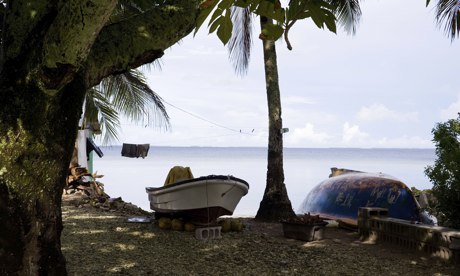
Boats in the Marshall Islands, where José Ivan finally landed after 16 months adrift in the Pacific
Boats in the Marshall Islands, where José Ivan finally landed after 16 months adrift in the Pacific. Photograph: Alamy
 
Ola Fjeldstad, a Norwegian anthropology student, happened to be present at the time on Ebon, conducting research at that southernmost outpost of the Marshall Islands, and it was she who spoke to the AFP news agency. After he was found, he was taken to the main island  to meet the mayor who in turn contacted officials in Majuro, the Marshalls capital. They await the arrival of the sole plane capable of landing at Ebon, out of service for maintenance.

It's been difficult trying to communicate with him. I've gotten to know him through pictures he's drawing. He said he was on his way to El Salvador by boat when it started drifting. We've been feeding him nutritious island food and he's getting better," said mayor Ione deBrum. "He has pain in both knees so he cannot stand up by himself. Otherwise, he's OK."

A basic health examination revealed Mr. Ivan to be suffering from low blood pressure. He is managing to walk slowly with the aid of island people. His ordeal does not appear on the surface to have done any kind of irreparable damage to his health. Yet another tale to be added to the annals of seemingly miraculous human survival against the odds of facing nature at her rawest.

Impossible to imagine the kind of courage it would take to face day after day of isolation and privation. Hope inspires human beings to endure the unendurable and ultimately survive.

Labels: , , , ,

Saturday, January 18, 2014

No Man An Island

"I'm flabbergasted. To think so many people would offer to help someone who is not their kin, not their blood..."
"Duct tape and Tylenol. That's my medical care. I hate the doctors."
"Each day I'd jot something down that I thought was humorous. It was the only way I could keep my spirits up."
"I know my body. I know the cancer is spreading."
"Some people I just know that I can't accept their help. I said to one woman that just that thought that you're responding to someone you've never even met shows how beautiful you are. I said, 'Think about that the next time you look in the mirror.' Then I told her God bless -- I'm not really religious myself, but I could tell she was and I thought that's what I should say."
Scott Murray, Ottawa
Reluctant panhandler Scott Murray ‘flabbergasted’ by strangers’ kindness  Scott Murray spent most of Friday at his computer answering emails from people who want to help him.   Photograph by: Cole Burston , Ottawa Citizen

He appears to be alone in this world. Reliant on his own devices to get along. Once he was self-reliant as a mid-level bureaucrat with a stable, well-remunerated job. He worked for ten years as an import-export inspector. And that's when, in 2004, the cancer that now consumes his body was diagnosed for the first time. He underwent all the trials that people struggling to cope with that dread disease are exposed to, and when the cancer had gone into remission, he returned to his work.

Not originally from Ottawa, he has lived there for the last few decades, and at age 52 is now unable to do much of anything but persevere, endure, and look after himself as best he can. Himself and his cat Smokey. The non-Hodgkins lymphoma that had surfaced in 2004 returned a few years later, and he underwent treatment once again. And took up his life where it had temporarily been left, during the treatment to rid him of that miserable ailment.

But when it proved so stubborn that it returned for a third time, he decided that treatment at the hospital nearby his apartment was no longer worth the effort. After two and a half months of treatment, interacting with medical personnel and taking anti-cancer drugs, he called it finis. The deciding factor, he explained, was that he could no longer afford the medication. This, despite that he has a drug plan through his former government employment that pays the lion's share of the cost.

He lives on a disability pension of $1000 a month, which he says is precisely what he pays for his apartment rental. He also receives other benefits to the tune of $500 monthly, and that sum is required for all other expenses, inclusive of medication. He has found himself in arrears of his drug payments from time to time, and an understanding local pharmacist has given him leeway to run up his bills, in the knowledge that he always, somehow or other, makes good.

One day, looking in his refrigerator he found its yawning maw resembling the Arctic: white, cold, and nothing sustainable within in. He was hungry, and his cat was hungry. His cancer is no longer in remission and this time it means business. He's bald, his teeth are rotten with what he calls "meth mouth", a side effect of the cancer drugs. He is pencil thin,  and has "just about zero" energy, getting about as well as he can with the aid of a walker.

He decided he would do something completely unorthodox to his personality and his way of thinking about himself. He composed a message on a small poster that read: "Cancer patient just need some food and milk please and thank you", and stood with it at the entrance of a nearby shopping mall, stationed there with his walker, holding a cup. He gathered together in the two hours he stood there, the sum of $60.

Each time someone deposited a contribution in his cup he raised his head, looked at them, and softly thanked them as they moved on. "I had a list of what I needed and as soon as I saw I had enough I went and bought food." He bought some staples and some cat food. After a few days had passed he repeated the exercise in personal abasement. And the second time his appeal raised $40.

He felt very grateful to the fact that complete strangers felt compassion for his plight. Which led to his writing a note to the local newspaper, expressing his gratitude. The letter elicited interest from the newspaper who dispatched a reporter to speak with him and gather details for a public interest story. That story was published, and it elicited a storm of compassionate response from the reading public.

The reporter acted as a go-between, but an email address was published for those wishing to contact Mr. Murray directly. And he has since been kept busy responding to the emails. He has also received indirect messages through the medium of the reporter who had experienced his own rush of responses with members of the public telephoning him to convey their interest in helping Mr. Murray.

With the offers of assistance to aid him to be able to purchase enough food to maintain his precarious state of health, he has been given the gift of hope and gratitude, both of which he is eager to forward on to his benefactors and to society at large, to inform the society in which he lives that he is charmed beyond mere words at the care of strangers.

Labels: , , ,

Friday, January 17, 2014

Cultural Insensitivity

The world has been placed on notice. That is, the part of the world that thinks it cares about offending minorities or other cultures or religious beliefs or habits or pretensions or actually just about anything that might present as giving offence. Taking care with political correctness, thinking twice and then looking over your shoulder and thinking again -- hard -- is the order of the day.

Some might think of a scheme to have fun, lighten the atmosphere, use a symbol of some type to raise funds for charity; what have you; now the trend is to wait for the criticisms to fall as they may.
"As far as this particular image is concerned, I doubt that many Kanaka Maoli [native Hawaiian] voices would be raised in protest for a bunch of students in a very cold place who are trying to imagine being in a warmer place."
"Native people here have long since lost control of that icon, of people surfing, the diamond head in the background, the big blue wave. That has become such an appropriated, and huge, marketing tool for corporate tourism that when it's being appropriated, it's actually being appropriated from them and not from us."
Jonathan Kay Kamaka-wiwoole Osorio, Professor Hawaiian studies, University of Hawaii
A University of Saskatchewan student group's “Hawaiian Night” fundraiser was rebranded as “Tropical Night” after complaints over the original poster (L).
Handout    A University of Saskatchewan student group's “Hawaiian Night” fundraiser was rebranded as “Tropical Night” after complaints over the original poster (L).
"I can understand there is cultural sensitivities we may not have been aware of, but in my opinion, we changed the event very proactively on our own terms.
"We removed the original image of the female surfing as it was seen to be sexualizing indigenous women, and we changed the image to one of a small island with palm trees and sun in the background."
Dylon Pollon, vice-president, Arts and Sciences' Student Union (ASSU), University of Saskatchewan

Innocently enough, in a spirit of fun, a student group with the arts and sciences department of University of Saskatchewan had a brain-wave; in the midst of a cold, snowy winter lighten the atmosphere and the mood by planning for a Hawaiian-themed fundraiser. Then, in the spirit of never knowing when and where lightning may strike, accusations of racism thwacked the organizers upside the head. Bringing them quickly to their senses - run for cover!

A group on campus representing the movement Idle No More (for those with short memories, Idle No More is a proactive/reactive/activist, no-nonsense, no sense of humour, First Nations movement to liberate Canada's indigenous peoples from the historical and current yoke of colonialist racism. The poster depicting a woman surfing in a bikini with a pink lei thrown over her shoulders, looking quite delectable and enjoying her experience, elicited outrage and condemnation.

"It's basically an outsider selling an outsider culture to other outsiders without really reflecting on that process", was the opinion of Adam Gaudry, assistant professor of native studies at the university. Take that! Obviously, given the general social climate surrounding the white-hot topic of native empowerment following on generations of discrimination and neglect, sensitivities run high and any half-baked ideas revolving around having fun at the expense of aboriginals is distinctly lacking class.

And here is a perfect instance of one native group in an entirely other country taking umbrage on behalf of another native group living a far distance in a climate nothing like our own, who it would seem, from what a Hawaiian professor of Hawaiian history has to say, couldn't care less. Might, in fact, be hugely amused both by the poster, its implication of a warm, sunny destination and pleasure soaking up the surf and sun, a matter of national pride, in fact.

No sooner did the accusation of apprehended racism rear its ugly head than the student union moved with impressive alacrity to remove the offending image and replace it with a decidedly less glamorous but inoffensive one. Poof! gone the bikini-clad beauty ... Poof! in with the palm tree, sun, sandy island, and blue, blue Pacific Ocean. Harmless, lacking oomph! in the same manner as the one it replaced, but acceptable.

Mr. Gaudry, however, finds the "Tropical Night" exchange poster still problematical, concerned the intent is still there, and the change merely superficial. "To appropriate someone else's cultural traditions to celebrate a party that involves alcohol without involving the people who are supposed to be represented removes the agency of the people whose culture is represented, and how their culture is practised", he admonished.

The voice of reason responds with Mr. Osorio adding while he sympathizes with native students and professors "who have seen their own cultural icons appropriated, disfigured and, in some cases, mocked in a variety of different ways", speaking for his own culture, native Hawaiians actually couldn't care less.

Should Jews become outraged at the pillaging of Yiddish terms and words being absorbed into the lexicon of English buzz-words uttered by people who feel clever using them as they are so richly expressive of situations and observations that they become irresistible to those who consider themselves clever and cool appropriating expressions to show how au courant they happen to be?

Help yourselves.

Labels: , , , ,

Thursday, January 16, 2014

Head Out To Saskatchewan

"The four-hour round trip from Whitewood to the centre drained Mr. Scott's energy, especially when coupled with his attempts to return to part-time employment. He believed that the trip to and from the centre diminished the benefits he received from the pool therapy he took there.
"SGI had agreed that the lap pool was an approved form of rehabilitation for Mr. Scott. The upshot of this is that SGI admits that it determined the lap pool was considered necessary or advisable for the rehabilitation of the appellant."
Saskatchewan Court of Appeal
According to one pool installation company, a lap pool can cost anywhere between $50,000 to $500,000 to install and maintenance costs can be as little as $200 a month.
Files    According to one pool installation company, a lap pool can cost anywhere between $50,000 to $500,000 to install and maintenance costs can be as little as $200 a month


It is a huge problem, no doubt about it. The interaction of humans and animals in the wild, that is. Particularly at dusk and dawn, for drivers not sufficiently alert to the potential for large animals like deer or moose to dash onto highways from the cover of nearby tree stands. Such encounters are almost always fatal for the wildlife. They collapse and die at the scene of the collision or they desperately limp their way back into the bush, to die a slow agonizing death.

As for the people driving their vehicles -- most often for country folk trucks like half-ton pick-ups, or if they're city folk, vans -- the encounter can be a costly one in vehicle repair, or in a long miserable rehabilitation period to recover from physical injuries they themselves may have come away with. There are, of course, highway warning signs to be particularly vigilant for the presence of wildlife. Turkeys roaming in flocks have become more commonplace in the last few years.

They aren't about to do huge damage to a vehicle if there's a collision, but the dust-up is likely to distract a driver who may then steer into a ditch, a tree, another vehicle. The horrendous roadkill at certain seasons of the year when animals begin their mating rituals, when certain species begin their migratory period or begin laying eggs or having young, making them vulnerable, is an aspect of man-animal interaction that is truly regrettable.

In the case of a man from Saskatchewan, Dennis Scott of Whitewood, there is no word on the condition of the moose he hit on December 23, 2005, but Mr. Scott suffered serious spinal damage. The Saskatchewan government insurer came to an agreement with Mr. Scott in 2010 to pay for the installation of a lap pool at his home.

Saskatchewan Government Insurance consulted with a physiotherapist who assured them that a lap pool would most certainly aid Mr. Scott in his ongoing rehabilitation. Water therapy was a significant portion of his rehabilitation, and he would often swim at pools at the Wascana Rehabilitation Centre in Regina and alternately a nearby fitness centre. Visiting them from his home required a two-hour drive each way.

Mr. Scott testified before the Court of Appeal that the long, tedious drive diminished the beneficial results of the swim therapy, because he felt exhausted after the drive. A situation that led him to approach the government insurer to pay for the installation of his own private lap pool to ameliorate the situation, and they agreed.

Consultation with the physiotherapist convinced SGI to build the pool for an estimated cost of $278,782. They agreed, in addition to allocating an annual $692 for maintenance.

Mr. Scott, however returned to SGI to complain that the allotted maintenance sum was insufficient; it would cost about $10,000 yearly, including chemicals heat and energy to maintain the pool and he felt the insurance corporation should be prepared to pay that, too, which SGI was reluctant to commit to.

The appeal court, however, ruled that since the insurer had agreed that the plaintiff required a lap pool for his rehabilitation and they would pay for it, they should also be committed to pay the $10,000 annual upkeep.

When a Saskatoon pool installer was asked to render estimates of lap pool installation costs and annual maintenance, Neil Shule of Pleasureway Sales commented that such a pool can cost anywhere between $50,000 to $500,000 to install. "It depends on what material the pool is [made of] and how large the pool is", he said. Although maintenance costs vary, they can be as little as $200 monthly.

Good deal for Mr. Scott, not so much perhaps for the taxpayer of Saskatchewan.

The court in its wisdom ruled that the insurer is released from an obligation to pay for any raise in Mr. Scott's house insurance or property tax increase, since the lap pool will have the effect of increasing his house value.


Labels: , , ,

Tuesday, December 10, 2013

Another Scientific Medical Advance

"We saw that this snake venom is able to inhibit platelets from bonding one to another and to the vessel wall. What's most promising is that this reaction works best when the blood is flowing very fast -- exactly the conditions when there is a major blockage."
"What we're going to target is the early stage. If a patient has chest pain, it could stop the disease becoming worse."
"The concept that we can harness something potentially poisonous in nature and turn it into a beneficial therapy is very exciting."
Dr. Heyi Ni, St. Michael's Hospital, Toronto, scientist with Canadian Blood Services
Green Pit Viper Snake/www.earthtimes.org

It's certainly a leap of imagination to think that the venom milked from a deadly viper native to Southeast Asia, a pit viper, one of the most poisonous of all snakes, so potent it is referred to by locals as a hundred pacer -- someone bitten by the pit viper, it is believed, will be capable of walking 100 steps, before dying -- could represent a possible stroke prevention. But that doesn't appear to have stopped Dr. Heyu Ni of Toronto's St. Michael's Hospital from researching its potential.

The 1.5-metre patterned snake is known scientifically as Deinagkistrodon acutus, also the sharp-nosed viper or Chinese moccasin. It is indigenous to China, Taiwan and Vietnam. Researchers have filtered out all but one protein present in the venom milked from the snake. That one protein has led to the creation of a drug called Anfibatide. In human testing the drug has proven useful in preventing blood clots from forming while not prolonging bleeding.

Venom is extracted from a Southeast Asian viper in this undated handout photo. It's one of the world's most poisonous snakes, and researchers hope the venom of a viper dubbed the hundred-pacer can provide a drug to prevent one of the world's leading killers. THE CANADIAN PRESS/HO - St. Michael's Hospital
The purpose of the new drug is to target specific receptors on platelet surfaces in the blood, known to be involved in the formation of clots. Platelets tend to clump together to stop bleeding when a blood vessel's wall -- typically resulting from plaque buildup -- becomes injured. Sometimes things go awry when this occurs even after bleeding has ceased, and the formation of clots in blood vessels prevent blood flow. Such blockages in the coronary artery cause heart attacks; in the brain, strokes.

The drug attaches to platelets close by the injured wall, controlling their response. Resulting in fewer platelets drawn to the injury, yet a needed plug to halt bleeding can still be formed. Blood from healthy volunteers was mixed with the snake venom in Dr. Ni's laboratory in Toronto, to do a microscopic evaluation of how the blood's properties were affected. In China the drug was tested on 94 healthy volunteers and found effective. It has been deemed a safe compound with no obvious side effects.

If, after ongoing testing on patients undergoing balloon angioplasty to open narrowed coronary arteries, the drug continues to be found effective, Anfibatide would require testing in a randomized controlled trial of patients, and then submitted for government approval whereby it will be possible to market the drug for wide use. Another arrow in the quiver of medical science to aid whatever health-averse conditions afflict human beings.


Labels: , , , , ,

Saturday, June 29, 2013

A Lifeline, Not a Lifetime

It would have to be the stuff of fearfully grisly science fiction. An unfortunate accident, to begin with, that would have the result of destroying someone's face. A death sentence, surely. If means could be found to surgically restore some function to whatever remained of a face which contains someone's vital features, organs allowing one to breathe, to see, to hear, to consume liquid and food, then survival, albeit awkward, could be achieved.

Means found, through medical-surgical intervention to reconstruct vital organs allowing someone to breathe on their own, to eat, ensure survival. If sight and hearing are impaired, an individual can still learn to use alternative means of replacing those senses to inform him/herself and be capable of living a public life. That public life becomes complicated, however, with the reality of that disastrous accident resulting in a monstrous distortion of facial features.
Pat Semansky, The Associated Press


Enough so that to the public coming face to face with a victim of a personally cataclysmic accident, the immediate, reaction is shock and revulsion. It is a vicarious human reaction. With some people adding their own particular brand of cruelty in offhand comments measured to inform the individual whose face has become monstrously contorted that they should be confined to an interior where no one would have to see them.

This is what happened to Richard Norris, 38, of rural Virginia, who fifteen years ago was the victim of a shotgun blast that utterly and savagely ravaged the lower half of his face. "I've heard all kinds of remarks. A lot of them were really horrible", he said. The result of that accident was a face absent a nose, teeth, and leaving him with a partial tongue, and no sense of smell.

Dozens of surgeries later he was still left using a hat and face mask, going out into the public arena only at night. "You can create a semblance of something, but I can guarantee you it's not normal by any means", explained Dr. Eduardo Rodriguez, head of plastic surgery at the University of Maryland Medical Centre, R. Adams Cowley Shock Trauma Center.

A relative handful of facial transplants have been attempted worldwide, under 30 in total. Four recipients died. Survivors can anticipate a lifetime of being reliant upon immunosuppressant drugs to ensure their facial transplant is not rejected by their own body's immune system. The drugs themselves take a toll on people's health; they suppress the immune system, after all.

Face transplants are optional. Like cosmetic surgery. Richard Norris, like others who have suffered catastrophic accidents that have robbed them of their birthright facial characteristics that make them physically uniquely themselves, would have been capable of continuing to live with the face he was left with after reconstructive surgery which did not restore his former face, but did allow him to use whatever was left of it.

The surgery involved is complex. Face transplant patients are informed forthrightly that when they make the decision to proceed with their transplants they risk death. "If you talk to these patients, they will tell you it is worth the risk", says Dr. Rodriguez. He informed Richard Norris's mother that her son faced a 50-50 chance he would not survive surgery.

"We looked at Richard and we told him we loved him the way he was and it didn't matter to us, but it was his life. That was what he wanted to do and we supported him", his mother explained.

Richard Norris, now living with a transplant gift he received when a 21-year-old died after he was hit by a minivan crossing a street, contacts the family of the young man part of whose face he wears, to keep them informed about his progress. His transplant surgery took 36 hours to complete. It included teeth transplantation, upper and lower jaw, part of the tongue and all the tissue from scalp to base of the neck.

Immunosuppressant medications come complete with patient risks. Patients know in addition that it is an unknown how long the transplant itself may survive. If all proceeds according to optimistic expectations, says Dr. Rodriguez, a transplanted face may last 20 to 30 years.

It is a lifeline, but it is not a lifetime.

Labels: , , ,

Saturday, February 02, 2013

A Monster Rises from the Sea in Japan


Photo from space of the Sakurajima volcano in Japan
ISS-eye view of the Sakurajima volcano, smoldering off the coast of Japan. Click to hephaestenate.
Image credit: NASA


When I was a kid (and yes, fine, even now) I loved Japanese monster movies. Godzilla, Ghidorah (my favorite, because c’mon, three heads), Gamera…they made it, I watched it. Saturday morning monster movies were the best thing of my week.

Back then I was too young to ponder on the exegesis of these movies. It was enough that giant monsters came out of the Sea of Japan and stomped around. But now, sometimes, I wonder why these creatures were so popular in Japan. And then I see a picture like the one above, taken by an astronaut on the International Space Station, and I have to think this had some effect on the culture.

It shows the Kagoshima Bay on the southern Japanese island of Kyushu. Dominating the shot is the Sakurajima volcano, a stratovolcano over 1100 meters (3600 feet) high. There are several things to note here. One is that the entire volcanic shield is about 10 kilometers (6 miles) across. The second is that it used to be an island, but an eruption in 1914—the most powerful Japan would endure in the 20th Century— actually grew the volcano enough that it met with the mainland to the southeast, converting it from an island to a peninsula.

And third, it’s surrounded by several relatively decent-sized cities. Kagoshima has around 700,000 inhabitants, for example, and is only 12 kilometers (7 miles) away to the west.

Zoomed out shot of the volcano
Wider-field view of the volcano, showing the surrounded—and heavily inhabited—region.
Image credit: NASA


In the picture from the ISS, you can see a plume of ash and water vapor rising from the summit, blowing south. Once it gets high enough, winds blow it abruptly east. Volcanologists keep a close eye on the volcano; it’s been active continuously since 1955, and it’s had several larger episodes in the past few years.

With real monsters looming in the waters of Japan, is it any wonder they would make fictional ones as well?

Labels: , ,

Monday, January 14, 2013

The Banality of Death Selection

"They were very happy. It was a relief to see the end of their suffering. They had a cup of coffee in the hall, it went well and a rich conversation. Then the separation from their parents and brother was very serene and beautiful.
"At the last there was a little wave of their hands and then they were gone."
Dr. David Dufour 

These are the placidly satisfied words of a medical doctor. Who was engaged in the euthanization of twin brothers, 45 years of age. Born deaf, the brothers were inseparable. They lived together, and worked together as cobblers. Hugely dependent on the presence of one another for comfort and security.

The brothers were diagnosed as being in the position of losing their eyesight. This was a health affliction that both suffered from. And which apparently caused them both mental anguish. They informed doctors the thought of not being able to see one another ever again, once total blindness set in, was simply intolerable to them.

Modern medicine has, and continues to create miracles in advances in health and medical issues that hugely compromise the quality of peoples' lives. Virtually daily there are new initiatives, new understanding, new types of surgery, new pharmaceuticals, new interventions and protocols that have the effect of impacting peoples' health in the most positive of ways.

The glass-almost-empty syndrome belies that there is hope in the fullness of time. A hope that is extinguished when people opt to cease living.  As did these two brothers. Under Belgian law euthanasia is permissible as long as those intent on ending their lives are capable of conveying clearly valid reasons to induce a doctor to believe they are suffering unbearable pain.

Neither of the two men - the twin brothers 45 years of age and fully capable of living out their lives with some adjustment to their routines, exercising new skills that would allow them to continue to be together, irregardless of the new complications in their lives - was in pain.

Most people who become blind adapt to the loss of this important sensory capability, and manage to compromise successfully, developing other, compensatory skills.

Doctors at Brussels University Hospital "euthanized" the two men from Antwerp, as per their wishes, by lethal injection on December 14. One wonders, did their other family members not attempt to dissuade them from such an intemperate decision leading to an early, unneeded departure from life?

At the present time Belgium, which is the second country in the world after Holland to legalize euthanasia, now permits the law to apply only to those over 18. It is, however, prepared to "update" the current law to enable it to be "extended to minors if they are capable of discernment or affected by an incurable illness or suffering that we cannot alleviate".

A change in Belgium's euthanasia law will allow minors and those suffering from dementia to seek permission to die.

Incomprehensible.

Labels: , , , ,

Thursday, January 03, 2013

And So - There!

Rules and regulations are placed into law - or in the instances of municipalities, by-laws - for the purpose of ensuring that there is a level playing field, that everyone adheres to common practise, or agreed-upon strictures that have the long purpose of structuring society in a manner that brings order and security to our lives. 

Sometimes, though, municipal by-laws are simply too ridiculous in their restrictions on peoples' wishes to proceed with simple manoeuvres that help them get on with their lives.

Like the upper-middle-age couple with health problems who had a brilliant idea; to use their garage as a laundry room.  They don't own a vehicle, and if they did have one they would do as others in their very short street of small homes do; park it in their ten-metre-long driveway.  As it is, their garage is used by them as storage space.  And in their community this is a common use for these single-car garages attached to modest-sized houses.

The mistake, perhaps, was in seeking permission to use their garage in such a manner.  It's perfectly all right to jam it full of excess belongings, but woe betide the householders who contemplate placing a washer and drier in one corner of the garage.  It is simply not done.  Not done because a municipal bylaw will not permit a laundry-room conversion. 

Perfectly unaccommodating. 

This is a couple whose compromised health makes it difficult to carry laundry up and down steps to the basement of the house where their washer and drier are currently located.  As for parking their car, if they had one, in their driveway; heaven forfend.  It must go into the garage.  A zoning by-law with grey whiskers mandates one parking space per home and that parking space must be in a garage.

Evidently the brilliant planners who wrote that by-law considered the driveway not as a parking space, but as part of the front lawn.  The couple could make an application to seek a zoning amendment for a variance, but that would cost them over $7-thousand, and they've been cautioned, it's unlikely it would be granted.

The woman of the house suffers from fibromyalgia and her husband has undergone numerous surgeries resulting in chronic pain and the use of a walking cane.  To assist them in remaining independent and in their own home the couple has undertaken some alterations to their kitchen making accessibility easier for them. 

They had hoped to be able to to ease the strain on their physical resources by straining their financial resources to turn half of their garage into a laundry room requiring plumbing, heating, insulation and drywall, along with a new floor to raise the level of the 'laundry room' flush with the main floor of the house.
Couple’s plan to convert garage runs afoul of nonsensical bylaw 
Dave MacDonald and Deb Bertrand don’t have a car and use the garage of their Fallingbrook home for storage. But their plans to install a washer and dryer in the garage have run afoul of a city bylaw that requires it to be kept for parking.Photograph by: Bruno Schlumberger , Ottawa Citizen

Bureaucracy is famously - at any level of government - resistant to change.  The municipal planning department is stonily averse to permitting such a radical, socially-abusive alteration to restrictions put in place 'for the good of the entire community'.

Labels: , , , , ,

Saturday, December 22, 2012

Cosmic Esoterica

Are We Living in a Simulated Universe?

It’s a testable question.  Slate

Lawrence Fishburne and Keanu Reeves in The Matrix, 1999.
Are we all Neos, living in a simulated universe?
Still from Warnes Bros. All rights reserved.


If the universe is just a Matrix-like simulation, how could we ever know? Physicist Silas Beane of the University of Bonn, Germany, thinks he has the answer. His paper "Constraints on the Universe as a Numerical Simulation" has been submitted to the journal Physical Review D.

Justin Mullins: The idea that we live in a simulation is just science fiction, isn't it?
Silas Beane: There is a famous argument that we probably do live in a simulation. The idea is that in the future, humans will be able to simulate entire universes quite easily. And given the vastness of time ahead, the number of these simulations is likely to be huge. So if you ask the question: “Do we live in the one true reality or in one of the many simulations?” the answer, statistically speaking, is that we're more likely to be living in a simulation.

JM: How did you end up working on this issue?
SB: My day job is to do high-performance computing simulations of the forces of nature, particularly the strong nuclear force. My colleagues and I use a gridlike lattice to represent a small chunk of space and time. We put all the forces into that little cube and calculate what happens. In effect, we're simulating a very tiny corner of the universe.

JM: How accurate are your simulations?
SB: We're able to calculate some of the properties of real things like the simplest nuclei. But the process also generates artifacts that don't appear in the real world and that we have to remove. So we started to think about what sort of artifacts might appear if we lived in a simulation.

JM: What did you discover?
SB: In our universe, the laws of physics are the same in every direction. But in a grid, this changes since you no longer have a spacetime continuum, and the laws of physics would depend on direction. Simulators would be able to hide this effect but they wouldn't be able to get rid of it completely.

JM: How might we gather evidence that we're in a simulation?
SB: Using very high-energy particles. The highest-energy particles that we know of are cosmic rays, and there is a well-known natural cutoff in their energy at about 1020 electron volts. We calculated that if the simulators used a grid size of about 10-27 meters, then the cutoff energy would vary in different directions.

JM: Do cosmic rays vary in this way?
SB: We don't know. The highest-energy cosmic rays are very rare. A square kilometer on Earth is hit by one only about once per century so we're not going to be able map out their distribution any time soon. And even if we do, it'll be hard to show that this is conclusive proof that we're in a simulation.

JM: But can we improve our own simulations?
SB: The size of the universe we simulate is a box with sides 10-15 meters long. But we can use Moore's Law to imagine what we might be able to simulate in future. If the current trends in computing continue, we should be simulating a universe the size of a human within a century, and within five centuries, we could manage a box 1026 meters big. That's the size of the observable universe.

JM: How have people reacted to your work?
SB: I gave a lecture on this topic the other week and the turnout was amazing. Half of the people looked at me as if I was disturbed and the other half were very enthusiastic.

This article originally appeared in New Scientist.

Labels: , ,

Wednesday, December 19, 2012

Dunce Cap Time

Municipal infrastructure is getting creaky, leaky and old all across the country.  Governments at all levels; federal, provincial and municipal are beginning to get the picture.  A crumbling infrastructure and its unreliability poses a threat to those who drive on bridges and under them, on highways that suddenly develop huge vehicle-swallowing sinkholes.  Remediation and replacement is required. 

That costs a lot of money, but the alternative is not feasible; the economy suffers if transport trucks cannot operate expeditiously, if people heading to and from work and home cannot do so safely.

So, what is the City of Ottawa spending our money on?  Well, the good news is that a contract was signed that may help with the expeditious disposal of waste rather than continue to rely on shrinking dumpsite availability and a light rapid transit system to carry an increasing rushhour traffic to destinations is set finally to begin construction.

 All of these are hugely expensive, but quite necessary to the ongoing developing economy and to provide for security to residents.

At the other end of the scale of necessity is beautification.  In the sense that some areas of the city present as hideously unattractive commercial developments.

Ottawa hasn't all that many of these areas; for the most part it is a beautiful city with more than its share of outdoor greenery, extensive parks and parkways, and proximity to a jewel of a semi-wilderness forest administered by the National Capital Commission, as a large forested heritage acreage, the pride of the community and a gift to all Canadians.

The main thoroughfare - one of them actually - in Orleans, part of greater Ottawa, is a jumbled, thoughtless mess of unattractive strip malls, unsightly and unnecessarily so.  In a move to encourage entrepreneurial investment in beautifying St. Joseph Boulevard with the building of needed community social and commercial infrastructure, the city devised a taxpayer subsidy; through taxation relief, the funding and building of such structures would receive a considerable valuable boost.

Trouble is, when applications came in those who are authorized to approve them haven't been too discriminating.  Does the Ottawa taxpayer feel it is desirable to hand over funding extracted from household taxes to corporate interests whose business is making money, an enterprise they excel at?  These well-funded corporations invested in building huge shopping centres because they're money-making enterprises don't need taxpayer dollars to encourage them to do what they plan to do in any event.

Yet when Place d'Orleans decided to construct a purpose-built structure to house a new location for another remunerative enterprise, Farm Boy, they saw nothing amiss in  applying to the incentive program.  For which city council is prepared sign off on a grant to the value of $460,000 to the mall as incentive to build something that has already been built and has been in operation for months.

store picture    
Applicants to the incentive program were expected to meet a minimum of one of four requirements to be viewed as qualified for consideration: new building addition, improved facade, upgraded landscaping and signage.  The new Farm Boy building certainly meets those criteria, but the mall is owned by a real estate investment trust that posted a net income of $139-million last quarter, with assets of $3.8-billion.  Tax money tossed out the window.

But this doesn't represent the only instance of absurdity in City Council deliberations.  Other businesses have taken advantage of the incentive, and perhaps the subsidy (relaxation of tax revenue imposed on the business) makes a little more sense there.  On the other hand, even to reward a dentistry practise for building a new site on the street, and a retirement home, both enterprises which qualified and are receiving the tax-relief bonus, it's wasted money because both would have proceeded to build without the incentive.

But there are other insults to the taxpayer.  How about handing over $48,000 in incentive subsidies to Tim Hortons?  Because that's just who the fourth recipient in the beautification project for St.Joseph Boulevard in Orleans is.  Tim Hortons, a well-established Canadian icon, a money-making franchise enterprise of the first order, and we're aiding and assisting it to the tune of $48,000 when any village idiot could readily think of better ways to spend scarce tax dollars.

Labels: , , , , ,

Friday, December 07, 2012

Playing With Justice

The conclusion?  That someone who has acted irresponsibly in a manner that constituted a direct and dire threat - potential until it becomes a startling reality - can feel entitled to fund their way out of responsibility and justice if they have the wherewithal.  A professional who is a big earner can hire out expensive trial lawyers to defend them. 

Lawyers who have availed themselves of knowledge of legal tricks that confound the law and justice.

Apart from declaring herself innocent of the criminal charges of impaired driving, driving with a blood-alcohol level over 80, and dangerous driving, causing death, Pembroke dentist Christy Natsis hired the professional expertise of two high-rated lawyers to argue her defence and ensure she is not found guilty as charged; charges that she denies paints an accurate picture of her behaviour.

One gathers that the prosecution, in this case the Crown - must prove three things, i) An intentional course of conduct with a motor vehicle ii) By a person whose ability to drive is impaired, or their blood alcohol ration exceeds the legal limit; and iii) In circumstances that creates a realistic risk of danger to a person or property (Giuseppe Cipriano, criminal defence lawyer, Edelson Clifford D'Angelo LLP).

There is more than ample witness testimony from a wide array of sources, onlookers/bystanders, paramedics, police and emergency-room physicians; first-responders all the latter, well seasoned and accustomed to recognizing people under the influence of alcohol; that Ms. Natsis was impaired due to alcohol consumption on March 31, 2011 when she drove erratically and caused a head-on crash, causing the death of Bryan Casey.

Ms. Natsis's main defence lawyer has time and again cast aspersions on the interpretation of the symptoms testified to by all the witnesses for the Crown.  And now Ms. Natsis's legal team has invoked Charter rights violations to encourage Ontario Court Justice Neil Kozloff to examine written arguments from the defence/Crown whether such breaches actually occurred.

It worked for another social figure - Margaret Trudeau - though she hadn't caused the death of another motorist.  And, despite testimony and evidence that should see Ms. Natsis found guilty as charged, claiming that the arresting OPP Const. Ryan Besner lacked reasonable and probable grounds to arrest Ms. Natsis, and violated her Charter rights with respect to securing legal advice, has prejudiced her case.

The defence lawyers insist, as a result, that breathalyzer tests that registered blood alcohol levels of 211 mg of alcohol and 198 mb of alcohol in 100 mL of blood be thrown out.  Twice the legal limit.  Inebriated?  Indubitably.  Driving while under the influence?  Without a doubt, and well witnessed.  Causing the death of another human being as a result of careless indifference?  You bet.

Guilty under the law? 

Labels: , , , ,

Sunday, November 18, 2012

Defence firms seek broader agenda

Ellsworth Mountains in Antarctica
A number of defence and aerospace companies have begun to explore how they could apply their skills to help with global challenges like energy shortages, the environment and natural disasters. But is this just a potentially lucrative new market to compensate for stagnating defence budgets?

This week some of those involved in the initiative gathered at a conference in London. One of the instigators, Nick Cook, a former aerospace journalist who now runs a company called Dynamixx, explained how he latched on to the idea.

"It was patently obvious to me that the aerospace and defence sectors had technologies which operated in all segments of the eco-sphere from sub-sea to space," he said. "So why should they not know about the environment and how to go about tackling some of the particularly big problems encapsulated by climate change?"

Satellite image of Storm Sandy over the US Storm Sandy battered the US, but could defence firms have helped?
 
It is not new for defence companies to be looking at, for example, alternative power supplies, or for aerospace companies to be developing more fuel-efficient engines. But the intent of this initiative is clearly to take things a lot further.

Recently, five of the major defence and aerospace companies - US firms Lockheed Martin, Raytheon and Northrop Grumman, and Saab and Finmeccanica from Europe - signed up to a statement promising to look at co-operation to tackle what they called "global challenges", that could include renewable energy, climate change, and disaster relief. Of course, just what that will mean in the end is another matter.

Among the technologies that might be of use are satellite surveillance, long-range drones to plot the impact of ice melt, and robust command and control systems to help communities cope with natural disasters. The Vice-President for Research and Innovation for Raytheon, John Zolper, points to his company's involvement in air traffic control systems.

"We're in the process of taking those systems and making them transportable and deployable in a rapid response situation," he said. "In a day you could set up a completely new traffic control system wherever needed."

There is, of course, a potentially significant economic incentive. Defence spending globally is still growing. But Western defence budgets are stagnating or declining, and the global market is getting more crowded. On the other hand, it has been estimated that the market for global infrastructure development could amount to $40 trillion (£25trn) over the next 25 years.
Northrop Grumman Global Hawk drone, file image Northrop Grumman makes drones, but believes its expertise could be put to other uses
 
To the sceptics, this is just companies seeking new sources of revenue as their traditional markets falter. There are questions over whether it risks militarising the environment and development agendas. And there are plenty of other innovative industrial sectors which might be more appropriate.

"There is money in it, clearly," acknowledges Mr Cook. "But the most fundamental reason we're asking them to engage is because we think they have solutions to offer, particularly in the way they bring big systems together, that no other sector can do."

Mr Cook suggests the defence and aerospace companies could offer technology that could have helped even a major city like New York to have coped better with the recent super-storm Sandy. This could include mapping and sensing techniques to spot areas most vulnerable to flooding, and portable power systems to overcome blackouts.

For smaller, more vulnerable states, disasters like Sandy mean not just chaos, but governments and societies collapsing for a period, and high-tech industrial help could be valuable. "There must be a way to have that experience incorporated," says O'Neil Hamilton, a Jamaican diplomat currently at the Stimson Center in Washington.

These companies could have an effect, he says, particularly on "how particularly small island developing states like those in the Caribbean really impact their security arrangements and really have the security/development nexus benefit from their experience."

It is not just about the big industrial players. Small defence companies are also especially vulnerable to the cyclical nature of defence orders. Supacat is a small British engineering company involved with military vehicles.

Its managing director, Nicholas Ames, says his concerns about the nature of the defence business drove him to look at new areas. "I've always been thinking about other sectors we should be looking at with our skills," he says.

Mr Ames alighted on the offshore renewable energy sector, because of work Supacat had done with Britain's Royal National Lifeboat Institution. "For my part I see a whole plethora of marine engineering challenges that are frankly being thrown out by these new renewable energy devices."

This may not be a revolution. Many companies already straddle different markets. Equally, there is clearly still resistance and some scepticism on both sides of the equation. But this may well be the shape of things to come.

More on This Story

Related Stories

Labels: , ,

Friday, November 16, 2012

Matt Gurney: As debate heats up, Canadian support for unrestricted abortions skyrockets

Matt Gurney | Nov 15, 2012 6:04 PM ET | Last Updated: Nov 15, 2012 6:36 PM ET

AP Photo/Orlin Wagner; REUTERS/Aaron P. Bernstein; REUTERS/Chris Wattie
AP Photo/Orlin Wagner; REUTERS/Aaron P. Bernstein; REUTERS/Chris Wattie U.S. politicians Todd Akin and Richard Mourdock, and Canadian Stephen Woodworth, all of whom have been at the centre of abortion-related debates in the past few months.
 
A Forum Research poll for the National Post recently asked 1,735 randomly selected Canadians 18 years of age or older when abortion should be legal.

A full 60% of Canadians said always.

That’s surprisingly high. Even more surprising: That number’s skyrocketed in recent months. In a similar Forum poll conducted last February, only 51% of Canadians took that position.


That Canadians are pro-choice isn’t news. But even many pro-choice individuals (this one included) feel that while abortion should be legal, safe and available, some restrictions or at least regulations are warranted. The complete absence of any laws surrounding abortion makes Canada an anomaly, and has long been contentious even here.

Any poll is just a snapshot in time, of course. The sudden swing toward the extreme pro-choice side of the spectrum could be a blip that will disappear the next time the same question is asked.
But why the blip?

Forum president Lorne Bozinoff has a theory: “In the absence of anything else happening, it appears [Conservative] MP Stephen Woodworth’s attempt to re-open the abortion debate had the effect of hardening opinion in favour of legal abortion.”

That’s an interesting thought. Could the maneuverings of the pro-life forces have produced a backlash among moderates?

Mr. Woodworth’s goal was pretty tame — he was seeking an all-party committee, not mortaring abortion clinics. But Mr. Woodworth’s (ultimately defeated) private member’s motion wasn’t happening in the “absence of anything else.” It was happening alongside a U.S. election campaign in which abortion played a very prominent, contentious part. And Canadians seem to have responded by becoming even more pro-choice.

The first major incident was Missouri Republican Todd Akin, who said that in cases of “legitimate rape,” the female body can avoid pregnancy. Remembered for being spectacularly insensitive to victims of sexual violence, his comments were actually addressing abortion. Mr. Akin didn’t believe abortion should be permitted for rape victims since, if they were pregnant, any talk of rape clearly wasn’t legitimate. Then, in October, Republican Richard Mourdock of Indiana, also addressing the issue of post-rape abortion, declared that pregnancies resulting from non-consensual intercourse were “God’s will.”

Mr. Mourdock’s fumble came right before the new Forum poll. He called pregnancy-by-rape God’s will on Oct. 23. Forum made their calls on Oct. 27, at a time when Canadian media outlets were closely covering the American election. (Both lost, and their comments have been cited as one reason women voted so disproportionately against Mitt Romney, a key reason for his loss.)

Canadians’ access to abortion goes further than even what most U.S. pro-choicers advocate for, so it wasn’t really an issue that should have resonated here. But, for 9% of the sampled Canadians, something sure resonated. The buffoonish fumbling of two GOP nobodies could have have moved the needle on Canadian opinion as much as Mr. Woodworth’s motion.

And for Canada’s pro-lifers, there’s a lesson to learned from that. Fiery rhetoric will kill your cause. Debating legal safeguards and definitions of life may not grab as much attention as fuming about “legitimate rape,” but it’s the best shot you have.

But it’s hard to promote your cause while treading cautiously. And Mr. Woodworth walked softly indeed, but when Status of Women minister Rona Ambrose voted for his motion, the NDP called on her to resign.

The bar for what constitutes extremism in Canada is set remarkably low. It’s not enough for Canadian pro-lifers to avoid sounding like Messrs. Akin or Mourdock. They’ve got to overcome the suspicion of millions of Canadians that, deep down, they agree with them, all while knowing they’ll be set back to zero if some abortion horror story — take the recent death of a woman in Ireland, dead of blood poisoning after being denied a medically necessary abortion — hits the news.

And that’s a tall order indeed. Canada should have an abortion law — that’s a fight worth fighting. But it might not be a winnable one.

National Post

Labels: , , , , ,

Thursday, November 15, 2012

Peng Liyuan: Folk singer who became China’s first lady 

BBC News online - 15 November 2012

Chinese singer Peng Liyuan, wife of Xi Jingping (file photo) Ms Peng is the first high-profile political spouse at the top level since the late wife of Chairman Mao
For decades, Peng Liyuan has appeared on China's state-run television programmes, singing syrupy sweet folk tunes extolling the wonders of China's rise. Now, she is about to become China's new first lady. 

With dozens of dancers swaying in the background behind her, the glamorous Ms Peng last appeared on national television in January as the closing act of this year's military-themed Chinese New Year gala.

"People are who the Party cares about forever," Ms Peng, wearing a while military uniform, sang to a rapt audience which included President Hu Jintao and her husband, incoming leader Xi Jinping.

Ms Peng is China's first high-profile political spouse at the top level since Jiang Qing, the late wife of Chairman Mao Zedong. 

In contrast, the women married to previous Chinese leaders, from Deng Xiaoping to outgoing leader Hu Jintao, stayed largely behind the scenes. Overseas, Ms Peng has been compared to former French first lady Carla Bruni.

It is possible that Peng Liyuan's celebrity status will make the secretive Communist leadership appear more accessible.

"The image of the Communist Party used to be very dull and the leaders behaved like robots as a part of the state machine with no personal charm at all," said Li Yinhe, a sociologist at the Beijing-based think-tank the Chinese Academy of Social Sciences.

"Peng Liyuan is expected to bring something different to the leadership."

However, it is more likely that the Chinese media will string virtual caution tape around Ms Peng. Even now, the simplest questions about Ms Peng's musical career elicit vague answers from those in the Chinese music industry.

"It's hard to comment on her music, given the complication of her current situation," admits He Li, director of the China Folk Song Music Board.

"We don't want to comment on her too much. If you say she's the best, others will gossip. If you say she's not good, some may object. It's hard to say anything."

The celebrity wife

Peng Liyuan sings an army song at the Great Hall of the People in 2007 in Beijing, China
  • A well-known Chinese folk singer and actress, Peng Liyuan regularly appears on Chinese state TV's New Year Gala - the most watched TV programme of the year
  • She was one of 23 people to receive the first Chinese Arts awards and a 1m yuan ($159,800, £100,000) prize in December 2011
  • Appointed World Health Organisation Goodwill Ambassador for HIV/Aids and tuberculosis in June 2011
  • She is a major-general in the People's Liberation Army
Nicknamed "The Peony Fairy", Peng Liyuan joined the Chinese People's Liberation Army early in her career and made her name as an entertainer approved by the Communist Party, appearing frequently on state television to sing propaganda songs with titles like Plains of Hope and People From Our Village. 

"Probably 90% of her songs are complimenting the Communist Party, and the rest celebrates our wonderful life," explains music critic Qi Youyi, with a hint of sarcasm in his voice.
'Cultural warrior'
 
Now Ms Peng only appears on stage occasionally, for large performance gala shows on state television. Though her name remains well-recognised, her music is mostly appreciated by people over the age of 40, says He Li.

"People who like her songs are mostly born in an era when there was little variety of art forms and broadcasting channels, only radio probably," she said.

"There was not much entertainment then. If you played it today, not as many people would like it."
Peng Liyuan did not always enjoy a rosy relationship with the Communist Party. Like Xi Jinping, her family was persecuted during the Cultural Revolution.
Xi Jinping Peng Liyuan was already famous when she met Xi Jinping in 1986
 
In an interview with Chinese television in 2004, Ms Peng said her father was categorised as a "counter-revolutionary" because some of their relatives served in the Taiwanese army.

Those hardships did not prevent her early entry at the young age of 14 to the Shandong University of Arts as a vocational training student specialising in Chinese folk songs.

Peng Liyuan then joined the People's Liberation Army in 1980 to work as a so-called "arts and cultural warrior".

The soprano's performance in the debut New Year's Gala on China Central Television (CCTV) in 1983 made her a national celebrity.

Over the years, she followed the company to perform overseas in New York, Tokyo and Vienna.

 
When Peng Liyuan met Xi Jinping in 1986, she was already a famous singer while he was the deputy mayor of Xiamen City in southern Fujian province and a divorcé.

After just months of dating, they married in September 1987. Their daughter, Xi Mingze, was born in 1992.

Many now question what kind of role Peng Liyuan might be allowed to play in the Chinese government. She has already begun to scale back her singing career, appearing less often on state-run television.
Xinhuamen gate of the Zhongnanhai leadership compound at the centre of Beijing Ms Peng may also want to enjoy her time living in Zhongnanhai
 
"She only shows up on very big-scale political performances and she won't sing new songs," He Li said.

It is unclear, however, whether Ms Peng will play the traditional role of a political spouse by accompanying her husband on foreign trips.

When Xi Jinping visited the US for a high-profile meet and greet in February, Peng Liyuan was not by his side. At the time, some suggested that Ms Peng was trying to avoid overshadowing her husband.

Ms Peng might do more charity work. She already serves as a goodwill ambassador for the World Health Organisation, spreading awareness on tuberculosis and HIV/AIDS. She is also an ambassador for the Chinese Association on Tobacco Control.

Of course, Ms Peng may also want to enjoy her time living in Zhongnanhai, the central Beijing compound that houses China's top leaders.

In an interview with the state-run Global People magazine in 2011, she described how she enjoyed everyday chores, such as riding a bicycle to the market and bargaining with hawkers.

While at home, she said that she and Xi Jinping treat each other as husband and wife rather than as state leader and singing superstar.

Labels: , , , , ,

 
()() Follow @rheytah Tweet