The dwarves of Auschwitz
The
story of a family of dwarves snatched from the gas chamber by Josef
Mengele himself sounded incredible. But how to verify the testimony of
Holocaust survivors? And should you even try?
-
Yehuda Koren and Eilat Negev
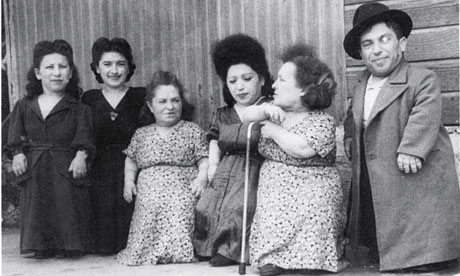
The Ovitzs (from left): Elizabeth, Perla, Rozika, Frieda, Franziska and Avram
'I was saved by the grace of the devil,"
Holocaust survivor Perla Ovitz told us. Again and again, she recounted in detail how she and her
family
were taken to the gas chamber and ordered to strip naked. A heavy door
opened and they were pushed inside. "It was almost dark and we stood in
what looked like a large washing room, waiting for something to happen.
We looked up to the ceiling to see why the water was not coming.
Suddenly we smelled gas. We gasped heavily, some of us fainting on the
floor. With our last breath we cried out. Minutes passed, or maybe just
seconds, then we heard an angry voice from outside – 'Where is my dwarf
family?' The door opened, and we saw
Dr Mengele standing there. He ordered us to be carried out and had cold water poured on us to revive us."
The
Ovitz family, from the village of Rozavlea in Transylvania, was the
largest recorded family of dwarves: a dwarf father who sired 10
children, seven of them dwarves. Perla, born in 1921, was the youngest.
In that remote part of Romania in the early 20th century, it was
difficult for anyone to eke a living from the land and livestock, and
impossible for someone standing less than 3ft tall.
Their mother,
anxious for her children's future, guided them towards a common skill,
a profession in which they could together make a living and would be
neither isolated nor ostracised. As the five sisters and two brothers
were all good-looking and musically gifted, the stage seemed the perfect
choice: for where else could they be applauded, courted, honoured?
Throughout
history, dwarves had been entertainers, often part of a circus or
vaudeville show. But the Ovitzs wanted the stage all to themselves. They
appropriately named their musical ensemble the Lilliput Troupe, and for
15 years had a flourishing career in central Europe. Their two-hour
show consisted of popular hits of the day, skits and music. Perla had a
tiny, four-string pink guitar that looked like a toy, her sisters Rozika
and Franziska played on quarter-sized violins, Frieda struck on the
cimbalom, Micki played both a half-sized cello and accordion, while the
energetic Elizabeth took on the drums. Their elder brother Avram was the
scriptwriter, actor and general manager.
The Ovitzs lived a
communal life in one big house in the village. When any one of them got
married, the spouse moved in and joined the enterprise. While the
dwarves basked in the limelight, the average-height family members
worked behind the curtains as stagehands and wardrobe mistresses. It was
the only all-dwarf ensemble with a full show of their own in the
history of entertainment.
When the Nazis came to power, the Ovitzs were doubly doomed: under the
Aktion T-4 euthanasia programme,
the Germans set out to kill people who were physically or mentally
disabled, whose lives were considered "unworthy of living", "a burden on
society"; and, as Jews, the Ovitzs were the target of the
Final Solution.
On 19 May 1944, they were brought to the
Auschwitz-Birkenau death camp because they were Jews. But, by a twist of fate, their
disability
played for them. It was rare that one person from an entire family
survived the camp, let alone two, but all 12 members of the Ovitz family
– the youngest a baby boy just 18 months old, the oldest his
58-year-old dwarf aunt – emerged alive.
Listening to the
unimaginable horrors of Holocaust survivors, you shrink, stunned. But
historians are reserved about oral testimonies. The witness may get the
timeline wrong, forget facts or infuse memories of others into his or
her own. Close to the event, the witness often finds it difficult to
convey details of the trauma they endured. Crucial events can be
forgotten, and trivial ones take centre stage. Consciously or
unconsciously, shame and guilt can obliterate vital facts.
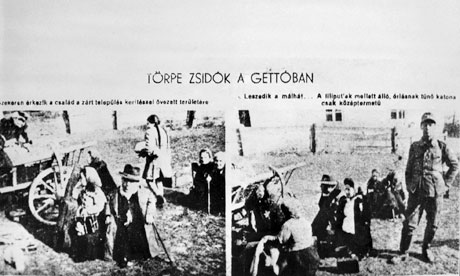 The Ovitzs leaving Auschwitz-Birkenau in May 1944
We embarked on the trail of the seven dwarves of Auschwitz with the
notion that we would subject their story to the same rigorous
examination that would be applied to any other historical source. So we
not only collected their testimonies, but crosschecked them with those
of dozens of other survivors, inmates and doctors, either first-hand or
in archives and libraries. We unearthed medical documents in Poland and
Germany. Still, we followed the advice of Professor
Yehuda Bauer, a Holocaust historian and himself a survivor, that "one must never argue with a survivor".
Descending
the ramp at Auschwitz-Birkenau, the seven dwarves and their five
average-height family members were immediately separated from the others
in the transport. They were told to wait for the arrival of Mengele. In
rotation with other physicians, he was sending the multitudes to their
immediate death, and selecting the few fit enough for slave labour. He
was also using his long shifts on the ramp to pluck out twins, as well
as hunchbacks, hermaphrodites, giants, dwarves, obese men and corpulent
women – in general, anyone suffering from a growth disorder.
On
the night the Ovitzs arrived, Mengele was asleep in his room at the
nearby SS headquarters. All the troopers on duty at the ramp, however,
knew well of his passion, of his collector's mentality. To gain favour
with the freak-hunter, they were always on the lookout for new specimens
to enrich his "human circus". While a lone dwarf did not provide reason
enough to knock on Mengele's door in the middle of the night, seven
dwarves, along with their tall siblings, seemed good cause for
disturbance.
While the SS were brutal towards the newly arrived,
they were cheerful with the dwarves. Realising this, two families from
the Ovitzs' village approached and told the officer they were related.
The Ovitzs kept silent and did not prove them wrong. Now they were 22.
Mengele hurried out to see his new acquisitions. He was delighted:
"I now have work for 20 years," he exclaimed.
A black army truck
took them to a building at the edge of the camp. They were pushed in,
stripped naked and smelled the fumes. The event indelibly etched the
imminence of death not only on Perla's memory; three other members of
the group, whom we interviewed, as well as Elizabeth, Perla's sister,
who wrote her memoir, all attested that they were beginning to be gassed
and would have died if Mengele had not suddenly reappeared.
Though
we had five first-hand eyewitness accounts, we wanted to verify the
story. The only way to do so was to study the procedures and manuals of
operating a gas chamber. These were designed to kill between 500 and
2,000 people at once, depending on the size of the hall.
Cyclone B
was effective only at a room temperature of 27C, which was achieved by
cramping a mass of people together. Gas chambers were simply not
operated for merely 22 people; small groups were shot.
Furthermore,
according to the camp's rigid safety orders, SS personnel had to wear
gas masks when operating Cyclone B. Although the victims died within 15
minutes, the SS men routinely waited half an hour before turning on the
powerful fans that dispersed the gas from the chamber. Only then were
the doors opened. The operators themselves did not enter; instead,
Jewish inmates from the
Sonderkommando
were sent in to drag out the bodies for cremation. Once the
extermination process had begun, it could not be halted, because by then
it would have been impossible to open the doors.
What actually
happened was that the Ovitzs and their neighbours were taken to the camp
sauna for disinfection, where the water poured over heated stones
produced much steam and fumes, as well as temperatures intense enough to
cause someone to faint. The sauna had a particularly traumatic effect
on both small children and fragile dwarves that might easily have
created the impression of being gassed.
And what about the
appearance of Mengele at the door? They regarded him as their saviour,
and there were several later incidents in the camp when he indeed
rescued them from imminent death at the hand of one of his rival
doctors. So, for the Ovitzs, every narrow escape that they had in the
camp was thanks to him.
Mengele had several hundred twins at his
disposal, and he carried out notoriously cruel experiments on them that
led to countless deaths. But he had only one family of dwarves, so he
was careful not to put his precious guinea pigs at risk. He gave them
special living quarters and their food portions were larger. Their hair
was not shorn, because he needed it for his experiments. They were
allowed to wear their own clothes, because prisoners' uniforms did not
fit their bodies. Former inmates told us that they thought they were
hallucinating when they saw a colonnade of seven dwarves dressed warmly
and elegantly, as if for a
Shabbat stroll.
In the research on twins, Mengele was the field worker for his mentor,
Professor Otmar von Verschuer,
in Berlin. But he was looking for a research niche of his own and he
found it in dwarfism. Mengele was aiming not only to discover the
biological and pathological causes of the birth of dwarves, but to
demonstrate the racial theory that in the course of its long history,
the Jewish race had degenerated into a people of dwarves and cripples.
Members
of the Ovitz group described to us in detail the painful blood-taking
that they underwent. Often they fainted and water was poured over them
to revive them, only for siphoning their blood to resume. Medical
science of the time was obsessed with blood and its constituents, and it
was generally believed that plasma contained all genetic traits. But
only the medical records, all bearing Mengele's flamboyant signature,
clarified what he was looking for: signs of kidney problems, liver
function,
typhus and syphilis.
Written
accounts of inmate doctors shed further light on the endless
anthropological measurements and comparisons between the Ovitzs and
their neighbours, whom Mengele mistook for family. The doctors extracted
bone marrow, pulled out healthy teeth, plucked hair and eyelashes, and
carried out psychological and gynaecological tests on them all.
The
four married female dwarves were subjected to close gynaecological
scrutiny. The teenage girls in the group were terrified by the next
phase in the experiment: that Mengele would couple them with the dwarf
men and turn their wombs into laboratories, to see what offspring would
result. Mengele was known to have done it to other experimental
subjects.
Inmates in Auschwitz-Birkenau tried to improve their lot
with whatever talents they had. A barber would hope to shave a kapo
(prisoner supervisor) for a piece of bread or two cigarettes; a
seamstress might mend the block elder's clothing; a painter would get a
piece of sausage for making portraits for the SS guards; and one
champion chess player was kept alive to play with Mengele.
Professor Israel Gutman,
an Auschwitz survivor and prominent historian, recalls that "feasts and
saturnalias were celebrated at kapos' and block elders' quarters. The
artistic programme consisted of obscenities and dirty jokes. Sometimes
a prisoner with a sweet voice would sing prewar hits in various
languages. The kapos especially favoured melancholy tunes. The famous
stars were very popular among the kapos and enjoyed a special income,
thanks to their art."
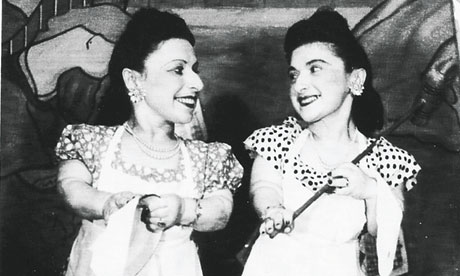 Perla (right) and Elizabeth Ovitz: as the five sisters and two
brothers were all good-looking and musically gifted, the stage seemed
the perfect career
Perla (right) and Elizabeth Ovitz: as the five sisters and two
brothers were all good-looking and musically gifted, the stage seemed
the perfect career
However, Perla Ovitz insisted that she and her family never took part
in the "nightlife" of the death camp: they never performed in these
drunken revelries, never sang in public nor entertained parties of kapos
and SS men. She did remember one event. Sunday 30 July 1944 was the
fast of Tishah Be'av, commemorating the destruction of the Holy Temple
in Jerusalem. Being familiar with the Jewish calendar, Mengele
perversely ordered the leader of the women's orchestra to prepare a
special concert to desecrate the holy day. Perla remembered that the
programme consisted of romantic, melancholy German songs that moved her
and her sisters to tears as they watched the performance from their tiny
stools in the audience.
Yet in her autobiography,
Playing For Time,
singer Fania Fénelon remembers it entirely differently: "We start with a
foxtrot, Mengele waving his hand, the dwarves filling the stage, some
couples dancing, other participants only managing a kind of grotesque,
depressing twist. The men bow with a touch of servility; the women
follow. Their jewellery, silk, ornaments glitter in the sun, igniting
thousands of sparkles, dancing, swinging, intermingling. These
creatures emit joyful sounds, trying to sing along with Clara, Lotte and
me. They have high shrieking voices. The orchestra plays a march
and they accompany with clapping and stamping."
Against the bleak
backdrop of the death camp, the concert was so vivid that it became
deeply etched in the memory of the survivors whom we interviewed. Isaac
Taub was part of a group of twin boys enlisted to carry chairs and
benches and arrange them in rows. The teenagers were allowed to stand at
the back during the performance and Taub clearly remembered the Ovitzs
on stage. "We all knew that the dwarves were performing for the Nazis."
Yet
Perla denied that they ever took part. As pious, God-fearing Jews, the
Ovitzs deemed performance in Auschwitz to be an abomination, like
singing and dancing in a graveyard. Nor would performance under coercion
have lessened their shame – not with a painful awareness that while
they were entertaining Nazis, the chimneys never stopped smoking.
No wonder they strove to erase their experience from their history, and
their minds.
Death was the master of Auschwitz and its toll was
piled outside for all to see, like so much garbage waiting to be
collected. A space suddenly empty in a bunk did not shake heaven and
Earth. Those who survived the night walked about as if wrapped in an
invisible shell, praying to live one more day. But the Lilliput Troupe
drew the inmates beyond their shells, to care about them and their
whereabouts. Subsequently, many survivors referred to the fate of the
dwarves in their own memoirs.
In her autobiography,
Auschwitz: True Tales From A Grotesque Land,
Sarah Nomberg-Przytyk describes in appalling detail the horrible death
of two members of the Ovitz group, one of them an 18-month-old baby boy
who died as a result of one of Mengele's experiments: "Around him, like
pillars of stone, stood a large woman, along with the child's mother,
slim and frail; the three midgets sat in miniature chairs." In the
evening, the dead toddler was placed outside the block with the other
corpses to be taken to the crematorium. Nomberg-Przytyk also recounts
the death of Avram Ovitz, the leader of the group: "The old midget
wanted his wife" and tried to slip through the barbed wire; a guard
spotted him and, when Avram got close enough, shot him. "He never made
it to his wife."
But the little boy and his uncle Avram were
not killed, and lived to see liberation day. What, then, caused
Nomberg-Przytyk to make such grave mistakes? Most likely she was
compressing a number of events, and attributed to the dwarves two common
occurrences in the daily life of the camp: the death of a child in his
mother's arms and the shooting of an inmate who approached the
electrified fence.
And there were others, such as Renee Firestone,
who described the death of the Ovitz dwarves: "The Germans found a
community of midgets, transported them to Auschwitz, shot them en masse
and then were forced to let them sit in a pile for three days until the
crematoria could take them."
One plausible explanation for the
discrepancy between fact and remembrance is that the survivors, who
regarded their own deliverance as miraculous, found the chances slim
that someone as helpless as a dwarf could escape death. The fact that
the Ovitzs were transferred several times from one side of the camp to
the other caused their fellow inmates to lose touch with them, and in
Auschwitz, when you stopped seeing someone, it could mean only one
thing.
The seven dwarves, as well as their entourage, all survived
the war, and emigrated to Israel in May 1949. Three months later, the
Lilliput Troupe was back on stage. In 1955 they made their last bow, but
dwarfism did not affect their life expectancy. The first-born, Rozika,
reached the age of 98 and her sister Franziska died aged 91. Perla Ovitz
died in September 2001.
Labels: Anti-Semitism, Atrocities, Family, Germany, Holocaust, Judaism, Politics of Convenience