Ruminations

Blog dedicated primarily to randomly selected news items; comments reflecting personal perceptions

Tuesday, July 26, 2016

A Family's Misfortune

"You can't go against five cops at once. It was unnecessary."
"[There was blood] all over the place He looked weird -- he looked dead. It was weird that they didn't [immediately] call paramedics. It took way too long. Everything was moving very slowly."
Asli Mohamed, 20, Hintonburg area, Ottawa 

"I told the police he's a crazy man. They hit, they hit, they hit, they hit everywhere. Then he was unconscious. Then I was scared. Then I'm shocked."
"It's the first time in my whole life I see a human being hit by another human being. He's usually fine [the victim']. I don't understand."
Zainab Abdallah, building resident, neighbour

"I think we're all just surprised because we live in Ottawa and we don't really encounter these kinds of problems."
"I wanted to give the benefit of the doubt, but the way that the situation played out it seemed like it was because we were like immigrants or we were black."
"[The Somali community were not being treated] the way we were supposed to [not] being cared for the way [they] were supposed to [that Sunday morning]."
Mariam Ali, 18, University of Ottawa student
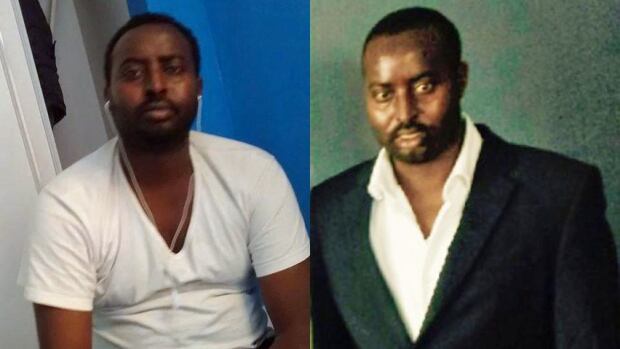
Abdirahman Abdi composite photos Abdirahman Abdi, 37, was a Somali-Canadian with mental health issues, whose family moved to Canada eight years ago. He was pronounced dead Monday afternoon after losing vital signs during a confrontation with police on Sunday morning. (Images supplied by family)
"Sometimes police have a perceived notion of what a person is doing, or what will happen. They don't always have all the facts. They have only seconds to make an assessment. They are operating on the best information they have at the time."
"You could get two or three psychiatrists to sit there, and they would disagree about the diagnosis [mental state of a suspect]. Then you have a young officer with three years' experience [on the job] with only seconds to react [to an ongoing situation]."
"Police have one main objective: compliance. Stop what you're doing, or come with me. People are shocked when police use force. But police have to do what the law compels them to do."
"There is such a range of possible situations. All situations are so complex [police training cannot possibly encompass all potential situations and the best-case reactions]. You can't give them recipes You can't give them formulas. It's really about observation and focusing on the risk of harm, not doing a diagnosis."
"We don't ask police to do a diagnosis on the scene. You don't want police to assess if someone is mentally ill -- are they delusional? Are they schizophrenic? Are they under the influence? You want police to focus on the behaviour."
Rick Parent, 30-year police officer, professor of criminology, Simon Fraser University
Const. Dave Weir, left, and Const. Daniel Montsion, centre, are seen kneeling by Abdirahman Abdi outside his apartment building on Hilda Street. CBC News has learned both officers are the subject of an SIU investigation into Abdi's death.
Const. Dave Weir, left, and Const. Daniel Montsion, centre, are seen kneeling by Abdirahman Abdi outside his apartment building on Hilda Street. CBC News has learned both officers are the subject of an SIU investigation into Abdi's death. (YouTube) 

Dr. Parent points out from his experience, his education and his observations and the study of statistics and crime literature that about a third of the 15 to 30 police shootings that take place in Canada annually, have a mental health component. And this incident that took place several days ago in Ottawa was one of those. Police had been called to a Bridgehead cafe on Wellington Street near the apartment building where many Somali community members live. Staff at the cafe complained that 37-year-old Abdirahman Abdi, who was non-verbal, was harassing a woman.

When police arrived the man fled, despite being told to stop, and a foot chase ensued. A relatively short one, given the short distance between the cafe and the apartment block. Witnesses described the fleeing man being tackled, brought to the ground by several police officers who proceeded, they said, to kick, punch and beat the subdued man with their batons. He was handcuffed, and lay there, bleeding on the sidewalk.

It took ten minutes, said the onlookers, before the injured man was taken in hand by paramedics and given medical attention. Someone had recorded a 27-minute video which clearly shows the man, wrists cuffed behind his back, trousers pulled down, lying face down for close to ten minutes before the arrival of paramedics and CPR was started. A later news report indicated that the two police officers had been instructed by whoever took their 911 call to initiate CPR; when paramedics arrived they took over.

Witnesses also said that police made an effort to seize cellphones held by bystanders, recording the event. Zainab Abdallah, a resident of the building where Abdirahman Abdi's family also lived watched him run toward the apartment door, the officers in close pursuit, shouting at him to stop. Failure to comply saw him tackled and taken to the ground. When the man was taken to hospital by paramedics, his condition was grave. There were rumours that air had been cut off to his brain.

Despite emergency application by medical personnel at the hospital the man did not survive the physical ordeal and trauma he had suffered. His family is devastated and desolate. They had arrived from Somalia as refugees to Canada in 2009. Both parents have steady jobs. Their oldest son was known to have mental incapacity. In most situations Canada will not permit immigrants to bring in family members who suffer chronic illness of any kind.

The cruel irony, of course, is that refugees who flee violence in their home countries to find haven in other countries, sometimes find instead of a peaceful future, a future cut short by a horrible misadventure of some kind, not necessarily of their own making. It might also be noted that young men from the Somali community are over-represented in proportion to their numbers, in incidents of criminal activity and violence.

The police officers involved in this unfortunate incident with its dreadful outcome are under suspension, while the oversight body that is brought in to investigate when incidents such as this occur, the Special Investigations Unit, is set to launch a probe. Whatever the probe comes up with, the details that have so far emerged do not look very complimentary to these members of the Ottawa Police Force.

Labels: , ,

Sunday, December 06, 2015

Hope and Courage

"It looked like my legs were flying. But I think it was just me being dragged by the train, away from them. I saw them detach and fly off my body and land in the snow. I thought it was just my feet; I got new Uggs [boots] two days before that."
"I was looking around, figuring that something was going to happen, someone was going to stop and run over. It wasn't like I was in the forest in the middle of nowhere. And then I thought, 'It's dark. It's really dark and I'm in a ditch."
"After the accident happened, I hated myself so much. It was like, 'How could everyone else not hate me, too? I felt I was worthless and gross and disgusting. But I got so much support; it was amazing. I couldn't have recovered without it. So I'd like to do something that would benefit others."
"There are times that I feel stupid and angry with myself for letting it happen. I feel ugly for the way that I look, and I get annoyed with how long things take me and the things I can't do, and I'm sometimes bitter. But I don't feel sorry for myself, and I don't want other people to."
Sarah Stott, 22, Tunney's Pasture, Ottawa
Sarah Stott tries out her prosthetic left leg at the Ottawa Hospital Rehabilitation Centre. Shelly Stott

It is two days short a year that a young woman living in Montreal as a university student and working as a waitress at the Irish Embassy Pub & Grill was involved in a bizarre and heartbreaking accident that has changed her life forever. An accident occurred that mutilated Sarah Stott, to the extent that most people would be in permanent shock over the change in their physical state. She has chosen to view her life as an ongoing challenge to adapt to what misfortune brought her, but what hope and determination can minimize.

She could very well have died on December 8, 2014 when she fell and tripped over train tracks as she popped between two parked freight cars, taking a short-cut in the wee hours of a morning after working the night shift, to get to her apartment. That short cut through train yards was illegal, she knew, but everyone seemed to use it, and so did she. When she tripped onto the tracks she fell directly in the path of an oncoming train. The train sliced off her legs and she fell into a frozen ditch.

This was two in the morning and the temperature was minus-14 Celsius, and perhaps that saved her life, making it too cold for her blood to flow freely taking life away from her horribly injured body. Her purse holding her cellphone was not within reach; it, like her legs had gone flying away from her when the train hit. The pain she felt was minimized by both the cold and her state of high agitation. She could see people in the distance and called, but no one could hear or see until four hours later when someone did see her.

In hospital for the next few weeks she was heavily sedated in an induced coma as her body was subjected to a dozen operations. Right leg amputated above the hip, left below the knee and what was saved of both hands due to frostbite was half of each thumb and part of an index finger; her other digits were lost. By February she was able to begin rehabilitation and there was six months of that at the Ottawa Hospital Rehabilitation Centre where doctors told her it would be October before she might walk again.
Sarah Stott practises being upright. 'I don't remember learning to walk when I was a baby.'
Sarah Stott practises being upright. ‘I don’t remember learning to walk when I was a baby.’ Shelly Stott

By June, however, she was up and walking with prosthetic legs. Her love of nature and being out-of-doors took her through the spring, summer and fall months with hope for the future. She has a Staffordshire terrier companion, and looks forward to spending time doing things familiar to her before her accident. "My favourite part about still being alive is being able to enjoy nature. I love fishing and ATVing, being out with my dog, swimming, boating, and that was the hardest part, to think 'Oh, my god, I'll never do this again'."

As her body adapts to the changes that have and continue to occur, prosthetics require updating, new ones built as the old are discarded. She now has her fifth left leg. The right prosthetic leg is built with a costly microprocessor in the knee. Although she had prosthetic fingers produced that cost about $40,000, the device does not function as hoped. Her wheelchair which cost $20,000 is forever malfunctioning. She is hoping at some future time to have a modified car to enable her to get around independently.

Her mother's health insurance helps with costs. An online crowdsourcing fundraiser [www.gofundme.com/j2uc84] raised almost $100,000, about half of what her prosthetics have cost, to date. She does a lot of reading, takes a few courses, in communications and abnormal psychology at Algonquin College, but aspires to return to university.

Labels: , ,

Saturday, September 26, 2015

A Small Town Tragedy, A Universal Event


Mourners hold a candlelit vigil in remembrance of Carol Culleton, Anastasia Kuzyk and Natalie Warmardam in Wilno on Friday, Sept. 25, 2015.
Mourners hold a candlelight vigil in remembrance of Carol Culleton, Anastasia Kuzyk and Natalie Warmardam in Wilno on Friday, Sept. 25, 2015. Justin Tang / The Canadian Press

"She [Mary Ann] states that the marriage and Sahra's conception were Basil's strategies to manipulate the court."
"His mission was to marry and conceive another child, thinking that no judge would send a married, expectant father to jail -- particularly when the wife was in support. Mary Ann's mantra throughout her testimony was that she did what she was told because the underlying message was that no one would believe her and the threat that if she disappointed, he would take the children."
Justice Rick Leroy, December 2011 judgement

"I've tried to take the children from him [Borutski], not allowing any access whatsoever. I have made false statements about him to convince authorities he should not have custody. I have destroyed the children's lives unknowingly ..."
"I want to make sure my husband has the right to take care of the children and all financial decisions. I believe he's the only person that I can trust to do what is right and fair for everyone concerned. I am doing this on my own free will and I am not being coerced or threatened."
Mary Ann Mask, 1994 marriage contract
Mary Ann Mask informed a judge in 2011 when she was obtaining a divorce from her husband Basil Joseph Borutski, now 57 and facing three charges of first-degree murder, that the man "destroyed her spirit by relentless threats and abuse". It's beyond difficult for onlookers to understand how and why it is that any woman would commit to a relationship that is horribly abusive. But that this is a commonplace occurrence is beyond dispute.

Whether it is love that inspires women to stand by men who have challenged those women's determined belief of respect and equality and tender love in an intimate relationship, or the fantasy that the quality of their own love and their patient personalities will be ample to the task of persuading the men to become better human beings, is beyond anyone's ken. Women seem, to begin with, to be all too often attracted to men whose characters are of a dubious, black nature.

Clearly, Mary Ann Mask was attracted to the man who later abused her dreadfully over the 26 years that they had such an intimate relationship that after he had been charged by her with brutality, they were reconciled three times, were later married and conceived and raised two children together. Until the final break came when it was no longer possible to live with a man whose degrading violence, threats and psychotic control destroyed the love that was present, leaving only fear.

Mary Ann Mask sought legal defence for domestic assault for the first time in 1985. At that time Basil Borutski defended himself successfully at the cost of $20,000 in legal fees. Despite that history of co-habiting dysfunction the common-law couple moved back together to a home, separating in 1993 when he was once again charged with assaulting Mary Ann Mask. Yet she was persuaded and bullied once again to reconcile with the man, marry him in 1994, and have a second child with him.

After the acrimonious divorce Borutski continued the fiction of his innocence the victim of false allegations by a mentally ill, vindictive woman. He'd had her copy out and sign a marriage contract in 1994 wherein she 'admitted' fault, and authorized his complete custody of their children and all their finances All charges of assault and uttering death threats were withdrawn time and again, with Borutski informing court that his wife's injuries had been self-inflicted.

This week, three women with whom Basil Borutski had had intimate relations were found murdered in the span of a few hours, in and close to the community of Wilno, some few hours' distance from the nation's capital, Ottawa. Carol Culleton, 66, had been strangled in her cottage on Kamaniskeg Lake Road, Anastasia Kuzyk, 36, had been shot dead at her home on Szezipior Road, and Nathalie Warmerdam, 48, was shot dead as well at her farmhouse on Foymount Road, on Tuesday.

Basil Borutsky is in custody. A man whose long predation on women and violence toward them had gone unpunished and unchecked.

Video thumbnail for Raw Video: Candlelight vigil for slain women in Wilno, Ontario

Labels: , , , ,

Sunday, February 01, 2015

Dream House Turned Nightmare

"Essentially they had removed part of the foundation wall. I could see through to the neighbours. I could pass a coffee cup through for sure."
"I remember Jimmy [her husband] pulling me over one day and showing me cracks in the ceiling and down the walls."
"He's like, 'You're not going to believe this, they tore down the house. And I thought to myself, 'No, no, no. It can't be that bad."
"As I'm driving up the street, I guess my face just dropped."
"I have a Welsh bible that's been in my family for 100 years, so I grab that. I grab some jewellery. We grab a couple of changes of clothes and a toothbrush and we get in the car."
Allison Pantaleo, Toronto
Supplied Photo
Supplied Photo   When Jim and Allison Pantaleo first met — as coworkers at a pub called Gabby's on the Danforth — it was something close to love at first sight. Not long after that, they were married.

A home needn't be a palatial palace to be viewed by its owners as their castle. Certainly the modest semi-detached house that Jim Pantaleo and his wife Allison bought represented the exalted status of home ownership, a place of their own, their haven, a home where they would raise a family, and live of course, happily ever after. Except for the fact that this isn't what happened with the young couple who had made such glorious plans for their future together.

The house they bought was twinned with a house bought by another couple, Jonathan Wood and his wife Gillian Irving. But the Pantaleos were ecstatic, they bought the modest house by bidding just over the selling price, and it cost them $340,000. Only in Toronto's overheated housing market would such a house as they bought on Dunkirk Road, number 29, sell for that inflated price. Unless, of course, they were living in Vancouver, where houses are even more over-priced.

But it was their own, and they loved it. They set about upgrading the house, small and old as it was. They had the kitchen refurbished with granite counter tops and limestone floors, had new cherry wood floors laid throughout, added new lighting and painted the entire interior. And then prepared to move in. While renovations were simultaneously taking place at number 31 Dunkirk Road, the half attached to their own.

A City inspector turned up to inspect the property attached to the Pantaleo family's. He found a number of problems on the building site, ordering the contractor doing the work, Ironwood Construction Ltd. to "stop work immediately"; have a structural engineer come in, to address the issues before they would be given the green light to continue. That house was being completely gutted.

The order was lifted eventually and work resumed. At the same time the Pantaleo family's contractor alerted them to his concerns. "The site's not secure", he said. "I don't think this guy knows what he's doing." Part of the foundation wall had been removed. The foundation began to shift. Propane fumes from the next-door worksite seeped into their home. The floors were cracking; the stairs separating from the walls.

Supplied PhotoSupplied Photo

The couple had met at work, in a pub. They ended up buying that pub together and managing it very well indeed. They got married, and made their plans for the future. Their business was going well, they were busy, but their thoughts turned to starting a family. That's when they began looking around for a house. They looked for a full year before they first saw the semi-detached house they ended up buying.

That house, in fact, turned out not to be the place of their dreams, but the site of their living nightmares, as the couple who bought the next-door semi to which their own was attached, seemed to have attached no importance whatever to what their plans for their half of the attached building would be doing to the other half owned and lived in by another young couple.

Finally, the decision was made to go beyond merely gutting the house to replace it with a new interior. The decision was made by the other couple living at 31 Dunkirk to entirely demolish their half of the building. During which the workers tore a hole in the Pantaleos' roof. And it was soon realized that without the support from 31 Dunkirk their house began to lean toward the open pit where the other half had once stood.

Supplied Photo
Supplied Photo   The Pantaleos planned to move in to their new home, at 29 Dunkirk Rd. (right) on 
Oct. 31, 2009.

The engineer the Pantaleos had engaged advised them to vacate the house, it was unsafe to continue living there. They took what few possessions they could, including their three cats and left their dream house. Eventually 31 Dunkirk was rebuilt entirely. The owners chose to sell it, making a considerable profit on the exchange; the $519,000 they realized for the house was twice what they had paid for it. The Pantaleo house was sold as well, at a $30,000 loss.

And the couple, Allison and Jim, weren't in too good shape, the stress they were under more or less ruined their marriage and they separated. "He was just a shell of who he used to be. He looked horrible. He sounded horrible. He was literally doing nothing", said a friend, speaking of Jim Pantaleo. He was deeply in debt and losing money faster than he made it. And decided to sell his business.

His body was discovered by a jogger, in Riverdale Park, beside the Don River in Toronto. He had mortally shot himself, leaving suicide notes with his mother for distribution to the people he cared about. Allison now lives in a small one-bedroom apartment close to the home she and Jim once owned and based their future plans on.

The lawsuit that she and her husband launched is ongoing. They had filed a lawsuit in Ontario Superior Court against the owners of 31 Dunkirk, the operator of Ironwood Construction, the engineer and the City of Toronto, asking for $2.8-million in damages.

Allison occasionally sees that couple, who now have a young child. She had known them earlier as occasional diners at the pub she and Jim had once owned. "I didn't say anything, because what are you going to say? But just watching her with her daughter ... it's not fair. It's just not fair", she says wistfully, of the last encounter when she saw them in Starbucks.

Labels: , ,

Tuesday, November 25, 2014

Million-Dollar Baby

"It’s a very sad position to be in. I wouldn’t wish it on anybody."
"I had a bladder infection and I hemorrhaged a bit at four months. My doctor saw no reason for me not to go."
"We had no questionnaire [from Blue Cross]."
"As of March, Blue Cross pretty much washed their hands of the whole case,” she said. “We’ve just kind of been sitting ducks not knowing what to do."
"My doctor felt my pregnancy was stable. Who can pay a $900,000 bill, not to mention the $30,000 it cost us to live down there? We’re still paying catch up from that."
"I guess our next steps are whether or not we proceed with the lawyer. We have a couple decisions to make here in the next day or two and we'll see what becomes of it."
 Jennifer Huculak-Kimmel, Saskatchewan
Jennifer Huculak-Kimmel
Saskatchewan resident Jennifer Huculak-Kimmel, left, gave birth to Reece nine weeks early while in Hawaii. (David Shield/CBC)

If only we mortals could look into the future, how different our decision-making and our actions might be. We would be enabled for one thing to prepare for all contingencies. Avoidance of unnecessary stress and misfortune would be priceless. But we can't even look as far ahead as two days' time to guide, inform and warn us of untoward plans best left unfulfilled in the prevention of untoward events.

On the other hand, sometimes a little common sense will fill the gap of not being capable of foreseeing certain events. That's why we look both ways before crossing the street. It's why we're careful, if we're prudent, not to spend more money than we have available at any given time. It's why we carefully consider what might conceivably go wrong if we embark on a venture that might have consequences we'd prefer to avoid.

That said, most of us tend to think that nothing can go wrong, if we really look forward to doing something. And Jennifer Huculek, pregnant six months, thought evidently that she had months to spare, and in the interim she and her husband Darren Kimmel could embark on a bit of a vacation. To some expectant parents it might seem prudent to remain put until the pregnancy was over, the child delivered to their waiting arms.

To others, obviously, the desire to celebrate unencumbered for the last time before a birth, might appear too attractive to pass up. Having had a bladder infection, and some bleeding during the pregnancy might not appear too serious, but perhaps in the interests of a trouble-free pregnancy caution might have been prescribed, although the Hucelek-Kimmels, husband and wife, felt they were home-free on the issue.

Particularly as they went to the trouble of procuring travel insurance. But when, two days after arrival in Hawaii, the pregnant woman's water broke and she was taken to hospital, the situation turned fairly serious. She was there for quite the stay, the baby was born prematurely and required a two-month stay in the neonatal intensive care unit of the hospital. All of which even the village idiot knows is prohibitively expensive. All the costs would have been taken care of had these hospitalizations taken place in Saskatchewan.

But Saskatchewan Blue Cross from whom the travel insurance was taken, cited a "pre-existing condition" to render them ineligible for coverage to pay the whopping hospital-medical bill they faced of almost a million dollars. The bladder infection that had surfaced before the pregnancy was the culprit, so obviously that complication is not viewed as innocently harmless to the pregnancy as the prospective parents believed it to be.


Indeed, when the pregnant woman was hospitalized reflecting a pregnancy emergency, Blue Cross contacted the couple informing them that their coverage had expired even before the baby was born. At that juncture, making arrangements to return to Saskatchewan would have required that a private jet with medical attendants be arranged for, yet another costly prospect whose cost they dismissed.

The parents of the baby have been receiving quite a bit of attention and sympathy.

Even from Blue Cross:

"The challenges facing this family are extraordinary and difficult. As such, we urge Ms. Huculak to have our decision reviewed by an independent ombudsman. OmbudService for Life and Health Insurance (OLHI) is a national independent agency that provides impartial, third party reviews of customer concerns."
Posted to the Saskatchewan Blue Cross website
Saskatchewan Blue Cross stated that the family had been presented with a two-page explanation of its review where it cited nine events that disqualified them from Blue Cross honouring their insurance claim. The family chose not to share the contents of the letter with the media interviewing them and in so doing, disseminating to the wider public the family's financial plight. They are obviously hoping that public pressure through sympathetic censure of Blue Cross will convince the insurer otherwise.

They're looking at a total bill of $950,000 of which about $160,000 represents the mother's hospital stay, $40,000 a medical evacuation, and the remainder the cost to care for the baby in the Hawaii hospital's neonatal intensive care unit. Of that total sum Saskatchewan Health, the province's universal health coverage for in-province care has paid $20,000 of the bill while the United States generously paid for the cost of baby Reece's delivery of $12,000.

Hospital-surgical expenses are huge; without insurance coverage they can utterly debilitate a family's savings and future financial prospects. The family has been left with the bulk of the remaining bill of $918,000.

The lessons here are numerous; when pregnant and having experienced some hemorrhagic bleeding during the pregnancy, stay home and close to medical care; a reckless decision to travel regardless should be accompanied with the knowledge that an untoward event would be costly; when purchasing travel insurance: caveat emptor.

Wipe that scowl off your face, and shake your head over unwise decision-making. And consider, perhaps, the offer of pro-bono service from a lawyer willing to take the case. If you think you have a case, other than eliciting sympathy from the public. And continue to treasure your good health, if not wise decision-making. Cherish that healthy, growing baby.

Labels: , , ,

Monday, May 05, 2014

Three 'hairialist' acrobats remain in critical condition

BBC News online -- 5 May 2014
The incident happened in front of a full house

Three people remain in critical condition in hospital after a group of women acrobats fell from an aerial platform at a circus in the US state of Rhode Island on Sunday.

Eight acrobats plummeted up to 12m (40ft) when the scaffolding structure holding them collapsed.
The performers, from the US, Brazil, Bulgaria and Ukraine, were in the middle of a hair-hanging high-wire act.

Authorities continue to investigate the cause of the accident.
Acrobats Dayana Costa, Julissa Segrera and Stefany Neves remain in critical condition at Rhode Island Hospital, a spokeswoman told the Associated Press news agency.

Performers hang during an aerial hair-hanging stunt The performers fell during an aerial hair-hanging stunt, as captured in Friday's performance
 
Viktoriya Medeiros and Viktorila Liakhova have been listed in serious condition, while performers Samantha Pitard, Svitlana Balanicheva and Widny Nevas are now considered in good condition.
The names and conditions of three other people hurt were not released.

The collapse occurred during a Ringling Bros. and Barnum and Bailey show act in the eight performers hung from their hair "like a human chandelier", according to the circus.

According to the circus website, the eight performers, known as "hairialists", feature in a "larger-than-life act... spinning, hanging from hoops, and rolling down wrapped silks all while being suspended 35ft in the air by their hair alone".

The metal frame from which the acrobats hung is said to have come free from a metal truss, a circus spokesman told US media.

"It just went crashing down... Everyone was freaking out. We heard this huge clatter and then we just heard the girls scream," witness Sydney Bragg, 14, told the Associated Press news agency.
Further performances were cancelled on Sunday and Monday as the circus worked with federal and local officials.

"We want to make sure all of our performers are safe," Stephen Payne, a spokesman Ringling Bros. parent company Feld Entertainment, said.

"An accident like this is unprecedented involving this number of performers," he added. "We're just grateful that as of now, none of the injuries appear to be life-threatening."

Labels: , ,

Friday, March 07, 2014

A Tragedy

"It's a tragedy. We have a young fellow who was trying to help out another person ... and we've lost a life needlessly on the highway."
Ontario Provincial Police Sgt. Brian Humber

"We're proud of what he did, trying to help someone else when most people wouldn't have stopped. It didn't surprise us he stopped. That was Jonathan, he was very selfless." 
"He saw the man in distress and Jonathan, being the gentleman that he is, he pulled over to help."
Christine Turmaine, step-mother

"It didn't matter it was 3:30 in the morning. He wouldn't leave someone stranded. He was always willing to help people."
"He liked working with his hands and working outside. He's a big, strong kid and that's what he liked to do. He always made sure he was never late for work."
Pierre Paquette
Jonathan's parents speak in the present. It is Jonathan 'is', not Jonathan 'was'. It will take them quite a while to wrench their minds toward the horrendously painful reality that Jonathan no longer is there, in the flesh. He is there certainly, but in their memories. And they will evoke the memories of the young man forever in their minds, recalling his spirit and his character. It is, after all, what they have left of him.

It was far earlier in the morning than most people would find themselves out, driving on a snow-slick highway Monday morning, February 24, on Highway 400, at half-past three, well before daylight, between Barrie, Ontario and Victoria Harbour. A van plowed off the highway, flipped and landed on its roof. Inside, the driver was trapped, aware that a handful of other vehicles were passing by.

Unable to help himself, awaiting help, but no help arrived. At least for the first half-hour.
 
Jonathan Antler-Paquette, right, is pictured with his father Pierre Paquette. Jonathan was killed early in the morning on Feb. 24 when he was struck while stopping to help a driver who’d slid off the road on Highway 400 near Barrie. (Photo supplied by Pierre Paquette)
 
What might have been the sixth vehicle to come across the accident scene did stop. And out of the vehicle stepped a 21-year-old man. He would help. His name was Jonathan Antler-Paquette. The past tense is used here because Jonathan, though he didn't know it, when he exited his own vehicle which he had carefully parked at the side of the highway, hadn't much longer to live.

On seeing the overturned van, Jonathan pulled his car to the shoulder, and approached the van. The man inside explained to Jonathan's parents later that he "was surprised to see a young man" approaching but overwhelmed with relief. Neither Jonathan's expectations of acting the Good Samaritan or the trapped man's relief at immediate rescue, as it happened, came to fruition.


Jonathan had studied computer technology and Internet security at Algonquin College. He lived with his mother, Kimberley Ada Antler at Victoria Harbour, commuting to his Toronto job with Harris Rebar as a rodbuster, laying, tying reinforcing rebar steel at construction sites. He was, in fact, on his way to pick up someone he worked with, when he deviated from his immediate purpose, to stop and help a stranger in need.

When Jonathan had pulled over and approached the van he was focusing on the man trapped within. Evidently he wasn't aware, didn't notice an oncoming tractor-trailer. The driver of the tractor-trailer attempted to stop while approaching the scene, but in the process the trailer jackknifed, blocking the southbound lane, striking Jonathan.

Another, fourth vehicle slammed into the trailer. Neither the tractor-trailer driver nor the subsequent pickup driver that slammed into the trailer was hurt. Jonathan Antler-Paquette died immediately at the scene of his intention to rescue someone in need of help.

Labels: , , , ,

Monday, October 28, 2013

Despite Diligent Care

"There was some sort of medically trained person with the military and a number of good Samaritans and eyewitnesses provided some aid, so it was nice to see."
Adam Loria, Calgary EMS

"The bystanders were really good. They had the scene contained and controlled. They were looking after the victims and they were here on scene prior to EMS and fire department and seemed to have it well in hand."
RCMP Sergeant Glen Demmon 
(THE CANADIAN PRESS/Larry MacDougal)

School buses are universally painted bright yellow. That is because this is acknowledged as the most readily seen-and-identified shade in the colour spectrum. The colour brings instant attention and recognition. And municipal laws are in effect that stringently support safety measures with the conveyance of any country's most treasured resources; it's children, vulnerable to harm on any nation's highways and byways.

School bus operators must comply with  Regulation 612  of the Highway Traffic Act (HTA).  School buses are compliant with the Canadian Standards Association Standard, CSA Standard D250, a prescriptive manufacturing standard that school buses must be built and maintained to throughout the service life of a school bus.  
  • The Highway Traffic Act
  • Dangerous Goods Transportation Act
  • Public Vehicles Act
  • Motor Vehicle Transport Act
  • Compulsory Automobile Insurance Act
  • Environmental Protection Act 


Section 175 of the HTA helps keep children safe by requiring motorists to stop when a school bus is stopped with its overhead red signal-lights flashing.  Motorists must not proceed until the bus moves or the lights have stopped flashing.  Failing to stop can result in heavy fines and demerit points.
Parents trustingly send their children off to school through the medium of school buses, whether living in the city, a town, or rurally. School bus drivers are trained to take care of their charges' safety. They must themselves rigidly tend to rules and regulations in the Highway Traffic Safety Act in the operation of a commercial vehicle, with especial emphasis on their role of bringing children safely to their school destination.

Drivers and operators of other road vehicles must acknowledge that they are aware of the presence of a school bus by adhering to all the rules about stopping when a school bus is stopped, and never passing it when a mechanical arm is outstretched indicating the egress or ingress to a bus of local children. Everyone concerned with the transfer of children through a commercial medium in the absence of their parents feels fairly secure in the atmosphere of safety.

And when an accident occurs, and it has disastrous impacts on the children entrusted to the care of a commercial bus operator, all that emphasis on safety and security suddenly plummets into the sphere of concern that nowhere is completely safe of threats to a child's well-being. Which is precisely what occurred near Crossfield, north of Calgary last Friday morning.

When a female bus driver experienced the misfortune of crashing the school bus she was driving into a truck, hitting it head on. Children aged 5 to 13 on their way to a nearby elementary school were treated by paramedics and firefighters and then sent on to hospital. "They were all very brave and ... my heart goes out to them. They were trying not to cry and [were] very shook by what was happening", according to the Deputy Fire Chief with Rocky View County.

The bus driver was in serious condition. Of the three children whose condition was considered to be serious, the little boy whose condition was most serious is the son of the bus driver. What greater assurance of care and responsibility can be implied under those circumstances, of a driver? Six children were considered to be in serious but stable condition, and the remaining four children came out of the event relatively unscathed physically.

The bus remained upright, stuck against a guardrail after the collision, its windshield gone, its front end crushed. A large pickup truck was positioned nose down in a ravine. It had smashed through a reinforced guardrail.
"We're not quite sure what the contributing factor to this collision was, whether that's limited visibility or road conditions or what's actually there. We've contacted our collision reconstructionists out of Calgary to attend and determine that." 
RCMP Constable Robert Frizzell

Labels: , , , ,

Wednesday, May 15, 2013

Nightmare Psychopathy

A family is in an agony of grief. Suddenly a young father of a two-year old child leaves that child with a single parent, a mother who will now live out her life in his absence. Tim Bosma advertised his pickup truck on popular Internet websites. Two men appeared interested in his truck. They drove up from Toronto to his home address in Hamilton in the early evening for a test drive.

And the 32-year-old Tim Bosma casually called back to his wife that he'd be back home in short order.

As he drove with the men out of his driveway, however, another vehicle followed them. And as it happened, Mr. Bosma simply did not return home, at all. Not that evening, not ever. For a week family and friends desperately attempted to find clues to his possible whereabouts. Police too looked for clues, and they found them, although a huge mystery continues to surround the abduction of Mr. Bosma.

As long as the mystery continued with respect to where he was, his family could find comfort in hoping that he was being held somewhere against his will, possibly for ransom. In his absence, with no word there was yet hope. But that hope died a cruel and abrupt death when police discovered his body, barely recognizable, burnt beyond immediate identification. An autopsy indicated that he had been murdered the very evening of his abduction.

Abduction, however, for what purpose, other than simply malignant misadventure...? Police feel assured that Mr. Bosma had experienced no previous encounter with the two men who had appeared at his door, ostensibly interested in his truck. His truck, in fact, was discovered to be in a trailer in the drive of 27-year-old Dellen Millard's mother's country home in Kleinburg, near Toronto.

Dellen Millard is from a Canadian aviation family, himself a pilot. From a wealthy, privileged family. A young man with a good education and some amount of personal history of good repute. He has been charged with forcible confinement and theft over $5,000. Added to those initial charges, now that the body of Mr. Bosma has been found, will be a charge of first-degree murder.

Mr. Bosma's burned remains were discovered on a rural property in Ayr, Ontario owned by the Millard family. Mr. Millard had no conceivable need for ransom in abducting a young man with no personal wealth himself. In contrast, Mr. Millard's family owns the 50,000 square-foot hangar of Millard Air, an aviation company his grandfather founded located at Waterloo International Airport.

Police investigators are now looking for suspects other than Mr. Millard, accomplices; the person who was with him on the test drive, along with one or more individuals who were in the vehicle following Mr. Bosma's truck, taken on that fateful test drive a week earlier. There is a certain risk to the public, it is felt, until such time as all the suspects in the case are apprehended.

"Look what he did the first time to Mr. Bosma. So, yes, there is a fear and we are doing everything we can to identify this person and get him under arrest. He will be arrested, I can guarantee that", assured Staff-Sgt. Kavanagh of the Hamilton Police Force. "I don't know the motive at this time."

Labels: , , , ,

Friday, May 10, 2013

Dhaka building collapse: Woman pulled alive from rubble

BBC News online - 10 May 2013
The BBC's Akbar Hossain: "People here are extremely surprised." Photo courtesy Shariful Islam
A woman has been pulled alive from the ruins of an eight-storey building that collapsed in a suburb of Bangladesh's capital, Dhaka, 17 days ago. 

Rescuers said the woman, named Reshma, was found in the remains of the second floor of the Rana Plaza after they heard her crying: "Please save me."

She has been taken to hospital, but is not thought to have serious injuries.
More than 1,000 are now confirmed to have died, most of them women working in clothes factories.
The authorities said 2,437 people had been rescued, of whom about 1,000 had suffered serious injuries.

Reshma: "I kept banging whatever I could with my legs but no-one could hear me"
Dozens lost limbs as they were cut free from the wreckage.

The accident is one of the deadliest industrial disasters in history.
Crews using heavy machinery have begun removing rubble from the worst-damaged areas, and are expecting to find more bodies.

Brig-Gen Siddiqul Alam said rescuers had found a huge number of bodies under staircases.
"When the building started to collapse, workers thought they would be safe under the staircases. Each time we moved a slab of concrete, we found a stack of bodies," he said.

Soldiers were reported to have been preparing to break through a large concrete slab at about 15:15 local time (10:15 GMT) on Friday when the woman was discovered.

The worker who first discovered her told the BBC Bengali service: "I was cutting iron rods when I suddenly found a silvery stick just moving from a hole.

"I looked closer and heard someone calling 'Please save me'. I immediately called over soldiers and firefighters."

Officers ordered workers operating heavy machinery to stop, and rescuers used video and audio detection equipment to locate her exact position.

Crews saw a woman waving her hand, and she shouted "I'm still here" and told rescuers her name was Reshma.

Within minutes, hundreds of soldiers and firefighters rushed to the scene to help clear the rubble, says the BBC's Akbar Hossain in Dhaka.

The woman said that she was not badly hurt, and she was given water and biscuits while handsaws and drilling equipment were brought in to cut through iron rods and debris.

Rubble survivor records

  • Naqsha Bibi - buried for 63 days in what had been her kitchen after 2005 Pakistan quake; survived on rotten food and water
  • Evans Monsignac - trapped for 27 days in the rubble after 2010 Haiti tremor; stayed alive by drinking sewage water
  • Park Seung Hyun - pulled from the wreckage of a supermarket in South Korea in 1995, 16 days after it collapsed; drank rainwater
  • Pedrito Dy - spent 14 days in the ruins of a hotel after the 1990 Philippines tremor; drank water and urine
Rescuers worked for 40 minutes before finally pulling her from the rubble, amid cheers from the crowd.

She was taken to an ambulance and then rushed to the nearby Combined Military Hospital for evaluation and treatment.

She later told local TV from her hospital bed that she never dreamt she would see daylight again.
"I heard voices of the rescue workers for several days. I kept hitting the wreckage with sticks and rods to attract their attention. No-one heard me," she said.

"I ate dried food for 15 days. The last two days I had nothing but water."

Prime Minister Sheikh Hasina, whose government has been criticised for lax oversight of the clothing industry, spoke to the woman on the telephone.

Ms Hasina was reportedly flying to the hospital by helicopter to meet her.

Rana Plaza had housed several factories that made clothes for companies including Western retailers.
A preliminary government report suggested the collapse was been triggered when electricity generators switched on during a blackout.

At least nine people have been arrested over the accident, including the owner of the building and several factory bosses.

Labels: , , , , , ,

Sunday, April 21, 2013

HazMat Safety and Security

There are the psychopaths in society, those whose hatred for institutions, for the social compact, for the people around them motivate them to become predators and killing machines. And then there are those who swoop in selflessly without a moment's thought that they are placing themselves in danger, desperate to aid those who have been caught up in a scene of disaster, and suffering.

They are the first-responders, passersby sometimes, but for the most part the professionals; police, firefighters, paramedics.

Without their humane, compassionate and security oriented response, scenes of mayhem and chaos would take far longer to take on order. They rush in where all others dare not tread, where the dangers are alternately obvious and not-so-obvious. Where others flee the scene of carnage and wreckage, they see it as their duty to be there, to scrutinize and evaluate, to safeguard and to humanize the intolerably inhumane scene of death and destruction.

West Fertilizer Co Epa
Firefighter conduct a search and rescue operation at an apartment destroyed by an explosion at a fertilizer plant in West, Texas, Thursday, April 18, 2013. A massive explosion at the plant killed as many as 15 people and injured more than 160, officials said overnight. (AP Photo/LM Otero)

And so it was in a small town in Texas, which had in its midst a fertilizer plant. Which had presented with safety and security problems in the past when its operations had been been checked by the Environmental Protection Agency. The U.S. Pipeline and Hazardous Materials Safety Administration had fined West Fertilizer last summer for safety violations. The company was found in default of required safety procedures.

But West Fertilizer, in a risk-management plan that was filed with the Environmental Protection Agency, denied it was handling flammable materials. It had no sprinklers, water-deluge systems, blast walls, firewalls or safety mechanisms in place in the plant. And it assured the EPA and local authorities that the factory was never at any risk of explosion. This despite that it held 54,000 pounds of a gas that could explode at very high temperatures, if sparked.

A worst-case scenario, according to the officials operating the West Fertilizer Co. plant was that a short-lived gas release could occur that would never result in injuries to anyone. Presumably, those very same officials will now be offered the opportunity to explain just how they reached those conclusions, at subsequent enquiries, and in all probably in a court of law.

A explanation will be expected to make sense of the catastrophic explosion that took place at the plant on Wednesday night. Good thing it happened at night, when it might have been expected that no workers would be present. Dreadful thing that it happened at all, drawing people in the neighbourhood to observe at close range a fire out of control, before the explosion occurred. Before the explosion occurred, firefighters were on the scene.

The resulting concussion from the explosive might of the ignited fertilizer was enough to register on sensitive seismographic machinery as a small earthquake. The sound was heard for miles across the Texas prairie, demolishing almost everything for blocks around the plant, destroying the comfort and security of the town, while injuring over 200 people.

And fourteen people died. Most of them first-responders rushing to the scene to put out the initial fire. "Everyone knows the first-responders, because anytime there's anything going on, the fire department is right there, all volunteer", mourned one long-time resident of West. These first-responders were town residents, known personally to everyone.

"People's lives are devastated here. It's hard to imagine", said firefighter Darryl Hall, from a town about 80 kilometres away from West, who was one of the rescuers aiding with the house-to-house search looking for other possible victims. In the town of 2,700 people, 50 homes were destroyed. Three fire trucks and an ambulance were destroyed in the blast, along with a 50-unit apartment building, and damage done to the town's intermediate school.


The state, through its Texas Commission on Environmental Quality requires all facilities handling anhydrous ammonia, as West Fertilizer Co. did, to have sprinklers installed, along with other safety measures in recognition that the chemical is flammable. Inspectors failed to check whether the law was being respected in the plant, and the plant's officers felt no compulsion to obey laws that no one seemed anxious to enforce.

The town is picking up its pieces, and it is mourning its dead, those who felt compelled to respond when disaster struck their community, only to be struck down in the process.

Labels: , , , , ,

Thursday, April 11, 2013

In The Middle Of Nowhere

"It was immediately apparent how much of a good position we were in, considering. From a psychological perspective, you want to look for reasons why you're going to survive, versus the other option. We had a number of rules on our boat, and the number one rule is don't die. Above all else that is what we wanted to do, live and survive to tell our tale."Adam Kreek
"I'm like, OK, time to really get this door closed, and as I'm thinking that, this wave of water hits the side of the boat, and I think, 'It's going to be OK, we've seen these before'. And all of a sudden it did something funky and starts washing into the cabin, and it was a lot more water than I expected. All of a sudden it went from 'I can't close this door', to 'I gotta get to the port side of the boat', to 'I just need to get out of here', probably with a second or two."
Pat Fleming

Left to right: Adam Kreek, Jordan Hanssen, Pat Fleming and Marcus Pukonen arrived safely to the United States Coast Guard base in San Juan, Puerto Rico Sunday night after their boat capsized early Saturday.
The Canadian Wildlife Federation / Erinn J. Hale     Left to right: Adam Kreek, Jordan Hanssen, Pat Fleming and Marcus Pukonen arrived safely to the United States Coast Guard base in San Juan, Puerto Rico Sunday night after their boat capsized early Saturday.
 
Adam Kreek, Jordan Hanssen, Pat Fleming and Markus Pukonen had set out on quite the adventure. They were out to prove that it was possible to cross the Atlantic in a rowboat -- although this was some state-of-the-art rowboat, equipped with electronic gear, sleeping arrangements, food and water to last them for months, in the interests of embarking on an expedition to obtain scientific data, sponsored by the Canadian Wildlife Federation.
SEYL LOU/AFP/Getty Images
SEYL LOU/AFP/Getty Images    Canadian Adam Kreek, left, maneuvers with American 
Jordan Hanssen on Jan. 23, 2012 off Ngore beach outside Dakar before attempting to 
row 6,700 kms across the Atlantic to reach Miami, Florida.

Their route was to take them from Senegal to Florida, and they had been rowing steadily for two and a half months, using a protocol of two rowers at a time in turn, while two rested. It was during one of the exchanges when Adam Kreek and Pat Fleming had gone to the cabin, and Jordan Hanssen began to row, while Markus Pukonen prepared to join him after making use of the toilet bucket and just at that point they experienced what it felt like to have a rogue wave hit and swamp their rowboat which was supposed to be capable of self-righting.

Unfortunately, the weight of the water the rowboat had taken on, made hash of theory and what had worked on previous occasions, to swiftly overturn the rowboat. The four quick-thinking, swift-acting men went into an overdrive of activity to preserve their lives. Their OAR Northwest Expedition had run up against nature's challenge, and nature partially won. After 72 days of rowing, they were close to their goal, but in the spirit of man proposes and nature disposes, it was not to be.

They found themselves adrift on their life raft, nicely provisioned and in good spirits, despite the unexpected and startling end to their journey. They had attempted for three hours to flip the boat, to no avail. They were 650 km north of Puerto Rico, with their emergency beacons sending out distress calls. Their athletic training, experience and their careful planning left them with enough to get by on; food, water, blankets. When the U.S. Coast Guard C130 plane responded, dropping an emergency barrel, it contained nothing they required.

But for a radio. Since they were unaware the barrel contained a radio and they had no need of its contents to supplement what they already had, the barrel was left unopened and they had no means of communication. The Coast Guard was puzzled by the lack of contact, and dropped a second barrel, labelling it "Open Me!!!" -- containing another radio, and then communication was established. And then they learned that a cargo vessel was en route to their rescue.

The crew of the Panamanian flagged Heijin, took very good care of the four shipwrecked sailors. They landed at the Coast Guard station in San Juan Puerto Rico, and begin planning how they might be able to recover their boat, still adrift, named the James Robert Hanssen.

Labels: , , , ,

Sunday, March 10, 2013

Imminent-Danger Oblivion

The Elliot Lake Algo Centre Mall enquiry under Commissioner Paul Belanger has resulted in some fascinating testimony from architects, engineers, inspectors and individuals who were, over the years, intimately involved in the technical plans and decision-making in the construction of the mall and its second-level parking garage. New techniques of waterproofing and new materials were being used.

Construction was taking place at a time of year when materials were being exposed to inimical conditions. The result was an engineering nightmare waiting to happen.
"The primary source of our problems was the choice of the hollow-core structural deck and the way it was constructed. There were too many slabs of hollow-core precast concrete loosely tied together and they moved more than we would have expected and in ways we didn't expect."
Dave Monroe, former vice-President, Harry S. Peterson Co., Michigan

Severe leaking at the mall was the nightmare that just wouldn't end. Inspectors warned of the dangers inherent in not addressing the problem. They also described a disabled system incapable of doing the job it was designed and installed to produce. And the danger they saw in not tackling the problem head on, as soon as possible. And then, having produced their reports, moved on, trusting that the urgency of the situation would be met with a solution.

Except it wasn't. The leaking from the parking deck into the stores below proved to be a problem beyond the experience of the construction company that had originally installed the system.  Remedial measures all carried some measure of hope that the problems would finally be resolved. There were many 'Eureka!' moments, but they were brief and transitory.

Construction of the mall was completed in 1980. The problem with leaks began almost immediately. A decade later an engineering inspector stated: "The design used for this roof slab is inappropriate in achieving a watertight condition." That's pretty unequivocal. It could be interpreted as a warning that to continue using the parking level as it was designed to be used, would be to be oblivious to the potential for disaster.

The solution seemed simple enough. No more heavy vehicles permitted to access the parking garage. No more light vehicles, No more vehicles, period, of any type, that would carry salt to corrode metal and concrete and cause water seepage and threaten the engineering and architectural integrity of the entire complex. But that evidently was too simple a solution. Parking had to be available somewhere, after all.

And it seemed not to have occurred to the mall owners - a succession of several different owners as it changed hands and responsibility, that a new parking area, on the ground adjacent the mall, be constructed, and the second level parking be completely abandoned, thus securing the integrity of the building. Other than dismantling it completely and starting all over again.

Use of the upper level garage continued. Inspections failed to flag the imminent danger of collapse. And on June 23, 2012 two women were killed and several other people injured when the rooftop garage finally collapsed into the mall supporting it below. The resulting rescue effort was an utter failure. And there was more than ample blame to go around.


A former Peterson employee, Henry Jasskelainen, testified.  He explained that the installation of the waterproofing began late because of project delays. Temperatures and moisture adversely affected vital curing of the sealant materials to bond to the concrete. "We were basically under the gun to put the system in. It seemed to always be wet here and we had an early winter. It created a very difficult environment."

Labels: , , , ,

Thursday, February 07, 2013

Japanese Town Inaugurates Statue to Honor Israeli Aid


February 7, 2013 2:05 pm  the algemeiner
IDF aid delegation to Japan takes a quick break to entertain the local children, residents of Minamisanriku, who experienced deep losses from the 2011 tsunami and earthquake. Photo: wiki commons.

Two years after a tsunami devastated the eastern seaboard of Japan, the people of Minamisanriku,  inaugurated a statue Tuesday honoring the assistance Israel provided the city following the tragic event.

Titled “Rebirth and Resurrection,” according to website Israel Today the statue was produced by Israeli artist David Susanna, and was installed in front of the municipal offices and temporary Israeli hospitals established in the city. The new sculpture is meant to symbolize Israeli solidarity with the suffering of the Japanese people.

Israel was one of the first countries to offer its help to Japan in the immediate aftermath of the tragedy. The IDF sent an aid delegation to Minamisanriku that erected a field clinic featuring a pediatrics ward, a surgical ward and a pharmacy among other offerings. The clinic’s first patient was the mayor of Minamisanriku, who was injured during the tsunami.

Labels: , , , , ,

Tuesday, January 08, 2013

 How Devastating It Is

"People don't know how devastating it is until you go through it. It's unbelievable."
"He couldn't do anything wrong; great kid."
"When we were younger, it was always you went out and you had a fist fight and whatever and it was all over. Now it's always guns and knives and it's just not right."
Daniel O'Grady, grieving grandson Sheldon O'Grady's death
 On Friday Sheldon O'Grady went to the dance club at 177 Promenade du Portage in Gatineau from his home in Ottawa. Accompanied by some friends out to enjoy an evening together. A brawl ensued as the 18 year old confronted another young man slightly younger, still 18, Mourad Louati.  Security personnel at the bar, Club Addiction, asked the two to step outside.

"They were not forced out -- they were asked to come outside", explained club owner Paul Martineau. "It seemed to be resolving itself. Then more people gathered around and it fuelled the fire. It ended up as a fight out in the street."  And it appeared that security from the bar assisted in seeing that the conflict concluded, the antagonists walking away.

Sheldon O'Grady reentered the bar to retrieve his jacket, and then he left.  A bouncer noticed some time later the prone form of Sheldon O'Grady lying in a pool of blood on the wet, snowy sidewalk.  And police were called. As a result the bar was placed in lockdown so police could interview the 150 people remaining there at 1:00 a.m.

Witnesses have not yet come forward if indeed there are any who saw what occurred after Sheldon O'Grady left the bar for the last time, without any of his friends present with him.  "It burned me inside. It really burned me. Of all people that this could happen to, why did this have to be him? It's still really hard to believe. It's unexpected that something like this could happen to someone so good", one of his friends mourned.

An autopsy has been set for Monday which will clarify what kind of weapon was used in the stabbing death; five separate stab wounds were initially identified.  No knife or any other sharp, penetrating object has yet been found.  The young man who was arrested and charged, Mourad Louati, pleaded not guilty to the charge laid against him. He remains in custody until a bail hearing.

The owner of the club has proffered his  "deepest sympathies" to the family of the dead young man. "They're 18 years old -- what kind of issues can you have to start stabbing someone?  I'm a little emotionally disturbed by this, too."  Mourad Louati, arrested on a charge of second-degree murder has asked for trial by judge and jury.

His lawyer has had previous purely professional dealings with the family.  Mourad Louati's older brother, as it happens, is a convicted killer, a drug dealer, and a sex offender.

Labels: , , , , , , ,

Monday, January 07, 2013

Utterly Senseless Violence

"We would like to thank everyone who attended Addiction Friday night and sat patiently thru (sic) the long tedious process. The police kept us around to see if someone witnessed something outside. The incident happened down the road, but the police just wanted to question us in case we had seen anything to help solve the crime. It is unfortunate that this kind of incident happened but we will do what we can to help. Addiction will open Saturday night as usual. Hopefully the police will apprehend the culprit and the victim is OK."
Club Addiction Facebook page notice

Actually, the victim is not 'OK'.  The victim is very dead.  He was repeatedly stabbed by an assailant until his life blood ebbed and his soul departed his body.  The victim was all of 18 years of age.  A talented soccer player for whom the future looked very bright.  People who knew him at Algonquin College thought highly of him and their shocked messages of grief and support have given comfort to the family of Sheldon O'Grady.

The coach at Algonquin College where Sheldon O'Grady played midfielder for the Algonquin College soccer team is quoted as describing him as a person who would take the shirt off his back for anyone.  The young man's funeral is to take place on Monday.  It will doubtless be well attended by his many friends.  Some of whom he was with when he decided to go along to a Gatineau night club named Club Addiction

And, as it happens, the police did 'apprehend the culprit'.  Pity that the charge will not be physical assault instead of murder.  The attacker, Mourad Louati, is also eighteen years of age.  Gatineau police arrested him and charged him with murder.  The murder weapon has not yet been recovered.  Flags at Algonquin College will be drawn at half-mast the day of Sheldon O'Grady's funeral as the College mourns along with those who knew him.

He had been stabbed multiple times in the abdomen outside Club Addiction, after a brawl on Friday night.  He died at 8 a.m. Saturday morning.  "Were not just losing a teammate, we're losing a really good guy, a good friend. It's going to be very difficult. I don't know how you recover from something like this", commented Algonquin College head coach Jimmy Zito.

Labels: , , , ,

 
()() Follow @rheytah Tweet