Ruminations

Blog dedicated primarily to randomly selected news items; comments reflecting personal perceptions

Saturday, September 26, 2020

Discovering The Perfect Match

"It was pretty shocking, actually. I had never seen a dog with a cleft lip before."
"The dog [puppy] has been fantastic. She even stands up to our big [family] dog."
"He [his infant son] won't feel like he's alone on this journey [through early life together]."
Brandon Boyers, farmer, Jackson, Michigan

2-year-old born with cleft lip adopts puppy with cleft lip
Bentley Boyers, 2, Puppy Lacey
"I immediately told him to adopt her. I said to bring her home today."
"They [the puppy and her two-year-old son] were head over heels for each other right away. Everyone started crying."
"I found out he [her son] was going to have a cleft lip during my gender ultrasound. He had his first surgery when he was five months old. He is the strongest little boy I know."
"He knows that the dog has the same condition as he does. He understands. It so remarkable to see him share something in common with the puppy."
"Bentley spends all day playing with her. They play outside with balls and find sticks and rocks. And all three of them take a daily nap on the dog bed together."
Ashley Boyers, 23, mother of two-year-old Bentley
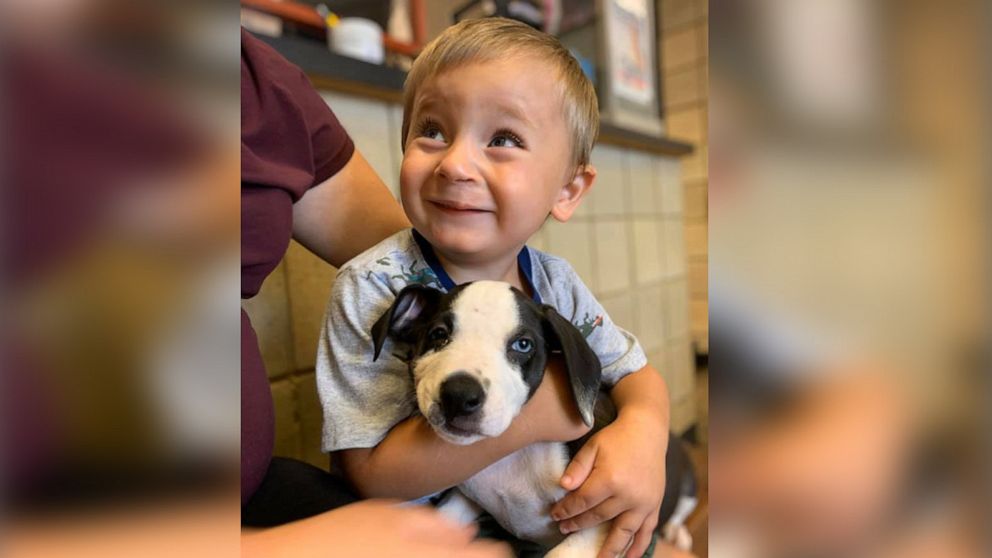
"I explained that they could take the puppy home two days later, after she had her final vet appointment."
"We [staff at the animal shelter] were all in tears seeing the two of them together. The fact that this is something we never see, the puppy came from a thousand miles away and that Bentley's dad just happened to be here at that moment, it was just amazing."
"The puppy immediately started soaking up all his love. It was genuine joy. She was one of the last ones of the 25 to be adopted."
Lydia Sattler, director, Jackson County Animal Shelter
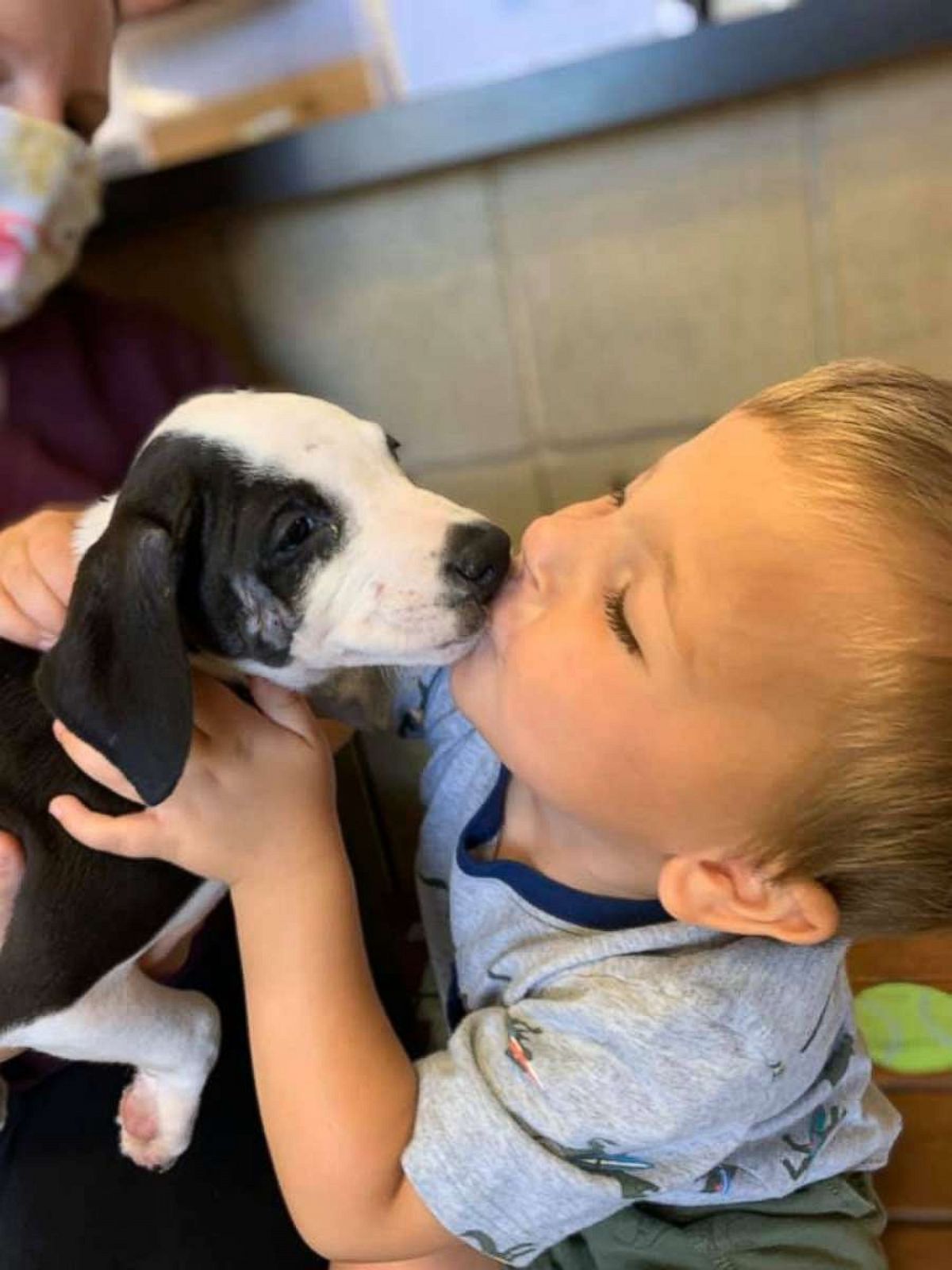
PHOTO: Bentley Boyers, 2, is seen kissing his newly adopted rescue puppy, Lacey, on Sept. 4, 2020 at Jackson County Animal Shelter in Jackson County, Michigan. Both Bentley and Lacey were born with a cleft lip.
Bentley Boyers, 2, is seen kissing his newly adopted rescue puppy, Lacey, on Sept. 4, 2020 at Jackson County Animal Shelter in Jackson County, Michigan. Both Bentley and Lacey were born with a cleft lip.

The U.S. Centers for Disease Control and Prevention states that approximately one in 2,800 babies in the United States is born with a cleft lip. A little boy, now two years of age, was born to two young parents in their 20s, living in Jackson, Michigan with a cleft lip. A child that has already at his tender age, experienced surgical operations to correct his condition, with more yet to come. Even at his young age, the little boy appears to know that there is something 'different' about him. It is a difference he now shares with a female, rescue puppy that has joined his household.

It isn't known how prevalent cleft lips are among dogs, but evidently purebreds experience a higher incidence rate than do mixed-breed dogs. The mixed pedigree of this puppy that little Bentley now knows as Lacey, his very own dog companion, can only be guessed at. The shelter that received the puppy feels her ancestry is manifold, reflecting many dog breeds. All of which should, in fact, result in genetic vigour. She will likely grow to canine adulthood as a sturdily healthy dog, even as the little boy grows into his own maturity.

The Jackson County Animal Shelter had a recent visitor, a man who entered in the hope that rescued chickens could be had, to help the expansion of his family's small farm. In the event, 27-year-old Brandon Boyers discovered that the chickens had already been adopted. But the chickens and his mission to acquire them escaped his mind when he looked incredulously at a puppy up for adoption, with a recognizable condition; a split lip, just like his son Bentley.

The presence of the little black-and-white puppy spurred him to call his wife. Who responded by asking her husband to adopt the puppy on the spot, and bring her home with him. Both parents were immediately struck with the thought that the puppy would make a perfect companion for their child. Because the director of the shelter advised that another vet appointment had first to take place, and then they could bring the puppy home with them they were anxious for their son to see the new friend that would soon be joining him at home.
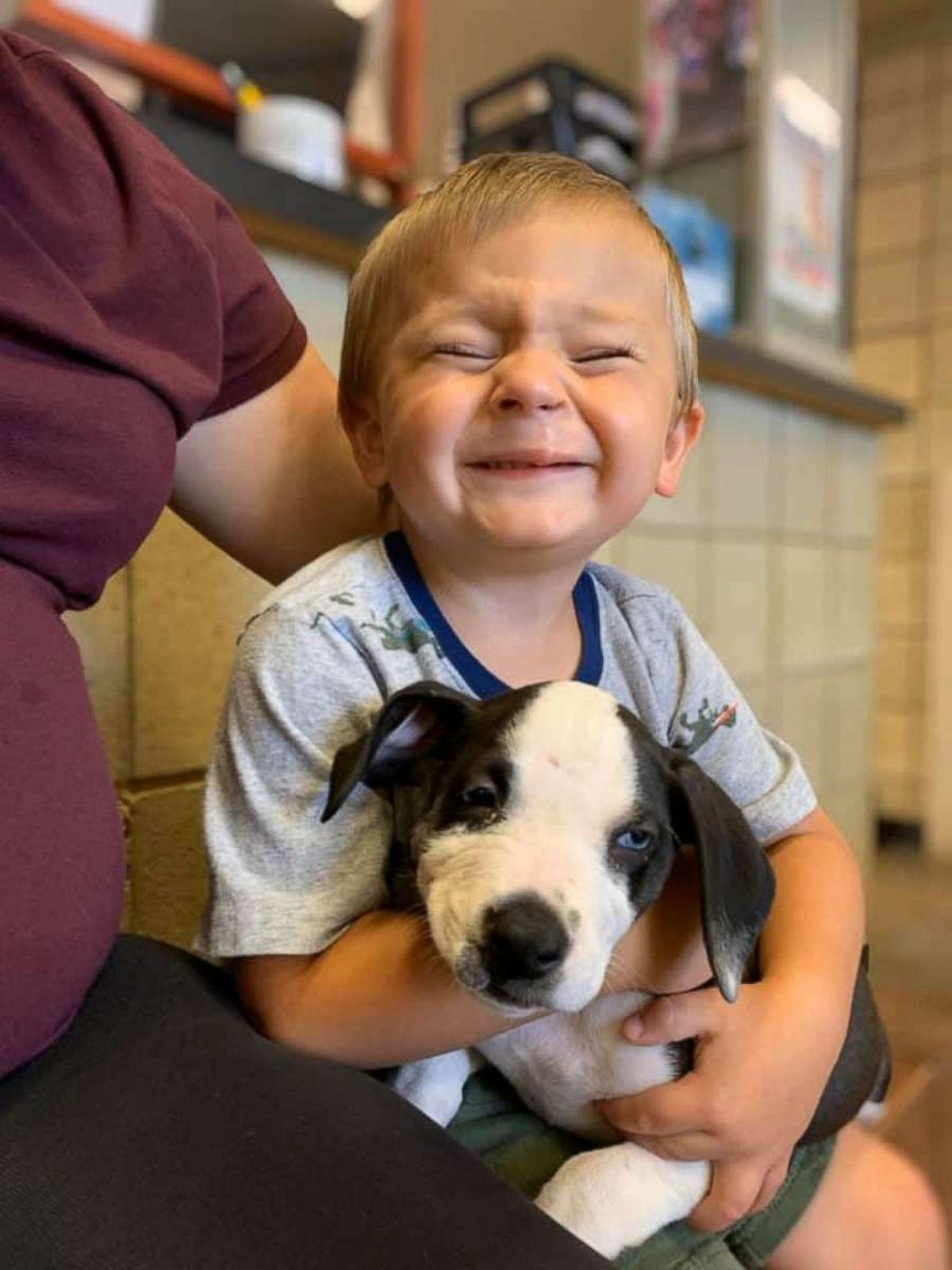
PHOTO: Bentley Boyers, 2, is seen holding his newly adopted rescue puppy, Lacey, on Sept. 4, 2020 at Jackson County Animal Shelter in Jackson County, Michigan. Both Bentley and Lacey were born with a cleft lip.
Bentley Boyers, 2, holding his newly adopted rescue puppy, Lacey
The following day Ashley Boyers brought her son Bentley for a visit to the shelter. Bentley made directly for the puppy, cradling the little creature in his arms, then settled down next to her, a natural and loving reaction between the two was sparked, and the witnessing staff became emotional. They had never before sheltered a dog with a cleft lip. The puppy had come to their facility from Mississippi which had been overwhelmed with too many dogs in need. There were 25 dogs in all, and all went to new homes in short order, leaving Lacey unclaimed.

Bentley has already undergone two surgeries. Several additional procedures are planned for the future, among them a bone-grafting operation. The abnormality with which he was born will be corrected by surgery, and as far as the future condition of Lacey, there is confidence that the puppy will go on to enjoy a healthy, normal lifespan. The coincidence of the split lip in both the little boy and the puppy and the chance encounter by the father to discover the presence of the puppy was heart-warming to all concerned.

As expected, Lacey is adjusting with ease to her new home. A home which comes complete with another, older canine, a nine-month-old English mastiff, named Remi.
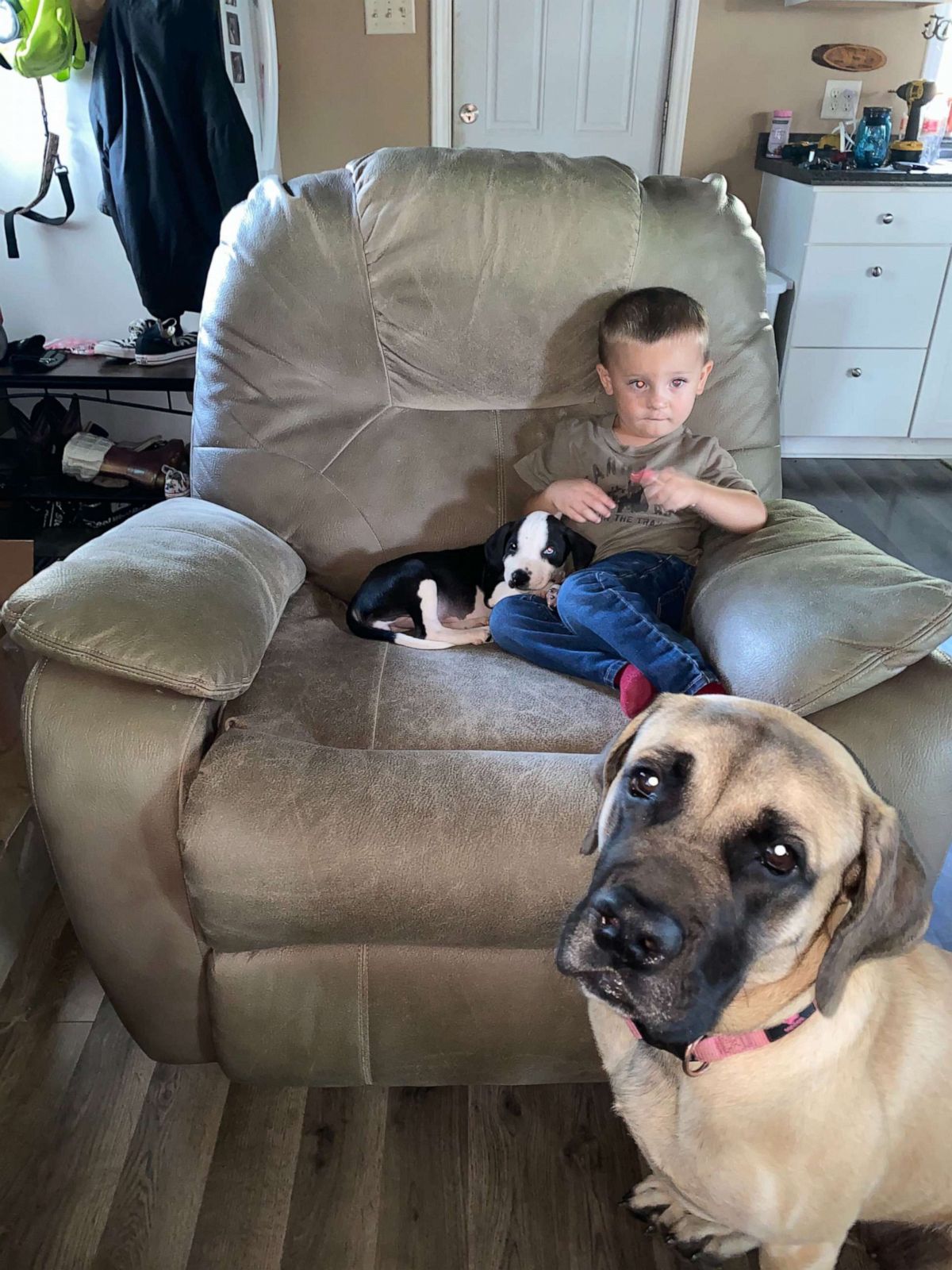
PHOTO: Bentley Boyers, 2, is seen with his puppy Lacey and English Mastiff, Remi. Both Bentley and Lacey were born with a cleft lip.
Bentley Boyers, 2, is seen with his puppy Lacey and English Mastiff, Remi.

"It's so hard to put into words how meaningful this adoption is to all of us. Bentley found his match today in this tiny pup who also has a cleft lip. They instantly loved each other", read a Facebook post written by the shelter.

Labels: , , ,

Thursday, July 09, 2015

When Brothers Help One Another

"Michael is a brother. He needs me just as much as I need him."
"That's not being fair to the dog [should the man dependent on its aid as a service dog commit suicide], not being fair to that partner who's stood beside me forever."
"When you can escape yourself for a minute, and stop being selfish and think about the things you have, in my world, it's that dog."
Sgt. 1st Class Matthew Bessler, Cody, Wyoming
Bonnie Jo Mount/ Washington Post
Bonnie Jo Mount/ Washington Post   Sgt. 1st Class Matthew Bessler and his brown Belgian Malinois Mike take a walk in Cody, Wyoming. Both suffer from PTSD since serving in Iraq, but now Mike is a service dog and they are helping each other heal.

They were partners in conflict, Matthew Bessler and 'Mike', the 52-pound brown Belgian Malinois who was trained by the military. They worked well together in Iraq, and the results were such that Sgt. Bessler was awarded two Bronze Stars. Their second tour, part of an elite Special Operations group in the most dangerous phase of the war in Iraq saw them spending every day and each night together, for an eight-month period.

Mike is no longer a combat dog. He is retired. And the military personnel who look after military dogs have concluded that combat canines too, can suffer from post-traumatic stress disorder. As it happened, Sgt. 1st Class Bessler also retired with the realization that his symptoms of post-traumatic stress disorder meant he would never return to combat. Matthew Bessler had applied to adopt Mike, and bring him home.
Michelle Siu for National Post
Michelle Siu for National Post   Many soldiers who worked with canine units during recent wars bring the dogs home afterwards, where they become service animals.

In his twenty-year career with the military in Special Operations, his expertise in engineering and intelligence-gathering had him dispatched to a variety of violent conflicts that the United States military was involved in; Somalia, Haiti, Bosnia, Iraq. The decorated Army Ranger understood that the trust and affection between himself and the combat dog was special and that connection could help them both recover from the extreme stress that exposure to a conflict environment left them with.

Matthew Bessler retired to his farm in Fountain, Colorado. Mike was billeted at the army's military kennels about 20 kilometres north of the farm, at Fort Carson. The required paperwork had been completed for adoption, and Matthew Bessler would rise at dawn daily and drive to Fort Carson to be with the dog who was refusing to eat unless his combat buddy was beside him.

"He won't work with anyone else. He's waiting for you to come back. Come pick up your dog", one of the Fort Carson dog trainers informed Bessler three weeks after they had both arrived back from Iraq to the U.S., and the adoption was finalized. That should have settled Mike down, but it didn't. He began chewing on rocks, crushing his teeth and his gums and part of his lip in nervous reaction to his condition.

Where before Mike was exposed to action on the war front, now it became a veterinary emergency installation where a veterinarian performed a number of surgeries to reconstruct Mike's nose and mouth. He was put on Prozac, becoming calmer, trusting again. But he needed something to focus on to distract him from his PTSD. The answer came as in his turn Matthew Bessler became increasingly traumatized as his own PTSD settled in.

The thought occurred that Mike could become a service dog; his service dog, to help him overcome the pathology that afflicted him. When the human of the duo becomes overstimulated and begins to panic Mike steps into the situation, walks into a quiet corner with his man, and waits out the stress; the close physical presence reducing anxiety as the hormone oxytocin is stimulated for both, aiding their mutual recovery.

The moodiness and the psychical pain can become overwhelming. And Matthew Bessler may begin to fantasize that suicide would release him from the demons that overtake his life periodically. Mike senses these crises and responds by climbing on Bessler, to ground him, so he is unable to do harm to himself, refusing to leave until the crisis has passed.

Sgt. 1st Class Matthew Bessler and his brown Belgian Malinois Mike (at top with black Labrador Ziva in Powell, Wyoming) were part of a canine tactical team with the 10th Special Forces Group. Their tours in Iraq led to post-traumatic stress, but soldier and dog have been helped by their deep connection.
Bonnie Jo Mount/ Washington Post    Sgt. 1st Class Matthew Bessler and his brown Belgian Malinois Mike (at top with black Labrador Ziva in Powell, Wyoming) were part of a canine tactical team with the 10th Special Forces Group. Their tours in Iraq led to post-traumatic stress, but soldier and dog have been helped by their deep connection.

Labels: , , , , ,

Sunday, July 07, 2013

Life's Tough Calls

Buttercup

 Buttercup, the dog the Humane Society put up for adoption while its owner, Paul Lane, was at the ROH. Psychiatrists says this will result in a major depressive relapse.Buttercup, the dog the Humane Society put up for adoption while its owner, Paul Lane, was at the ROH. Psychiatrists says this will result in a major depressive relapse.

She's only a dog, after all. So, in a sense, it hardly matters if her life is one of disruptions, uncertainty. Only people who have no familiarity with dogs as intelligent and loyal companions whose company and interest in and trust of their humans can mean so much to the quality of life that both enjoy through that cooperative relationship.

Buttercup's purpose is to give comfort. And in the case of Buttercup, and her owner, Paul Lane, she gives immense comfort to the afflicted. Her human, Paul Lane, is in dire need of as much comfort and understanding as he can possibly eke out of his life and the world surrounding him. He is mentally ill and has few supports other than his three-year-old German shepherd.
"The dog is like a service dog to (Lane), and his constant companion throughout his recent crises. I believe the loss of his dog through the adoption process would be devastating and would trigger a major depressive relapse."
Dr. Michael Chan, psychiatrist, Province Care, Queen's University hospital affiliate

Mr. Lane is 55 years old, formerly married, with two children, though estranged from his adult son, and without much contact with his teen daughter. During his productive working life he was a computer software analyist. Buttercup represents, as it were, his only family. "I miss (Buttercup) very much. I've been crying all week."

Dog owners who invest in their canine companions much of their emotional baggage, know what he means; even dog owners who are socially well-adjusted and in full control of their minds and thought-processes. Separation from a beloved household pet is a difficult matter to contemplate. Permanent separation creates an emotional depression as deep as a freshly-dug grave.

Mr. Lane is being treated at the Royal Ottawa Mental Health Centre. He is there for the more immediate purpose of a mental assessment to be delivered to authorities representing the Ontario Review Board for the purpose of allowing them to deliberate his fitness to stand trial on a number of relatively minor charges. Theft, for example, of a can of Pepsi-Cola.

Mr. Lane is homeless, having been evicted last winter from his apartment at a time when he was undergoing an earlier mental assessment in Kingston. This was for another arrest in February representing two different incidents with shoplifting. During that time Buttercup was taken into the custody of the Ottawa Humane Society.

Following the assessment in Kingston, Mr. Lane returned to live in downtown shelters and from there graduated to outdoor life. His lawyer took temporary care of Buttercup at her home for a three-month period. But when Mr. Lane was most recently taken into custody for a criminal infraction, Buttercup was with him and she too was once again taken to the Ottawa Humane Society facilities.

Mr. Lane's lawyer deplores the inadequacy of services available to people in dire situations as a result of their mental instability. That, for example, there should have been a group home facility prepared to take Mr. Lane in, while he was being rehabilitated. And when he was prepared to live again on his own, become reunited with Buttercup, rather than being forced to sleep in shelters where his condition became aggravated.

She's absolutely right there. And the other side of the coin is the increasing burden on society to make funds available through taxation for programs such as this. The increased burden, placed in the light of a life saved ... spending to help someone surmount mental health disabilities, enabling them to live on their own without disrupting society, represents a need to be faced.

In the long run, society gains much, even while it aids someone who may find himself eased of his mental pain, finally capable of living within his own manageable devices, albeit with the ongoing help of charitable assistance. However, in February, the Ottawa Humane Society which operates under rules enabling it to further its agenda to aid animals in distressed conditions requiring they too be rescued, advertised Buttercup for adoption.

Appeals to the OHS by Mr. Lane's lawyer urged reconsideration. Mr. Lane was discharged from Kingston hospital, pleaded guilty to those minor charges, and freed on time served. He was charged a fee of $500, reduced from the original $1000, representing the costs to the OHS for caring for Buttercup throughout those months.

Still, his lawyer was left to care for Buttercup, since her client had nowhere except downtown shelters to stay. Buttercup represents a hope for the future; that at such time when Mr. Lane is able to fend for himself, and find a place of his own to stay in, and begin to live a stable life, Buttercup may join him.

What represents hopeful aspiration to Mr. Lane can be construed by the critical to be a lack of permanency and destabilization for Buttercup, shunted between Mr. Lane, his understanding and kind lawyer and the Ottawa Humane Society. Perhaps for the good of all concerned, Buttercup should be adopted by a family prepared to love her and give her the stable existence that every dog should have.

Labels: , , , , ,

Friday, June 14, 2013

Crediting Compassion

Squirrel found in Angela Campbell's toilet

"Around 5 a.m. the dogs were growling and kind of pacing in the hallway and we couldn't figure out what was bothering them. Then around 7 a.m. I heard what sounded like a bowling ball splashing in a tub. Like it was just very loud and flippy. It must have really been banging itself hard to get out. So then I went in and looked down the toilet and the squirrel was looking right back at me.
"At first I thought it was a rat, because it really did look like a rat when it was wet. I just couldn't believe what I was seeing.
"How am I going to get it out of there? I thought I need something to keep my distance if it wants to bite. So I brought out the barbecue tongs. When I reached inside the toilet and put the little tongs underneath its armpits, it just kind of rested there. It looked happy. It was kind of like, 'Ahh, I don't have to keep trying to swim.' And then I lifted it out and put it into the tub.
"It was really dirty. Like covered in a urine film. It was really sticky and gross. It stank really, really badly. The smell was suffocating. So I rinsed it off with a bucket, just kind of pouring water on. I did make the water lukewarm because it must have been freezing. It wasn't putting up a fight at all or a fuss. It almost seemed to welcome it. It just kind of seemed to surrender."

These are the words of a Winnipeg-area resident who had an unusual experience. Finding a little black squirrel in one's house, let alone in one's toilet does not represent a common occurrence. But Angela Campbell dealt with the experience. She didn't view the tiny creature with repugnance, nor was her impulse to harm, but to aid it to escape from its dreadful fate. She is obviously a calm person, a fast thinker to whom solutions come readily.

She saved the squirrel's life. Managed to get it out of her house so it could resume its life in the trees surrounding the house. She chose not to abandon the helpless creature, but to instinctively come to its assistance, and she did so compassionately, understanding its panic, its fear and its exhaustion. She has theorized that the squirrel somehow entered her home's sewage system through a pipe, and then found itself trapped.

The only thing worse than seeing a squirrel desperately attempting to extricate itself from certain death by drowning in a toilet, is to find a dead, drowned squirrel in a toilet. By her swift action Angela Campbell ensured that this squirrel didn't end up in the latter category. The world needs more Angela Campbells.

And far less of those people who reacted to what she had seen and done by saying, as they did to her: "Ugh, I would have flushed it. I would have stepped on it...They're diseased, they're gross." Her thought was that it was a living creature that did not deserve to have its life ended through casual misadventure. "How could you kill something that ended up there, just because? Why does it deserve to die? Just because it's there and you don't like it and it's ugly and dirty?"
Angela Campbell deserves a medal for doing the obviously right thing. Failing a medal, a congratulatory pat on the back. She is an admirable human being.

Labels: , , ,

Saturday, May 25, 2013

5 climbers feared dead: The five disappeared Monday on Mount Kanchenjunga, and bad weather was preventing a rescue helicopter from reaching their base camp.

By Associated Press / May 24, 2013
A view of the Kanchenjunga mountain along the Himalayan mountain range on the frontier between Nepal and Sikkim is seen in 2005.   Desmond Boylan/Reuters/File

KATMANDU, Nepal
Five climbers including two Hungarians and a South Korean are missing on the world's third-highest mountain and feared dead, a mountaineering official said Friday.

The five disappeared Monday on Mount Kanchenjunga, and bad weather was preventing a rescue helicopter from reaching their base camp.

Mountaineering Department official Dipendra Poudel said Friday that the climbers were descending from the summit when they were believed to have slipped or fallen at an altitude of about 7,900 meters (25,900 feet).

The Hungarians have been identified as Zsolt Eross, 45, and Peter Kiss, 27, while the South Korean climber is Namsoo Park, 47. The Nepalese guides have been identified as Phu Dorjee, 24, and Bibash Gurung, 25.

Eross has scaled 10 of the 14 highest peaks in the world and was the first from his country to scale Mount Everest.

Kanchenjunga is 8,586 meters (28,162 feet) high.

Labels: , , , ,

Tuesday, May 14, 2013

Angelina Jolie Removed Her Breasts to Save Her Life. Some Fans Wish She Hadn't.

166302833
Angelina Jolie in April Photo by Alistair Grant - WPA Pool/Getty Images

Today, Angelina Jolie published a piece in the New York Times about her decision to undergo a preventive double mastectomy last month. As a carrier of a gene mutation called BRCA1, Jolie cut her chances of contracting breast cancer from 87 percent to under 5 percent by undergoing the procedure. I felt so honored to read Jolie’s detailed first-person account of her experience, as well as her advocacy for all the women around the world to gain access to the too-expensive tests and procedures that have empowered her to fight for her own life. Those warm feelings were soon deflated by some of the unexpectedly nasty commentary that pooled around her story. Commenters snarked that Jolie had received a “boob job.” Some suggested that her medical emergency was just a tabloid ruse to cover up elective breast implants. Others morbidly asked after the whereabouts of the breast tissue removed from her body. “RIP Angelina’s boobs” was a typical ignorant comment. Said one commenter on a Jezebel post about the op-ed, “How many guys stopped reading as soon as they realized Angelina Jolie has no breasts—she's dead to me!"

I’d like to dismiss these commenters as trolls, but their attitudes are unfortunately pervasive in our culture, and they don’t just represent a personal affront to Angelina Jolie, a veteran of such inappropriate body commentary. These comments affect every woman who has undergone a similar procedure—every woman who has overcome the pain, the fear, and the constant and casual reminders that her breasts are more valuable than her life. Really, these comments affect all women who have seen their bodies reduced to mere objects for others to consume. As scholar of the stars Anne Helen Petersen says, “Remember: What we talk about when we talk about celebrities is, as ever, ourselves.” Some of us are not speaking very highly of the women in our lives today.

Jolie, for her part, addressed aesthetic concerns straightforwardly in her op-ed. (She also made a worrisome reference to "wonderful holistic doctors working on alternatives to surgery," which I can only hope won't steer readers away from the valid medical treatment they may need). “There have been many advances in this procedure in the last few years, and the results can be beautiful,” Jolie wrote. “On a personal note, I do not feel any less of a woman. I feel empowered that I made a strong choice that in no way diminishes my femininity.” It’s powerful to hear Jolie own this choice as beautiful. But I’d go further to say that, regardless of the aesthetic aftermath of breast cancer surgeries—and the individual choices every woman makes in how to deal with them—the results of these procedures are necessarily and breathtakingly beautiful. Not only does this procedure not diminish a woman’s femininity in any way—it highlights her humanity. As Jolie put it, “Brad was at the Pink Lotus Breast Center, where I was treated, for every minute of the surgeries. We managed to find moments to laugh together. We knew this was the right thing to do for our family and that it would bring us closer. And it has.”

And yet, perversely, some fans feel as if a part of Jolie has been stolen from them. One well-meaning but misguided commenter told me on Twitter yesterday: “Happy to hear she's giving herself much better odds. As a guy, I will miss her lovely curves though.” (The reconstructive surgery she described presumably restored her curves.) I can tell you from experience that when a person you love makes it through that surgery, they have never looked more lovely. I don’t mean that in a strictly emotional sense—it registers physically, too. The way that they look at you when they wake up. The breaths they take. Their smile. The way they move through space. You don’t miss anything: You are reminded of all of the wonderful things that you are not missing. It's gorgeous.

Labels: , , , ,

Thursday, May 09, 2013

Solving Problems

Now there's a knotty mind-bender. Two adults, of the age of consent, fall in love, marry. They are handicapped. Society has many people within it who are handicapped in one way or another. Most of whom manage to get along. On a fairly basic level of being able to accomplish ordinary everyday tasks, of looking after themselves, their nutritional needs, their hygiene. And often they are quite capable of performing relatively simple occupations. Many live in group homes.

But here is a couple who live in group homes in New York State, and both are mentally disabled. They do not live in the same group home; each in one of their own. They have been forbidden, however, to live together as a married couple. "We're very sad when we leave each other", explains Paul Forziano. "I want to live with my wife, because I love her."

And she, of course, wants to live with her husband for the very same reason. They have been companionable for three years, and decided they wanted to marry. "It's not something we wanted to do -- it's something we had to do", said the mother of the bride rather obliquely. Which could mean many things, that the parents feared things might get out of hand if they didn't agree to the marriage the most obvious explanation.

And, in their refusal to allow the two young people to live together as man and wife, it is obvious that those who operate the group homes believe that their jobs and their lives will become infinitely more complicated should things get out of hand. It's natural enough to feel concerned. They, the people who know Hava Samuels, the bride, best, feel she hasn't the mental capacity to consent to sex.

That said, sex would and most likely will in time, occur. And the natural outcome of that will be two young people, chronologically mature, but mentally disabled, will have a child. And how will that go down? Both the pregnancy and all that it entails, and the eventual birth. Who will tend to the child, ensure its most basic needs are met?

The couple has launched a federal civil rights lawsuit against the state-sanctioned non-profits that operate the group homes they inhabit. Both the newly married couple and their parents are challenging the decision of the group homes. There is a certain dissonance here; obviously the parents don't feel they are competent enough to have their mentally disabled children live with them.

As a result, their children live in not-for-profit institutions whose purpose is to provide a stable and secure environment for these adults with the minds of children. An Oregon state legislator, member of the National Council on Disability board of directors explains her position, and claims that most Americans agree; that the disabled should have the right to choose to live their own lives, marriage and sex being part of that decision-making.

On the other hand, perhaps they are not capable of fully understanding the commitment to which they aspire. If they were capable of full understanding, are they capable of acting on that understanding? "Sex is a healthy and full part of the human experience. I know it makes some people uncomfortable to think people with intellectual disabilities are engaging in sexual relations, but I don't understand that." Obviously the full picture of the situation also eludes her.


The Catholic Health Systems operates the Maryhaven Center of Hope where Hava Samuels has been taken in, in a facility in Manorville meant for women only. As for the independent Group Home Living program in Manorville where Paul Forziano lives, there are no facilities for married residents, nor do legal requirements force the home to house them.

Perhaps the parents of the happily married couple could solve the vexing problem confronting their children by offering to have them live happily ever after with them? Problem solved.

 Disabled newlyweds live apart: Paul Farziano and Hava Samuels on their wedding day in Wading River, NY.
AP Photo: Bruce Presner. Disabled newlyweds: Paul Forziano and Hava Samuels are suing for the right to live together in a group home.

Labels: , , , , ,

Thursday, April 11, 2013

In The Middle Of Nowhere

"It was immediately apparent how much of a good position we were in, considering. From a psychological perspective, you want to look for reasons why you're going to survive, versus the other option. We had a number of rules on our boat, and the number one rule is don't die. Above all else that is what we wanted to do, live and survive to tell our tale."Adam Kreek
"I'm like, OK, time to really get this door closed, and as I'm thinking that, this wave of water hits the side of the boat, and I think, 'It's going to be OK, we've seen these before'. And all of a sudden it did something funky and starts washing into the cabin, and it was a lot more water than I expected. All of a sudden it went from 'I can't close this door', to 'I gotta get to the port side of the boat', to 'I just need to get out of here', probably with a second or two."
Pat Fleming

Left to right: Adam Kreek, Jordan Hanssen, Pat Fleming and Marcus Pukonen arrived safely to the United States Coast Guard base in San Juan, Puerto Rico Sunday night after their boat capsized early Saturday.
The Canadian Wildlife Federation / Erinn J. Hale     Left to right: Adam Kreek, Jordan Hanssen, Pat Fleming and Marcus Pukonen arrived safely to the United States Coast Guard base in San Juan, Puerto Rico Sunday night after their boat capsized early Saturday.
 
Adam Kreek, Jordan Hanssen, Pat Fleming and Markus Pukonen had set out on quite the adventure. They were out to prove that it was possible to cross the Atlantic in a rowboat -- although this was some state-of-the-art rowboat, equipped with electronic gear, sleeping arrangements, food and water to last them for months, in the interests of embarking on an expedition to obtain scientific data, sponsored by the Canadian Wildlife Federation.
SEYL LOU/AFP/Getty Images
SEYL LOU/AFP/Getty Images    Canadian Adam Kreek, left, maneuvers with American 
Jordan Hanssen on Jan. 23, 2012 off Ngore beach outside Dakar before attempting to 
row 6,700 kms across the Atlantic to reach Miami, Florida.

Their route was to take them from Senegal to Florida, and they had been rowing steadily for two and a half months, using a protocol of two rowers at a time in turn, while two rested. It was during one of the exchanges when Adam Kreek and Pat Fleming had gone to the cabin, and Jordan Hanssen began to row, while Markus Pukonen prepared to join him after making use of the toilet bucket and just at that point they experienced what it felt like to have a rogue wave hit and swamp their rowboat which was supposed to be capable of self-righting.

Unfortunately, the weight of the water the rowboat had taken on, made hash of theory and what had worked on previous occasions, to swiftly overturn the rowboat. The four quick-thinking, swift-acting men went into an overdrive of activity to preserve their lives. Their OAR Northwest Expedition had run up against nature's challenge, and nature partially won. After 72 days of rowing, they were close to their goal, but in the spirit of man proposes and nature disposes, it was not to be.

They found themselves adrift on their life raft, nicely provisioned and in good spirits, despite the unexpected and startling end to their journey. They had attempted for three hours to flip the boat, to no avail. They were 650 km north of Puerto Rico, with their emergency beacons sending out distress calls. Their athletic training, experience and their careful planning left them with enough to get by on; food, water, blankets. When the U.S. Coast Guard C130 plane responded, dropping an emergency barrel, it contained nothing they required.

But for a radio. Since they were unaware the barrel contained a radio and they had no need of its contents to supplement what they already had, the barrel was left unopened and they had no means of communication. The Coast Guard was puzzled by the lack of contact, and dropped a second barrel, labelling it "Open Me!!!" -- containing another radio, and then communication was established. And then they learned that a cargo vessel was en route to their rescue.

The crew of the Panamanian flagged Heijin, took very good care of the four shipwrecked sailors. They landed at the Coast Guard station in San Juan Puerto Rico, and begin planning how they might be able to recover their boat, still adrift, named the James Robert Hanssen.

Labels: , , , ,

Tuesday, March 05, 2013

Serial Lifestyles


Many people invest themselves so completely in their jobs that they simply cannot think of anything they would be able to do without that job to fill in time and be part of the social order or useful production. Their work is fulfilling to them, it reflects their values and their concerns about the order of things, of their place in the social contract. Their work represents their value to society, and therefore to themselves.

When they perceive of themselves as retired they see a great empty field of time needing to be consumed in some manner, but they are unable to conceive of anything they might do in place of the work that they're familiar with, to spend that time. Work in and of itself has become their reason for living. And without that reason there is no fulfillment and no reason to continue living.

Retirement, to these people, is commensurate with stagnation and decay; they slowly surrender the will to make the most of their lives because they have been forced to abandon the only value that has meaning to them; work. Where they once had complete control of their lives through the meaningfulness of routine and work and the economy of time well spent, they are left with nothing.

No interests outside of the work experience. Their self-regard is so entirely wrapped within what their work represented to them, of them, how it shaped them and their perceived value to society, and how society regarded them, that they are incapable of visualizing doing anything else with their lives. And their lives become meaningless, bereft of purpose, of direction, of discipline and of order.

These are the people who, if they are self-employed, simply keep on going well into their frail elderly years, and if their minds remain intact they are capable of performing, but at a more leisurely pace. For those who are employed by others, that option is rarely left intact. There is a societally-observed appropriate time to retire, and expectation is that they will retire and leave employment open for the emerging generation eager to take their jobs.

If these people have the flexibility of purpose and mindset to be motivated to continue to enjoy life on their own terms, not that of an employer, they may find themselves eager to spend time they formerly were unable to, doing a multitude of things of interest to them. Not necessarily travelling, but studying a new discipline, writing, painting, any type of enterprise that for them has a renewed and compelling value.

If they are more interested in extending the use of their productive professional years they have the option of volunteering in a number of different disciplines and social-enterprise areas where they qualify through their working backgrounds.  Those who find retirement tedious and without interest are simply devoid of imagination and enterprise. There are countless retirees who have discovered there is no problem filling in time pleasurably and usefully to themselves.

If we remain intellectually flexible in viewing a new perspective in life's opportunities and make use of our abilities, greater satisfaction can be found in the retirement years than those that we appreciated in the working years of our lives.

Labels: , , ,

Saturday, March 02, 2013

Dog 'saved life' of missing Polish girl

BBC News online - 2 March 2013
Dog Firefighters said the animal stayed with the child throughout the night
 
Firefighters in Poland say a small dog probably saved the life of a three-year-old who went missing from her home overnight in freezing temperatures.

The child, Julia, vanished on Friday and was found lying in marshes several kilometres from her house on Saturday morning, with the dog by her side.

She is now in hospital in western Poland, suffering from frostbite after temperatures fell to -5C (23F).
Firefighter Grzegorz Szymanski said the dog kept the child warm enough to live.

"For the whole night the animal was with the girl, it never left her. Remember, it was 5 degrees below zero and the child was wet," he said, adding that the animal was the most important factor in the girl's survival.

Julia Julia was found lying in marshland
 
More than 200 people had searched for the child overnight. It is thought she spent hours wandering through the forest near her home in the village of Pierzwin.

Her parents had last seen the three-year-old playing in the backyard with the small black mongrel.
She was eventually discovered by firefighters after she was heard crying for her mother.

Labels: , ,

Monday, February 18, 2013

Much Ado

"It's either a major case of absent-mindedness or a massive deceit. It's very possible that complicity exists on a European level."
Tonio Borg, EU health and consumer commissioner
Not particularly because there have been slow news days. We are not short of news lately. Coming out of various points of the compass, and all of them riveting our attention on the inescapable fact that human nature is perverse, violently adverse and unpredictable. So perhaps a story that has shocked a nation of horse-lovers is really meant as a kind of diversion from the truly unspeakable news of mass slaughters of a different kind.

The British are extremely fond of equine companions. The well-to-do have traditionally kept thoroughbred stables on their properties. Riding is an accomplishment and a matter of pride. Competition in riding and jumping a sport for kings - and commoners alike.

The British also like their beef. And they prefer it unadulterated. Which is how they usually get it. Until they were shocked out of their collectively placid (sanguine?) attitudes by the stunning revelation that their beef was contaminated with horseflesh.

This is, of course, the same Britain that was glad to eat horsemeat back during the Great Wars, when all manner of normal meat consumption was disrupted as a result of global shortages in all kinds of comestibles. In the present era, however, there are no shortages of anything - with the exception of common sense, proportionality and a sense of humour.

Britain has been scandalized.

Horsemeat has illegally entered the market, passing itself off as beef and none the wiser. Until tests revealed that consumers have been eating beef contaminated with the presence of horsemeat. There are some societies that consider horsemeat a delicacy, and many others that think of it as a good alternative to other forms of animal flesh meant for human consumption. Not, however, Brits.

Councils throughout Britain have withdrawn processed beef dishes from their menus after shepherd's pies with a certain element of horsemeat included were sent to 47 schools. Hospital patients were also given beef meals containing equine DNA. Pubs, restaurants and supermarkets were all affected. "People will be shocked and dismayed that horsemeat has now been found in schools and hospitals", sagely commented the shadow environment secretary.

British police have raided companies suspected of selling the tainted meat. Inspectors from the Food Standards Agency seized computers, documents, meat samples for further testing. "Clearly, it is not acceptable for beef products to be sold containing horse meat", fumed a director at the agency.

Calling on Interpol.

Labels: , , , ,

Tuesday, February 05, 2013

Dogs With No Names

Who is there, after all, to name them? They represent a vast community of feral dogs. Dogs left to fend for themselves in an utterly hostile climate. Dogs are companion animals, bred and accustomed to living among humans whose existence they complement. And humans who take advantage of canine companionship also take on an inherent obligation to care for their pets. Whether those animals are meant to stay indoors alongside their human protectors, or to remain outdoors.

Todd Korol for National PostTodd Korol for National Post   "A lot of the dogs just disappear, there are a lot of coyotes out here," says Mona Jorgensena volunteer with the DWNN (Dogs With No Names) Project.

Dogs are kept as pets, as early warning signals that someone approaches, as guard dogs, as working animals, helping to herd sheep, or to guide the blind, the deaf. They require care. They are not equipped by nature to forage for food in an atmosphere that has no natural food they can easily acquire for themselves to stay alive. And in a landscape where other wild animals exist that compete for food, feral dogs become that food.

If inclement weather and starvation does not lead them to an early death, the existential need of carnivores will. There are no municipal bylaws to protect dogs or people, there are no licensing programs, dog-catchers, or seemingly people with a sense of community responsibility and compassion in many First Nations communities. Where dogs are maintained on a casual basis, or simply allowed to roam, to procreate and to starve.

Which is rather strange, since one hears time and again declarations of aboriginals proudly claiming they live as one with nature. If that nature is one of casual disregard for the well-being of the very creatures so hugely dependent on a caring environment that is being discussed that's one thing; the neglect of the most basic needs of companion dogs a failure of another kind entirely.

Those feral dogs who fend for themselves under the most desperate of survival conditions, bereft of the kindness of human oversight, live an average of three years. "In the summer, they'll have puppies and all eight puppies will survive. In the winter, they're dead when they hit the snow. We find frozen puppies with placentas", explained Bragg Creek veterinarian Judith Samson-French.

"I've seen dogs with 16 puppies and these puppies are just wandering around, fighting for limited resources".

Todd Korol for National PostTodd Korol for National Post    Feral dogs on the Tsuu T'ina Indian Reservation. It is not uncommon for children on reserves to die of dog attacks.

Dr. Samson-French believes there could be as many as a million unhoused dogs on reserves across Canada. She estimates there are at least two semi-wild dogs for every home on a reserve. Although Aboriginal Affairs has conducted no research on the subject, it’s not uncommon for children to die of dog attacks and for remote reserves to conduct culls.

And when children die, the reserve populations become angry and arrange for culls. After a death of a child a dog that appears aggressively wandering about reserves is immediately dispatched. If dogs are seen near schools, particularly in a pack of three or four, they are held to be a potential danger. This approach to control of the feral dog population does not produce a solution of any meaningful dimension.

In southern Alberta, packs of rottweilers, border collies and pitbulls roam reserves. Some of them may have originated within the reserves, many more may just have been owned by urban dwellers who tire of the responsibility and who drive then them to remote areas and release them to fend for themselves. Dogs naturally gravitate to wherever humans live, to hope to find edible scraps to sustain themselves.

"A lot of the dogs just disappear, there are a lot of coyotes out here", said Mona Jorgensen, a retired police officer who along with Lori Rogers, a senior health technologist at the Calgary Zoo are volunteers for a new charity, Dogs With No Names. Whose purpose is to reduce wild canine populations. They operate an contraceptive implantation program.

They also buy bags of dry dog food and scatter it in bowls for the feral dogs that tend to gather around Reserve houses. They also try to put out wet dog food laced with dewormer.  The implants last about a year and a half in effectiveness, just about the time that reserve dogs die in maturity. The charity has implanted 155 dogs with contraceptive devices so far.

Dr. Samson-French feels that the program has in all likelihood been instrumental in preventing the birth of 100,000 puppies. "It's good. It's really good. If the ladies weren't here, I think we'd be in trouble. We'd have even more puppies", points out a farmer on the Tsuu T'ina reserve who oversees himself about a dozen large, short-haired dogs with pelts coloured grey, blue and cream.

One reserve resident who works at the administrations corrections office has begun looking after a stray that her daughter informally adopted. "I've left a bed outside and he's been sleeping there at night. It's really cold outside, but he's not there yet", she said of the dog's unwillingness to sleep indoors. She plans to have the dog neutered, accepting bags of dog food from Dogs With No Names.

Todd Korol for National PostTodd Korol for National PostMona Jorgensen (L) a volunteer with the DWNN (Dogs With No Names) Project and Lori Rogers a senior animal health technologist works with feral dogs on the Tsuu T'ina Indian Reservation near Calgary.

"I'm glad you guys are out here doing this", she tells the volunteers.

Labels: , , ,

Tuesday, January 08, 2013

Spare The Compassion

"Why intelligent, education folks would fall prey to this kind of a plan or scheme is baffling.  There is a perfect Yiddish word for this - farkakte".  It's a hare-brain scheme, ill-advised with no possibility of success.  That is exactly what this is."
Leonard Shore, lawyer for Clarke and Mary Margaret Webster

Clarke and Mary Margaret Webster are in their elderly years, still practising dentistry.  As a profession, dentistry is quite remunerative.  They were certainly not experiencing any financial difficulties.  That was then, throughout their professional careers.  More latterly things have changed, they are either very gullible or very greedy, or quite possibly, both.

They had evidently believed everything they learned through attending seminars that taught about the unconstitutionality of government exacting taxes on working cirtizens.  Books, pamphlets, CDs, seminars and the Internet were all tools used by Paradigm Education Group.  Taxing someone's labour, according to Paradigm, runs counter to the Canadian Bill of Rights.

This righteous explication of the taxation system whereby government raises its operating funds to provide services to those whom it serves, seemed to serve the purposes of this upper-middle-class couple very nicely indeed.  The Websters felt that the $31,200 they paid to be educated in the ways of getting around the imposition of filing taxes to be well worth it.

Oddly enough, it was another pair of Ottawa dentists, Tanya Kovaluk and Lee Williams, who introduced the Websters to this sure-fire scheme to defraud the taxman and the tax paying public at large, while satisfying the Websters' urge to retain all of their income sans social obligation to help pay for the services they most certainly use as citizens of Canada.

"This was an out-and-out fraud on the taxpayer and it was motivated by greed and in the circumstances, it was particularly disgraceful" according to Ontario Superior Court Justice Charles Hackland who judged this case of tax evasion to which both Websters pleaded guilty, and disavowed their previous belief in the Paradigm scheme.

They no longer believe taxes to be unconstitutional and a criminal offence by the federal government against the hard-earned income of dental professionals.  They now face a $342, 407 tax bill representing the amount of tax they refused to pay.  As well as a one-year conditional sentence for Clarke Webster, six months for his wife followed by 27 months' probation.

They fear this large bill will threaten their ownership of their home.  Why, goodness me, what on Earth did they do with the funds they failed to pay for taxes on their income?  That considerable income, representing a whopping big tax bill and nothing banked to enable them now to withdraw it all to pay back what they owe?

An obvious instance of personal fiscal mismanagement. Go to the back of the class.  Right, sit over there in the corner, and clap that dunce cap securely on your balding pate.

No hearts bleeding for this pair.

Labels: , , , , ,

 How Devastating It Is

"People don't know how devastating it is until you go through it. It's unbelievable."
"He couldn't do anything wrong; great kid."
"When we were younger, it was always you went out and you had a fist fight and whatever and it was all over. Now it's always guns and knives and it's just not right."
Daniel O'Grady, grieving grandson Sheldon O'Grady's death
 On Friday Sheldon O'Grady went to the dance club at 177 Promenade du Portage in Gatineau from his home in Ottawa. Accompanied by some friends out to enjoy an evening together. A brawl ensued as the 18 year old confronted another young man slightly younger, still 18, Mourad Louati.  Security personnel at the bar, Club Addiction, asked the two to step outside.

"They were not forced out -- they were asked to come outside", explained club owner Paul Martineau. "It seemed to be resolving itself. Then more people gathered around and it fuelled the fire. It ended up as a fight out in the street."  And it appeared that security from the bar assisted in seeing that the conflict concluded, the antagonists walking away.

Sheldon O'Grady reentered the bar to retrieve his jacket, and then he left.  A bouncer noticed some time later the prone form of Sheldon O'Grady lying in a pool of blood on the wet, snowy sidewalk.  And police were called. As a result the bar was placed in lockdown so police could interview the 150 people remaining there at 1:00 a.m.

Witnesses have not yet come forward if indeed there are any who saw what occurred after Sheldon O'Grady left the bar for the last time, without any of his friends present with him.  "It burned me inside. It really burned me. Of all people that this could happen to, why did this have to be him? It's still really hard to believe. It's unexpected that something like this could happen to someone so good", one of his friends mourned.

An autopsy has been set for Monday which will clarify what kind of weapon was used in the stabbing death; five separate stab wounds were initially identified.  No knife or any other sharp, penetrating object has yet been found.  The young man who was arrested and charged, Mourad Louati, pleaded not guilty to the charge laid against him. He remains in custody until a bail hearing.

The owner of the club has proffered his  "deepest sympathies" to the family of the dead young man. "They're 18 years old -- what kind of issues can you have to start stabbing someone?  I'm a little emotionally disturbed by this, too."  Mourad Louati, arrested on a charge of second-degree murder has asked for trial by judge and jury.

His lawyer has had previous purely professional dealings with the family.  Mourad Louati's older brother, as it happens, is a convicted killer, a drug dealer, and a sex offender.

Labels: , , , , , , ,

Friday, January 04, 2013

Mountaineers are driven people 

 The mountains, inaccessible to most mortals, appear to them to exist for the sole purpose of enticing them to ascend and in so doing experience an affirmation of their quest to surmount seemingly impossible geological challenges, climatic excesses, all that Nature conspires to challenge humankind's endurance and dedication with, in a seemingly mischievous or perhaps even malevolent inspiration to demonstrate her dominion over all.

Modern summiteers like Joe Simpson who miraculously survived a climb in the Peruvian Andes despite breaking one of his legs in an unfortunate descent of horrendous danger and monstrously inclement weather conditions, amply demonstrate, despite their respect for the mountains and the unease and fear some may suffer of the dangers they will encounter, how some manage to survive.

Anatoli Boukreev, a climber of immense capability and experience, wrote movingly of his personal view of an ascent of Mount Everest that took too many lives when the mountain was crowded beyond the capacity to ensure a timely final ascent and early enough descent to avoid catastrophe.  Jon Krakauer wrote of his own version of those very same events, but both captured the essence of the allure of the climb and the ascent.

And David Brashears, who ascended Mount Everest repeatedly, representing the most successful of the many challengers that the Himalaya has seen, further made his place in history by producing a finely detailed, interactive view of the mountain that has fixated so many aspiring climbers.

The team spent months taking the 477 images that make up the panorama - and have thousands more ready for a larger version
Mingmar, one of the team who captured the 477 images that make up the panorama - and they say they have thousands more ready for a larger version

Many make the attempt, and in the endeavour many experience the most harrowing adventure of their lives.  Now comes word that Ireland's most accomplished mountaineer has been killed on Mount Kilimanjaro during a massive lightning storm.  "Torrential rain all day.  "Spirits remain good even if drying clothes is proving impossible! We pray for drier weather tomorrow - the big day", wrote Ian McKeever.

Three days of serious weather conditions culminated in a lightning strike that killed Mr. McKeever outright and injured six other members of the 20-person climbing crew he was leading to the summit of the mountain.  The team of climbers was intent on reaching the summit of 5,895-metre Kilimanjaro, and raising funds for charity.

The climbers had ascended to the 4,000-metre level despite the weather, heading to the Lava Tower for an acclimatization exercise, after which they would plan to descend to a lower level, make camp and begin the final ascent toward the summit on the following morning.  As they climbed the storm became more dangerously threatening.

Mr. McKeever's career in mountaineering gained him a formidable reputation, setting a world record for scaling the highest peaks on all seven continents - an ambitious goal shared by many seasoned mountaineers to cap off their mountain climbing career with the glory of achievement - in 156 days.

Labels: , , , ,

Monday, December 17, 2012

Family Life Choices

It is the rare young family today where one parent has opted to remain at home with the children, rather than have both parents absent throughout the working day, attending to paid jobs, and ensuring that some one is looking after their children.  Mostly through day care, though in some few instances another family member - grandmother, for example - has undertaken that important function. 

It is not just that since feminism a new kind of social contract has overtaken the old which has freed women to think of themselves as vital members of the paid working community. That too, of course. 

For some peculiar reason women who remain at home responsible for the care of their young pre-school-age children are made to feel by prevailing standards of society that they are not contributing in an important way if they do stay at home.  They feel defensive when they're asked what they "do" and they respond with the answer that they are stay-at-home mothers. 

Performing a vital, difficult and responsible task.  And one they and they alone should recognize is their responsibility. A woman - or a man - as a parent has assigned to themselves a responsibility for the well-being and needful raising of a young child if they have decided to have children.

 Hiving the day-to-day care of young children off to paid minders whose most important task is to return those children intact at the end of the working day to their parents has become the societal norm, but it does not express a situation that is optimal for responsibly raising children.

Most two-parent families of the middle-class are not prepared to make financial sacrifices for the children they aspire to.  They want children but neither parent wants to forgo the paid workforce, nor the salary that comes with it, and the approval of society that now views this as normal. 

Without a double salary much of what modern society takes for granted representing lifestyle and its accoutrements would be denied a family with a parent at home. Childcare costs are expensive, but this is a requirement in families where the mother is preparing to return to the labour force after giving birth. 

That cost accelerates enormously when more than one child requires child care.  The quality of life for parents and children is not optimum; any day has finite hours and if a working life is combined with a home life, the working hours take precedence.  With less time to spend with children the solution seems to be lavishing possessions on those children.

The choice has been made then, to become an acquisitive consumer to rationalize too few quality hours 'left over' for children.  People live a lifestyle that is inclusive of meal shortcuts through pre-packaged food choices, eating out, expensive vacations. 

Add to that household upkeep that includes charges for Television reception/channel choices, cellphone and computer/Internet, and the latest gadgets and toys for children who have too little time at home to make full use of them. The choice to live in this way is mandated by what has become the norm within society. 

In Canada, where medical/hospitalization costs are provided through government programs, and education is paid through taxation as well, the true necessities of life; shelter, food have been hugely supplemented by luxuries that are also now considered necessities.  It is the add-ons that bring costs up, and which are dispensable.

A home without a television set can be one where books are more appreciated and where conversations are conducted continually, and board games indulged in, each of these alternates providing exposure to more value in a child's life through meaningful interpersonal interactions than  the mindless slumping before a television set with its detached and meaningless programs lacking true social value.

Labels: , , , , , ,

Thursday, December 06, 2012

Dismal Disaffection

It is difficult to understand how people can be so removed from one another.  Even among strangers there must be a bond as between human beings one feels charitably about.  If we see another person in difficulty, isn't it basic human nature to try to offer comfort?  If we are in the direct vicinity of someone whom danger is approaching are we not obligated by decency and our common human heritage to warn them, to guide them, to offer assistance if and as needed?

Can we do less to affirm our own humanity?

And what can it possibly be that afflicts some of us so that we are oblivious to basic decency?  That we observe, unaffected by the travails of others.  Could it be the effect of pervasive and ever-surrounding news sources that expose us continually to photographs of people being threatened and assailed by civil war, by natural disasters, by untoward accidents, by unavoidable and intractable war situations affecting civilians?

By photographs in the news media of wounded, wailing infants, of melancholy displaced refugees, of grief-stricken parents looking in vain for their children from whom they have become separated in the throes of some dreadful incident out of their control.  Have we allowed ourselves to become so hardened to the welfare of others that we cannot see it in ourselves to become involved, to make an effort when we are in proximity to those requiring help?

On the evidence provided by an incident in New York at the Times Square subway station, when a 58-year-old man waiting for his train, was shoved by a 30-year-old man - described as homeless and most certainly mentally deranged - into the path of an incoming train, and no one standing nearby makng an effort to help, we must, as a society have lost the valuable trait of caring. 

That people, as bystanders close enough to hear the 30-year-old attacker mumbling to himself, witnessing a minor altercation between him and the older man culminating in Ki-Suck Han's being pushed off the platform with a train scheduled for arrival, not having the inclination to move swiftly to help Mr. Han extract himself from the maw of death, is inconceivable. 

But it is the truth of the matter, nonetheless.

A free-lance photographer happened to be on the scene, and he took photographs of the dreadful situation.  It was such a photograph that was published in The New York Times on its Tuesday front page.  Of a man whom circumstances had fated to die in a matter of mere seconds from when the photograph was taken. 

Photographer R. Umar Abbasi was himself waiting to catch a train. When fortune presented to him the opportunity to immortalize a dread disaster in the making.  And he chose to do just that, instead of moving forward swiftly with the intention of offering whatever assistance he could to the man desperate to save his life in an instant of time. 

The photographer has defended himself, claiming that others were standing much closer and made no motion to help the endangered man clinging to the ledge of the platform.

"It took me a second to figure out what was happening ... I saw the lights in the distance.  My mind was to alert the train.  The people who were standing close to him ... they could have moved and grabbed him and pulled him up.  No one made an effort", explained Mr. Abbasi. 

No one else other than the quick-thinking Mr. Abbasi had the glory of seeing their independent photograph front and centre under the masthead of The New York Times.

Labels: , , , , , ,

Wednesday, November 14, 2012

A Running Tab on the Drip, Drip, Drip of the Petraeus Affair: The Kelleys' Money Woes

156335252
Jill Kelley looks out the window of her home as Gen. David H. Petraeus is seen on the television in the background on November 13, 2012 in Tampa Photo by Tim Boyles/Getty Images.


Thanks to the general nature of the Web and Twitter, the ongoing story of what we're going to call the David Petraeus Scandal (for a lack of a better name) is spilling out in increments, a not-so-slow drip, drip, drip in the form of scoops and scoop-lets delivered in more or less the same breathless tone as all those that came before.

All those pun-filled tweets and headlines can make it mighty hard to keep track of the latest newsy nuggets, be they major (the temporary postponement of a confirmation hearing) or minor (a found ID belonging to one of the partipants). With that in mind, we'll keep a running tab below on the noteworthy developments that can't find a home elsewhere in Slate's coverage of the affair.


But first, don't forget we've got a handy cheat sheet (no pun intended) here listing all the major and minor players in the ongoing saga—from Petraeus himself to the shirtless FBI agent who set the investigation that cost him his job in motion.

Wednesday's updates:
MONEY WOES: The Associated Press:

Hundreds of pages of court documents in several lawsuits detail financial troubles for the Kelleys and Jill Kelley's twin sister, Natalie Khawam, who lived with the couple. Chase Bank sued Scott Kelley in 2010 over a $25,880 unpaid credit card bill, and an investment by the Kelleys in a Tampa office building turned into a dispute with the tenant over $28,000-a-month rent. The couple didn't pay the mortgage and entered into foreclosure.
Attorney Barry Cohen represented the Kelleys in the case, but they turned around and sued him over legal fees, claiming he overcharged them by $5,000. The suit was dismissed, but court documents did not say what happened.
Natalie Khawam worked for Cohen's firm. She filed a lawsuit against the firm's chief financial officer, claiming she was sexually harassed after she asked about reimbursement for expenses, according to the court documents. She claimed Alan Goldberg asked her why she needed the money and she said because she was a single mom and needed to pay her divorce lawyer. "You have nice legs, your lawyer won't drop you" she claimed he replied. Cohen, defending Goldberg, disputed all of her accusations, and said Khawam had a history of lying to the court, according to the documents.
FRIENDS NO MORE: ABC News:
Jill Kelley ... has lost the privilege of visiting MacDill Air Force Base in Tampa without an escort. The base is home to U.S. Central Command (CENTCOM) and U.S. Special Operations Command (SOCOM), and Kelley, who enjoyed rubbing shoulders with top military brass, had been granted unescorted access to the base under a program initiated by the Air Force unit that runs operations at the base.
A Defense official confirms to ABC News that Kelley participated in a base program known as the "Friends of MacDill" where she was placed on a master list that allowed her to clear security when entering the base.
A person must be nominated to enter the program, and must pass a background check by the wing's security office. The official did not know who nominated Kelley for the program.
OBAMA WEIGHS IN: Politico:
President Barack Obama said Tuesday that he was not aware of any breach of classified information due to the situation that led to the resignation of Gen. David Petraeus as CIA director—but referred questions about the investigation to FBI Director Robert Mueller. “One of the challenges here is that we’re not supposed to meddle in criminal investigations,” Obama said at the White House, during his first press conference since winning a second term.
However, he added, “I have no evidence at this point from what I’ve seen that classified information was disclosed that would have in any way have had an impact on our national security.”
PETRAEUS TO TESTIFY, EVENTUALLY: Politico:
Gen. David Petraeus will testify before the Senate Intelligence Committee regarding the attacks in Benghazi, Senate Intelligence Committee Chairwoman Dianne Feinstein told POLITICO Wednesday morning. But the exact schedule has not been set for his testimony. "Mr. Petraeus has indicated his willingness [to testify].  He is eager to come before the committee so we will work out the details,” Feinstein said.
ABOUT THOSE DOCUMENTS: The Washington Post:
Senior law enforcement officials said that a late-night seizure on Monday of boxes of material from the North Carolina home of Paula Broadwell ... marks a renewed focus by investigators on sensitive material found in her possession. "The issue of national security is still on the table," one U.S. law enforcement official said. Both Petraeus and Broadwell have denied to investigators that he was the source of any classified information, officials said.
The surprise move by the FBI follows assertions by U.S. officials that the investigation had turned up no evidence of a security breach — a factor that was cited as a reason the Justice Department did not notify the White House before last week that the CIA director had been ensnared in an e-mail inquiry.
DOWN THE ROAD: The Daily Princetonian:

University staff members voiced concerns about the potential candidacy of former CIA director David Petraeus GS ’87 for University president at the third open forum held by the University’s presidential search committee Tuesday afternoon. ...
The University Board of Trustees is expecting to receive a recommendation from the search committee on the candidate for University president by late March or early April.
Background: the student paper reported back in September that Petraeus "harbors a serious interest in one day serving as University president," according to those who know him.
Tuesday's updates:
EASY TO START, NOT SO EASY TO STOP: The Wall Street Journal:
On Tuesday, people familiar with the case said that at one point in the summer, after the investigation began pointing to larger potential national security issues, Ms. Kelley tried to get the FBI to drop the matter. The people said she made the request because she was worried about the personal information being provided to investigators.
Ms. Kelley, a 37-year-old volunteer who organized social events for military personnel, developed misgivings after friends in her Tampa social circle urged her to drop the matter, saying the probe would only cause bigger problems, the people familiar with the case said.
Ms. Kelley's apparent regret points to one of the more unusual aspects of the case: what began as a seemingly minor case of cyberstalking mushroomed into fears that the Central Intelligence Agency director's personal email account had been hacked, which spawned concerns the CIA director might have passed sensitive information to his mistress.
AN EARLY END TO ROMANCE: Slate's Hanna Rosin via the Washingtonian:

Paula Broadwell and her husband Scott did in fact enjoy their romantic Friday night dinner at the Inn at Little Washington, following a romantic weekend out of an ad for the Virginia tourist association: hikes, bike rides, and a room at the romantic Middleton Inn. ...
Just to get the timeline straight, Slate broke the name of Petraues’ mistress on Friday evening, just around the time when the couple would have been sitting down to dinner. It’s possible that they made a rule to keep their phones back in the room of another inn where they were staying, and had no idea her name had become public. If not, how could they possibly have made it through dinner without someone emailing Broadwell and telling her what was up? ...
The Washingtonian also reports that when they checked into the inn, her husband had a bottle of Champagne and a bouquet of pink roses and white lilies waiting to mark her 40th birthday. And then they checked out “earlier than expected” on Saturday morning and Scott Broadwell was described as “not talkative.”
CHARACTER WITNESSES: The Associated Press:
Court records indicate that Petraeus and Allen intervened last September in a messy custody dispute on behalf of Jill Kelley's sister. Both four-star generals wrote letters supporting Kelley's twin sister, Natalie Khawam, in a custody battle over her son.
Not only did the judge in the case award her ex-husband custody last year of their 3-year-old son, John, but he also told Khawam to pay his legal bills amounting to $350,000. Khawam filed for Chapter 7 bankruptcy in April after racking up more than $3 million in debt, according to federal court records.
CHARITY IN NAME ONLY: The Huffington Post:
Jill Kelley ... founded a questionable charity for cancer patients with her surgeon husband, Scott Kelley. Based out of the couple's mansion, the Doctor Kelley Cancer Foundation claimed on its tax forms that it "shall be operated exclusively to conduct cancer research and to grant wishes to terminally ill adult cancer patients."
From the records, it appears that the charity fell far short of its mission. While the origins of the seed money used to start the charity in 2007 are unclear, financial records reviewed by The Huffington Post reveal that the group spent all of its money not on research, but on parties, entertainment, travel and attorney fees.
A CALL FOR HELP: Fox 13 out of Tampa:
The South Tampa woman connected to the Gen. David Petraeus scandal has called police to her home several times in the last few days, and at least once tried to invoke "diplomatic protection."
Media from around the world have convened on the two-story Bayshore Boulevard home of Scott and Jill Kelley. ... Two 911 calls were made from the Kelleys' home on Sunday.  In the first recording, a man whose name was redacted says there is someone at the door who won't leave his property.  The second caller, who identifies herself as Jill, says there's someone lurking in their yard.
WHITE HOUSE WEIGHS IN: The New York Times:
President Obama has faith in Gen. John R. Allen, the top American and NATO commander in Afghanistan, the White House spokesman said on Tuesday, after it was disclosed that the general was under investigation for what the Pentagon called “inappropriate communication” with the woman whose complaint to the F.B.I. set off the scandal involving David H. Petraeus’s extramarital affair.
“The president thinks very highly of General Allen,” the spokesman, Jay Carney, said at a White House news briefing. “He has faith in General Allen,” and believes that he has done “an excellent job” as commander in Afghanistan, Mr. Carney added. General Allen’s recent nomination to become the supreme allied commander in Europe, Mr. Carney said, is delayed at the request of Defense Secretary Leon E. Panetta pending the investigation’s outcome.
FOUND DRIVERS LICENSE: U.S. News:
The woman revealed to have been carrying on an affair with former CIA Director David Petraeus lost her driver's license in a Washington, D.C., park recently, sources tell U.S. News.
A Maryland National Capital Park Police spokesman confirmed that a jogger found a North Carolina license in Rock Creek Park belonging to Paula Broadwell. Park Police planned to hold it for 90 days, per policy, and then send it back to the North Carolina Department of Transportation.
Elsewhere in Slate: Katie Roiphie on why this whole thing isn't even a "sex scandal." It is just sex. And Amanda Marcotte on why it barely merits the word "scandal." And:

Labels: , , , , ,

 
()() Follow @rheytah Tweet